Sectionals That Turn Into Beds: Southern Oregon Guide


A sleeper sectional usually enters the conversation when a room has to work harder than it was designed to. In Grants Pass, that might be a ranch living room that hosts family on weekends, a bonus room over the garage that doubles as a guest room, or a manufactured home where every square foot has to earn its keep. In those homes, sectionals that turn into beds aren't a novelty, they're the furniture answer to real life.
That's the right way to think about this category. It's not a sofa with a gimmick attached, it's day seating plus overnight sleeping in one piece, which is why it keeps showing up in compact homes and multipurpose rooms. The global sleeper sofa market was valued at USD 6.08 billion in 2025 and is projected to reach USD 8.98 billion by 2033, while sectionals already held 28.76% of the global sofa market in 2025 within a USD 104.7 billion sector, which tells you this format is mainstream, not niche, according to the market context cited here.
The three decisions that matter most are simple. First, choose the conversion style that fits how often the bed will be used. Second, judge the sleeping comfort like a real bed, not just a sofa. Third, make sure the room, the doorway, and the delivery path can handle it without turning the purchase into a headache.
For families who want straight answers, not polished jargon, that's the whole point. Gates has been in Southern Oregon since Est. 1946, and George Gates Jr.’s promise of “Service and Value” still makes sense here. A sleeper sectional should be chosen the same way every important purchase should be chosen, with honest testing, practical measurements, and a clear view of how the piece will live in the house.
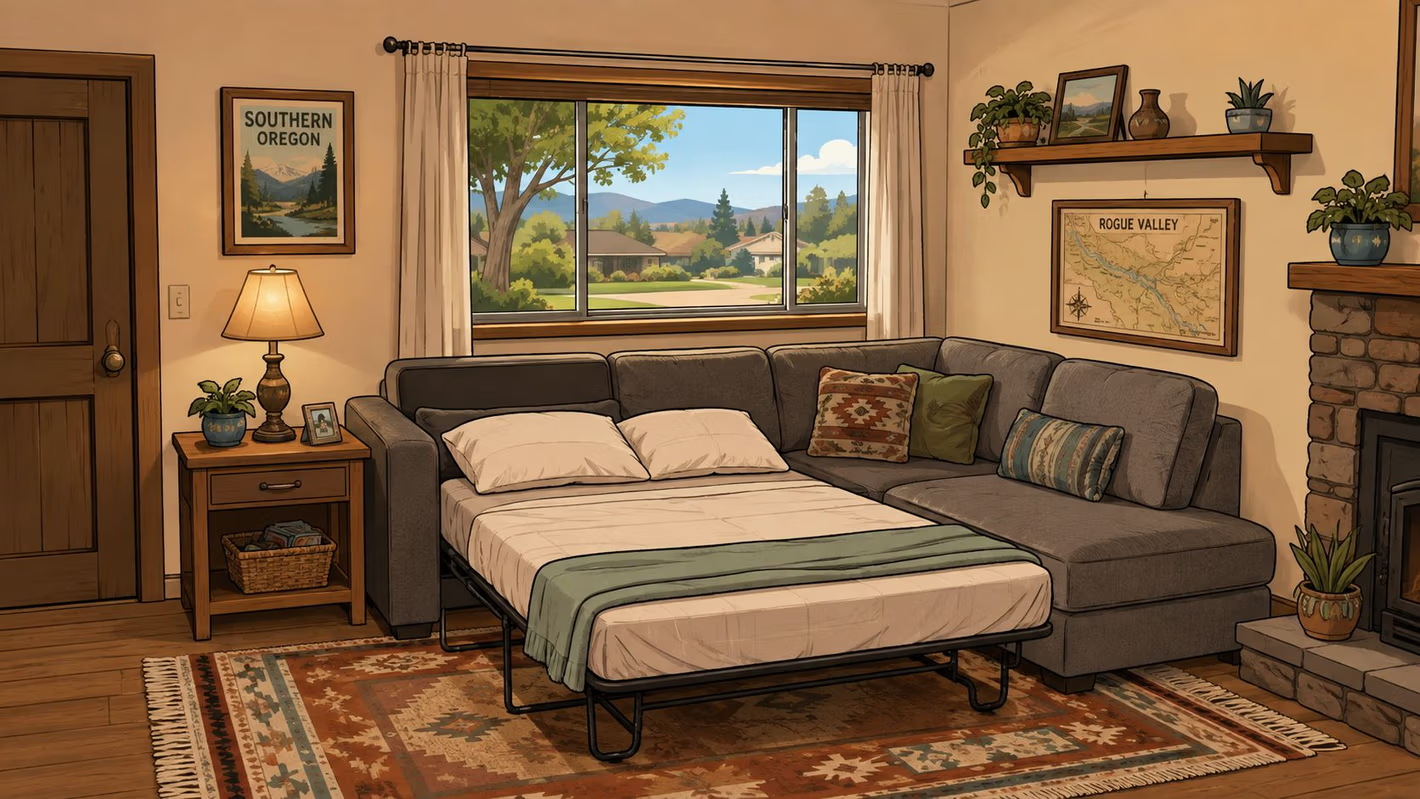
Why a Sleeper Sectional Makes Sense for Real Southern Oregon Homes
A sleeper sectional makes sense when a home has to be flexible without feeling cramped. That's a familiar situation in Grants Pass, Medford, Central Point, and Ashland, where a living room may also serve as the spare room, the movie room, and the place where visiting relatives crash after dinner. A sectional that turns into a bed solves that by staying useful all day and opening up at night.
That's why the old idea of a separate sofa bed tucked away for rare occasions doesn't fit many modern homes anymore. Today's buyer usually needs something that works for frequent guests, not occasional emergencies. A sleeper sectional gives the room a proper seating arrangement and a real sleep surface without needing a separate air mattress or a dedicated guest room.
What shoppers should decide first
A good rule is to start with use, not style. If the bed will be opened every few weeks, the conversion should be easy enough that nobody dreads it. If it's mostly for holiday visitors, comfort still matters, but daily durability can sit a little lower on the list.
The best reason to buy one is simple. It lets a house host without surrendering an entire room to an item that only gets used part-time. That's especially useful in homes where the great room, den, or bonus room already has to do double duty.
Practical rule: if the room already functions as a hangout zone, the sleeper sectional usually adds value. If the room is wide open but rarely hosts overnight guests, a standard sectional may be the cleaner choice.
The family-owned side of this matters too. Gates has built its reputation on Service and Value since 1946, and that philosophy is useful here because sleeper sectionals are one of those purchases where a generic checklist doesn't cut it. Local shoppers need a piece they can sit on, open, and compare in person, not just admire in a photo. For a broader sectional overview, see the sectionals buying guide.
The Three Ways Sectionals Convert Into Beds
Sleeper sectionals do not all open the same way, and the mechanism should match how the room gets used. The main options are pull-out mattresses, click-clack or fold-flat systems, and modular rearrangement styles, so shoppers have real choices instead of one generic setup. The right call comes down to how often the bed will be opened, who will sleep on it, and how much room the household can spare.
Pull-out mattress sleepers
This is the classic version many people picture first. A hidden mattress folds out from the sectional frame, which gives the room a more familiar bed feel and usually suits buyers who want a true guest-bed setup. It makes the most sense when the sleeper will be used often enough that a dedicated mattress surface feels worth the added bulk.
Click-clack and fold-flat sectionals
These are the fast-conversion models. Some fold the backrest down, while others pull the seat frame forward, and a sectional example can go from a deep seating shape to a much wider bed surface, which shows how the sleep area can exceed the seating depth by a lot. Some click-clack models convert in just a few seconds, making them a smart fit for frequent hosts who want speed, especially after checking the mechanism in person and asking how easy it feels to open and close it on the showroom floor.
Modular rearrange sleepers
These work differently. Instead of hiding a mattress, they use removable sections, deep seats, or add-on pieces like ottomans that can be pushed together into a flat sleeping surface. That makes sense for households that already like modular seating and want the layout to change with the room. The trade-off is simple, the bed setup depends more on how carefully the pieces are lined up, so the sleep surface should be tested for gaps, seam height, and how stable it feels once everything is joined.
Good match by use: pull-out mattress for the most bed-like feel, click-clack for speed, modular rearrange for flexible rooms and occasional guest sleeping.
If the bed will be opened often, shortlist the faster systems first. If the room changes shape a lot, modular can be the smartest compromise. For a quick comparison of sleeper styles, the futon and sleeper sofa guide is worth reading before a showroom visit.
What Makes a Sleeper Sectional Actually Comfortable to Sleep On
Comfort starts inside the frame, not with the fabric color. The parts that matter most are the frame structure, the sleep-support system, and the mattress core. A sleeper that sits well can still sleep badly if those layers are weak.
The structure under the cushions
A well-built sectional sleeper uses a load-bearing metal frame with wood inserts, plus orthopedic slats or electro-welded mesh. That combination spreads weight more evenly and keeps the transition area from sagging early. Cheaper builds usually fail there first, because repeated opening and closing puts stress on the same spot.
The mattress core matters just as much. Look for pocket-spring mattresses with high spring counts and foam perimeter pads. That build gives better support and less motion transfer than basic foam-only mattresses, and it holds up better when two guests share the bed. In showroom terms, it usually feels more consistent from edge to center, which is exactly what you want in a real guest bed.
What that means in plain English
A pocket-spring sleeper usually feels steadier for adults, especially when two people share it or when one sleeper moves a lot during the night. Foam-only sleepers can work for short stays, but they often feel flatter, and the edges usually give less support. For a guest staying longer than one night, that difference is easy to feel.
A sleeper sectional is a real sleep surface, so test it like one. Open the mechanism, lie down on it, and stay there for two minutes. Pay attention to the seams, the center support, and the edge feel. If the middle dips or the seam line keeps catching your back in the showroom, that problem will still be there at 2 a.m.
Seam management matters more than shoppers expect. A mattress with a thin, uneven join can turn a decent sleeper into a restless one, even if the upholstery looks upscale and the mechanism feels smooth. A better build keeps the sleep surface flatter across the joint, and that is what guests notice after the lights go out. If you want a simple way to compare firmness levels before you visit, the mattress firmness guide gives you a useful frame for judging what feels too soft, too firm, or just right.
Topper strategy is the last piece. A thin topper can soften a firm sleeper and smooth out minor seams, but it should not be used to rescue a badly built bed. If the sectional already has weak support, a topper just masks the problem for a night or two. In a Grants Pass showroom, I tell shoppers to test the mattress first, then decide whether a topper is a comfort upgrade or a patch for a surface that should be better from the start.
Measuring Your Room and Planning the Layout
A sleeper sectional can look perfect online and still fail at home if the room math is wrong. The first job is to measure the wall span, the open floor area, the doorway widths, and the hallway turns that the sectional has to pass through on delivery day. The second job is to leave room for the bed to open without moving the coffee table every time.
A 12×14 living room in a Medford home can often handle a larger layout, especially if the sectional sits on one long wall and the sleeper opens into a clear central lane. A 10×12 family room in a Central Point rental needs a tighter plan, usually with a smaller sectional footprint and a conversion that doesn't steal the whole floor when opened. The same piece can work in one room and fail in another, which is why room fit matters more than the upholstery finish.
What to measure before shopping
- Wall lengths: Measure the exact span where the sectional will live, not the “rough” area by eye.
- Open clearance: Leave enough room for the sleeper to open fully without moving everything around it.
- Doorways and hallways: Check the path from the front door to the room so the delivery team isn't forced into a last-minute pivot.
- Ceiling height and sight lines: Taller sleepers are more comfortable when the room doesn't feel compressed or boxy.
- Traffic flow: Make sure people can still walk through the room when the bed is open.
The safest move is to test the layout in person before buying. Photos don't show whether the chaise crowds the path, whether the arm blocks a window, or whether the sleeper pulls out into a useful direction. Gates' 30,000-square-foot showroom in Grants Pass is built for exactly that kind of comparison, so customers can walk the layouts, sit in each configuration, and pull the mechanism themselves before committing.
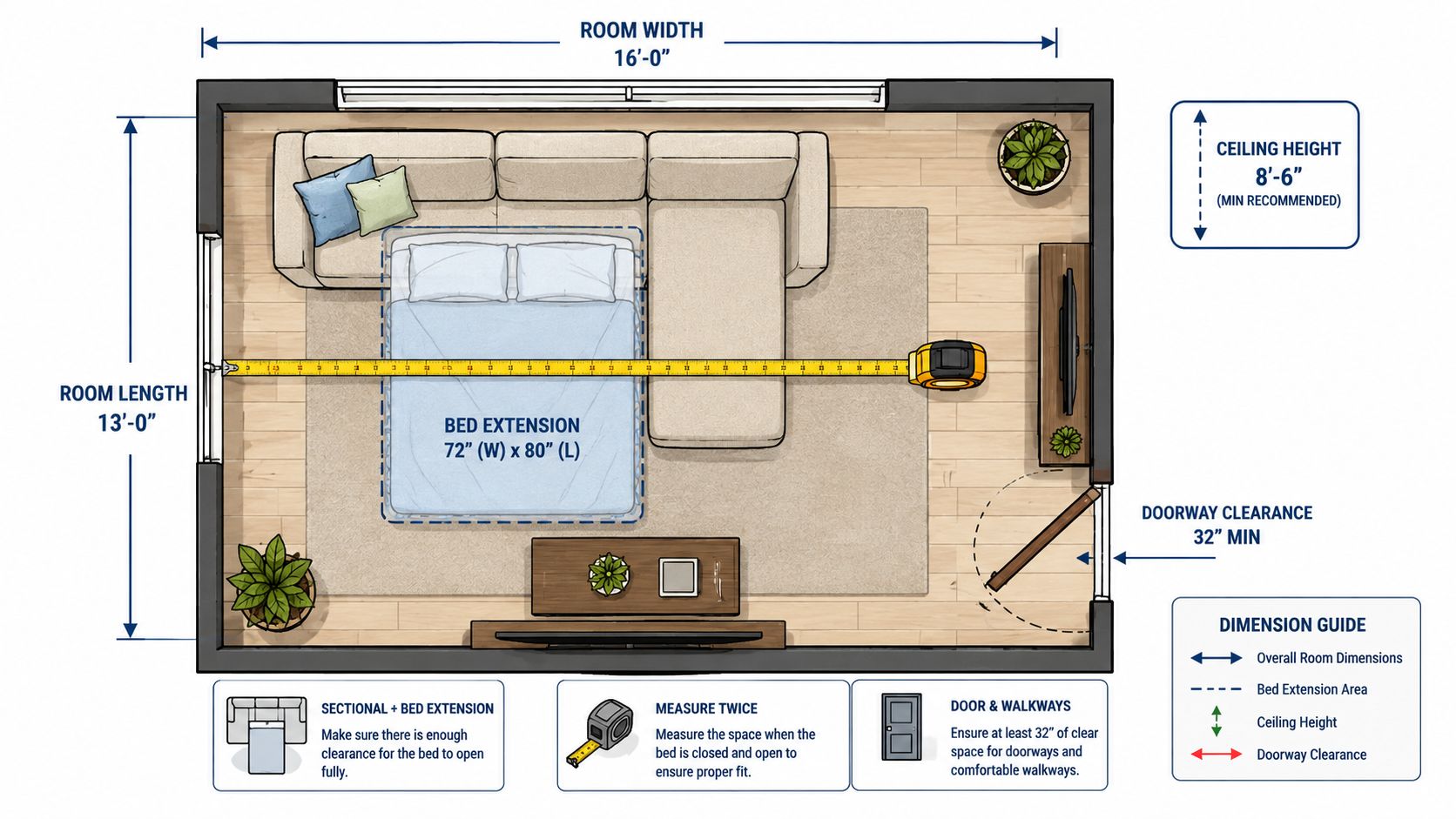
For measurement prep, the furniture measuring guide is a smart place to start before driving in from Medford, Ashland, or anywhere else in the Rogue Valley.
Honest Pros and Cons of Living With a Sleeper Sectional
The strongest argument for a sleeper sectional is that it prevents a room from sitting idle. A bonus room can become a genuine guest space without becoming a permanent bedroom, and a family room can host overnight visitors without pulling out a separate air mattress. That kind of flexibility is real value, especially in homes where the same space has to serve daily life and occasional company.
The trade-off is just as real. Sleeper sectionals are usually heavier than standard sectionals, and they can feel bulkier in small rooms because of deeper seats and thicker arms. The mechanism also has more moving parts than a basic sectional, so repeated daily conversion will wear it faster than occasional use.
Where the balance tips
A sleeper sectional makes the most sense when hosting happens often enough that convenience matters every month. It loses value when the bed is used only a couple of times a year, because the owner pays for mechanism weight, complexity, and bulk that mostly sit still. That's the line shoppers should draw before buying.
Modular designs and pull-out designs also serve different habits. A modular setup can adapt to room changes and guest needs, while a pull-out gives a more traditional sleeping surface. The better choice depends on whether the household cares more about layout flexibility or about a more recognizable bed feel.
If overnight guests are regular, the sleeper earns its footprint. If guests are rare, a standard sectional plus a separate sleeping backup may be the cleaner solution.
There's no point pretending every sleeper sectional is a perfect compromise. The good ones are practical and comfortable enough to justify their size, but they still ask for a little more planning than a standard couch. That's fair, because they're doing two jobs at once.
Styling, Bedding, and Care Tips That Make It Work
A sleeper sectional should still look like living-room furniture when the bed isn't open. The easiest way to keep it polished is to treat the sleeper seam like part of the design, not a flaw to hide in panic. A large throw blanket, structured chaise, or well-placed accent pillows can make the piece feel intentional during the day and still keep it ready for guests at night.
Keep the host setup simple
A nearby basket or cabinet should hold the bedding that belongs to the sleeper, not scattered linens in another room. The cleanest setup includes a fitted sheet, flat sheet, pillows, and a memory-foam or thick fiberbed topper so a guest doesn't have to settle for the bare mattress. That way, conversion takes minutes instead of becoming a midnight chore.
The topper matters because it can help smooth out seams and make the sleeping surface feel more consistent. For modular setups especially, seam management is the difference between a passable crash spot and a bed that feels thought through. On a related textile note, anyone caring for soft throw layers can also use this guide to washing Luxe Cuddle blankets from On Pins & Needles Quilting Co. as a useful care reference.
The care habits that protect the mechanism
- Vacuum the frame area: Dust and crumbs build up around moving parts faster than people expect.
- Rotate the mattress: Even support wears more evenly when the sleeping surface isn't always folded the same way.
- Flip or shift cushions seasonally: That keeps the seating side from developing one tired spot.
- Use fabric protection on performance upholstery: Spills and daily wear are easier to manage when the fabric is prepared for them.
Gates Care Shield fits naturally into this conversation because accidental spills and tears are exactly the kinds of problems that show up on high-use furniture. The point isn't to baby the sectional, it's to keep a busy room from turning a practical purchase into a headache. Care and a few smart habits stretch the life of the piece.
Financing, Delivery, and the Local Showroom Experience
The purchase doesn't end when the right sectional is chosen. It still has to fit the budget, get into the house, and land in the room without drama. That's where Gates Easy Pay matters, because flexible financing can make a sleeper sectional realistic for a household that wants quality now instead of waiting months.
The options are straightforward. Shoppers can look at $0 down with six equal payments, six months interest-free when paid in full, no-credit-needed programs, and lease-to-own options. There's also a quick online-only approval path for people who'd rather handle financing privately at home, which helps keep the process simple and discreet.
What delivery should actually include
White-glove delivery is not a curb drop. The team brings the sectional inside, assembles it in the room, sets it where the customer wants it, and can haul away the old sofa or mattress if needed. That matters because sleeper sectionals are bulky, and the wrong delivery setup can wreck a move-in day fast.
The showroom side matters just as much. Gates carries trusted names like La-Z-Boy, Flexsteel, Ashley, and Beautyrest, which gives shoppers a real comparison floor instead of a random assortment. For financing details on a broader level, the furniture financing options page lays out the basics clearly.
A local furniture destination should also earn trust in smaller ways. Gates' 1946 founding story and Service and Value promise still matter because a sleeper sectional is not just a box to drop off, it's a piece that needs setup, testing, and support after delivery. Shoppers who also want distinctive decor can ask about the Unique Finds, including reclaimed wood, teak, and one-of-a-kind statement pieces, while they're in the store.
Screenshot for the showroom and sale context.

For a separate take on collaboration and community offers, the gifted collaboration application details can be a useful reference point for local partners exploring the process.
Southern Oregon FAQ and Your Next Step
Shoppers from Grants Pass, Medford, Central Point, and Ashland usually ask the same practical questions first. Delivery coverage, white-glove setup, and what happens if the sleeper mechanism starts feeling off years later are the ones that matter most. The short answer is that the bed frame is built in, so no special foundation is needed, and if the mechanism ever needs attention, Gates Care Shield and the service team are there to help.
Bring measurements and room photos to the showroom. That makes it much easier to compare a few layouts quickly, especially if the room has an awkward doorway, a tight corner, or a specific wall length that has to be respected. The most efficient visit starts with a tape measure and ends with a sleeper that fits the way the home is used.
Good sleeper sectional shopping is boring in the best way. Measure, test, lie down, and check delivery details before the impulse to buy kicks in.
The decision usually comes down to one question, does the household need a real bed that disappears into daily seating, or just a sectional that looks good and can handle the occasional overnight guest. If the answer is the first one, the search belongs in a showroom, not on a screen. For anyone in the Rogue Valley ready to make that comparison in person, the next step is simple.
Gates Home Furnishings has the sectionals, mattresses, and local delivery support that make a sleeper sectional purchase easier to live with long after the sale. Visit Gates Home Furnishings in Grants Pass to test the comfort, compare the mechanisms, and get a real feel for what fits your Southern Oregon home.