Is a Sectional Better Than a Sofa? Space Guide


A sectional is better for a dedicated shared-lounging zone in a larger room, while a standard sofa is better for flexible layouts, narrow spaces, and frequent rearranging. In a 2025 survey, more than one-third of buyers were considering a sectional, and 17% had purchased one during the previous year, but the right choice still depends on the room.
A living room decision often starts with a simple problem. The household wants everyone together for movie nights, yet the room also has a doorway, a hallway, and perhaps a view toward the kitchen. A large sectional can create the comfortable family hub everyone wants, but it can also turn a walking path into an obstacle course. A sofa may leave more breathing room, but it might require extra chairs to serve a larger household.
For Southern Oregon homes, the practical answer is clear. Choose a sectional when shared lounging matters most and the room can hold its full footprint. Choose a sofa when circulation, rearrangement, or future flexibility matters more.
| Living room priority | Stronger choice | Why |
|---|---|---|
| Shared television viewing and stretching out | Sectional | Creates one continuous lounging zone |
| Narrow room or multiple walkways | Sofa | Leaves more open circulation space |
| Frequent rearranging | Sofa | Easier to rotate, relocate, or pair with chairs |
| Large family room with an unused corner | Sectional | Converts the corner into usable seating |
| Older adults or mobility concerns | Sofa or supportive modular sectional | Makes seat depth, firmness, and access easier to control |
| Uncertain future layout | Reconfigurable sectional or sofa | Allows the arrangement to evolve |
How Sectionals and Sofas Differ
A family in a Southern Oregon home may want one place for movie nights, yet still need a clear route from the entry to the kitchen. That conflict matters more than the number of seats on the tag. A sectional suits households that want one coordinated seating zone for shared viewing and relaxed lounging. A conventional sofa suits a narrow room, frequent furniture moves, or a household adding chairs over time.
The 2025 Furniture Today Strategic Insights survey of 1,016 U.S. adults found that more than one-third were considering a sectional within the next year, while 17% had purchased one during the previous year. Among sectional buyers, 36% chose a three-piece configuration, 28% chose two pieces, and 18% chose four pieces. L-shaped designs accounted for 76%, compared with 22% for U-shaped designs. (Furniture Today survey context)
The three-piece result gives shoppers a useful starting point. A sectional does not need to dominate the room. In many family rooms, an L-shaped arrangement provides a sofa, corner seat, or chaise while leaving a practical walking route.
A sofa remains the stronger choice for apartments, narrow living rooms, and homes where furniture moves between walls. Separate chairs can face a television, fireplace, or conversation area as needed, while the sofa remains a dependable anchor. That arrangement also gives older adults and visiting relatives more control over seat access, depth, and firmness.
Practical rule: A sectional is better only when its full footprint improves daily movement instead of interrupting it.
Before shopping, review this ultimate sofa buying guide for a living room and compare upholstery, depth, support, and placement. Maintenance deserves attention too. Connected cushions and a corner can collect dust, crumbs, and pet hair, so this sectional couch cleaning step-by-step guide can help households plan realistic upkeep.
How Modularity and Layout Flexibility Compare
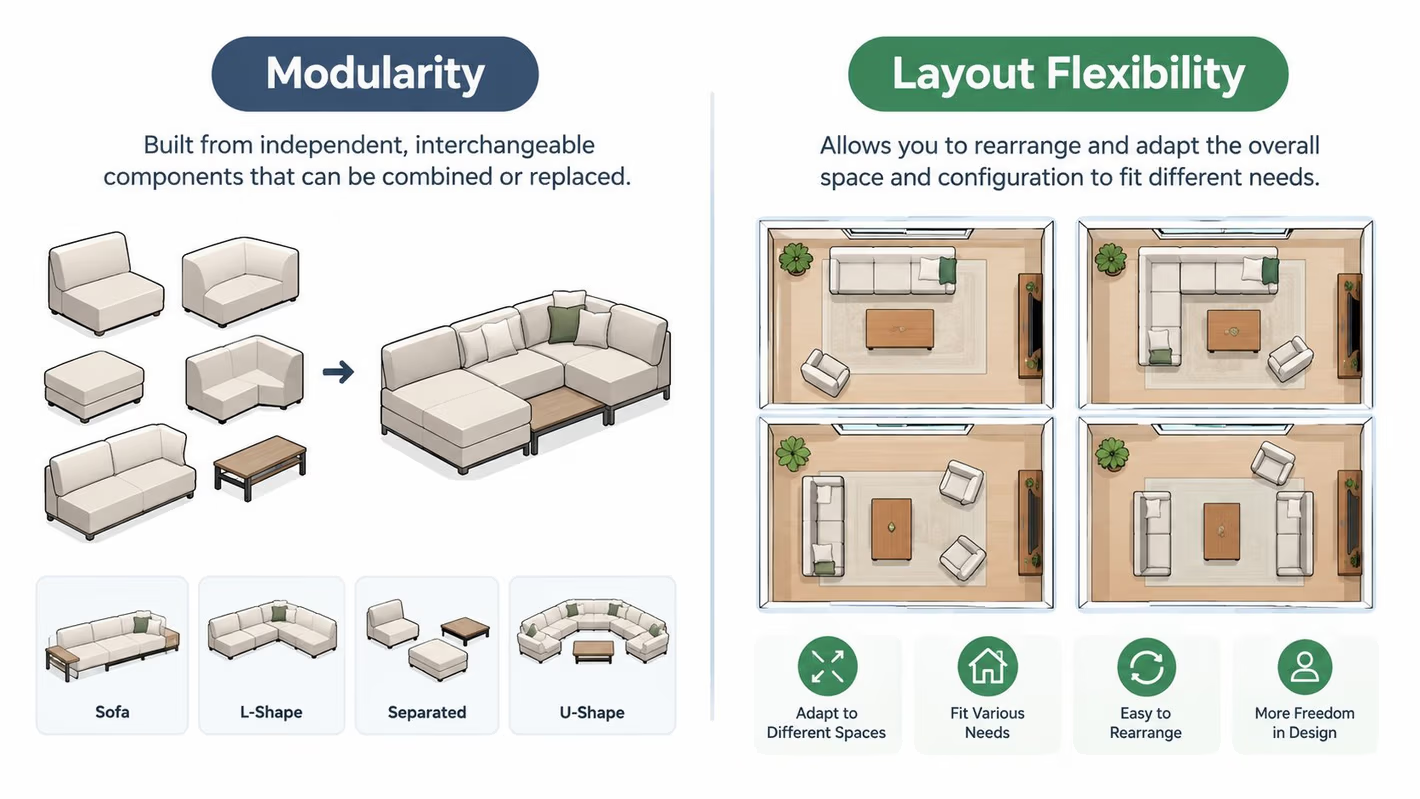
Sectionals were built around a different idea from the traditional sofa. Their historical advantage is modularity, meaning individual pieces can combine into a coordinated grouping rather than remaining one fixed seat. A documented milestone came in 1936, when designer Wolfgang Hoffmann and manufacturer Karl Schneider-associated modernist furniture experiments popularized a “grouping principle” using armless chairs and corner units that resembled today's L-shaped sectional.
That design logic still matters in Southern Oregon homes. A sectional can use an awkward corner, establish a defined living zone in an open floor plan, and keep family members facing the same screen or conversation area. In a large Grants Pass family room, that unified shape often feels more intentional than scattering a sofa, chair, and recliner across the floor.
A standard sofa solves a different problem. It acts as a standalone anchor and leaves room for a recliner, accent chair, loveseat, or occasional table. When a household changes the television location, hosts a different type of gathering, or moves to another room, separate pieces generally offer more options.
Where each style earns its place
A sectional is the stronger layout tool when:
- The room has a usable corner: The return can sit against a wall without closing off a doorway.
- The household lounges together: Connected seating keeps conversation and viewing centered.
- The room feels visually scattered: One coordinated piece can define the seating area.
- The layout includes an entertainment focus: A sectional naturally points several seats toward one shared destination.
A sofa is more adaptable when:
- Traffic crosses the living room: Separate pieces can leave a wider passage.
- The room has several focal points: Chairs can angle toward a fireplace, window, or television.
- Furniture may move later: A sofa can relocate without taking a return piece with it.
- The home needs a lighter look: Broken-up seating often preserves more visible floor.
The choice also affects surrounding furniture. Gates Home Furnishings' Unique Finds, including reclaimed wood and teak statement pieces, can complement either arrangement. A sofa may pair with a narrow reclaimed wood table and a movable chair, while a sectional can use one carefully placed teak table to finish the corner without overcrowding it. For media-focused rooms, a separate home theater carpet buying guide can help households think about sound, comfort, and the relationship between flooring and seating. More sectional placement ideas are available in these sectional sofa layout ideas.
Measuring Your Room for Proper Traffic Flow
A sectional should never be measured by its longest side alone. Its return, chaise, depth, and delivery path all affect whether it works. Typical sectionals measure approximately 94 to 156 inches in overall length or depth and 90 to 168 inches in overall width, while a chaise commonly extends 60 to 72 inches. (Sectional measuring guidance)
A careful measurement process prevents the most frustrating delivery-day surprises.
Start with the room, not the catalog
Record the room's length and width, then mark every fixed feature:
- Doorways: Include the door slab and the direction it swings.
- Hallways: Measure the narrowest point, not the widest section.
- Windows: Note sill height and whether curtains need space.
- Vents and registers: Keep airflow from being covered.
- Fireplaces and media walls: Account for viewing position and safe clearances.
- Stairs and turns: A piece may fit through a doorway but fail at the next corner.
Wall length matters as much as total room size. Planning guidance recommends at least 30 inches for regular walkways and 36 inches for high-traffic routes, such as a path between the kitchen and front door. (Room circulation guidance)
Mark the full footprint
Use painter's tape to outline the sofa or sectional directly on the floor. Include the arms, back, chaise, return, and any planned coffee table. Walk through the taped layout from each entry point, and ask whether someone carrying laundry, groceries, or a child can pass without turning sideways.
For a compact sectional, a commonly cited configuration measures about 95 to 110 inches along the main side and 58 to 70 inches along the return, with capacity for roughly four adults. Matching that capacity with a sofa and separate chairs may require approximately 30% to 40% more floor area after chair clearance is included. (Compact sectional footprint guidance)
That efficiency disappears if the return blocks the only route through the room. A sofa may occupy one wall and leave the opposite side open, while a sectional can consume circulation space on two adjoining walls.
Check the delivery route
Measure the entry door, porch approach, interior doorway, stairwell, and tight turns. Ask whether the sectional arrives as connected pieces or separate modules. The right furniture choice must fit both the room and the route into the room.
A more detailed guide to measuring furniture can help households organize these dimensions before visiting a showroom in Grants Pass.
Evaluating Seating Capacity and Ergonomic Comfort
More seats do not guarantee more usable comfort. A sectional may provide a chaise and several places to sit, yet leave an older adult without a supportive edge seat or a clear path to stand. In Southern Oregon homes with children, grandparents, and guests sharing one room, accessibility matters as much as capacity.
A sofa and sectional should be judged by seat height, effective seat depth, backrest geometry, cushion firmness, arm support, and the user's body dimensions. A common sofa seat-height range is 17 to 19 inches, and seat depth should match the distance from the back of the buttocks to the back of the knee. Shoppers should sit fully back and check for about 1 to 2 inches of space behind the knees, while confirming that the lower back remains supported. (Sofa comfort and ergonomics guidance)
Match the seat to the person
A deep chaise works well for stretching out during a movie. It can leave a petite adult without lower-back support, however, and may make standing harder for a senior. Low, soft cushions and low or missing armrests can also make sit-to-stand movement more difficult for older users. (Accessibility research on sofa users)
Test every intended seat, not only the favorite chaise. Sit down, lean back, place both feet on the floor, and rise without pushing awkwardly against the cushion.
- For seniors: Choose a stable height, firmer cushions, supportive arms, and an accessible edge seat.
- For taller adults: Look for enough depth to support the thighs without forcing the lower back away from the cushion.
- For petite adults: Avoid making a deep chaise the only comfortable position.
- For mixed-age families: Pair upright supportive seating with one deeper lounge position.
Armrest height deserves a hands-on check. The arm should support the user's forearm without forcing the shoulder upward, while the edge of the seat should leave enough room to place both feet securely before standing. A sectional may position a firmer, shallower seat near a walkway and deeper seats farther inside the room. A sofa paired with a recliner or lift chair can work better when independent movement matters more than shared lounging.
Use this guide to features in a new sofa or chair to review support, construction, and daily comfort before visiting Gates Home Furnishings. Families from Medford to Ashland should test the furniture in person, because seat counts and photographs cannot show how easily each household member can sit, shift, and stand.
Planning for Future Moves and Layout Changes
A sectional doesn't have to be a permanent L-shaped fixture, but buyers need to confirm how much freedom the design provides. Some modular systems separate, reorient, or move between rooms. Others only appear modular while locking the household into one left-facing or right-facing arrangement.
The growing interest in adaptable furniture reflects a real household need. One survey-based consumer report found that 65% of buyers require living-room furniture that can split apart for multifunctional rooms.
Ask these questions before ordering
- Do the pieces lock together securely? A loose connection can shift during everyday use.
- Can the arms move to either side? Reversible orientation matters when a room changes.
- Are add-on modules available later? A household may need a larger configuration after a move.
- Can each component pass through local doors and stairwells? Smaller modules simplify difficult access.
- Will replacement covers or cushions remain available? Long-term service affects practical value.
A reconfigurable sectional suits a renter who may move from an apartment to a larger home, a young family whose room needs will change, or a homeowner who refreshes furniture layouts periodically. It can separate into two seating areas or change direction without abandoning the original investment.
A standard sofa still has a built-in advantage. It arrives as a familiar standalone piece, pairs easily with movable chairs, and can shift rooms without requiring the entire seating system to follow. That makes it a sensible choice for frequent movers, homes with uncertain layouts, and households that prefer to buy seating in stages.
The most useful comparison isn't sectional versus sofa. It is fixed sectional versus reconfigurable sectional versus sofa. Buyers should choose the configuration that remains usable when the household, doorway, or room arrangement changes.
Testing Comfort and Financing at Gates Home Furnishings
Measurements narrow the options, but sitting down makes the decision. Gates Home Furnishings offers a 30,000-square-foot showroom in Grants Pass where shoppers can compare sectional and sofa scale, seat depth, cushion support, fabric, and finishes in person. That physical test matters because a chaise that looks inviting online may feel too deep, while a sofa that appears compact may provide better upright support.
A useful showroom test takes only a few minutes:
- Sit fully back: Check whether the lower back meets the cushion without slouching.
- Place both feet on the floor: This reveals whether the seat is too deep or too tall.
- Stand without pushing hard: Notice cushion softness, arm support, and seat height.
- Try the corner and chaise: Those positions often feel different from the straight seats.
- Test the intended access seat: The easiest seat to enter and exit may matter most in a multigenerational household.
- Compare fabrics and finishes: Daily-use upholstery should suit children, pets, and cleaning habits.
The showroom includes brands such as La-Z-Boy, Flexsteel, Ashley, and Beautyrest, along with distinctive Unique Finds made from reclaimed wood and teak. A sofa or sectional can then be coordinated with tables, recliners, bedroom pieces, and other furnishings without losing sight of room flow.

Service should continue after the purchase
Founded in 1946, Gates Home Furnishings was built on George Gates' original promise of “Service and Value.” That promise fits this decision because the right furniture isn't only about choosing a shape. It also involves measuring the home, arranging delivery, and making sure the piece works once it arrives.
Gates Easy Pay provides flexible financing options, including $0 down, 6-month interest-free options, and no-credit-needed options. Details and eligibility can be reviewed through the furniture financing options page before a purchase.
White-Glove Delivery means the team doesn't just drop boxes at the door. Professional delivery includes heavy lifting, assembly, placement, and mattress haul-away when a mattress purchase is involved. That support is especially useful when a large sectional must clear a Grants Pass entryway, stairwell, or tight interior turn.
Final Recommendations for Your Household Type
Choose the seating around the room's job, traffic pattern, and the people who use it every day. A family room centered on shared television viewing usually suits a sectional. A narrow living room with a clear route from the front door to the kitchen usually works better with a sofa. Cushion count alone is a poor basis for the decision.
For casual entertaining, an L-shaped sectional is the strongest starting point when the room has an unused corner and one main viewing direction. It keeps people connected without closing off the entire space. In a typical Southern Oregon family room, tape an L-shaped footprint before shopping and check whether the chaise leaves a comfortable route around the seating.
A renter or frequent mover should choose pieces that can pass through the home's entry, halls, stairways, and interior turns. A standard sofa with a movable chair is often the practical choice. A separable modular sectional can work when its components are manageable and the layout can change after a move. Downsizing households should put sit-to-stand comfort first, especially when older adults use the room.
| Household Profile | Best Choice | Key Reason |
|---|---|---|
| Active family using one room for daily lounging | Sectional | Keeps shared seating together for regular use |
| Frequent entertainers with changing arrangements | Sofa with movable chairs or reconfigurable sectional | Lets conversation areas shift |
| Narrow living room or apartment | Standard sofa | Protects walkways and open floor |
| Multigenerational household | Supportive sofa or mixed-depth modular sectional | Pairs easier-access seating with lounge space |
| Frequent mover or renter | Standard sofa or separable modular sectional | Simplifies delivery and future placement |
| Large open-plan room | Sectional | Defines the living area without several unrelated pieces |
| Formal sitting room | Sofa with accent chairs | Supports face-to-face conversation |
| Home with an unused corner and one main viewing focus | L-shaped sectional | Uses the corner as coordinated seating |
Before ordering, tape the complete footprint, including the chaise, and mark the main walking routes. Leave enough room for people to pass without turning sideways. Then have every intended user sit down, stand up, and move into the corner seat. A chaise that blocks a doorway is a layout problem, not extra seating. A sofa that leaves a large family without one shared place to settle is too small for the room's daily job.
Make one appointment at Gates Home Furnishings in Grants Pass with your measurements and household needs. Test sofa and sectional comfort in person, check how easily each seat is entered and exited, and ask the showroom team to review delivery access before choosing. The 30,000-square-foot showroom also offers guidance on Gates Easy Pay options and White-Glove Delivery, helping you confirm that the piece fits both the room and the route into it.