Statement Dining Tables: Sizing and Styling


A dining room can look perfectly furnished and still feel unfinished. The chairs are comfortable, the rug is in place, and the lighting works, yet the room lacks the piece that gives family meals and weekend gatherings a sense of occasion. That's where statement dining tables earn their keep. The right table brings character without sacrificing elbow room, clear walkways, or the ability to live comfortably around it.
For homes in Grants Pass, Medford, Central Point, Ashland, and throughout the Rogue Valley, the strongest choice isn't the largest or most unusual table. It's a table with the right scale, honest materials, sound construction, and enough flexibility for everyday life.
Defining the Statement Dining Table
A standard dining table serves a purpose. A statement dining table does more. It anchors the room, establishes a visual direction, and gives guests something to notice before dinner is served.
Consider an open-plan home near Grants Pass. The dining area may be visible from the living room, kitchen, and entry. A thin, forgettable table can disappear into that arrangement. A thick reclaimed-wood top with visible grain, a live edge, or a carefully shaped pedestal base can hold the room together without adding unnecessary decoration elsewhere.
Three qualities set it apart
Scale gives a statement piece presence. That doesn't always mean oversized dimensions. A round table with a substantial central base can feel more commanding than a long rectangular table with ordinary legs. The proportions must suit the room, not compete with it.
Craftsmanship appears in details people notice over time. Look for carefully joined boards, a stable base, a smooth transition between materials, and a finish that supports the wood instead of burying its character. Thick tops, sculptural bases, breadboard ends, contrasting grain directions, and live edges can all create visual weight.
Material character makes the table individual. Reclaimed timber may show knots, nail marks, color variation, and traces of its earlier life. Teak offers rich grain, natural warmth, and a restrained sense of luxury. Neither should look mechanically identical from one table to the next.
For readers exploring how design traditions shape the dining experience, Everti's perspective on Japanese dining tables offers useful context around simplicity, proportion, and material presence. Those principles translate well to Southern Oregon homes, where a table often needs to feel welcoming rather than overly formal.
A functional centerpiece, not a short-term trend
The global dining-table market reached an estimated USD 8.68 billion in 2025 and is projected to reach USD 16.01 billion by 2034, a projected compound annual growth rate of 7.19%, according to Fortune Business Insights' dining-table market overview. Wood is projected to lead the material segment, accounting for 52.77% of the market in 2026, according to the same source.
That market context supports a practical conclusion. People still want dining furniture that works hard and looks distinctive. A well-made table can support weekday breakfasts, homework, holiday meals, and long conversations without being reduced to temporary decoration.
For more examples of pieces that give a room a strong identity, the statement furniture pieces collection provides a useful starting point. The best choice will still depend on the room's measurements and the household's habits.
Sizing for Comfort and Circulation
A dramatic table becomes a daily irritation when chairs collide with walls, walkways disappear, or diners lose usable knee space. Measuring first protects the design investment.
Start with the room's usable footprint, not the total square footage. Measure from the nearest wall, cabinet, island, or furniture edge to the opposite boundary. Mark door swings and identify the path people use to move between the kitchen, living room, hallway, and exterior doors.
Use the table edge to estimate seating
A practical allowance is at least 24 inches of table edge per diner, while 28 to 30 inches provides more comfortable elbow room for place settings and glassware, according to this dining-table planning guide.
That means advertised capacity deserves scrutiny. A table may technically accommodate several chairs, but thick legs, a heavy apron, or a central pedestal can reduce the places where guests can sit comfortably. Count usable positions, then test those positions with the actual chairs.
A 36-inch clearance between the tabletop edge and the nearest wall or furniture allows chairs to move back and leaves space for someone to walk behind a seated guest, according to the same guide. In a narrow dining area, that clearance matters more than the table's visual impact.
A practical measuring sequence
-
Measure the clear area. Record the distance between fixed obstacles, then subtract the clearance needed for chairs and passage.
-
Mark the proposed tabletop. Use painter's tape on the floor. This reveals whether a rectangular, oval, or round shape supports the room's traffic pattern.
-
Place the chairs. Include armrests, chair backs, and the distance needed to pull each seat out. A table that fits on paper may fail once chairs are occupied.
-
Check access. Measure the route from the entry to the dining room, including corners and doorways. A table that can't reach the room isn't a successful purchase.
Practical rule: Choose the largest table that preserves comfortable movement, not the largest table that fits before the chairs arrive.
Open-plan homes across the Rogue Valley need special care because dining furniture often shares space with living areas. A table that blocks a sightline or narrows the path to the kitchen can make the entire main floor feel crowded. For approachable styling ideas that still respect real homes, budget-friendly farmhouse table ideas can provide inspiration, while the dining table size guide helps turn inspiration into a workable layout.
Reclaimed Wood and Teak Materials
The material determines much of a statement table's personality. Reclaimed wood tells a visible story through irregular boards and marks from earlier use. Teak presents a different appeal, with natural oils, durable performance, and a more consistent sense of refinement.
Neither material is automatically right for every household. The better choice depends on the room, maintenance expectations, and the kind of character the buyer wants to live with.
Reclaimed wood brings history into the room
Reclaimed timber often contains knots, nail marks, changes in color, and grain variation that new factory-cut boards don't reproduce. Older timbers may also come from trees that grew more slowly, producing tighter growth rings and denser material. That can contribute to strength, stability, and resistance to wear, moisture, and insects, although each reclaimed board still needs individual evaluation.
The environmental case is meaningful when it's documented. A 2023 U.S. Forest Service study of 1,516 respondents found that 44% considered themselves knowledgeable about reclaimed lumber, and approximately 89% agreed that reusing wood from demolition sites helps reduce landfill waste, according to the U.S. Forest Service study. The same verified information reports that producing new framing lumber and wood flooring uses 11 to 13 times more energy than producing comparable items from reclaimed wood.
That doesn't make every reclaimed table equally responsible. Buyers should ask about the wood's original use, preparation, moisture conditioning, finish, and repair options. Material history matters, but construction and longevity matter too.
Teak favors durability and stability
Teak's natural rubber and oil content makes the heartwood strongly water-repellent. Compounds including tectol and tectoquinone help protect it from fungi and insects, while its dimensional stability supports long-term use. Teak's reported volumetric shrinkage during drying is about 7%, compared with approximately 13% for English oak, according to this teak wood reference.
That makes teak a sound option for households that want a distinctive table without an especially rustic appearance. Its grain can carry the room on its own, so surrounding furniture can remain simpler.
Reclaimed wood suits buyers who enjoy variation and visible history. Teak suits buyers who prefer durable natural material with a calmer, more polished expression. Gates Home Furnishings' reclaimed wood furniture collection gives Southern Oregon shoppers a way to compare those qualities in person instead of judging them from a screen.
Styling and Pairing Your Centerpiece
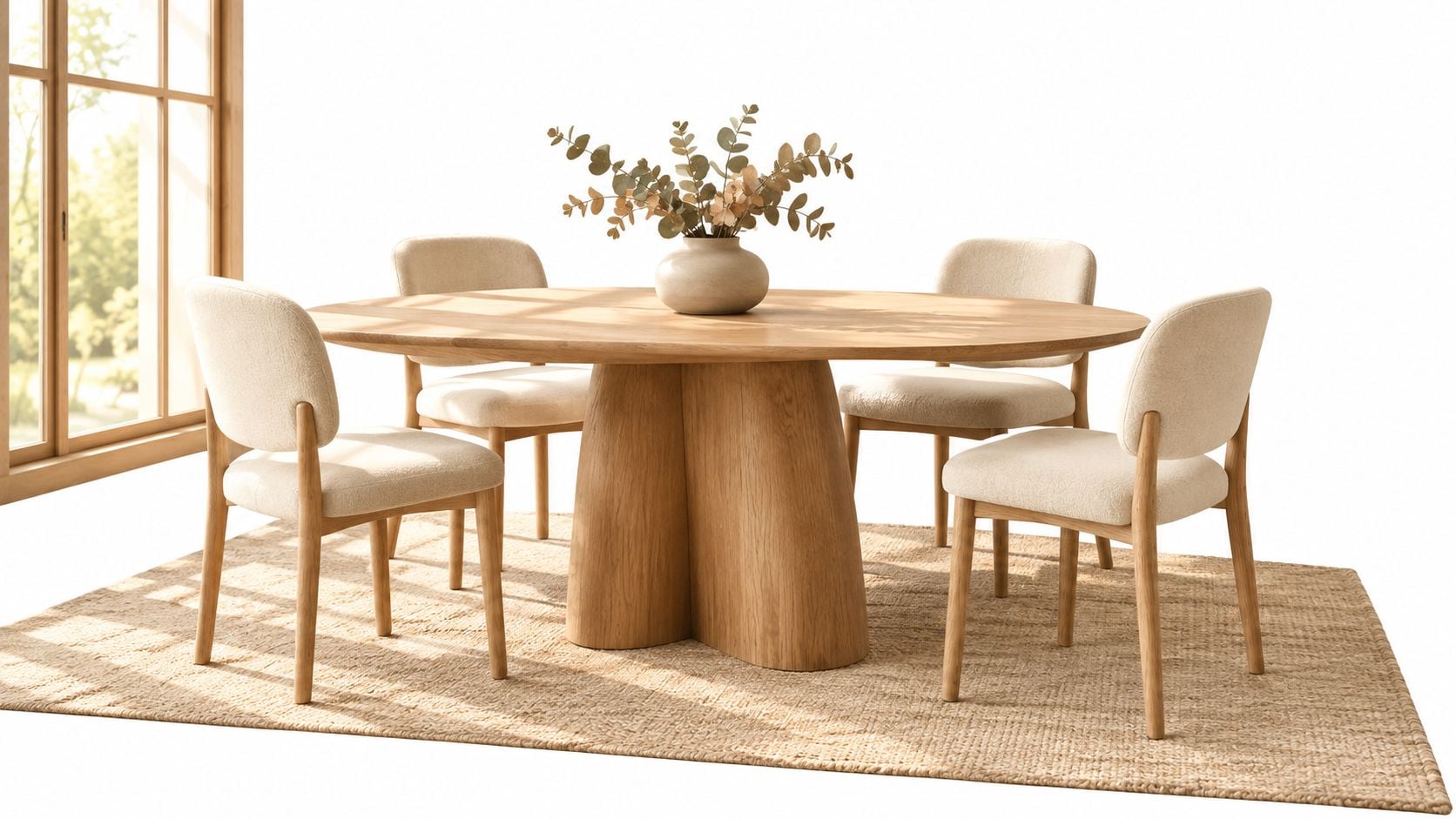
Once the table is chosen, the room should support it rather than compete with it. A substantial reclaimed or teak top already supplies texture, warmth, and visual authority. The surrounding pieces need enough contrast to keep the room lively, but not so much that the centerpiece loses its role.
Build contrast with restraint
Pair a heavy wood table with chairs that have a lighter visual profile. Upholstered seats can soften a thick top, while woven, painted, or slender wood chairs can introduce contrast without creating a style clash. If the table has an elaborate base, simpler chairs usually create a more balanced room. If the tabletop is quiet and refined, chairs can carry more of the decorative detail.
A useful centerpiece arrangement often relies on three related elements rather than a crowded collection. For example, a low bowl, a small branch arrangement, and a pair of candlesticks can create height variation while leaving space for serving dishes. The arrangement should be easy to remove before meals.
Let lighting reveal the material
A pendant or linear fixture should sit in visual relationship with the table's shape. A round table often benefits from a centered fixture, while a long rectangular top can support a linear fixture or a balanced grouping. The light should reveal grain and texture without creating glare across the finish.
Rugs help define the dining zone, especially in open-plan homes. The rug should extend beyond the occupied chairs, not merely sit under the tabletop. A subtle pattern can ground a bold table, while a plain rug can work well when the wood has dramatic grain or a strong live edge.
Add warmth through small details
Wall art, curtains, and serving pieces should repeat one or two tones from the table rather than copy its exact finish. Soft textiles can keep a substantial table from feeling severe. For entertaining details, guidance on candles for dinner parties can help shape a welcoming atmosphere without turning the tabletop into a display shelf.
A dining room should remain usable between gatherings. The dining-room accessories guide offers additional ways to add function around the centerpiece. Storage, textiles, and serving pieces should make meals easier, not create more objects to move.
Caring for Solid Wood Longevity
Solid wood changes with its environment. That isn't a manufacturing flaw. It's a natural response to moisture in the air, and responsible construction accounts for it.
Wood movement is greatest across the grain. Even moisture-content changes of only a few percentage points can create significant dimensional change, according to Purdue Extension's furniture guidance. Wide tops need room to expand and contract, especially when boards come from different sources or have already experienced years of changing conditions.
Construction matters more than a heavy finish
Rigidly fixing every point of a wide tabletop can restrict normal movement. Better construction may include elongated fastener holes, figure-eight connectors, clips, or properly designed breadboard ends. These details let the top move without forcing splits, cupping, restrained panels, or joint gaps.
A finish helps protect the surface, but it can't stop wood from responding to indoor conditions. Buyers should ask how the top is attached to the base and whether the construction allows seasonal movement. That question is particularly important for large reclaimed pieces.
A simple care routine
-
Control heat exposure. Keep the table away from direct heat sources and strong, concentrated sunlight when possible.
-
Keep indoor conditions consistent. Stable household humidity reduces stress on solid wood. Sudden changes create more risk than ordinary seasonal movement.
-
Clean gently. Use the care method recommended for the specific finish. Avoid treating every wood surface as if it has the same coating.
-
Respond to spills promptly. Blot moisture rather than allowing it to sit around joints, edges, or unfinished irregularities.
-
Respect the surface. Trivets, coasters, and placemats protect the finish while preserving the table's everyday usefulness.
Natural cracks, knots, and color variation may be part of a reclaimed table's identity. The important distinction is between expected character and a construction problem. A knowledgeable furniture professional can help buyers understand that difference before purchase and explain the appropriate wood furniture care routine.
The Gates Home Furnishings Experience
A statement table needs to be tested, not just admired. Sitting in the chair, checking knee clearance, viewing the finish from different angles, and walking around the base can reveal issues that photographs hide.
The 30,000-square-foot Gates Home Furnishings showroom in Grants Pass gives Southern Oregon shoppers room to make those comparisons. Customers from Medford, Central Point, Ashland, and nearby Rogue Valley communities can compare dining shapes, chair heights, finishes, and bases in one physical setting.
Unique Finds reward patient browsing
The Unique Finds collection includes reclaimed wood, teak, and one-of-a-kind statement pieces that bring more individual character than uniform mass-produced furniture. Each piece deserves a close inspection. Buyers can look for grain transitions, edge treatment, base construction, surface texture, and the finish's response to natural light.
The showroom also carries familiar home furnishings brands including La-Z-Boy, Flexsteel, Ashley, and Beautyrest, allowing shoppers to consider dining furniture alongside seating and bedroom needs. That broader selection is useful for households furnishing a new home, updating a room gradually, or coordinating comfort-focused pieces for multigenerational living.
Financing and delivery should be part of the plan
Gates Easy Pay offers flexible options that include $0 down, 6-month interest-free financing, and no-credit-needed options. Financing terms and approval requirements should be reviewed before purchase, but the choices can help budget-conscious buyers plan for a substantial table without treating quality as an afterthought.
Delivery also matters with a heavy solid-wood centerpiece. White-glove service means the team doesn't just drop boxes at the door. Professional delivery includes assembly and setup, with careful handling of the furniture inside the home. Mattress haul-away is also available for mattress deliveries, which is useful when a dining purchase is part of a larger household update.
A statement dining table should make the home more inviting, not create a delivery or layout headache. Visiting the showroom near Grants Pass lets buyers test comfort, confirm scale, and discuss the practical details before bringing a one-of-a-kind piece into the Rogue Valley home.
Gates Home Furnishings offers reclaimed wood and teak statement dining tables, in-person comfort testing at its 30,000-square-foot Grants Pass showroom, flexible Gates Easy Pay options, and professional assembly through white-glove delivery. Visit Gates Home Furnishings to compare unique dining pieces in person or browse the collection online.