Mid Century Modern Reclining Sofa Buying Guide


A living room can feel caught between two good ideas. The homeowner wants the warm wood, tapered legs, and crisp silhouette of mid-century design, but also wants to put both feet up after a long Southern Oregon day. A mid-century modern reclining sofa solves that tension only when its comfort hardware stays visually quiet and the room has enough space for the sofa to open fully.
The right piece should look intentional when upright, feel supportive during everyday sitting, and operate without turning a compact Grants Pass, Medford, Ashland, or Central Point living room into a maze. The following guide focuses on the decisions that matter most, from mechanism quality and clearance to upholstery, delivery, and long-term value.
Understanding the Mid Century Modern Reclining Sofa
A genuine mid-century modern reclining sofa doesn't need to imitate a museum piece. It needs to carry the style's essential visual language while accommodating modern engineering. The strongest examples have a low horizontal profile, slim or track arms, cushions, tapered legs, and warm wood accents. The reclining function should remain discreet when the sofa is upright, rather than dominating the frame with oversized padding or visible hardware.
Mid-century modern design broadly flourished from about 1945 to 1975, a period when designers reworked furniture for postwar homes, practical living, and changing family routines. That history helps explain why a reclining sofa can belong in the style. Mid-century design wasn't only about appearance. It also valued useful, comfortable furniture made for everyday life.
The mechanism came first
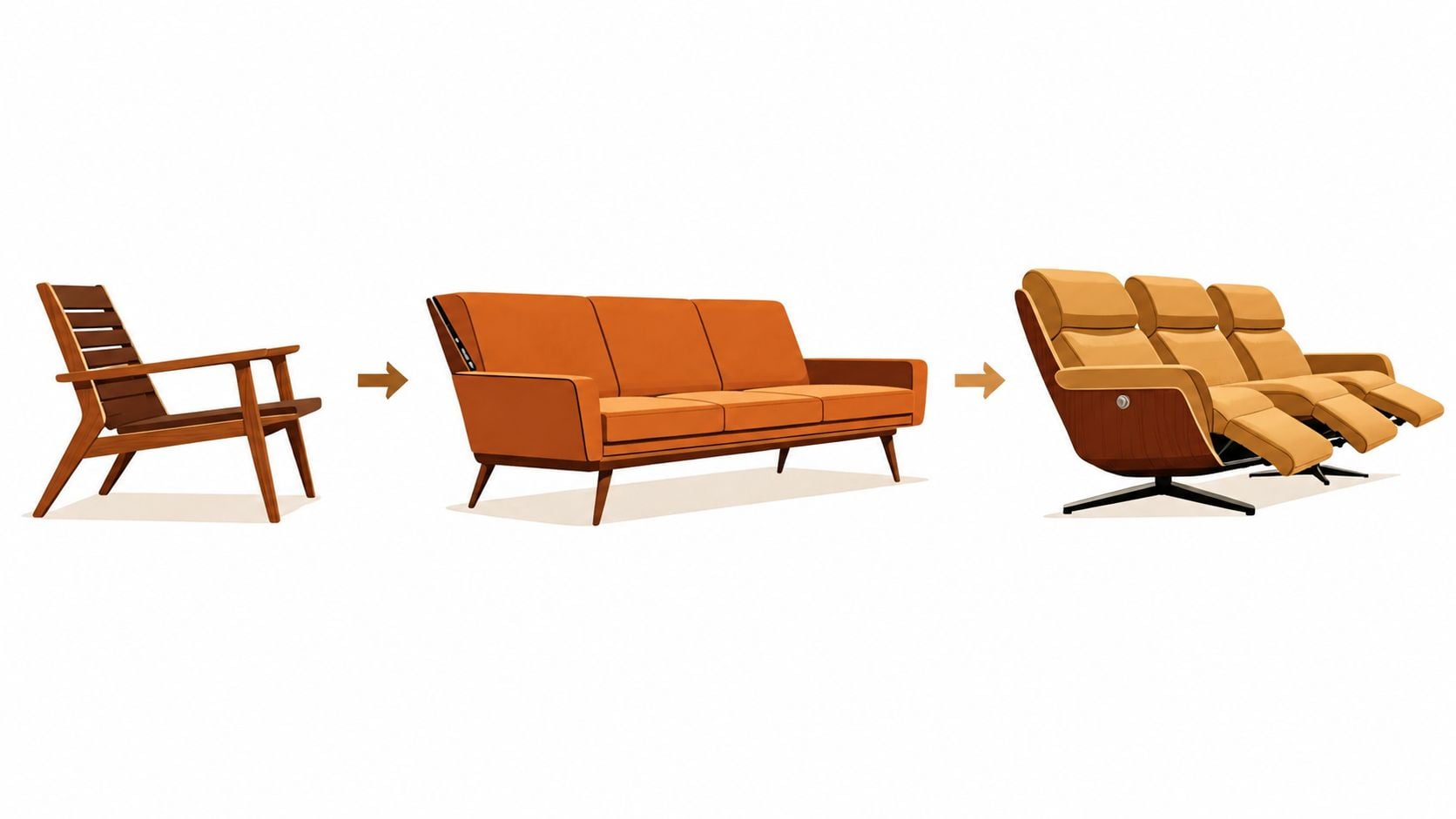
The reclining chair has a much longer history than many shoppers expect. An early documented design appeared in 1813, and a New York advertisement used the phrase “reclining, elevating, and revolving” in 1855. The modern American recliner began taking shape in the late 1920s, when Edward Knabush and Edwin Shoemaker filed a patent for a reclining wooden bench chair. By 1947, they had patented an integrated footrest, which later became a standard feature in recliner design. The recliner's documented history shows that the sofa-recliner didn't create the mechanism. It adapted an established one for shared seating.
A major transition arrived in 1969, when Knabush and Shoemaker began introducing products such as reclining couches and sleep sofas. That development marked the move from a single comfort chair to multi-seat living-room furniture. The category therefore sits at the meeting point of postwar modernism and comfort-driven engineering, rather than being a purely retro invention. The evolution from chair to sofa outlines the patent milestones in 1928, 1930, 1947, and 1969.
How to spot the right silhouette
A sofa can use a reclining mechanism and still look convincingly mid-century. The following details carry more visual weight than the control button or motor hidden inside the frame:
- Open legs: Tapered wood or simple metal legs make the sofa appear lighter.
- Slim arms: Narrow arms preserve seating space and prevent the piece from looking bulky.
- Clean upholstery: Tight backs, neat cushions, and restrained tufting support the period-inspired outline.
- Warm color: Camel, olive, cognac, charcoal, and grounded neutrals pair naturally with walnut, oak, and teak.
- A controlled side profile: The sofa should still look balanced from the side when the footrest is raised.
A useful reference for sofa construction, room fit, and buying priorities is the ultimate sofa buying guide for a living room. It helps shoppers judge the whole piece instead of choosing solely from a front-facing catalog image.
Key Features and Mechanisms to Evaluate
A reclining sofa can look authentically mid-century from across the room and still disappoint after months of daily use. The difference sits inside the frame, beneath the cushions, and in the way the mechanism moves. For a Rogue Valley living room, judge the sofa in this order: structural strength, reclining motion, control layout, then upholstery.
A low-profile design puts extra pressure on the internal structure. The frame supports the seats, arms, back, and moving footrests while preserving the sofa's clean proportions. A strong frame matters more than a thin outline. A slim exterior is useful only when the construction can handle repeated sitting and reclining.
Manual or power reclining
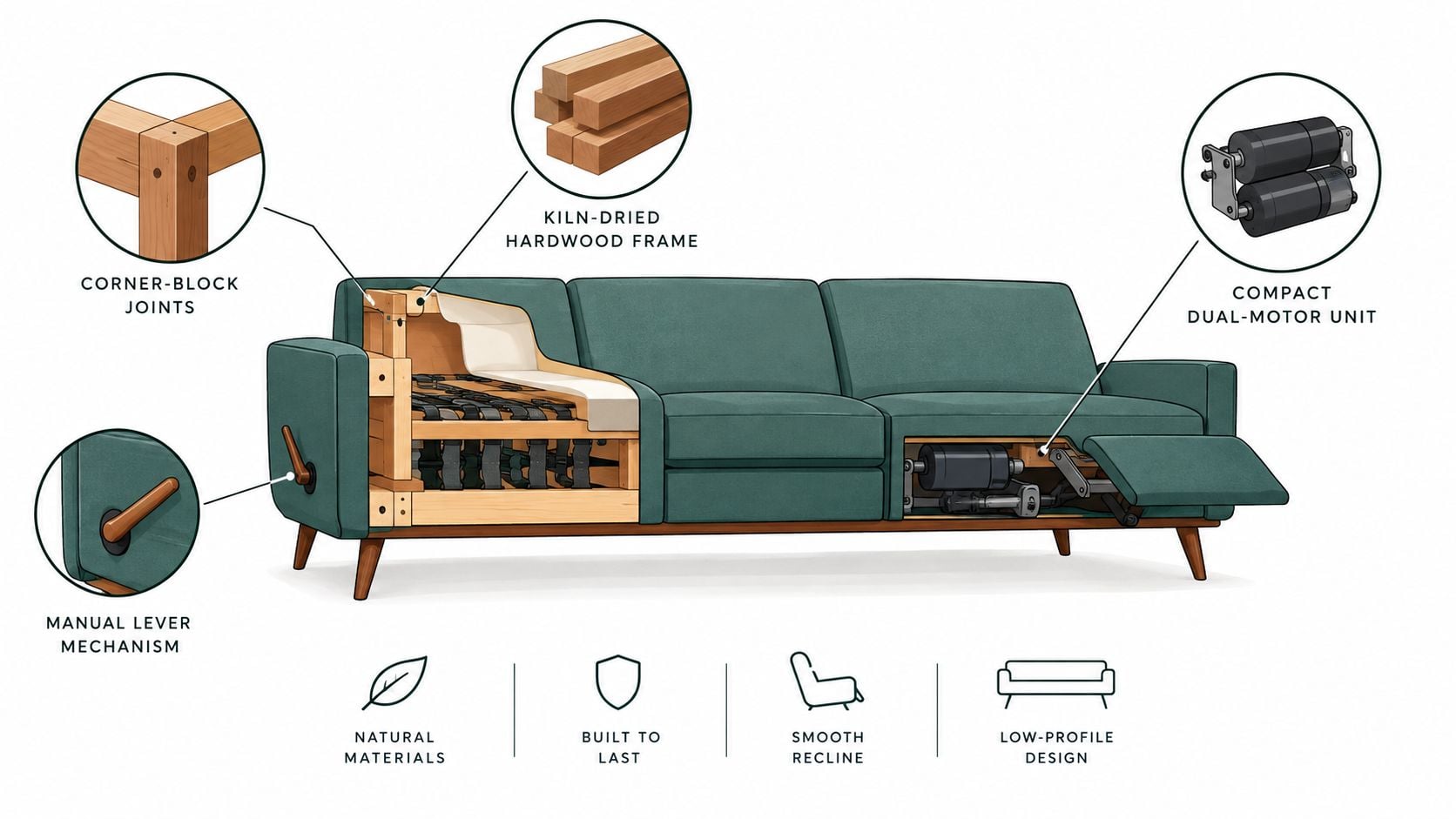
Manual and power systems serve different households. A manual recliner uses a lever or body pressure and has fewer electronic components. It suits buyers who want straightforward operation and fewer powered parts. A power model uses one or more motors, giving you smoother, more controlled positioning.
A one-motor system commonly moves the back and footrest together. A dual-motor system allows separate headrest and footrest adjustment, so one person can sit relatively upright while another reclines. That arrangement works well for couples, older adults, and households where the sofa serves several purposes.
Power models may include motorized headrests, leg rests, USB charging, triple-motion adjustment, or zero-wall operation. Choose those features only when they solve a real need. Test whether the controls are easy to reach, the motion is quiet and steady, and the fully open position leaves usable space around the sofa. This overview of power reclining seating types explains the difference between synchronized movement and independent adjustment.
Frame, joints, and load
Inspect the frame because reclining hardware adds mechanical stress. Kiln-dried hardwood frames with corner-blocked joints provide a stronger starting point than vague descriptions such as “wood frame.” Ask the showroom team how the frame, joints, suspension, and cushions are built.
Seat ratings for quality reclining sofas commonly fall in the 250 to 300 lb per seat range, with heavy-duty builds reaching about 400 lb. Ask the showroom team to confirm the rating for the specific model you are considering.
Use this checklist before choosing:
- Motor coverage: Confirm whether the motor warranty differs from the upholstery or frame warranty.
- Seat support: Ask about foam density, suspension, and cushion construction for extended sitting.
- Control placement: Side controls should remain convenient without disrupting the sofa's clean profile.
- Noise and speed: The mechanism should move smoothly and finish without a sudden jerk.
Fabric affects long-term performance too. Compare woven textiles, performance blends, and textured upholstery with this guide to modern sofa fabrics that hold up. At the showroom, sit upright, recline fully, adjust the headrest, and check that the arms feel narrow without feeling hard. That test connects the sofa's authentic mid-century shape with the mechanics you will use every day.
Sizing and Space Planning for Rogue Valley Homes
A sofa that looks perfectly proportioned in a showroom can crowd a Grants Pass living room once its footrest opens. Measure it in both upright and fully reclined positions. Listed widths for mid-century modern reclining sofas typically run 184 cm to 217 cm, with heights around 80 cm to 90 cm and upright depths around 80 cm to 82 cm. Seat heights commonly fall near 42 cm to 46 cm, while seat depths often measure 55 cm to 58 cm. Current category dimensions make clear why a product photo cannot answer the fit question by itself.
A practical measuring sequence
- Measure the wall and entry route. Record the wall length, doorway width, hallway turns, stair access, and ceiling height along the delivery path. Older Rogue Valley homes often have narrow halls, angled walls, or additions that complicate the route.
- Mark the upright footprint. Use painter's tape to outline the sofa's full width and depth on the floor.
- Mark the open footprint. Extend the tape forward to show the footrests and reclining backs at full travel. Include the space people need to pass safely.
- Walk the main paths. Test routes to doors, windows, the kitchen, and nearby seating. A footrest that interrupts a natural path becomes a daily annoyance.
- Place the rug inside the test area. Keep the front legs visually connected to the rug without placing the rug beneath a moving footrest.
- Check the coffee table. A round or oval table usually suits a reclining sofa better than a sharp rectangular table when the seating needs extra forward room.
Use this furniture measuring guide to record the room, doorway, and sofa dimensions before ordering. Write the measurements down, then compare them with the manufacturer's upright and open specifications. This simple record prevents a style decision from becoming a delivery problem.
Comparing mechanisms and clearance
The mechanism changes the room plan as much as the sofa's mid-century profile. Standard reclining designs generally need more space behind or in front of the sofa. Wall-hugger designs move the seat forward as they open, helping preserve the clean wall line that suits a smaller room. They still need usable space in front.
Wall-hugger clearance commonly falls around 3 to 6 inches, but requirements vary by model. Reconfirm the required clearance against the individual product specification before ordering, since wall-hugger requirements vary by model. Space and clearance guidance for the category supports measuring both positions.
| Mechanism Type | Upright Depth | Fully Reclined Depth | Required Wall Clearance |
|---|---|---|---|
| Standard reclining sofa | Product-specific | Product-specific and substantially deeper | More space behind the sofa than a wall-hugger |
| Wall-hugger reclining sofa | Product-specific | Product-specific, with the seat moving forward | About 3 to 6 inches, depending on the model |
| Separate stationary sofa with dedicated recliner | Sofa and chair measured separately | Recliner footprint measured independently | Flexible placement, but two pieces need their own zones |
For a compact room in Medford, Ashland, or Central Point, choose the mechanism after mapping the full movement zone. A wall-hugger can preserve rear clearance, yet it does not remove the need for forward space. If the sofa sits beside a busy walkway, a stationary mid-century sofa with one matching recliner often makes the better design choice. It keeps the authentic wood-and-line silhouette while giving the recliner its own comfortable zone.
Navigating Comfort and Material Trade-offs
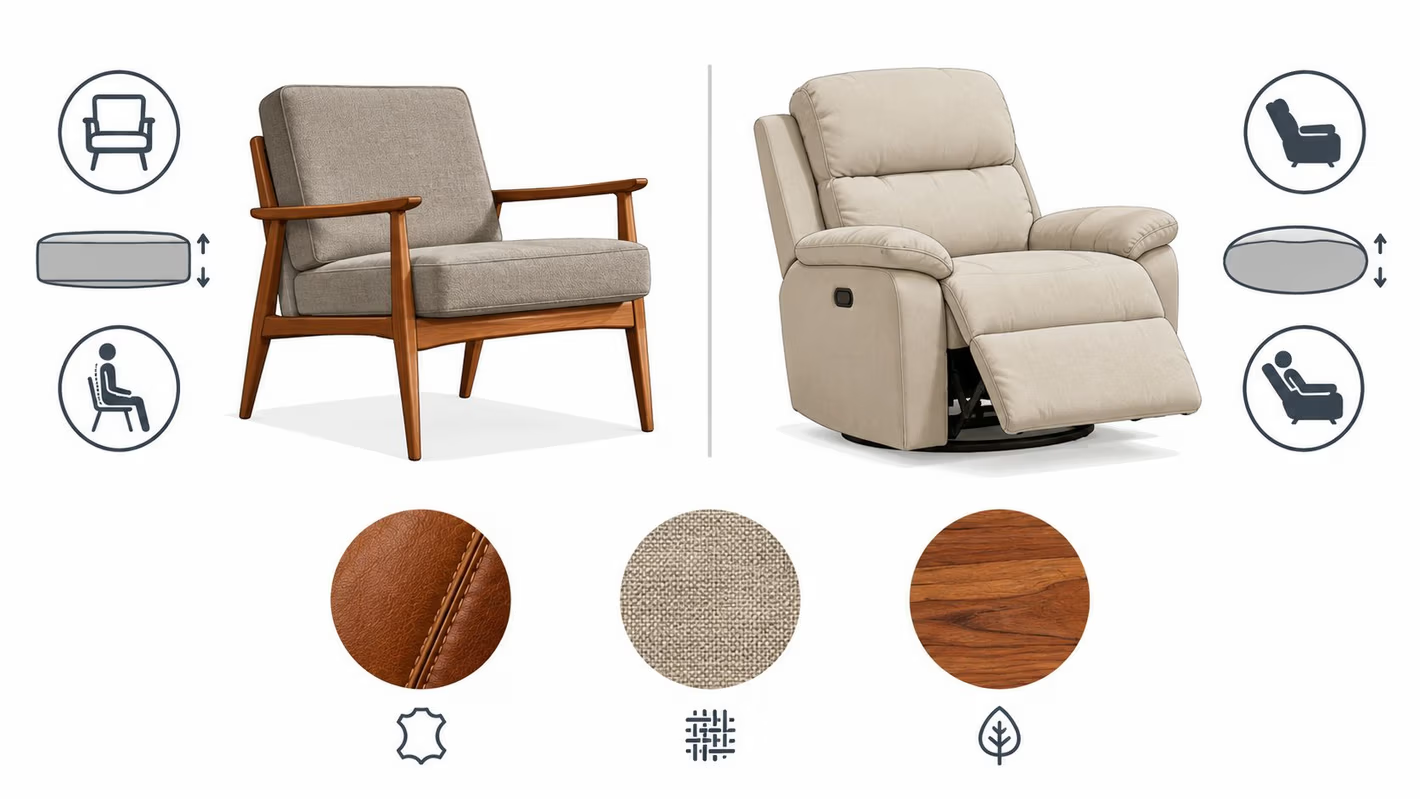
Mid-century seating often feels firmer and more structured than oversized lounge furniture. That firmness can provide stable support for upright conversation, reading, or visiting, while a deeper reclining seat creates a softer posture for television and extended relaxation. The correct choice depends on how the household really uses the sofa, not on whether the cushion feels impressive during a brief showroom sit.
A deep seat can improve lounging comfort, but it can also encourage slouching for some people. Medium-firm cushions offer a useful middle ground, especially when the back angle and headrest can be adjusted independently. Taller users may appreciate extra depth, while shorter users may find that their feet don't sit securely on the floor in the upright position.
Choosing the cushion feel
A structured cushion is usually the better fit when the sofa must support mixed activities. It keeps the room looking neat and makes upright sitting easier. A softer cushion suits households that primarily use the sofa for movie nights, afternoon rest, and long conversations with the footrest raised.
During a showroom test, each shopper should try three positions:
- Feet flat: The knees should feel supported without pressure behind them.
- Partially reclined: The lower back should remain supported without forcing the shoulders forward.
- Fully reclined: The headrest should support the neck without pushing the chin toward the chest.
Comfort isn't only softness. It also includes seat height, arm position, head support, footrest length, and the ease of returning to an upright posture. Seniors and back-sensitive users should pay particular attention to the transition between positions instead of judging the sofa only by its most reclined angle.
Upholstery for Southern Oregon living
Top-grain leather offers a polished, warm appearance and can suit a restrained mid-century palette. Performance fabrics provide a softer, more relaxed surface and may be a practical choice for active households with pets, children, or frequent guests. Textured fabrics can also make a power sofa feel less mechanical because they soften the visual effect of the moving parts.
Reclaimed teak is a strong accent choice for homeowners who want character without relying on mass-produced accessories. Sustainability research describes reclaimed teak as valuable because it avoids new harvesting, retains embodied carbon, and reduces processing energy compared with newly harvested teak. The environmental case for reclaimed teak offers useful background for evaluating a teak table, console, or accent frame.
For temporary storage, moving, or renovation work, a Heavy Duty Sofa Furniture Protector Cover Bag can help shield upholstery from dust and incidental contact. Material guidance covering fabric construction, cleaning, and wear is also available in this upholstery materials guide. The final choice should match the household's cleaning habits, sunlight exposure, pets, and tolerance for natural aging.
Purchasing and Delivery with Gates Home Furnishings
The purchase is only successful when the sofa works from the showroom floor through the front door and into the final room. Gates Home Furnishings has served Grants Pass, Medford, and the wider Rogue Valley since 1946, when WWII veteran George Gates Jr. founded the business around the promise of “Service and Value.” That philosophy is most useful when it appears in practical details, such as clear product guidance, realistic delivery planning, and help with placement.
A reclining sofa needs a more careful delivery plan than a small accent chair. The frame may be heavy, the mechanism needs protection, and the crew must know where the sofa will operate once it's in the room. Professional in-home delivery generally goes beyond leaving furniture at the doorstep. White-glove service typically includes in-home placement, unpacking, assembly or light installation, inspection, and removal of packaging, with some providers also offering haul-away of old items. A guide to white-glove furniture delivery explains the distinction.
Financing that fits the purchase
Gates Easy Pay provides flexible options for households furnishing a living room on a planned budget. Available options include $0 down, 6-month interest-free financing, and no-credit-needed options, subject to the applicable program terms. The important step is to review the payment schedule, promotional conditions, and total obligation before signing.
A sensible buying process looks like this:
- Set the room limit first: Decide the maximum width, depth, and open clearance before selecting upholstery or features.
- Test the function: Operate every seat, headrest, and footrest that household members will use.
- Review protection: Ask about the Gates Care Shield protection plan and how it addresses accidental spills and tears.
- Confirm delivery details: Verify assembly, room placement, packaging removal, and mattress haul-away availability.
- Match the rest of the room: Consider whether the sofa needs a teak table, a lighter accent chair, or a stationary companion piece.
White-glove delivery can cost more than a basic drop-off because the furniture is brought inside, assembled on-site, and placed where the customer wants it. Definitions vary by store, so buyers should confirm exactly what the service includes before paying, as advised by Consumer Reports' furniture delivery guidance. The local delivery and assembly details are outlined in the professional furniture delivery service information.
The 30,000-square-foot Grants Pass showroom gives shoppers room to compare comfort in person rather than guessing from dimensions alone. The selection includes La-Z-Boy, Flexsteel, Ashley, and Beautyrest, along with Unique Finds featuring reclaimed wood, teak, and one-of-a-kind statement pieces. That combination makes it possible to test reclining support, compare materials, and consider the surrounding furniture in the same visit.
Visit Our Grants Pass Showroom Today
The right mid-century modern reclining sofa balances three things: a clean silhouette, dependable mechanics, and a footprint that respects the room. A sofa that looks perfect from the front but blocks a walkway when fully reclined isn't a successful purchase. Neither is a beautiful frame with cushions that leave shorter users unsupported or a motor that the household finds difficult to operate.
Southern Oregon homeowners should bring room measurements, doorway details, and a clear idea of daily use when shopping. A homeowner in Grants Pass may need a compact wall-hugger near a busy path, while a larger Rogue Valley room may accommodate a deeper standard mechanism. A Medford or Ashland renter may get a better result from a stationary sofa paired with a dedicated recliner, especially when the living room has limited forward clearance.
The in-person test remains essential. Sit upright, recline partially, raise the headrest, extend the footrest, and stand up again. Check the arm width, cushion firmness, lumbar support, upholstery texture, and whether the sofa still looks balanced from the side. Then compare the sofa with room accents, including reclaimed teak and other Unique Finds that bring warmth without making the space feel themed.
The 30,000-square-foot showroom in Grants Pass is available for testing reclining comfort and exploring living-room options from La-Z-Boy, Flexsteel, and Ashley. Shoppers can also browse the online inventory from Medford, Central Point, Ashland, and nearby Southern Oregon communities before making the trip.
Gates Home Furnishings offers reclining sofas, supportive seating, flexible Gates Easy Pay options, and professional in-home delivery with assembly and mattress haul-away. Homeowners and renters seeking a mid-century modern reclining sofa should visit Gates Home Furnishings to test the fit, compare materials, and find a piece suited to the room.