Best Rocker Recliner Lift Chairs for Comfort and Safety


A customer in Grants Pass often starts by testing a rocker recliner, then pauses when standing from it feels harder than sitting down. A spouse may be weighing comfort against a parent's safety, or someone recovering from surgery may want a chair that feels inviting without making every transfer a struggle. Those aren't separate furniture questions. A rocker recliner lift chair is both a place to relax and an assistive seating device, so the right choice has to work for the person and the room.
Since 1946, Gates Home Furnishings has served Southern Oregon with the promise George Gates gave the business at its founding: “Service and Value.” That means helping a customer look beyond upholstery and feature lists to fit, safe transfers, delivery access, and support after the purchase. A chair that doesn't fit the user or the living room can become an expensive mistake, no matter how comfortable it looks in a catalog.
| What matters | What to check |
|---|---|
| Fit | Feet flat, knees comfortably near a right angle, and room behind the knees |
| Transfer | Smooth, user-controlled lift and sturdy armrests |
| Daily comfort | Seat, backrest, and footrest positions that suit the person's routine |
| Room setup | Clear space for the lift cycle, recline, power cord, and caregiver access |
| Protection | Rated capacity, warranty details, setup, and backup-power behavior |
Why This Decision Matters More Than the Recliner You Already Own
In our Grants Pass showroom, the conversation often starts with someone comparing a familiar rocker recliner to a lift model. They sit, try the controls, and discover that the issue isn't just how the chair feels while watching television. It's whether they can get up from it without straining, losing balance, or calling someone over for help.
That question matters in homes across Grants Pass, Medford, Central Point, Ashland, and the wider Rogue Valley. A person may be planning to age in place, recovering from surgery, or finding that a low, soft cushion has become harder to rise from. A lift chair's powered mechanism raises and tilts the seat toward standing, reducing the effort required to push up. It can also help a caregiver support someone with weakness or limited mobility. Fall-prevention guidance for older adults explains why safer transfers and supportive seating deserve attention in everyday home settings.
Comfort and mobility belong in the same conversation
A chair can be plush and still be a poor choice if its seat is too deep, its arms don't support a steady transfer, or its lift motion feels hard to control. On the other hand, a useful mobility feature doesn't excuse an uncomfortable fit. The best rocker recliner lift chairs balance both needs instead of asking the buyer to sacrifice one for the other.
That's why Gates' founding promise of Service and Value still matters. The purchase should suit the person's body, habits, budget, and room, not just look appealing on the showroom floor. The choice deserves the same care as any long-term piece of furniture used every day.
What a Rocker Recliner Lift Chair Actually Is
A rocker recliner lift chair serves two jobs: it provides a place to sit and relax, and its powered base helps the user move from sitting toward standing. As the lift engages, the seat tips forward and rises. A standard power recliner adjusts the backrest and footrest but does not raise the seat to assist with standing.
Each word describes a different function. “Rocker” means the chair can rock while upright. “Recliner” refers to the opening backrest and footrest. “Lift” means the seat can rise and tilt forward to support standing. The range of recline varies by model, so check the chair's movement in person rather than relying on its label.
Not the same as every other power chair
A conventional power recliner adjusts position for relaxation. A lift chair adds assistance when sitting down or standing up. A lay-flat sleep chair is designed for an extended reclined position, while a patient lift is a separate mobility device used to transfer a person between surfaces. These products have different purposes. Choose based on the movement the user needs, not on the broad category of “power chair.”
Why the mechanism deserves attention
Reclining-chair designs date back to patents and commercial models from 1927–1928. Patent records later describe reclining and occupant-assisting mechanisms, including lift-chair variants from 1969, 1975, 1988, 1989, 1995, and 1996. Practical electric lift chairs are generally associated with the early 1980s, and electronics advances in the 1990s expanded control options for home use. A lift-chair history and overview provides background on the move from ordinary reclining furniture to powered mobility seating.
Treat the modern lift chair as both a comfort chair and an assistive device. Check that its controls are easy for the user to operate and that its motion feels steady. Quiet operation and service support matter in daily use, too. If battery backup is available, ask how it works before choosing a model. Fabric and cushioning count, but they are only part of the decision.
Lift Motors, Power Versus Manual, and Recline Mechanisms Compared
The mechanism determines how a lift chair moves, so match it to the user's daily routine. A single motor usually links some reclining movements. With a dual motor, the backrest and footrest can adjust more independently, letting the user change leg position without changing the back angle. For a closer comparison of power recliners and manual recliners, consider how much adjustment and assistance the user needs.
Position labels describe the range of movement. A two-position chair reclines within a limited range. A three-position model offers an additional position, while an infinite-position chair allows finer adjustment across its operating range. Choose according to how the chair will be used, not the most impressive-sounding label.
| Configuration | Motor type | Recline positions | Best fit for |
|---|---|---|---|
| Basic lift | Single motor | Limited range | Someone who mainly needs help rising and a straightforward recline |
| Three-position lift | Single or dual motor, depending on model | Three-position | A user who wants more than a basic sit-and-recline arrangement |
| Independent adjustment | Dual motor | Infinite-position | Someone who wants to position the back and footrest separately |
Weight capacity is model-specific. Ask for the manufacturer's rated capacity, then choose a chair with room above the user's body weight. Capacity alone does not determine fit. A chair that is too wide or deep can still make sitting and standing awkward.
Power or manual
A powered lift chair needs an electrical connection for normal operation. Check that the controls are easy for the user to reach and understand, and ask how the chair behaves if power is interrupted. A manual push-back recliner has no powered lift, so it cannot provide the standing assistance a lift chair is designed to offer.
Make the choice based on the transfer the user needs. If standing has become difficult, a regular rocker recliner is not a substitute, even if it looks similar. Test the full lift cycle in person. Notice whether the movement feels steady and controllable, and whether the user can operate the controls without straining. The chair must work as both a place to relax and a practical aid for getting up.
Comfort, Safety, and Accessibility for Seniors
A lift chair serves two jobs: it should be comfortable for daily use and provide practical help during transfers. Falls make those transfers a real household concern. About 1 in 4 Americans aged 65 and older falls each year, and a previous fall roughly doubles the likelihood of another fall. About 1 in 5 falls causes a serious injury, and more than 3 million older adults receive emergency-department treatment for fall injuries annually. Historical National Health Interview Survey data from 1997–1998 found that 55% of fall injuries among older people happened inside the home. These figures frame the risk, but they don't prove that a lift chair prevents every fall. Stable seating and easier transfers deserve attention on their own.
Fit affects how safely someone sits and stands. Hong Kong Department of Health guidance recommends knees at approximately 90 degrees, feet flat on the floor, supportive armrests, a seat that isn't excessively soft or slippery, and a backrest-to-seat angle of about 100 degrees. Use Its seating and transfer guidance as a practical reference when assessing a chair.
Practical rule: Let the powered lift raise the user. Armrests should provide steady support, not require the user to haul themselves upright.
Make the room part of the safety check
Leave clear floor space for the chair's movement, keep its power cord out of the walking route, and allow caregiver access if help may be needed. Check that the user can reach and operate the handset, then consider whether they can stay balanced as the chair rises. Weakness, cognitive impairment, or unpredictable balance can make solo transfers unsafe. Get medical or occupational-therapy advice before relying on the chair alone in that situation. Caregivers reviewing home access and support needs can consult this accessibility page for caregivers.
A lift chair contributes to a safer setup; it cannot guarantee safety. If you are considering seating with a belt for positioning or restraint concerns, discuss a chair with a seat belt with a qualified clinician.
How to Test a Rocker Recliner Lift Chair in Our Showroom
A chair can look right and still miss the user's body by an important amount. Before visiting Gates' 30,000-square-foot showroom in Grants Pass, bring a few measurements and the person who will use the chair whenever possible. That turns a general browse into a practical fitting.
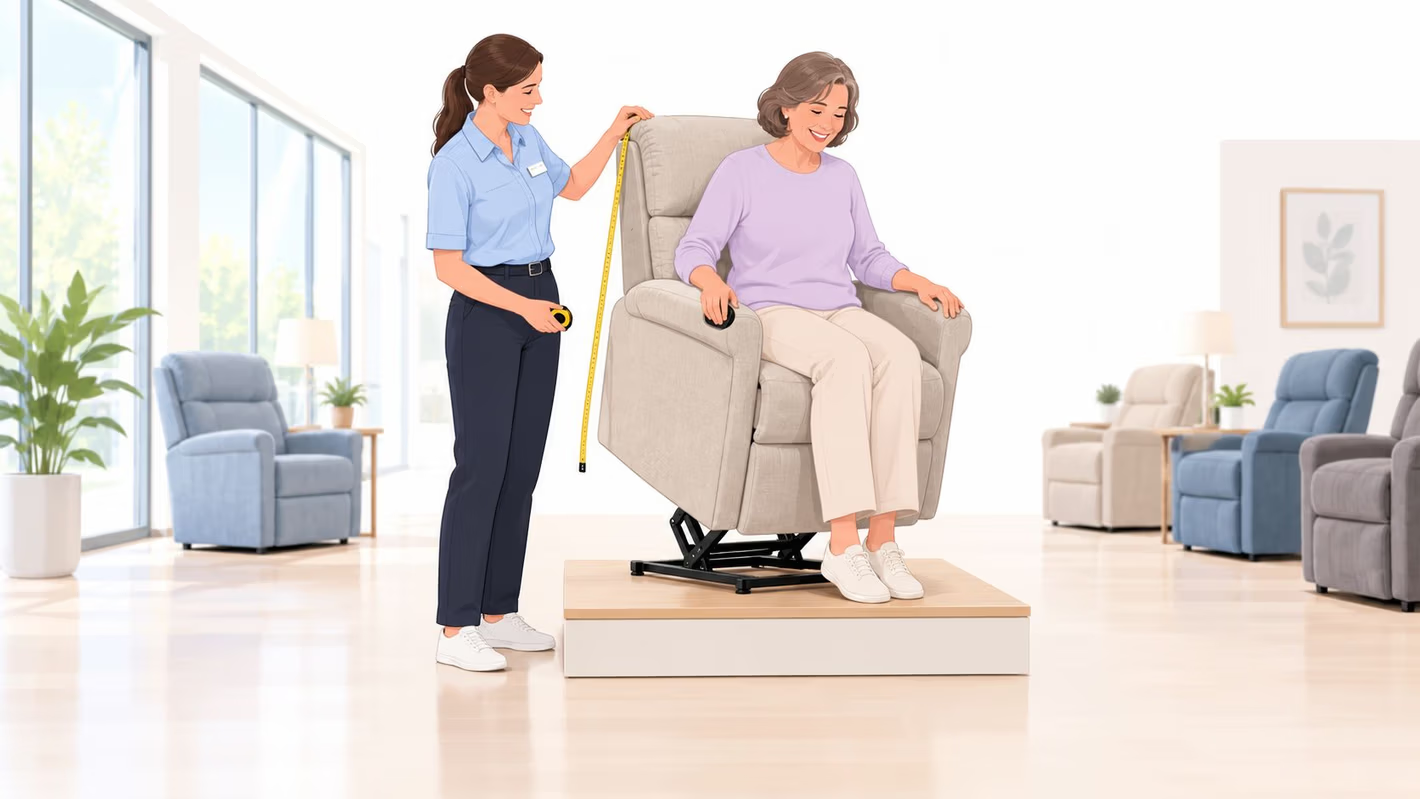
Bring a simple measurement worksheet
Record these measurements before selecting a model:
- Popliteal height: Floor to the back of the knee, taken while seated.
- Seated hip width: The user's width across the hips while seated.
- Buttock-to-knee length: From the back of the seated body to the knee.
- Torso height: To help judge back support and headrest position.
- Doorway width: Check the route the chair must travel during delivery.
- Fully reclined footprint: Measure the space the chair occupies when opened, not just its upright depth.
In the showroom, sit fully back and check that the feet stay flat, the knees sit near a right angle, and there's a small clearance behind the knees. The armrests should support a natural, stable transfer without requiring a hard push. Make sure the handset is readable and reachable, then check that the footrest supports the lower legs without pushing the knees upward.
Fit matters more than feature count. A chair with fewer extras that supports a steady transfer is a better choice than a feature-packed model that doesn't fit.
For a broader room-planning checklist, use Gates' ultimate recliner buying guide. In the showroom, the team can also help compare brands carried at Gates, including La-Z-Boy, Flexsteel, and Ashley, while focusing on the measurements that matter to the person using the chair.
Warranty, Protection, Financing, and Delivery at Gates
A lift chair works hard in ordinary daily use, so its purchase involves more than the frame and fabric. Before choosing a model, ask for the rated user capacity, warranty coverage for the actuator and controls, battery-backup behavior, clearance requirements, and information about safety testing. FDA-cleared lift-recliner documentation includes testing considerations such as electrical safety, electromagnetic compatibility, prevention of falls after device failure, rated-load performance, durability, service life, flammability, and battery performance where applicable. The FDA device documentation shows why a buyer should ask about the mechanism, not just the upholstery.
Protection and payment options
Gates Care Shield offers protection against accidental spills and tears, while the manufacturer's warranty addresses the terms set for the chair and its components. Read both carefully so the household understands what's covered and how to request help. Details of the Gates furniture protection plan can be reviewed before making a decision.
Gates Easy Pay offers flexible financing options, including $0 down, 6-month interest-free options, and no-credit-needed options. Available terms and approval requirements should be checked with the store before purchase. Financing can help a household plan for a chair that meets the user's needs without substituting a poor fit because it costs less up front.
Delivery is part of the setup
White-glove delivery means the chair isn't just dropped at the door. The delivery team provides professional in-home assembly and setup, and can demonstrate the controls so the user knows how the lift cycle works. Gates also provides mattress haul-away as part of its broader delivery services, which is useful when a household is arranging multiple home furnishings.
A lift chair needs careful placement: the team should check the route inside the home, position the chair with operating clearance, and confirm that the user can reach the handset. That service reflects the original Service and Value promise. The relationship shouldn't end when the receipt is signed.
Matching the Right Chair to Your Household
The strongest recommendation depends on who uses the chair, how often, and what happens around it. A solo senior planning to stay in a single-story home near Grants Pass should start with a powered lift model, a simple handset, and a fit test that confirms the feet remain planted. For upholstery, choose a practical, durable fabric suited to everyday use, then ask about protection for accidental spills and tears.
A person recovering from surgery may need lift assistance temporarily but still want a comfortable everyday seat. The right choice is a powered model with straightforward controls and positions that feel comfortable during recovery. Before buying, confirm the expected use with the person's healthcare team and choose protection based on how the chair will be used at home.
Caregiving and comfort-first households
In a caregiving household, prioritize room access before extra features. Place the chair where a caregiver can approach from the sides needed to help, keep tables and cords out of the transfer path, and check that the chair's lift motion works for the user. A sturdy, easy-to-clean upholstery choice makes sense in a busy room; add protection if spills or wear are a concern.
For someone who doesn't have mobility issues but wants a comfortable rocker recliner, a standard rocker may be the more sensible purchase. Gates carries rocker recliners such as the Jasper Rocking Recliner, which rocks and reclines with a manual legrest. If powered lift assistance is needed, the Vega Recliner offers power lift and power recline functions, while the Zecliner Model 2 Lift Recliner includes power headrest, power lumbar, zero-gravity positioning, a remote, and USB connectivity. Those features aren't a reason to skip the fit test.
Shoppers can also explore Unique Finds, including reclaimed wood, teak, and one-of-a-kind statement pieces, when coordinating the chair with the rest of the room. Gates' furniture measuring guide can help with doorway and placement planning before delivery.

Lift Chair Questions Southern Oregon Shoppers Ask Most
Does Medicare Part B pay for a lift chair?
Medicare Part B doesn't generally cover the complete furniture chair. If eligibility requirements are met, coverage is limited to the medically necessary seat-lift mechanism, and the beneficiary remains responsible for the chair portion and any applicable deductible or coinsurance. Eligibility generally requires physician documentation, a qualifying condition such as severe hip or knee arthritis or a severe neuromuscular condition, inability to rise independently from a regular chair, and the ability to walk after standing, even with an assistive device. Medicare's seat-lift coverage policy explains that the mechanism must operate smoothly and remain under the user's control, not spring suddenly upward.
What happens if the power goes out?
It depends on the model. Ask whether it has battery backup, how the backup operates, and whether it can complete the movement the user may need during an outage. Don't assume backup is included or that every model behaves the same way.
Will the chair fit through an older home's doorway?
Measure the doorway and the full delivery route, including hallways and tight turns. Share those measurements before delivery and confirm the chair's required clearance and fully reclined footprint. Small rooms and apartments can still work if the chosen chair fits the space and the lift and recline cycle won't block a walkway.
For medical coverage, Medicare lift-chair eligibility guidance also describes the distinction between coverage for the mechanism and payment for the chair itself. Confirm current requirements with the prescribing clinician and the relevant plan before relying on reimbursement.
Visit the 30,000-square-foot Grants Pass showroom to test rocker recliner lift chairs for fit, controls, and transfer comfort, with Gates Easy Pay and professional white-glove delivery available. Or browse Gates Home Furnishings online and start planning a chair that works for the person and the room.