Barn Wood Table Top Guide for Dining and Living Spaces

A dining room can feel almost finished, yet something still seems missing. The chairs are comfortable, the lighting is warm, and the room has enough space, but the table lacks the texture that makes people want to linger. A barn wood table top often fills that gap with visible grain, old nail marks, knots, and color changes that make the surface feel collected rather than manufactured.
That character comes from reclaimed boards being cleaned, stabilized, milled, and assembled into a usable surface. The important distinction is that genuine barn wood isn't new lumber with a distressed finish. It's material with a previous life, and its performance depends on how carefully that history is managed.
Introduction to Barn Wood Table Tops and Why They Endure
A family gathering offers an easy example. Someone sets down a serving bowl, a child draws a fingertip along a weathered groove, and a guest asks where the wood came from. The surface becomes part of the conversation because it carries evidence of time. No two boards have exactly the same grain direction, knots, faded color, or small imperfections.
That doesn't mean a barn wood table top is rough or unsuitable for everyday use. Properly prepared reclaimed wood can support dining, living, and occasional-use furniture, but it still behaves like solid wood. It responds to moisture, temperature, handling, and the finish applied over it. The charm comes from the irregularity, while the reliability comes from the maker's preparation.
Furniture has a particularly strong connection with reclaimed wood. A USDA Forest Service study found that furniture was the most popular reclaimed-wood product type among survey respondents, at 85%, and about 80% said they'd be willing to buy furniture made from old buildings or barns. That helps explain why barn-origin surfaces continue to appeal to homeowners who want warmth without a mass-produced appearance.
More than a rustic look
Barn wood differs from generic rustic styling because the visual variation comes from the material itself. A newly made rustic panel may imitate age through stains, distress marks, or repeated grain patterns. Reclaimed boards show a less predictable combination of wear, old fastener holes, softened edges, and color shifts.
The same principle appears in architectural applications. Readers interested in how salvaged timber can create warmth across a larger surface may find reclaimed wood cladding for architects useful for understanding the broader design language of reused wood.
At Gates Home Furnishings, a family-owned business established in 1946, that perspective connects with George Gates' original promise of “Service and Value.” The showroom's Mindfully Rustic collection reflects the idea that natural character should support comfortable daily living, not overwhelm it.
In Grants Pass, Southern Oregon homeowners can see how reclaimed wood works alongside softer upholstery, modern lighting, and traditional dining chairs. The right barn wood table top doesn't merely announce its age. It gives the room a grounded, welcoming center.
What Barn Wood Really Is and Where It Comes From
Genuine barn wood usually begins with a deconstructed barn, outbuilding, shed, or other salvaged structure. Workers remove the boards, inspect them, clean away dirt and debris, remove unsuitable sections, dry the material, and mill it for a new purpose. The finished top may preserve some marks from its former use, but it shouldn't carry avoidable structural or contamination risks.
Buyers often use “reclaimed,” “salvaged,” and “distressed” as if they mean the same thing. They don't.
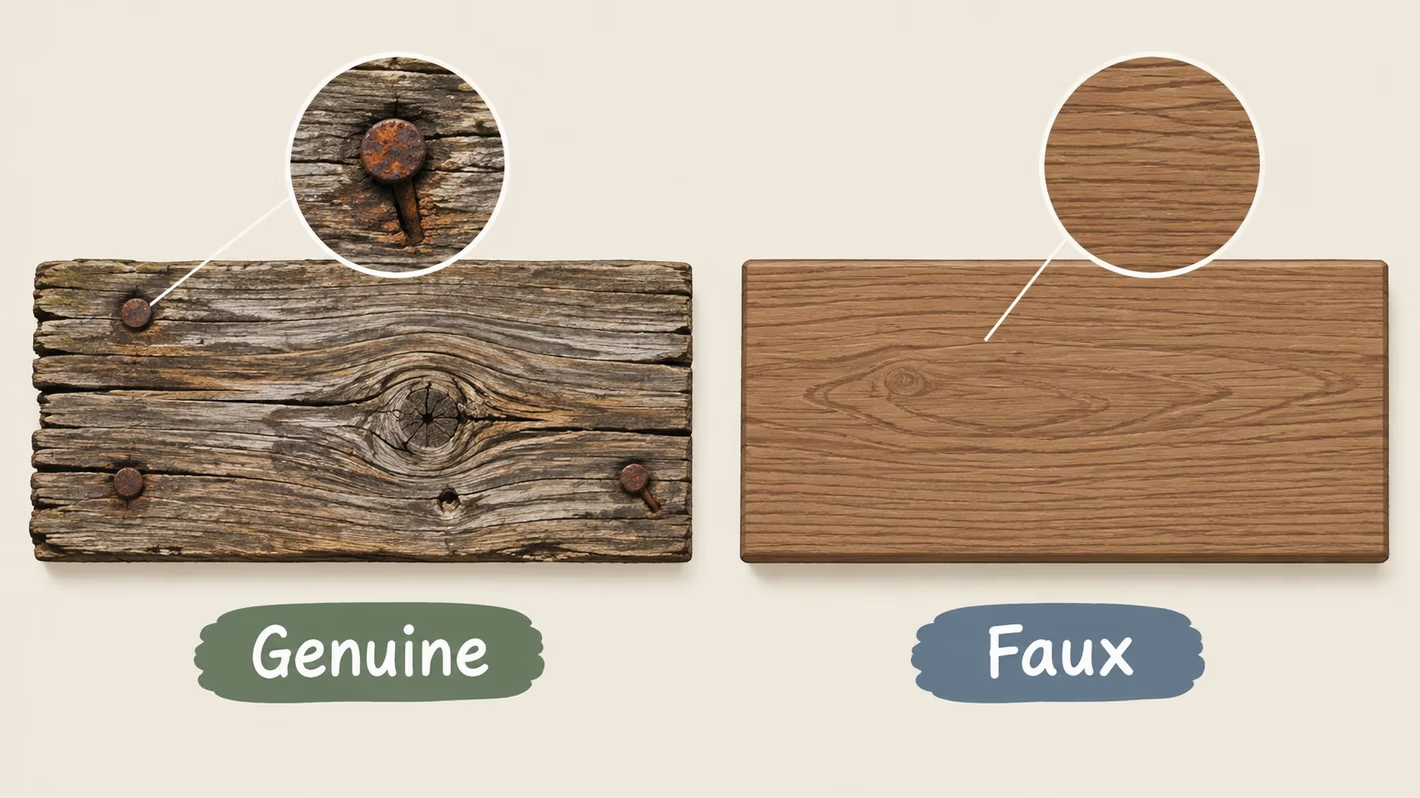
Three materials that look similar
Reclaimed barn wood has been used in an earlier structure. Its surface may show weathering, tool marks, faded coatings, old holes, or uneven coloration. The boards need careful preparation because their former environment and moisture history affect how they'll behave indoors.
New-salvage wood may come from unused stock, recovered construction material, or boards diverted before disposal. It can be a responsible choice, but it may not carry the same decades of exposure or visible history as barn lumber.
Distressed new wood is newly manufactured lumber made to resemble older material. It can offer more predictable dimensions, fewer defects, and a consistent finish, but its appearance is created rather than inherited.
The environmental case for reuse is tied to a substantial recovery challenge. The U.S. EPA reported that about 14.7 million tonnes of wood waste entered municipal solid waste in 2015, representing 6.2% of total MSW, while wood from MSW accounted for 3.9% of the 61.6 million tonnes recovered for recycling that year, as detailed in the EPA wood-waste material data. Reusing suitable boards for furniture gives part of that stream a longer useful life.
Questions that reveal the source
A shopper doesn't need to become a timber specialist. A few practical questions can reveal whether a seller understands the material:
- Ask about origin: Was the wood recovered from a barn, an outbuilding, or another structure?
- Ask about preparation: Has the lumber been cleaned, sorted, dried, and inspected?
- Ask about defects: Which knots, holes, cracks, and old fastener marks remain intentionally?
- Ask about finish: Is the surface sealed for regular use, and does the underside receive comparable treatment?
Gates' Unique Finds include reclaimed wood, teak, and one-of-a-kind statement pieces that bring this kind of material story into living and dining spaces. A shopper comparing options can judge whether the top's history feels authentic, while also checking whether its construction suits the room.
How Barn Wood Table Tops Are Built and Finished to Last
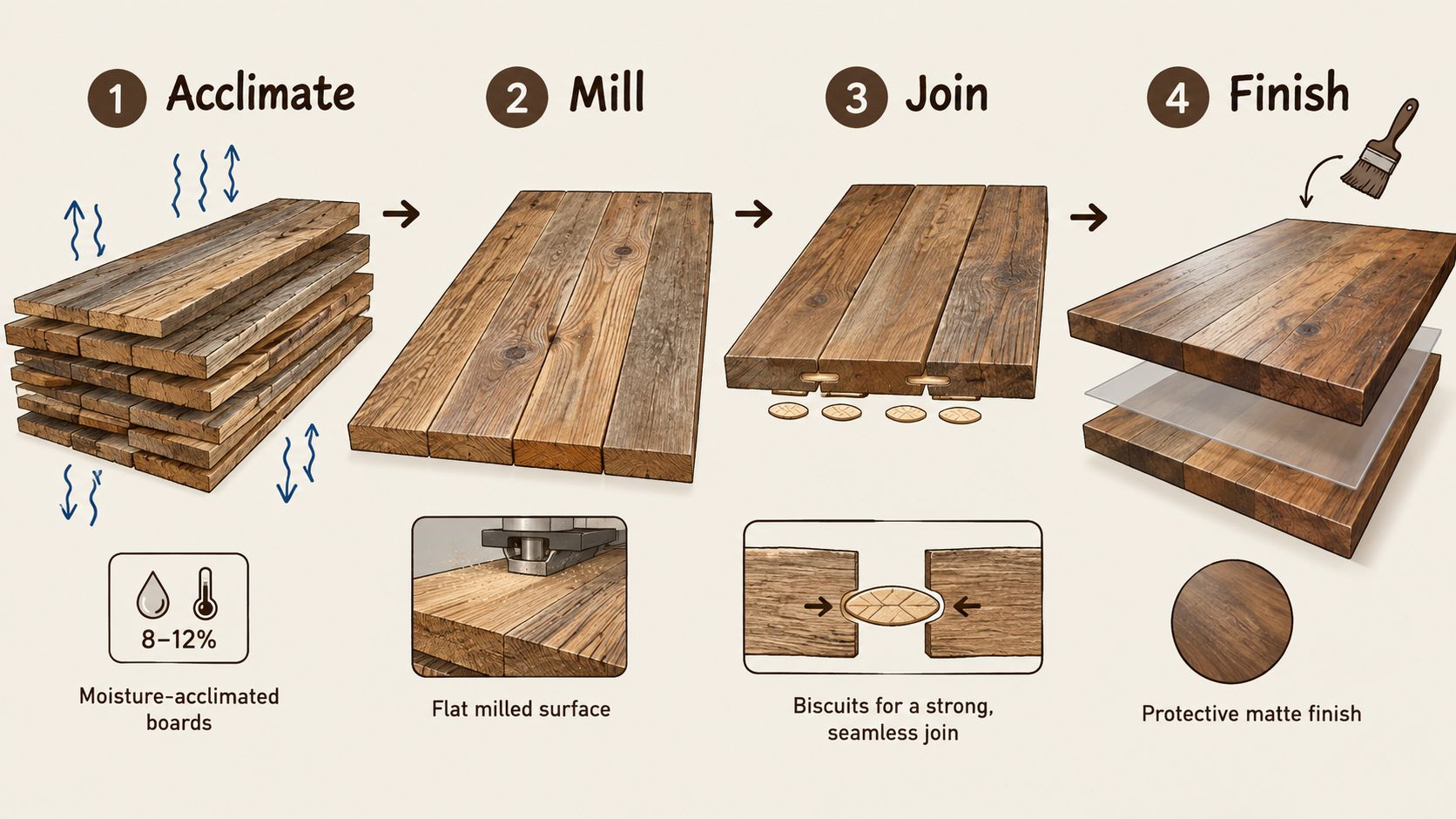
A beautiful surface can still fail if the builder ignores moisture movement. Wood below the fiber saturation point changes size as it gains or loses moisture, so reclaimed boards must reach a moisture condition suited to the room before final milling and assembly. The USDA Forest Products Laboratory wood handbook notes that indoor furniture often stabilizes around 6% to 9% moisture content in heated homes, with drier or more humid climates shifting that target.
The construction sequence
1. Acclimation comes first. A maker should take repeated moisture-meter readings rather than relying on a single measurement. Stable readings matter because a wide tabletop has more surface area across the grain, giving seasonal movement more opportunity to create cupping, joint stress, or finish checking.
2. Preparation follows. Boards are cleaned, inspected, and sorted. The maker decides which defects add character and which weaken the top, then mills the boards enough to create a sound glue-up without erasing every sign of age.
3. Joinery must allow movement. The boards can be joined securely, but the top still needs room to expand and contract across its width. Movement-tolerant fasteners, clips, or attachment hardware help connect the top to its base without locking the wood rigidly in place.
4. Finishing protects without pretending to stop movement. Film finishes slow moisture exchange, but they don't make solid wood dimensionally fixed. The underside, edges, and top should receive an even finishing approach, while the attachment method continues to accommodate seasonal change.
What a buyer should inspect
A shopper can look beneath the tabletop, not only at the display surface. The underside should appear intentionally finished or otherwise protected, the base attachment should avoid rigidly trapping the wood, and the glue lines should look deliberate rather than forced through badly mismatched boards.
Practical rule: Older wood isn't automatically better wood. Moisture control, defect sorting, finish coverage, and movement-tolerant hardware determine whether the top performs well.
A related discussion of material choices and surface decisions appears in these Jennifer Gilmer Kitchen & Bath design insights, particularly for shoppers comparing natural surfaces with more uniform alternatives. For furniture-specific background, wood furniture guidance can help buyers think beyond color and focus on how construction supports long-term use.
A breadboard end, when used, also deserves careful attention. It can frame the tabletop attractively, but it must be connected in a way that respects the top's seasonal movement. The same is true of a rigid metal or wood base. Secure doesn't have to mean immovable.
Pros and Cons You Should Weigh Before You Buy
A barn wood table top suits buyers who value individuality and material history. It may not suit someone who wants every edge, color, and surface detail to remain perfectly uniform. The decision becomes easier when the advantages and trade-offs are considered together.
Where reclaimed wood earns its place
Every top looks individual. Knots, old marks, grain variation, and softened texture give the table a visual identity that a uniform new panel may not provide.
Aged material can offer a distinct feel. Reclaimed boards from older structures are often described as denser, drier, or more stable than newly harvested lumber, but that outcome depends on the species, previous service, and the preparation completed before furniture-making. A guide to reclaimed wood characteristics provides additional background on why old structural timber can feel different from new stock.
Reuse gives the material a second purpose. Reclaimed lumber can avoid some processing associated with virgin material. One estimate places reclaimed wood's carbon-footprint reduction at 85% to 90% compared with virgin alternatives, while another places embodied-energy savings at 75% to 80%, as reported in this reclaimed lumber environmental overview.
Where caution matters
- Variation requires acceptance: A sample board may not represent every board in the finished top.
- Solid wood needs care: Heat, spills, harsh chemicals, and unstable indoor humidity can affect the finish and surface.
- Old paint needs investigation: Barnwood planks can contain residues including lead, copper, chromium, arsenic, and PCP, and the remaining risk can't be judged reliably without specific testing, according to barnwood safety guidance.
- A busy household needs the right finish: A refined protective finish may be more practical than a highly textured surface for frequent meals, crafts, or children's activities.
When painted boards are involved, a buyer should ask whether testing has been performed. Lead may be checked with a commercial test kit or laboratory analysis, and specialized handling is recommended when lead is present. A trustworthy seller should answer plainly rather than treating every old coating as harmless.
Sizing Measuring and Budgeting for Your Space
Start with the room, not the tabletop. Measure the area where the table will sit, then account for chairs, walking paths, nearby cabinets, doors, and the clearance needed to pull a chair out comfortably. A top that fits wall to wall may still make the dining area difficult to use.
Rugs add another layer. The rug should visually support the table and allow chairs to remain connected to it when they're pulled back. In a living room, a reclaimed top used as a coffee table or console also needs enough open space around it for movement and cleaning.
A simple measuring routine
- Mark the footprint: Use painter's tape on the floor to outline the proposed tabletop.
- Place the chairs: Pull them out as they would be used during a meal.
- Walk the room: Check the routes to doors, windows, storage, and adjacent seating.
- Check the base: Confirm that the legs or trestle support match the top's length, width, and attachment needs.
- Record the details: Note desired thickness, edge shape, finish sheen, and whether the top will be custom-built.
The dining table size guide offers a useful reference for organizing those measurements before a showroom visit. Cost usually reflects the source and species of wood, board width, preparation time, finish complexity, edge treatment, base design, and custom dimensions. A wide top with carefully matched boards and a refined finish requires different labor from a simpler, more uniform surface.
Barn Wood Table Top Sizing and Budget Quick Guide
| Room and Seating Need | Recommended Top Size | What Drives Cost |
|---|---|---|
| Compact dining area | A proportionate rectangular or round top that preserves clear walking space | Reclaimed-board selection, edge profile, and base style |
| Everyday family dining | A wider surface sized for chairs, serving dishes, and normal traffic | Board matching, thickness, protective finish, and construction |
| Open dining area | A larger top with generous clearance around all sides | Custom dimensions, longer boards, specialty bases, and finish detail |
| Living room surface | A coffee or console format scaled to surrounding seating | Top thickness, leg design, surface texture, and finish sheen |
Gates Easy Pay gives Southern Oregon shoppers flexible financing choices, including $0 down, 6-month interest-free options, and no-credit-needed options, subject to the applicable program terms. The 30,000-square-foot Grants Pass showroom also lets shoppers test scale and comfort in person before choosing a top for a home in Grants Pass, Medford, Central Point, Ashland, or elsewhere in the Rogue Valley.
Care Repair and Styling That Keeps Barn Wood Beautiful
Daily care is uncomplicated when the finish and household habits work together. Spills should be wiped promptly, harsh cleaners should be avoided, and hot cookware should rest on a protective barrier rather than directly on the surface. Solid wood responds to its surroundings, so indoor humidity deserves attention as part of normal ownership.
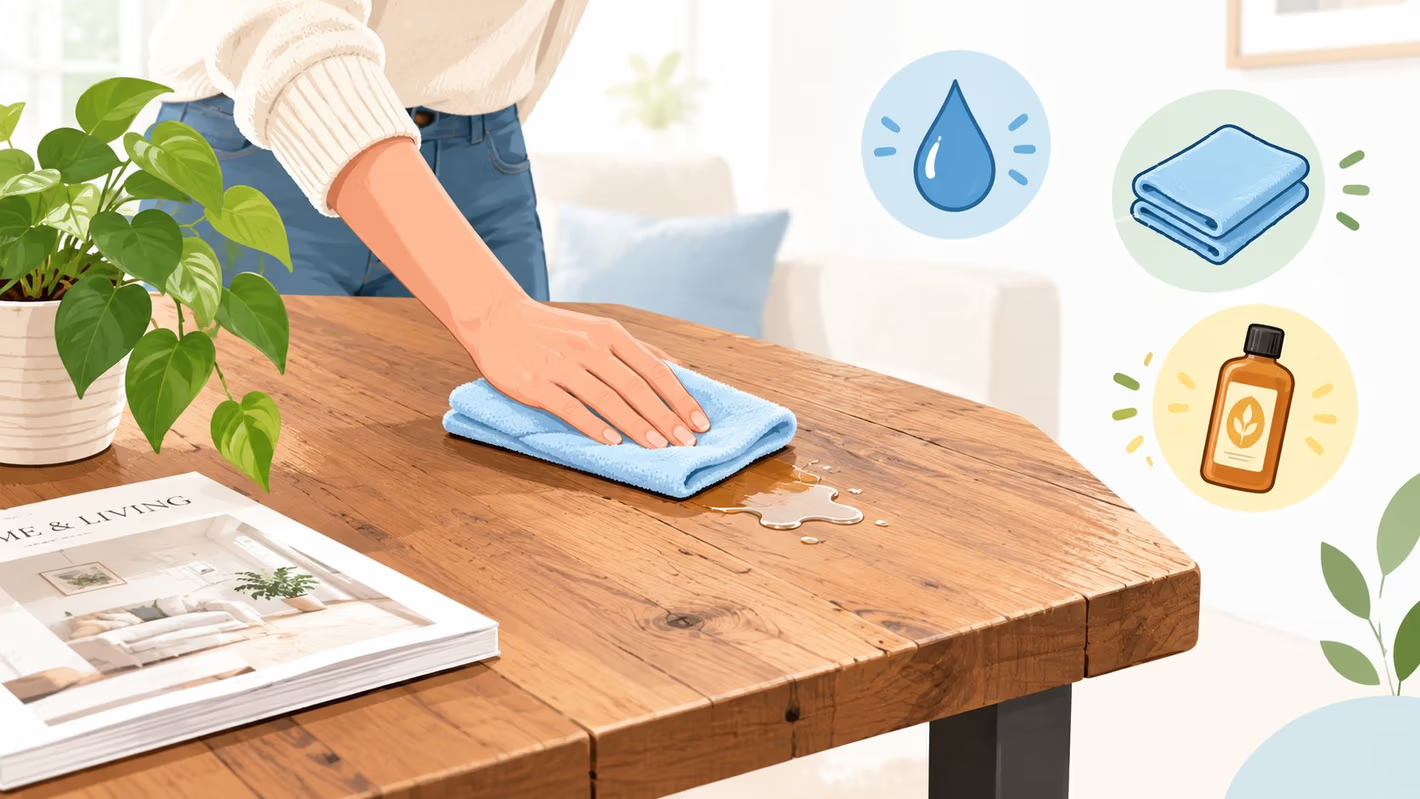
A livable care routine
- Wipe spills quickly: Use a soft cloth before liquid can sit in cracks, knots, or edge joints.
- Choose gentle cleaning: Follow the finish maker's care directions and avoid abrasive or harsh chemical products.
- Control the room: Indoor relative humidity is often kept around 30% to 60%, with lower humidity increasing crack risk and higher humidity increasing warp risk, according to this solid-wood tabletop maintenance guide.
- Protect from heat: Trivets, pads, and placemats reduce stress on the finish and help prevent marks.
- Expect small changes: Minor seasonal movement doesn't automatically mean the top has failed.
For more practical ideas about protecting wood surfaces, wood countertop care guidance offers a helpful reference. A deeper furniture routine is also available through wood furniture care guidance.
Styling old wood in a newer room
A heavily distressed top pairs naturally with farmhouse seating and woven textures, but it doesn't have to stay in that lane. Lighter, more refined finishes can let the grain and age remain visible while fitting contemporary chairs, clean-lined lighting, and quieter neutral upholstery.
In a living room, a reclaimed coffee table can soften a room built around structured sofas and metal accents. In a dining room, a simpler finish can make the old boards feel intentional rather than themed. The strongest styling choice usually balances the top's texture with calmer surrounding pieces.
Custom Options Ordering and Your Next Step with Gates Home Furnishings
Custom ordering becomes useful when a ready-made tabletop has the right character but the wrong dimensions. The important choices include wood species, plank layout, edge profile, thickness, finish sheen, base pairing, and the relationship between visible imperfections and everyday use.
A showroom conversation should cover more than color. Shoppers can ask how the boards were dried, whether moisture readings stabilized before construction, how the underside was finished, and what attachment hardware allows seasonal movement. Those questions help separate a well-prepared barn wood table top from a surface chosen only for its distressed appearance.
Gates Home Furnishings serves homeowners throughout Grants Pass and the wider Southern Oregon region, including Medford, Central Point, Ashland, and nearby Rogue Valley communities. The 30,000-square-foot Grants Pass showroom provides a place to test seating comfort and see how reclaimed wood works beside trusted brands such as La-Z-Boy, Flexsteel, Ashley, and Beautyrest.
The showroom's Unique Finds include reclaimed wood, teak, and one-of-a-kind statement pieces. Gates Easy Pay includes $0 down, 6-month interest-free options, and no-credit-needed options, while White-Glove Delivery includes professional in-home delivery, assembly, and mattress haul-away rather than dropping boxes at the door.
That service reflects the business foundation established in 1946, when George Gates built the company around “Service and Value.” For a custom or selected tabletop, the right next step is a conversation about room dimensions, construction details, finish needs, and delivery access.
Gates Home Furnishings offers reclaimed wood and distinctive furniture choices for dining and living spaces, along with practical guidance on sizing, finishes, and everyday care. Visit Gates Home Furnishings to browse the collection online, or visit the Grants Pass showroom to see table surfaces and seating together before choosing a barn wood table top.