Futon vs Sleeper Sofa: A Southern Oregon Buyer’s Guide


That call tends to come at the same time every year. Family is passing through Grants Pass. Friends from Medford want to stay after a concert. The kids invite extra guests for the weekend, and suddenly a home needs one more real place to sleep.
That's where the futon vs. sleeper sofa question gets practical fast. One piece needs to work hard, fit the room, and stay within budget. It also has to feel right for the people who'll use it.
Southern Oregon homes make that decision a little different than a generic online guide does. A smaller guest room in Ashland, a rental near Central Point, or a family room in Grants Pass all have different demands. Some households need a simple backup bed. Others want something that looks like a full-time sofa and sleeps like a real bed when guests arrive.
That local, practical approach has shaped furniture advice in Grants Pass for a long time. Gates Home Furnishings was established by George Gates Jr. in Grants Pass, Oregon in 1946, beginning as a 5,000-square-foot store at 7th and H Street before growing into a 30,000-square-foot showroom at 700 SW 6th Street, while keeping the promise of “Service and Value” at the center of the business, as noted by the Grants Pass & Josephine County Chamber listing. That kind of long view matters when a household is buying furniture meant to solve real life, not just fill a corner.
For readers who are also juggling a move, storage, or a first home setup, this practical guide for UK first-time homeowners is a helpful reminder that flexible furniture choices are often part of getting settled well.
Table of Contents
- Welcome to Your Extra Room Solution
- Futon vs Sleeper Sofa The Core Differences
- The Comfort Question Mattress and Sleep Quality
- A Look Inside Frame Mechanism and Durability
- Sizing Style and Fitting Your Room
- Best Uses for Your Southern Oregon Home
- Your Buying Checklist and The Gates Advantage
Welcome to Your Extra Room Solution
A lot of furniture decisions start with style. This one usually starts with a guest list.
A room might already serve three jobs. It may be a reading room during the week, a TV room on weekends, and a sleeping space when relatives come up from California or friends stay after a Rogue Valley visit. In that situation, the furniture can't just look good. It has to convert easily, fit the room, and feel comfortable enough that nobody wakes up stiff.
Why this choice gets confusing
The confusion usually comes from the fact that both options promise the same basic benefit. Both give a home a place to sit and a place to sleep. But they get there in very different ways, and those design differences affect comfort, style, footprint, and long-term use.
Practical rule: If the piece will act like a sofa most of the time, judge it first as a sofa. If it will act like a bed most of the time, judge it first as a bed.
That sounds simple, but it saves a lot of second-guessing.
What Southern Oregon households usually want
Most local shoppers aren't asking for a dorm-style backup bed. They're asking for one of these:
- A guest-ready living space that still looks polished day to day
- A budget-friendly extra bed for occasional overnight visitors
- A flexible piece for a smaller room where every square foot matters
- A better answer than an air mattress for holidays and sleepovers
That's why this comparison matters. A futon can be a smart, simple solution. A sleeper sofa can be the stronger long-term choice. The best answer depends on how the room is used and who's sleeping there.
Futon vs Sleeper Sofa The Core Differences
A lot of confusion clears up once we look at how each piece is built.
A futon uses the same padded surface for sitting and sleeping. The frame shifts position, and the mattress bends with it. A sleeper sofa starts as a standard sofa, then opens to reveal a separate bed tucked inside the frame. In plain terms, a futon is one surface doing two jobs. A sleeper sofa is two systems in one piece of furniture.
That construction difference affects how each option looks, opens, feels, and fits into daily life in Southern Oregon homes. After helping families in Grants Pass, Medford, and Ashland sort through this choice for decades, we've found that many buying mistakes happen when shoppers compare them as if they work the same way. They do not.
Futon vs. Sleeper Sofa Quick Comparison
| Feature | Futon | Sleeper Sofa |
|---|---|---|
| Basic design | One mattress serves as both seat and bed | Sofa contains a separate hidden mattress |
| Sleeping setup | The back folds flat to create the bed surface | A bed mechanism pulls out from inside the sofa |
| Mattress profile | Usually thinner and flexible so it can bend with the frame | Usually thicker and more structured because it stores separately inside the sofa |
| Entry pricing | Often the lower-cost way to add an extra sleep space | Usually costs more because the frame and bed system are more complex |
| Look in the room | More casual and visibly convertible | Closer to a standard upholstered sofa |
| Best fit | Tight spaces, occasional guests, multipurpose rooms | Living rooms, guest rooms, and homes that want a stronger sofa feel day to day |
One Surface Versus a Hidden Bed
The easiest way to picture the difference is this. A futon works like a hinged platform with a flexible mattress on top. A sleeper sofa works like a regular couch with a folding guest bed stored inside.
That may sound like a small distinction. In real homes, it changes a lot.
A futon usually feels more casual, both visually and structurally. It can be a smart answer for a bonus room, a first apartment, a study, or a smaller Ashland cottage where every inch counts. It is often easier to move, easier to place, and easier on the budget.
A sleeper sofa usually feels more like permanent living room furniture. The arms, seat depth, upholstery, and overall silhouette are designed first to function as a sofa. Then the hidden bed adds overnight flexibility. If you want to see how that looks in practice, our sleeper sofas for Southern Oregon living rooms and guest spaces show how far these designs have come.
Why shoppers react differently in the showroom
We see the same pattern every year. A shopper sits on a futon and understands it right away. It is simple. What you see is what you use.
Then they sit on a sleeper sofa and judge it by a different standard, because it feels closer to the sofa they already have at home.
That reaction makes sense. A futon asks one component to switch roles. A sleeper sofa separates those roles. If your room needs a flexible backup bed, a futon may be enough. If your room needs to look and feel like a true sitting area most days, a sleeper sofa usually makes more sense.
That is the core difference, and it is the one that should guide the rest of the decision.
The Comfort Question Mattress and Sleep Quality
Comfort is often the deciding factor. It's also where the biggest misunderstanding happens.
Why the sleep surface matters
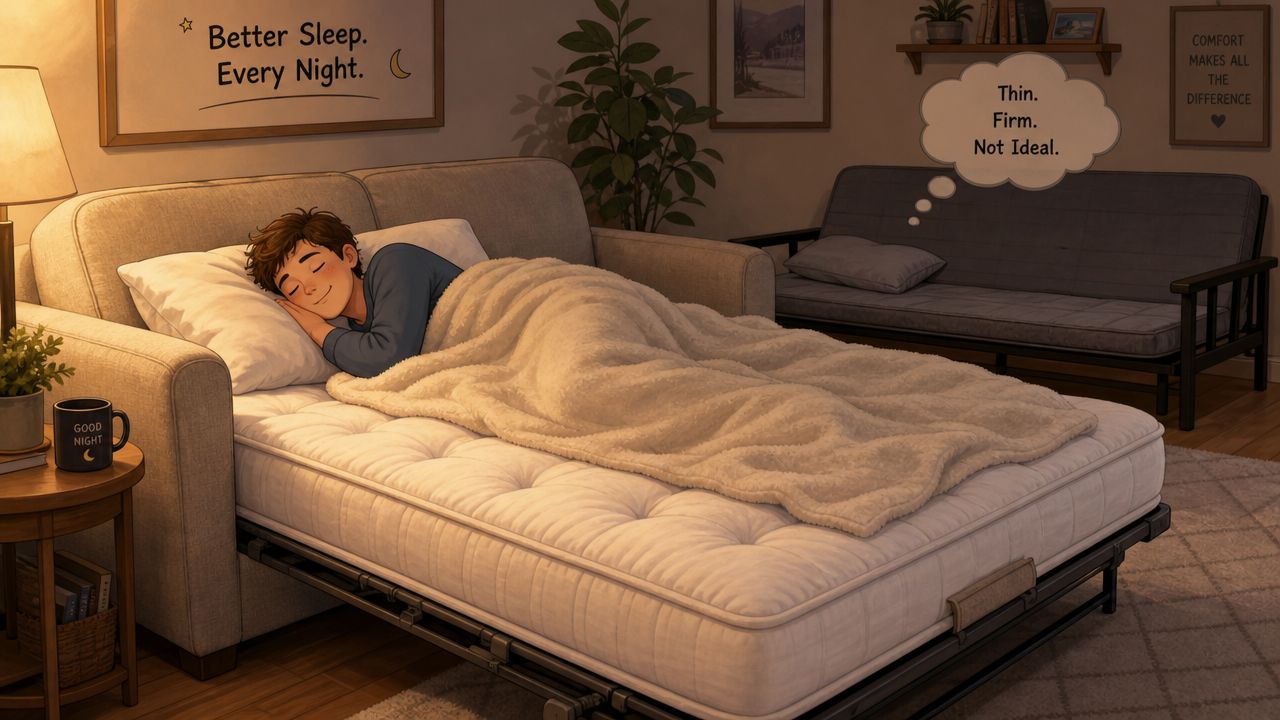
A sleeper sofa uses a dedicated fold-out mattress. A futon uses the seating surface itself as the bed. That means the sleeper sofa separates daily sitting from sleeping, while the futon asks one surface to do both jobs.
That difference shows up clearly in mattress build. Sleeper sofas provide “real-bed comfort” with dedicated fold-out mattresses that are typically 8 to 14 inches thick, while futons use the seat and back cushions as the sleeping surface with thinner mattresses typically 3 to 12 inches thick, making sleeper sofas the stronger option for regular guest use, according to this guide to sleeper sofa and futon comfort differences.
For many households, that explains why guests often sleep better on one than the other. The body isn't resting on a folded cushion seam or the same area that gets compressed every day during TV time and conversation.
How to test comfort the smart way
Comfort isn't just softness. It's support, surface consistency, and how the piece feels after more than ten minutes.
A useful in-store test looks like this:
- Lie in your normal sleep position and notice whether hips or shoulders dip too far.
- Roll once or twice and feel for ridges, folds, or pressure points.
- Sit on the edge as a sofa because some pieces feel good as beds but weak as seating.
- Check back support upright if the furniture will be used daily for reading or watching TV.
People often focus on the old “metal bar” story when they think about sleeper sofas. In practice, the more useful question is simpler. Does the mattress feel even and supported to the person who'll use it?
Good guest furniture doesn't just unfold. It lets the guest wake up feeling like sleep actually happened.
For shoppers trying to pair seating comfort with sleep support, this guide to choosing a mattress helps clarify what firmness, materials, and support really mean in day-to-day use.
A quick note on brands matters here too. Lines such as La-Z-Boy, Flexsteel, Ashley, and Beautyrest have shaped what many shoppers expect from upholstery and mattress comfort, so it makes sense to compare the bed feel and sofa feel separately instead of assuming one automatically predicts the other.
A Look Inside Frame Mechanism and Durability
Durability doesn't only depend on materials. It depends on where wear happens.
What wears out first
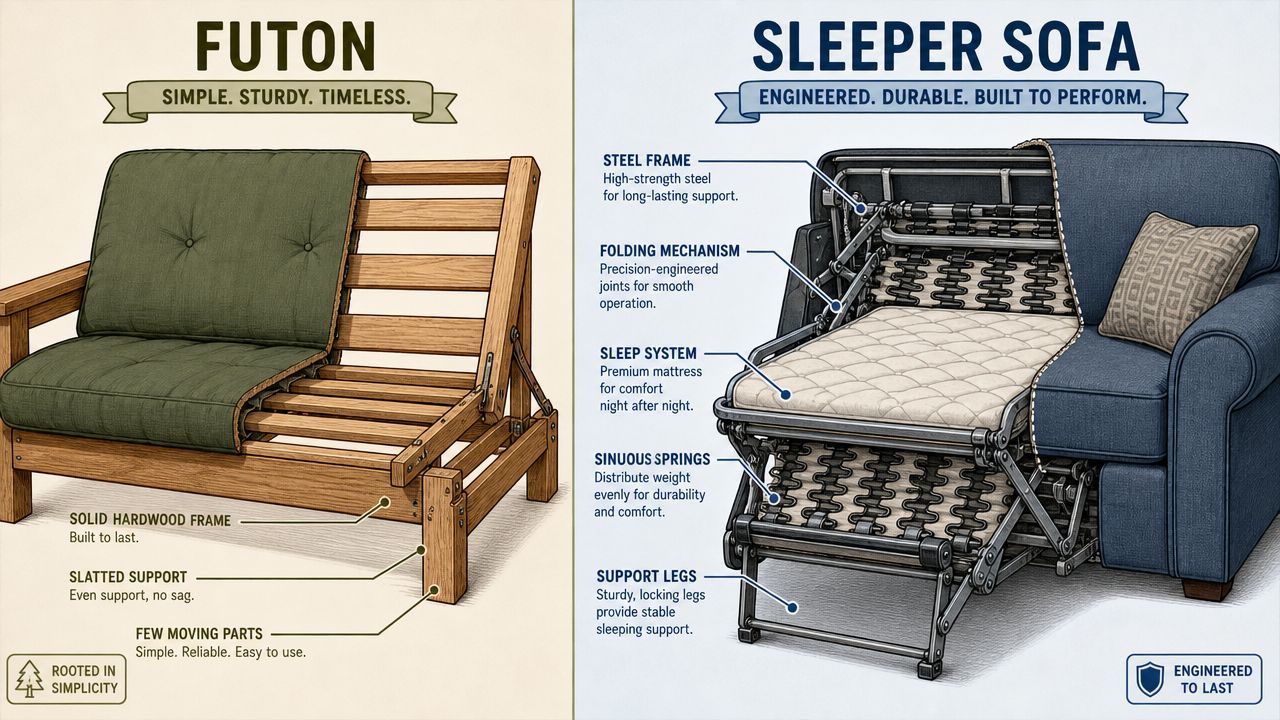
With a futon, the answer is usually the main surface itself. The same pad or mattress gets compressed when someone sits, leans, lounges, and sleeps. Over time, that double use can show up as sagging or uneven spots.
Consumer guidance notes that futons can last 8 to 10 years because parts are replaceable, but the single surface wears down from both sitting and sleeping. The same comparison explains that sleeper sofas are generally more durable for long-term use because they separate the seating surface from the sleeping surface, as covered in this futon and couch durability discussion.
Simple mechanism versus separated use
That doesn't mean a futon is fragile. In fact, one of its strengths is simplicity. A straightforward frame can be easier to understand and, in some cases, easier to refresh by replacing one component instead of the whole piece.
A sleeper sofa is different. It has more structure, more upholstery, and an internal mechanism. That makes it a more engineered product. It also means the part guests sleep on isn't getting worn down every afternoon by normal seating use.
This is often the key tradeoff:
- Choose a futon if simplicity, lower upfront cost, and easier part replacement matter most.
- Choose a sleeper sofa if the household wants the seating area and the sleep area to age separately.
- Think about frequency because occasional overnight use puts far less stress on either option than frequent hosting does.
For anyone comparing fabric life, cushion resilience, and frame feel, this guide to upholstery materials is useful because the cover and cushion build affect long-term satisfaction almost as much as the hidden bed system does.
Worth remembering: The longest-lasting piece isn't always the one with the fewest parts. It's often the one that spreads wear across the right parts.
That's why some households keep a futon happily for years, while others outgrow it quickly once guests start staying over more often.
Sizing Style and Fitting Your Room
A lot of sizing mistakes happen before anyone sits down. We see it in Grants Pass, Medford, and Ashland all the time. A piece looks right on the sales floor, then feels oversized once it has to share space with a coffee table, a walkway, and the door swing in a real home.
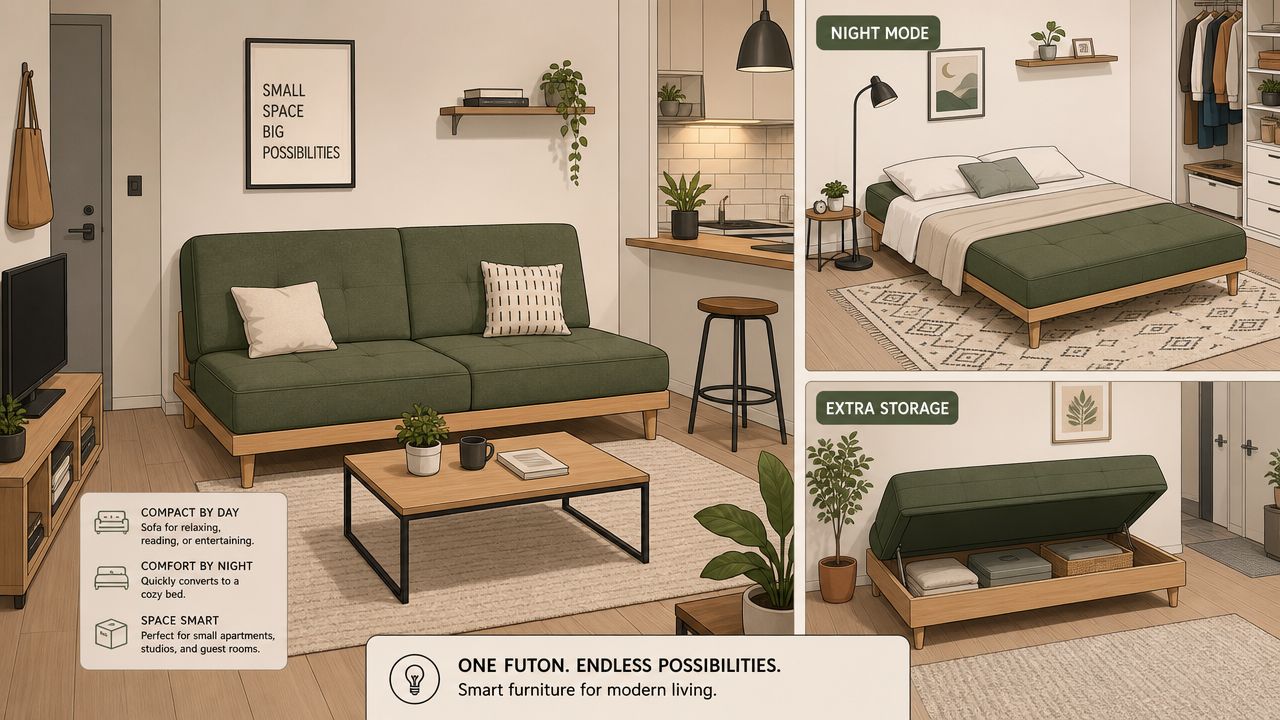
Measure the closed size and the open path
Futons and sleeper sofas can offer a similar place for a guest to sleep, but they ask the room to work in different ways. A futon usually needs more clear space behind or around it as it folds flat. A sleeper sofa often takes up more visual and physical space as a sofa, then needs room in front when the bed pulls out.
That difference matters in older Southern Oregon homes, where bonus rooms, offices, and dens are not always wide open rectangles. A narrow hallway in a Medford ranch or a tighter guest room in an Ashland cottage can turn a good-looking choice into a frustrating one if we only measure the wall.
A simple routine keeps the guesswork out:
- Measure the wall so the piece fits comfortably when closed.
- Measure the full open position so people can still walk through the room.
- Measure doorways, stair turns, and corners before ordering.
- Measure nearby furniture that may need to move on guest nights.
If you want a clear walkthrough, our step-by-step guide to measuring furniture for your room and entryways can help you catch the common fit problems before delivery day.
One small tip from decades on local delivery routes. Put painter's tape on the floor to mark both the sofa position and the fully opened bed. It works like a dress rehearsal for your room.
How each piece changes the look of a room
Size is only half the story. The other half is how the furniture reads the moment you walk in.
A futon usually feels more casual and more flexible. That can be a smart match for a home office, teen room, apartment, or relaxed den. A sleeper sofa usually looks more settled and more like a traditional couch, which helps in a formal living room or a guest space that needs to feel finished every day, not only when company arrives.
We often tell shoppers to look at the room the way a guest would. If the space already has clean lines and light furniture, a bulky sleeper can make it feel crowded. If the room has fuller-scale pieces and a polished look, a futon can sometimes feel out of step unless the design is chosen carefully.
The finishing touches matter too. A throw, a lamp, framed art, or a natural accent like this 35-inch macrame decor can make a convertible room feel planned and welcoming instead of temporary. After 80 years of helping Rogue Valley families furnish real homes, we have found that the best rooms do not try to hide their flexibility. They instead make it look intentional.
Best Uses for Your Southern Oregon Home
The best answer usually depends less on the product label and more on the room's real job.
Good fit for a compact apartment
For a renter in Ashland or a smaller apartment near downtown Medford, a futon often makes sense when budget and footprint lead the decision. It keeps the room flexible and handles occasional guests without making the whole space feel crowded.
That's especially true when the piece won't be used as a primary guest bed every week. In a smaller layout, easy conversion and a lighter visual footprint can matter as much as sleep comfort.
Better fit for a dedicated guest setup
A sleeper sofa often fits better in a family room, den, or guest-ready living area where overnight comfort matters more. If grandparents, adult relatives, or older guests stay over, the more sofa-like seating and more bed-like sleep surface usually make the room feel more welcoming.
This choice also tends to make sense in homes across Grants Pass and the broader Rogue Valley where the piece will serve as a true couch most of the year and only reveal its second role when needed.
If guests are expected to sleep well, not just sleep somewhere, a sleeper sofa usually earns the floor space.
When delivery and financing change the decision
Sometimes the right furniture choice gets narrowed by logistics, not preference. A heavier sleeper sofa can be harder to move into place, especially in older homes, upstairs rooms, or tighter hallways. A futon can be easier to maneuver, but setup still matters.
That's where service changes the experience. Gates Home Furnishings offers White-Glove Delivery that includes professional in-home assembly, heavy-lifting setup, and mattress haul-away, so customers receive a fully installed piece rather than “drop boxes,” as described in the available business context for Gates Home Furnishings.
Budget flexibility matters too. In this same context, Gates Easy Pay includes $0 down payment, 6 equal monthly payments, no-interest options within the promotional period, and no-credit-needed or lease-to-own programs. For many Southern Oregon households, that can make it easier to choose the piece that fits the home best instead of settling for the one with the lowest upfront price.
A local showroom also helps in a way websites can't. A 30,000 sq. ft. showroom in Grants Pass gives people from Grants Pass, Central Point, Medford, Ashland, and the wider Southern Oregon region a place to test sofas, recliners, and mattresses in person rather than guessing from photos and product copy.
Your Buying Checklist and The Gates Advantage
A clear checklist often makes this decision feel much easier.

A short checklist that clears up the choice
Start with these questions:
- Who will sleep on it? An occasional teenager has different needs than visiting grandparents.
- How often will it be used overnight? Rare use can justify a simpler solution. Repeated use usually calls for more support.
- What matters more day to day? Some rooms need a better sofa first. Others need a better bed first.
- How much floor space is available when open? This can eliminate the wrong option quickly.
- What budget feels comfortable now and over time? A lower purchase price isn't always the lower long-term cost.
If the answers point toward regular guest use, stronger seating comfort, and a more polished look, a sleeper sofa often rises to the top. If the answers point toward simplicity, tighter space, and lighter use, a futon often stays in the running.
Why testing in person still matters
There's still no substitute for trying the piece. Sitting, opening, lying down, and checking the room scale in person answers questions that product listings can't.
That matters even more with major brands such as La-Z-Boy, Flexsteel, Ashley, and Beautyrest, where construction differences can feel obvious once someone tests them side by side. A broad showroom also makes it easier to compare upholstered seating with nearby accent pieces, including distinctive reclaimed wood and teak “Unique Finds” that help finish a room with more personality than a standard set.
For shoppers who want to understand the full process before buying, this furniture buying journey guide is a helpful next step.
The financing side is practical too. Gates Home Furnishings offers Gates Easy Pay with $0 down payment, 6 equal monthly payments, no-interest options, and no-credit-needed programs, based on the available business context. That kind of flexibility can make a more comfortable long-term choice easier to bring home without unnecessary strain.
A final point is worth holding onto. Since 1946, George Gates Jr.’s promise of “Service and Value” has been the standard behind a long-running local furniture business in Grants Pass. For a purchase that affects guests, daily living, and how a room works for years, that kind of local continuity still means something.
Visit Gates Home Furnishings to explore styles online or stop by the Grants Pass showroom to test comfort in person, compare options from trusted brands, and find the futon or sleeper sofa that fits a Southern Oregon home the right way.