Recliner Chair XL Buying Guide: Fit, Weight and Delivery


Buying the biggest recliner that fits the living room is bad advice. A chair can look generous, carry an XL label, and still leave its owner struggling to stand, sliding away from the backrest, or facing a delivery crew that can't get it around the hallway corner.
A search for recliner chair XL should start with the person and the delivery route, not the outside width. For Grants Pass and Southern Oregon households, the right choice is the chair that supports daily use, operates comfortably, and reaches its intended spot without a clearance problem.
XL Recliner Sizes and Weight Ratings at a Glance
XL recliner specifications compared
The published specifications below illustrate why XL isn't a universal fit standard. Missing measurements aren't permission to guess. They belong on the list of details to obtain before ordering.
| Chair type | Rated weight | Seat width x depth | Seat height | Overall or reclined size |
|---|---|---|---|---|
| XL convalescent recliner, specifications in the MedicalEX XL recliner listing | 450 lb | 25 in x 20 in | 22.5 in | 36.25 in wide with side tables lowered; 62 in fully reclined |
| XL power-lift recliner, comparison specifications accompanying the same XL sizing reference | 500 lb | 23 in x 23.5 in | 22 in | 42 in wide x 40.5 in deep x 45.5 in high; 68 in fully open |
| Powered medical XL recliner, specifications in the powered medical recliner reference | 500 lb | Confirm interior measurements | Confirm finished seat height | 36.5 in wide x 44 in deep x 49 in high |
| XL/XXL lift chair, comparison specifications accompanying the same medical seating reference | 500 lb | 26 in x 22 in | Obtain model specification | Obtain upright and extended dimensions |
| Typical XL screening range, summarized in this heavy-duty recliner buying guide | 400 lb or more | 24-26 in x 21-23 in | Match the user's lower-leg length | Check the manufacturer's operating clearance |
What the comparisons actually mean
The convalescent chair combines a broad seat with a shallower sitting surface. That combination deserves attention from shoppers who need lateral room but don't want a deep cushion that separates their back from the backrest.
The power-lift example has a larger outside footprint without providing the widest interior seat. Outside width includes arms and structure, so it can't substitute for the measurement between the armrests.
The powered medical model illustrates another limitation of product summaries: overall dimensions don't establish usable seating space. Its missing interior measurements must be obtained before anyone can make a sensible fit recommendation.
The XL/XXL lift-chair example offers more lateral space than the power-lift example. That difference can matter, but extra room is only helpful when the armrests remain accessible and the user's body stays supported.
Capacity is a limit, not a comfort score
The screening range helps narrow a search. It doesn't establish what any particular chair can safely support, and it doesn't guarantee suitable cushioning, footrest reach, or transfer assistance.
The manufacturer's stated weight limit governs. A substantial-looking frame or an oversized cushion isn't evidence of a higher rating.
Comparison rule: Record interior seat width, seat depth, rated weight, and fully reclined length for every chair under consideration.
Add seat height and overall width beside those essentials. A comparison sheet with actual measurements is more useful than a collection of XL labels.
How to Measure Your Body for XL Recliner Fit
Start with the person who will use the chair. A flexible tape measure, a firm upright chair, and a helper make the job easier than trying to measure while sinking into a soft sofa.
The ranges below are rounded inch conversions from the anthropometric seating guidance, which identifies approximate hip width of 18-22 in, shoulder width of 20-24 in, legroom of 24-31 in, and footrest distance of 6-10 in as relevant variables.
Body measurements that decide XL recliner fit
| Body measurement | Typical range | What it decides |
|---|---|---|
| Seated hip width | Approximately 18-22 in | Seat width and arm spacing |
| Shoulder width | Approximately 20-24 in | Armrest spacing and side clearance |
| Legroom | Approximately 24-31 in | Seat depth and thigh support |
| Footrest distance | Approximately 6-10 in | Footrest extension and heel support |
These are reference ranges, not personal sizing instructions. In particular, a general legroom measurement isn't the same thing as a finished seat-depth specification.
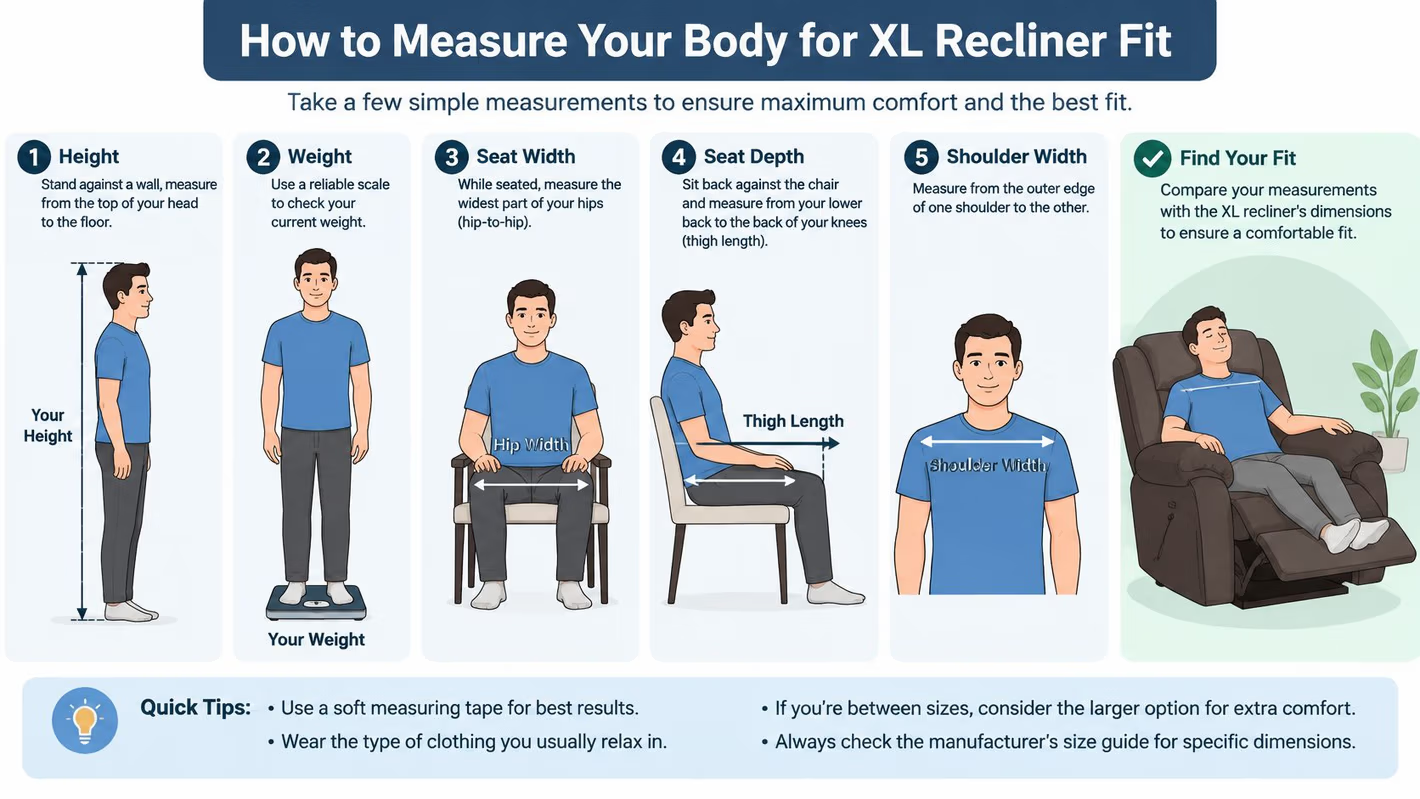
Take the measurements while seated
- Measure seated hip width. Sit upright on a firm chair, with the back against a flat support, and measure the widest part of the hips. Keep the tape straight rather than wrapping it around the body.
- Measure across the shoulders. Record the distance between the outer shoulder points. This helps identify whether padded sides or a narrow backrest will crowd the upper body.
- Measure buttock to back of knee. This establishes a useful starting point for seat-depth testing. The seat should support the thighs without pressing into the backs of the knees.
- Measure floor to back of knee. Wear the footwear normally used at home. This gives a practical starting point for assessing seat height.
- Measure back of knee to heel. Use this when checking lower-leg support and footrest reach, rather than assuming a long chair automatically fits a tall person.
Allow clearance without creating a loose fit
For a hypothetical shopper with 20 in hip width, adding 2 in of total clearance points toward an interior seat at least 22 in wide. That's a worked example, not a universal allowance or a manufacturer's recommendation.
The actual test is whether the armrests avoid squeezing the thighs while remaining useful. A wide frame can still provide inadequate thigh support for a tall user, while a shorter person may struggle to reach a deep chair's backrest.
The furniture measuring guide can help organize the room measurements alongside these personal dimensions. Bring the completed sheet to the showroom, then sit in the candidate chair before choosing.
Choosing an XL Recliner for Seniors and Tall Users
The roomiest, softest recliner isn't automatically the most usable. For someone with reduced leg strength, a deep cushion can feel welcoming on the way down and become an obstacle on the way up.
The older-adult chair-design study found that lower seats, greater rearward seat tilt, more reclined backrests, and softer, compressible cushions increased the time and effort required to stand. Sitting comfort and transfer ease therefore need separate tests.
Test the exit, not just the cushion
A useful showroom assessment asks:
- Does seat height suit lower-leg length? Feet should rest securely when the chair is in its normal upright position, rather than hanging above the floor.
- Can the back reach the backrest? The user shouldn't have to choose between back contact and supported feet.
- Can the user rise without twisting or pulling on the footrest? Armrests should be reachable and usable without an awkward forward scramble.
For families considering broader independence needs, the daily living guidance from Life Senior Placement provides context for discussing everyday assistance. Seating should be evaluated as part of the person's routine, not as an isolated decorating choice.
A chair that feels comfortable while someone else helps with every transfer may not be the right chair for independent use.
Separate XL seating from lift assistance
An XL comfort recliner provides additional seating room or capacity. A lift chair adds a powered lifting function intended to assist movement toward standing. Extra width alone doesn't provide that assistance.
The senior recliner comfort guide offers another way to organize the comfort questions before a visit. Anyone who needs hands-on transfer assistance should include the usual caregiver in the test and seek clinical advice when transfers are unsafe.
Tall users need a different emphasis. Check thigh support, backrest height, and whether an adjustable headrest meets the head without pushing it forward.
For a practical showroom routine, repeat sitting and standing three times. Test upright sitting and the preferred reclined position, but always return the chair fully upright and close the footrest before standing. Reject a chair that requires an awkward maneuver just because its cushion feels good.
Comfort Features and Cushions That Matter
Recline angle gets the showroom attention. Cushion contact decides whether the chair still feels right months later. The pressure-distribution review reports that a 30-degree backrest recline significantly reduced average seating interface pressure, while full recline to 90 degrees reduced seat forces by 61% relative to upright sitting in the cited studies.
Those numbers describe controlled seating tests, and a living-room recliner is a different surface. The accompanying hospital-recliner findings separate the effects of user weight and cushion type from chair position, so the cushion needs its own test instead of a decision made on angle alone.
Run a moving support test
- Sit fully back. Notice whether the pelvis stays in place or slides forward as the cushion settles.
- Recline gradually. Check whether the lower back loses contact and whether the middle back remains supported.
- Extend the footrest. Confirm that the lower legs and heels receive comfortable support without pressure at an uncomfortable edge.
Don't stop at the first comfortable position. Use the chair as it would be used for reading, watching television, and resting, then operate it back to upright. A cushion that feels plush in the first two minutes can compress and leave the hips unsupported later in the session.
Test features individually
Power controls deserve a hands-on trial. The guide to power reclining seating can help distinguish the available adjustments before testing.
- Power recline: Check button access, movement control, and whether the user can stop at a useful position.
- Power lumbar and headrest: Adjust each separately. Firm pressure and correct support are different things.
- Heat and massage: Treat these as optional comforts rather than substitutes for fit or pressure management.
- Upholstery and firmness: Review care requirements and durability information, then assess how far the cushion compresses under the actual user.
Gates Home Furnishings' 30,000-square-foot showroom in Grants Pass provides space for this kind of testing, which a photograph cannot. Brands carried include La-Z-Boy, Flexsteel, Ashley, and Beautyrest, across the store's furniture and mattress selection.
Choose dependable cushioning and lumbar contact before extra features. Heat, massage, and charging conveniences won't fix a seat that fails to support its owner.
Will an XL Recliner Fit Through Your Doors
Doorway and opening clearances for a recliner
The furniture doorway sizing guide gives one sizing example where removing a recliner back drops the pass-through depth from about 36 in to about 24 in, and its examples show why a labeled door size can overstate the clear passage.
| Opening or part | Clear width or depth | Notes |
|---|---|---|
| Nominal 36 in exterior door | About 32 in | After the frame and door stop |
| Interior door | About 30 in | Common hallway and room entry |
| Bathroom or closet door | 24-28 in | Check the chair's pass-through depth before ordering |
| Recliner with back removed | About 24 in pass-through depth | Typical after the back is detached |
Treat these as screening figures. Hardware, trim, nearby walls, and the approach angle can shrink the route.
For terminology that separates the opening from the frame around it, use Breaking Glass Co.'s interior door frame dimensions explained. Record the actual unobstructed opening rather than copying a nominal door size.
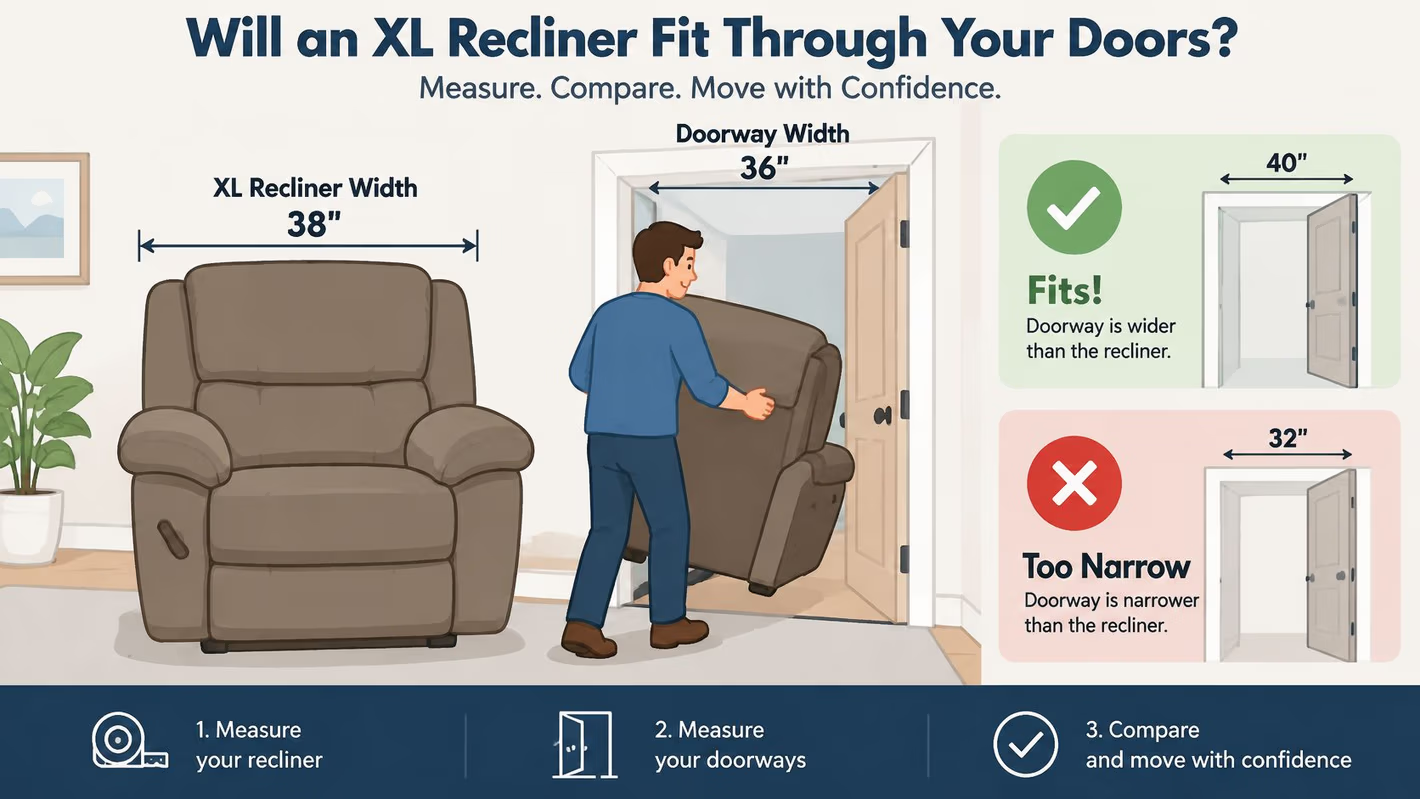
Complete the route checklist
- Measure every clear opening. Open each door to a right angle and measure the unobstructed passage. Note any door that can't open fully.
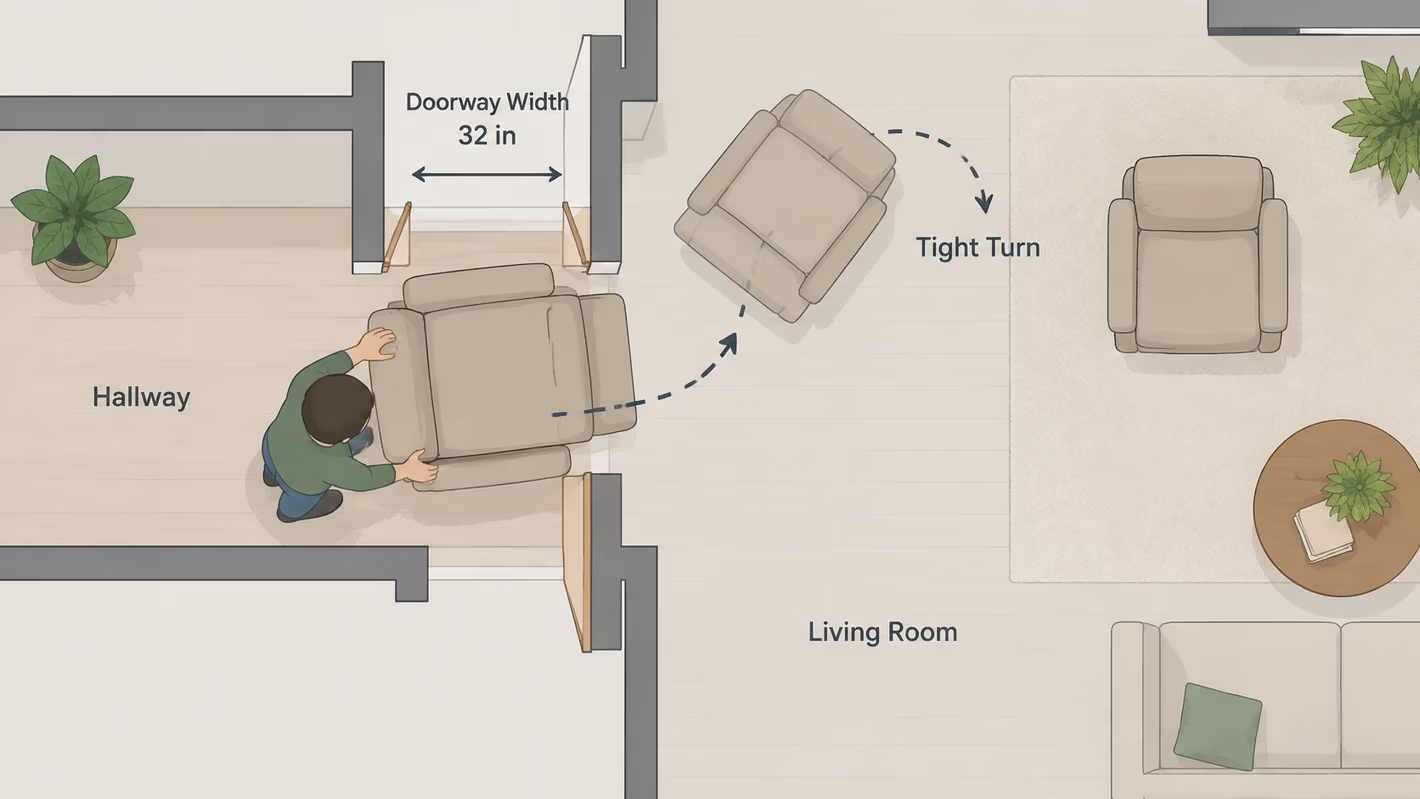
- Record hallway restrictions. Identify the narrowest section and the sharpest turn, including furniture or radiators that can't be moved.
- Confirm removable components. Obtain model-specific confirmation that the back or arms detach, plus the resulting transport dimensions.
- Check diagonal depth. Compare the chair's transport profile with turning space, not just straight doorway width.
- Inspect vertical clearance. Include stairs, ceiling height, landings, and any elevator entrance and interior.
- Reserve operating space. Allow the manufacturer's required clearance behind the back and ahead of the footrest.
- Mark the extended footprint. Use painter's tape to test whether the fully reclined chair blocks a walkway or another seat.
The lift-chair dimensions guide can help organize model measurements, especially when a lifting mechanism changes how the chair moves in the room. Photographs of tight turns are useful additions to the written measurements.
Pass both fit tests
The XL label settles neither test. A wide chair can match the room and still stop at a 30 in hall, a tight landing, or a door that opens only partway, so pass the route checklist before committing to a footprint.
A professional crew reduces the lifting burden. It cannot create missing turning space or operating clearance.
Re-measure before delivery and clear the intended room. Share the checklist, photos of tight turns, and the model's detachable-part dimensions with the store team so the delivery plan matches the actual route.
Before ordering: A taped outline in the room is only useful if the chair can reach that tape.
What White-Glove Delivery Covers and What It Cannot
White-glove service means the crew does the heavy work. Gates Home Furnishings delivers to the room of the customer's choice, professionally unpacks and assembles the furniture, and places it where the customer wants it, provided the location is accessible. For a large motion recliner, setup also means removing protective materials and shipping restraints and confirming the mechanism operates as expected.
Placement, unpacking, assembly, packaging removal, and cleanup are separate tasks in any furniture delivery, so confirm which of them your appointment covers before the truck arrives. That one phone call prevents most delivery-day surprises.
Prepare for setup and removal
Clear the delivery route and move fragile objects before the crew arrives. Keep the space around the chair's intended position open so the team can assemble and operate it without working around crowded furniture.
- Disclose removal items: Identify old furniture, mattresses, foundations, and box springs before delivery day rather than assuming removal is automatic.
- Make items accessible: Strip bedding and clear the path from the old piece to the exit so nothing slows the crew down.
- Confirm terms when booking: Removal arrangements differ between deliveries, so ask which items are covered and what shape they need to be in before the appointment is scheduled.
The Gates white-glove delivery details describe what the in-home service includes. Review them when you book so placement and removal questions are settled ahead of time.
Understand what service means afterward
Gates Home Furnishings was founded in 1946 by George Gates Jr. on the promise of "Service and Value." Professional in-home setup is a practical expression of that founding commitment.
Service also needs realistic expectations. Gates Home Furnishings repairs or replaces a defective furniture component rather than replacing the entire product, and items with easily transported parts, such as unattached cushions, removable drawers, lamps, and accessories, must be returned by the customer to the Gates service department for service.
Before delivery day, settle these questions:
- Arrival window: What delivery window has been arranged, and who needs to be present?
- Haul-away: Which items are included, and have they been made accessible for the crew?
- Room placement: Has the intended location been agreed upon, with a clear route and enough operating space?
Good preparation gives the crew room to do the work and leaves the customer with a chair ready for normal use.
Choose Your XL Recliner and Book a Showroom Test
A chair can win on the showroom floor and still fail at your front door. Shop with a completed measurement sheet: the candidate chair's interior dimensions, weight capacity, and extended footprint, the user's body measurements, and the narrowest opening along the delivery route.
At the Grants Pass showroom, run the chair through its everyday movements. Sit, recline fully, and stand from it more than once. If the chair will serve a senior, pay attention to how much effort getting up takes, since the softest seat is often the hardest to leave. You can ask to speak with a qualified staff interior decorator, who will discuss tastes, lifestyle, and budget while helping plan a living room, dining room, or bedroom.
Plan the room and the purchase together
Choose surrounding tables and accents only after leaving enough space for the chair's movement and the household's walking routes. The showroom's Unique Finds, reclaimed wood, teak, and one-of-a-kind statement pieces, suit buyers who want something with more character than standardized selections.
Financing can wait until the fit is confirmed. Gates Easy Pay includes a $0 down option with 6 equal payments, no-interest options when the balance is paid in full within the promotional period, and no-credit-needed options, with a quick online-only approval process. Review the applicable payment terms before choosing a plan.
Keep the satisfaction policy clear
A 14-day satisfaction guarantee covers the decision: customers who notify the store within 14 days of delivery may re-select merchandise of equal or greater value or receive a full refund, excluding bedding. Treat the showroom test as the main safety net anyway. A refund never returns the time spent on a chair that did not fit.
Shoppers from Medford, Ashland, and the wider Rogue Valley can turn a showroom visit into a practical fit appointment. Bring the measurements and the person who will use the chair so the decision rests on actual comfort and access.
Gates Home Furnishings offers a Grants Pass showroom for testing XL recliner fit, professional room placement and assembly, and help planning the space around the chair. Visit with body and doorway measurements in hand, or browse the collection online before arranging a comfort test.