Ottoman with Sliding Table: What It Is and How to Choose


It's Saturday in a Grants Pass living room. The sofa fits, the recliner is already claimed, and a full coffee table would cut the path to the kitchen. You still want a place for a mug during a game, and you still want somewhere to put your feet when the room goes quiet.
An ottoman with sliding table is built for that split job. The flat top stays inside the base until you need it, then it slides or lifts out to about sofa-arm height. Closed, it's a footrest. Open, it's a small hard surface. Photos hide the key question, which is how that top behaves at full extension, with a sofa on one side and a walking path on the other.
On our floor we pull the top all the way out, press the front edge, and watch the base. We also hand the pull to the person who will use it, including older shoppers and anyone with a shorter reach. The same checks matter in Medford, Central Point, Ashland, and the rest of the Rogue Valley, where living rooms are often asked to do more than one job.
What a Sliding-Table Ottoman Is and How It Works
In a living room, a sliding-table ottoman changes from footrest to usable surface without needing to be moved aside. A flat panel sits within the ottoman and travels out along a guided path. Depending on the design, slide rails or lifting flaps support the top, while travel stops prevent it from moving past its intended endpoint.
The top provides the hard working surface. The slide rails guide it out from the base, or lifting flaps raise and support it. Travel stops limit its movement. The base supports a person when the ottoman is used as a seat or footrest, and must remain steady as the top extends forward.
Three positions, three jobs
- Closed. The top is stored inside the ottoman. Use the piece as a footrest or extra seat, with no extended panel occupying the walking path.
- Partway out. The exposed surface can hold a laptop, plate, or mug while leaving more of the room available.
- Fully extended. The top reaches its stop, creating room for cards, a board game, or a light snack. Because the surface sits farther from the center of the base, this position reveals whether the ottoman stays stable.
Use the extended top for light tasks and snacks, rather than a daily family meal. The surface is compact, and its hardware is designed for repeated light use. Keep people off the extended top, too. It is a table surface, not a seat.
A long line of low, useful seats
Ottomans have a longer history than the sliding tabletop. The history of the ottoman) traces the form to seating in the Ottoman Empire, where low wooden platforms covered with cushions were often arranged in sections along walls. The form reached Europe in the late 18th century. During the 19th century, ottomans often became circular or octagonal, sometimes with a central column or arms. Hinged seats later added concealed storage to their roles as seats and footrests.
Convertible hardware extended those uses. U.S. Patent US5727476 describes an ottoman that could also serve as a table and step-stool, using a liftable top and flaps that lock when raised. An earlier patent, US3227112A, describes an auxiliary tabletop on internal slide rails, allowing a footstool to serve as a table in a living room or den. The sliding top has a long history of space-saving design.
A good piece earns its place by changing jobs without a second trip to the closet. If clearing it takes longer than using it, it will stay a footrest.
George Gates Jr. opened Gates Home Furnishings in 1946 on a promise of "Service and Value." At the Grants Pass showroom, a shopper can assess the design in person. The practical checks are direct: Does the top stay steady at full extension? Can the person who will use it pull the panel out comfortably, including someone with limited reach? Once open, does the piece leave a clear path through the room?
Sizing the Ottoman and Clearing Room to Pull the Table Out
A piece can fit beside the sofa and still be too large once its table is fully extended. Measure the base, then check the table's travel and the walking route that remains. In a real room, the useful footprint is the open position, not the closed ottoman shown in a product photo.
| Style | Width | Depth | Height | Best fit |
|---|---|---|---|---|
| Compact sliding-table ottoman | 28–34 in | 16–20 in | 15–17 in | Studio, bedroom corner, reading nook |
| Standard living room model | 36–42 in | 20–24 in | 16–18 in | Sofa footrest, drinks, games |
| Large sliding-table ottoman | 48 in | 26 in | 17 in | Sofa footrest with full-extension table use |
These are typical ranges for compact, standard, and large models, not fixed dimensions. The right choice depends on how far the table extends and where the ottoman sits relative to the sofa, wall, and walking path. A larger footprint can give you more table surface, but it also needs more clear floor space when open.
The measurement we actually write down
Start with this furniture measuring guide, then account for the moving top. Measure the closed piece and its full extension before deciding where it belongs.
- Record the base. Measure length, width, and height, including glides or casters. Use the closed seat height, not the height of the extended table.
- Measure full extension. Pull the top to its stop. Measure from the back of the base to the front edge of the table. That is the depth the piece occupies in use.
- Check the walking route. Allow about 36 inches of clear path along the side once the top is out, with room for a nearby recliner to open. If the route disappears, choose another placement or a smaller model.
- Check knee clearance. If the table extends toward the sofa, leave enough space for knees to pass. A typical sofa layout often needs about 14 to 16 inches between the table edge and seat edge. A tighter gap can make the surface awkward to use.
For shoppers with limited reach or older adults, the full-extension check is also a usability test. The person who will use the table should be able to reach and pull it without straining. If the top is difficult to move from the seated position, its surface area may not be worth the effort.
Wall, drinks, and meals
A wall-side placement still needs room for the table to travel. Check that its path clears the wall, a lamp, and any baseboard heater. If it does not, turn the ottoman so the top moves parallel to the sofa, or consider a design with a top that lifts instead.
Match the open surface to the job. A tray-sized top can handle drinks; meals or card games need enough room for two plates without stacking. If the extended top only fits coasters, it is not a practical dinner stand-in.
Compact-room rule: Keep a comfortable 36-inch walking path when the table is out. If the route gets narrower, try a smaller top or a different placement. Saving a second piece of furniture is no gain if people cannot pass the first one.
Key Features That Separate Sturdy Models from Wobbly Ones
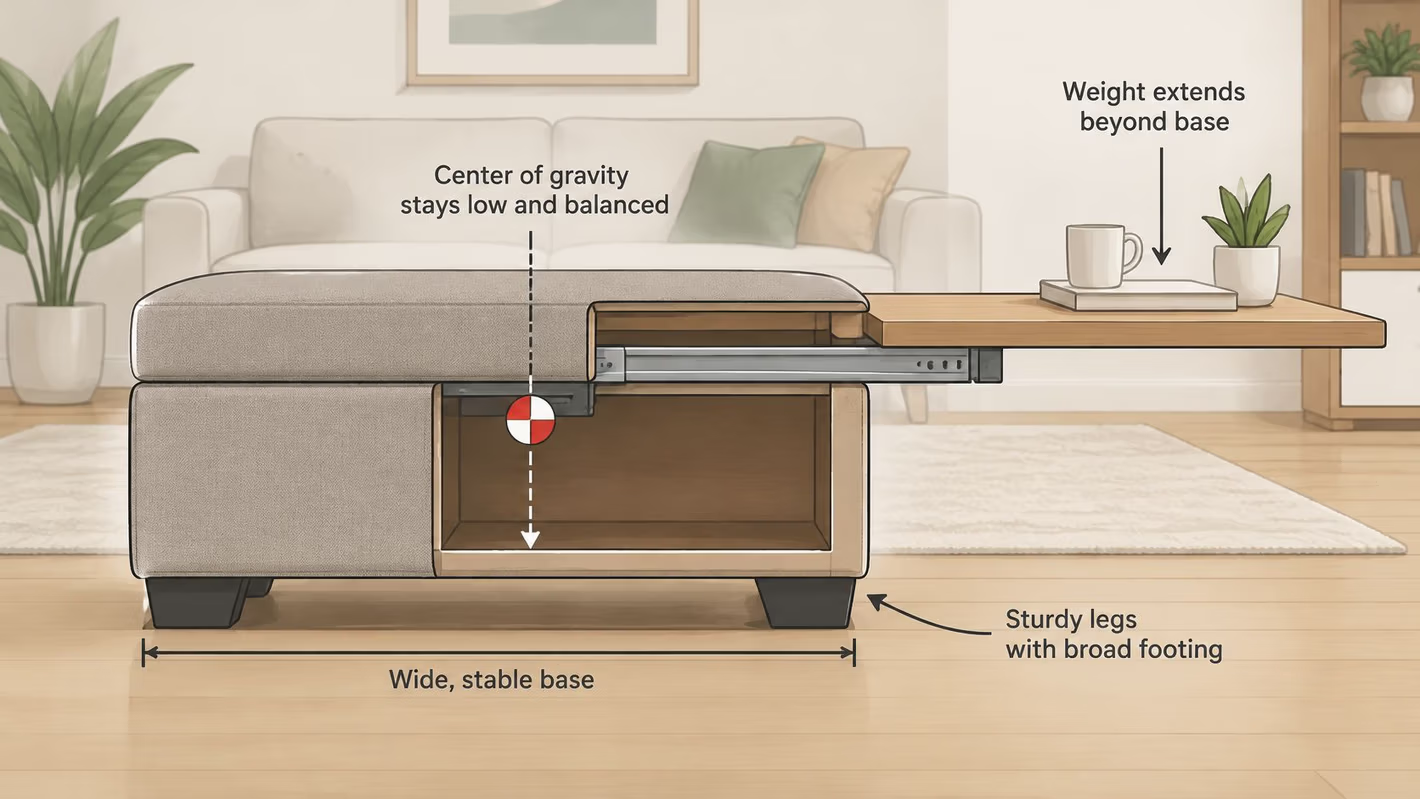
The failure we watch for is not a scratched finish. It's the moment the top is fully out and someone sets a bowl near the front edge. The center of mass has moved past the ottoman's footprint, so the overturning moment goes up. A stable design keeps the combined center of gravity inside the base of support. A broad, low, bottom-heavy platform does that better than a narrow or tall one.
Independent furniture-safety guidance from the ACCC consultation paper on toppling furniture treats center-of-gravity location and weight distribution as the main variables behind tip-over angle. Shorter, wider, deeper construction helps. So do retractable stabilizing feet or counterweights. On the floor we look for wide glides, locking casters, or those extra feet before we look at the fabric.
Slides are a repeated-use system
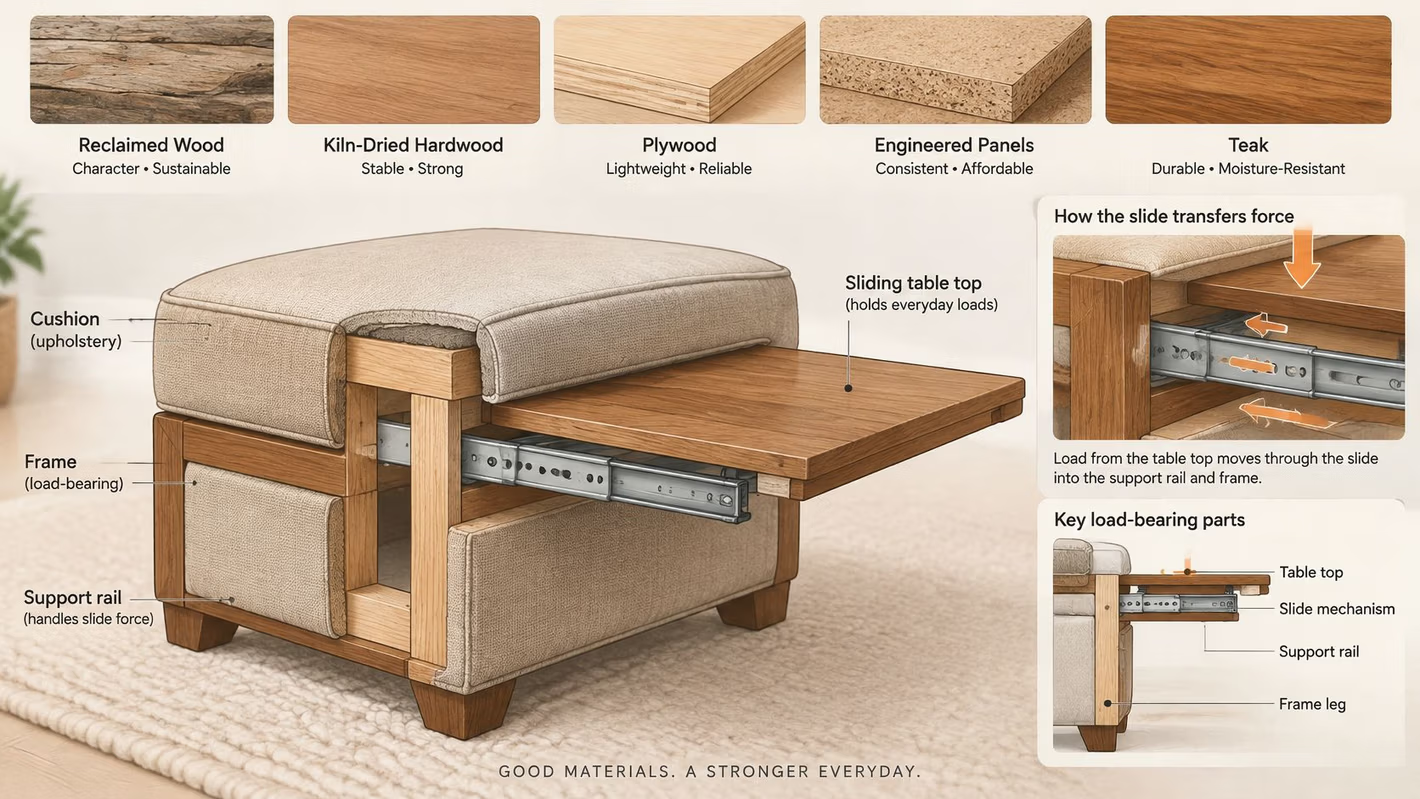
Don't judge the hardware as a one-time drawer pull. Dynamic load is what the slides carry while they move. Static load is tested with the top fully extended. One major slide maker, in its slide engineering guidance, reports static testing at twice the maximum permissible dynamic load, and endurance testing reaching 50,000 to 75,000 cycles for applicable hardware.
Ask for the slide model, the rated dynamic load, the extension length, and whether that rating is for a pair of slides under centered loading. Ratings can fall as the slides get longer. A drink set on a front corner twists the rails harder than the same weight in the center. The frame should send those forces into structural rails, which is the same reason we talk through solid wood versus veneer when a top is only a thin skin over a weak box.
We want a positive closed latch, full-extension stops, and an anti-rebound feature so the top can't creep open or overtravel. A stated tabletop load is a limit for objects. It is not permission for a person to sit, lean, or climb on the extended top.
| Check | How to test | Pass signal | Warning sign |
|---|---|---|---|
| Full-extension stability | Extend the table and press near the front edge | No rocking, frame lift, or caster movement | Frame tips or wobbles |
| Latch and stops | Extend and close the table five to ten times | Positive click at both ends, no overtravel | Slipping open or sliding past the stop |
| Slide smoothness | Load the center and both front corners, then cycle the table | Even gaps and quiet travel | Binding, scraping, or side-to-side play |
| Load limit | Read the stated maximum tabletop load before buying | Used for drinks, meals, and electronics | Assumed to support a person sitting or leaning |
| Replacement parts | Ask about slide model and hardware availability | Named model and parts on file | Proprietary hardware with no parts path |
Homes with children, or with someone who uses a walker, should favor the low, wide base that passes the front-edge press. Upholstery will not tell you that.
Materials From Reclaimed Wood to Teak
The frame and the top carry both the person and the slide hardware. Start there, then choose the look.
Kiln-dried hardwood rails are what we want under the slides. The screws land in structural members, not in a thin upholstery panel that flexes every time the top moves. Plywood and other engineered panels can be flat and stable, and they often make a good top skin, but they still need a real rail behind the slide bracket. If the only wood you can find is a staple strip under the fabric, the piece will loosen.
Reclaimed wood is a different decision. You get visible grain, knots, old nail holes, and color that shifts from board to board. Two ottomans from the same family will not match a catalog photo. Look at the actual piece, including the edge where the top meets the opening, because a proud knot can catch a slide.
Teak is dense, and its natural oils shrug off a bit of humidity, which matters if the ottoman sits near a slider that opens onto a Southern Oregon patio. Confirm whether you're buying solid teak or a teak veneer over another core. Veneer can look right and still be the wrong place to drive a slide screw.
Our reclaimed wood furniture sits with the other Unique Finds, curated one-of-a-kind statement pieces in reclaimed wood, teak, and mixed materials. As our statement-piece collection describes them, these aren't interchangeable big-box boxes. An ottoman with sliding table in that group can be a footrest and the wood accent the room is built around.
Upholstery is the last layer. A performance fabric earns its keep with pets and kids, because the closed top still gets feet, and sometimes paws. Leather wipes clean when the extended top sees condensation, though it will show scratches sooner. Neither fabric fixes a weak rail.
Choose reclaimed wood or teak when the room is on display. Choose the tighter frame spec when the room gets used hard. You can have both, but don't trade the rails away for a prettier photo.
Who Benefits Most and Where It Fits
Three rooms show the fit better than a feature list.
In a Grants Pass living room, the top comes out in the evening for a laptop and a mug, then goes away so the sofa stays a sofa. In a small apartment, one ottoman replaces a side table and a footrest, which matters when the only floor left is the path to the door. In a family room, the same top becomes a card surface after dinner, with the board and the drinks on a hard plane instead of a cushion.
Comfort-focused shoppers and older adults need a harder look. A lap-height surface can spare someone a deep bend to a low coffee table. It can also create a fall or a strain if the pull is forceful, the top has to be twisted, or the user must lean across a deep ottoman to reach the latch.
Research on home activities for older adults, summarized in a 2022 review of aging in place, points to keeping frequently used items at an easy-to-reach height. Separate seating research in that same body of work found a real trade-off. Many seats are too low for an easy rise, while a seat that's too high is uncomfortable to sit in. Seat height on this ottoman is part of the same trade.
Three questions before you call it a fit
- Seated reach. Can the user touch the latch and the front of the top without leaning off the cushion?
- One-hand pull. Can they draw the top and feel it lock, using one hand, without a jerk?
- Standing transfer. If they rise from the ottoman, is there a stable place for a hand that is not the moving top?
Walkers and lift chairs need clear floor beside the ottoman, not just in front of it. The stability and latch checks still apply. A smooth slide for a strong adult can be a stuck slide for someone with less grip.
The feature is not universally accessible. It fits some people well and others poorly. An in-person trial, with the actual user pulling the actual top, is what decides which.
Styling, Care and Keeping the Table Working
Place the ottoman at a distance from the sofa where the extended top arrives near the sitter and the side path stays open. If you have to kick it closer every evening, the closed position was never right.
- Use a tray on the open top. Drinks and coasters stay inside a rim, so a bump doesn't send a glass onto the rail opening.
- Style the closed top in odd numbers. A small lamp, a plant, and a book read as a group. Clear all three before anyone needs the table, and keep that clearing to one lift.
- Match the wood to the room. A warm reclaimed tone next to cool gray laminate will look accidental. Pull a finish sample against the sofa legs in daylight, not under a showroom spotlight alone.
Care that keeps the travel smooth
Wipe the top with a damp cloth and mild soap. Skip soaking the gap where the top enters the base. Coasters matter, because condensation is what swells a wood edge and what spots a leather one. Our notes on teak furniture care cover oil and water for those tops. The same restraint helps any wood panel. Don't flood it.
Crumbs and dust in the rails are what make a smooth slide turn gritty. Vacuum the track with a soft brush, and don't spray lubricant until you know the maker allows it. A wrong oil collects more dust.
Every few months, check fasteners and glides. Tighten screws that have backed out from vibration. Replace a worn glide before it scrapes a hardwood floor. If the top sticks, stop. Forcing it bends a stop or cocks a rail. Bring the piece back and let our Grants Pass team look at the travel. We show customers the features of new furniture and teach them how to use it, including how far the top is meant to go.
Small loose parts are a different trip. Items with easily carried pieces, such as unattached cushions, removable drawers, lamps, and accessories, need to be returned by the customer to the Gates service department for service. The ottoman body itself is not one of those carry-in parts.
Leave the top fully closed or fully extended when you're done. A half-open top loads the stops and invites a shin in the dark. If the piece will ride in a truck, a fitted cover from a mover's kit such as Furniture Protectors For Moving keeps the rails and the upholstery from picking up grit in transit. Grit in a slide is harder to fix than a scuff on a leg.
Confirm Size, Financing and Delivery Before You Buy
A sliding-table ottoman has to work with the sofa, the walking route, and the person who will pull it out. Check the full extension in the room, not just the closed footprint. Measure the clearance from the ottoman's base to the table's outer edge at full extension, then confirm that people can still pass without turning sideways or catching a shin.
At the showroom, ask to operate the mechanism yourself. Press near the front edge, cycle the latch, and slide the top while applying light pressure near a corner. The table should travel without catching or wobbling. If reaching the latch or pulling the top feels awkward, it may be difficult for an older adult or anyone with limited reach to use. Confirm the model's extension length and rated dynamic load, and make sure the floor sample matches the mechanism and finish you plan to order. Compare the finish with your sofa legs and flooring under light similar to your home.
Rather than relying on an unrelated product listing, set a budget around the ottoman's construction, mechanism, and fit in your room. Ask about the price of the specific piece and any available furniture financing options. Gates Easy Pay offers $0 down and 6 equal payments, as well as no interest if paid in full within the promotional period. Review the terms for the option offered before agreeing to a payment schedule.
Paying for it and getting it into the room
Delivery should account for the route into the room, not only the front door. Gates Home Furnishings delivers to the room you choose, unpacks and assembles the furniture, and places it where you want it. If setup in the designated room is not feasible, delivery is to an accessible area instead. Read about white-glove delivery and confirm the intended room and access details when arranging delivery.
Delivery dates are tentative and depend on manufacturer lead times. If the ottoman is not in stock when you buy it, the invoice delivery date may change depending on when it arrives. Ask about timing at purchase, especially if you are coordinating delivery with a move.
The showroom carries furniture from Ashley, La-Z-Boy, Flexsteel, and Beautyrest, so you can consider the ottoman alongside other home furnishings. Visit the Grants Pass showroom to check the table's reach, travel, and clearance in person, or browse the collection online before deciding what to test.
Gates Furniture has served Rogue Valley households since 1946. Before choosing an ottoman with a sliding table, confirm that the top extends far enough for comfortable use, that the mechanism works for the person who will operate it, and that the open table leaves a clear walking path. See the Gates Home Furnishings collection or visit the showroom to assess the piece in person.