Firm vs Soft Mattress: Which Fits Your Sleep Position

Why does a mattress that feels wonderfully supportive in the showroom leave you stiff and achy by morning? Usually it's because the shopper picked a firmness label instead of a firmness behavior. The label on the tag describes how hard the surface feels under a hand, not how your spine, hips and shoulders will be held eight hours later. Firmness is really two jobs in one: holding the body up and letting pressure off the points that carry your weight. Once you separate those two jobs, the firm vs soft mattress question stops being a personality test and becomes something you can measure in your own sleep position.
That's the gap in most advice. Conventional thinking says firm equals support and soft equals comfort, so you pick a side and hope. The clinical evidence points somewhere more useful and more specific, toward the middle of the range, and then hands the final decision back to your body and your sleeping position.
Firm vs Soft Mattress Side by Side
Start with the map, then walk the territory. The table below compares the three levels most shoppers choose between, on the criteria that decide whether you wake up comfortable.
| Criteria | Firm | Medium-firm | Soft |
|---|---|---|---|
| Firmness rating (1 = firmest, 10 = softest) | 2-3 | 5-6 | 8-9 |
| Pressure relief at shoulders and hips | Often higher peak pressure, less contouring | Balanced contouring for most sleepers | Greatest contouring, lowest peak pressure |
| Spinal alignment | Can leave the lower back unsupported | Best supported in clinical reviews | Hips and pelvis may sink too far |
| Usually suits | Stomach sleepers and heavier sleepers who need push-back | Back and combination sleepers, most first-time buyers | Lighter side sleepers who feel pressure at the shoulder |
The rating column is why medium-firm lands near the middle. On the scale used in clinical mattress research, 1.0 is the firmest surface and 10.0 is the softest, so a 5 or 6 sits almost exactly between the extremes. That middle position is not a marketing compromise. It's the range where a surface can still hold the lumbar curve while giving the shoulders and hips somewhere to settle.
The trade-off in one line: a firmer surface holds the body up but conforms less, while a softer surface contours more but lets the heaviest parts of you sink.
Two cautions before you shop with this table in hand. First, firmness labels aren't standardized across manufacturers, so a 6 from one brand can feel like a 4 from another. Second, the number describes the surface feel, not the support underneath it. A plush mattress with a well-built support core can hold alignment better than a rock-hard one with a sagging foundation.
That's why our showroom groups mattresses by comfort level rather than by number: Ultra Plush, Plush, Medium and Firm. Match whatever a manufacturer prints on its tag to one of those four rows and you have a common language again.
Use the table to narrow your search to one or two levels. Then go lie down. A shortlist of two is testable in an afternoon. A list of twelve is not.
Matching Firmness to Your Sleep Position
Your sleep position decides which parts of your body need cushioning and which need holding up. That's why the same mattress can be ideal for one sleeper and miserable for another, and why position is the first thing to settle before you compare models.
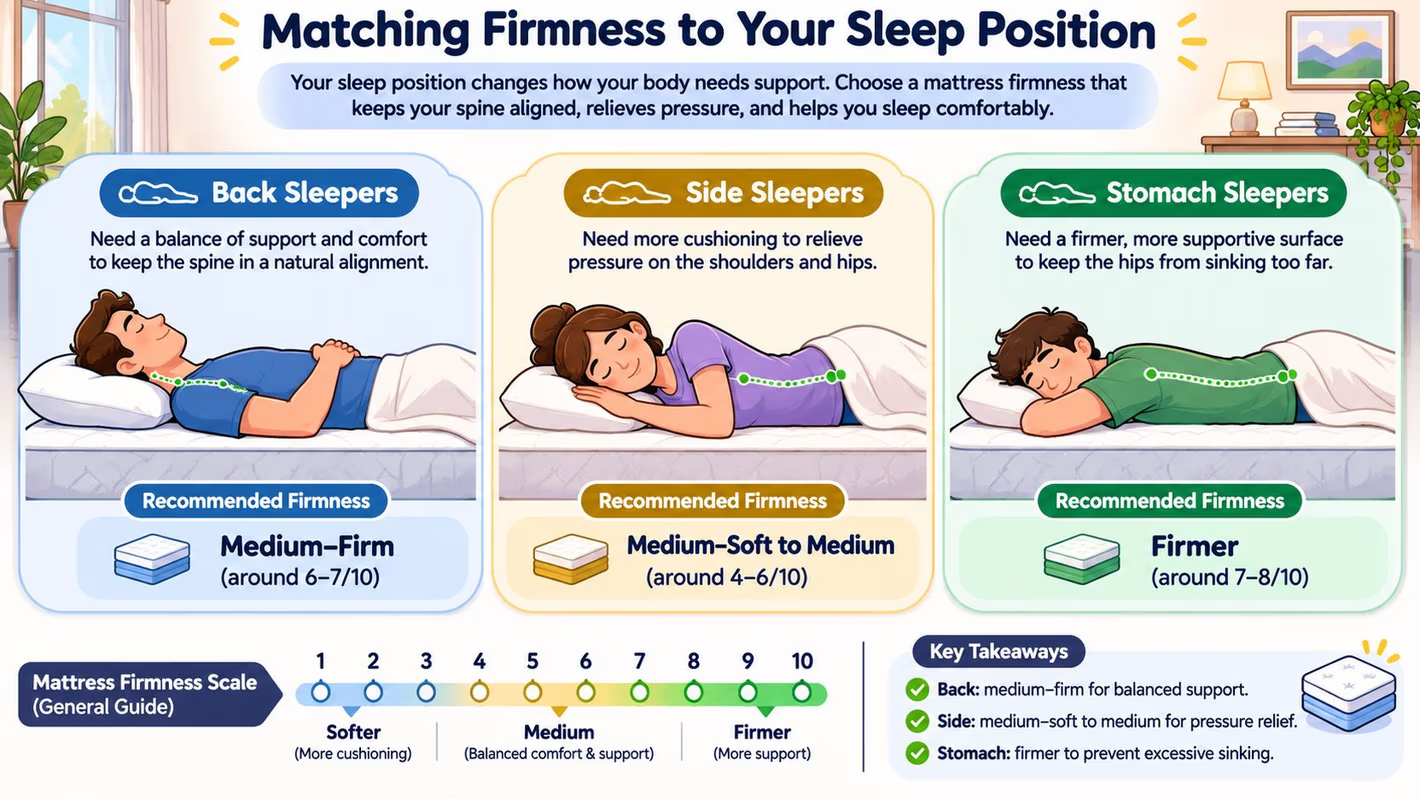
| Sleep position | Firmness that usually works | Support focus | Warning sign |
|---|---|---|---|
| Side sleeper | Soft to medium (about 6-8) | Shoulder and hip pressure relief | Hips sinking so far the spine bends |
| Back sleeper | Medium-firm (about 5-6) | Lumbar support with a natural curve | Gap under the lower back on very firm surfaces |
| Stomach sleeper | Firm to medium-firm (about 3-5) | Keeping hips and pelvis level | Chest and pelvis dipping into soft surfaces |
| Combination sleeper | Medium (about 5) | Even support while changing positions | Weak edge support when rolling toward the side |
Side sleepers carry their weight on the two widest points of the body. The surface has to let the shoulder and hip settle in far enough that the spine stays level from neck to tailbone, which is why this group usually needs more give than back or stomach sleepers.
Back sleepers need the opposite balance: enough cushioning to fill the natural curve of the lower back and enough resistance to keep the hips from dropping below the shoulders. A medium-firm surface does both for many sleepers.
Stomach sleepers run the highest risk of a sagging midsection, because the heaviest part of the body sits in the middle with nothing to brace it. A firmer surface keeps the pelvis level and stops the lower back from arching.
Combination sleepers get the most value from a medium feel with solid edge support, since changing position on a surface that's too soft turns into a climb.
Body weight shifts every range in that table. A lighter sleeper doesn't press as far into the comfort layers, so a mattress feels firmer than its label suggests and may want one level softer. A heavier sleeper compresses the same layers further and often needs more push-back. If you're still narrowing down a position, our guide to how to choose the right mattress for your sleeping style walks through the same ranges with more detail on each.
Morning self-check: numbness or tingling in the shoulder and arm usually means the surface is too firm. A sagging hip with low-back ache usually means it's too soft.
One more consideration belongs here. If your nights are broken by breathing pauses or gasping rather than by pressure points, the mattress isn't the problem, and a Pain and Sleep Therapy Center evaluation can separate a sleep disorder from a comfort issue before you spend money on the wrong fix.
What the Back Pain Research Shows
The strongest clinical evidence on mattress firmness comes from a 2003 randomized, double-blind, multicenter trial published in The Lancet, which enrolled 313 adults with chronic, nonspecific low-back pain. Every participant had been in pain for at least three months, including pain while lying in bed or on rising, which is exactly the group that cares most about this question.
Researchers assigned them to either a firm mattress rated 2.3 or a medium-firm mattress rated 5.6 on the standard firmness scale. After 90 days, the medium-firm group did better on all three measures. The odds ratio for improvement in pain while in bed was 2.36, for pain on rising 1.93, and for improvement in disability 2.10, with a confidence interval of 1.24 to 3.56 on the disability measure.
Read plainly: the harder surface did not win. The study undercuts the old assumption that a board-stiff mattress is automatically better for a bad back, and it suggests that excessive firmness fails to distribute pressure or hold comfortable spinal support for people with chronic low-back pain.
What the broader review adds
A 2021 systematic review of 39 qualified studies reached a matching conclusion, finding that medium-firm mattresses generally promote better comfort, sleep quality and spinal alignment than very firm or very soft alternatives, as summarized in this review of mattress firmness research. Both groups in the randomized trial improved, but the medium-firm sleepers reported greater gains in pain and disability.
A separate systematic review of controlled trials, reported through ScienceDirect's sleep health research, found that subjectively chosen medium-firm mattresses were associated with better sleep comfort and alignment, and reported that medium-firm surfaces improved sleep quality by 55% and reduced back pain by 48% in patients with chronic low-back pain. The same review noted that study methods and firmness definitions were not fully standardized, which is a real limitation and not a footnote.
What that means for a shopper: medium-firm is a strong starting range, not a prescription. Treat it as the first two mattresses you test, not the only two.
Two boundaries are worth stating plainly. Mattress choice is not a treatment for unexplained, radiating or persistent pain, and pain that travels down a leg deserves clinical evaluation before you shop. And no study establishes one correct firmness for every body. If you want the longer version of this ground, our guide to choosing a mattress for back pain covers the practical side.
Pressure Relief and Spinal Alignment Trade-Offs
Every mattress makes a deal between conformity and pressure, and you can feel both halves of it within a minute of lying down.
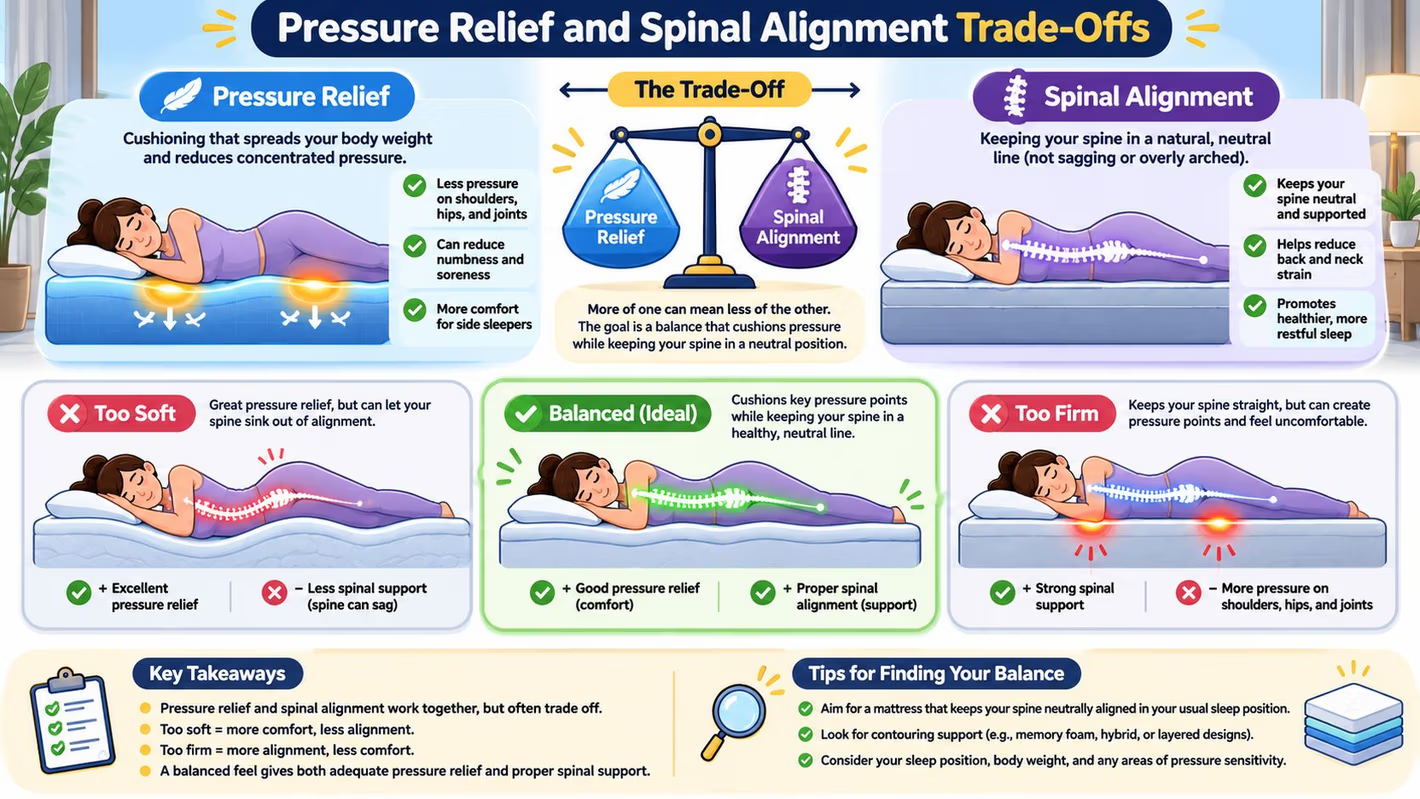
Biomechanical testing shows the mechanism directly. As firmness increases, the body touches less of the surface and peak pressure rises, with firm surfaces producing significantly higher peak pressure than both soft and medium-firm surfaces, according to this study of mattress firmness and body-interface pressure. The soft mattress created the largest contact area. The firm one left the lumbar region relatively unsupported because it conformed less to the body's natural curves.
That last point is the one shoppers miss. A hard mattress doesn't just feel hard at the shoulder. It can bridge across the lower back, holding the hips and ribcage while the lumbar spine hangs in the gap. A randomized crossover study of three mattress conditions found the hard mattress reduced lumbar lordosis and significantly increased contact pressure, meaning the lower-back curve flattened while more load concentrated against the body, as detailed in this crossover study on mattress mechanics.
Where soft goes wrong
Soft surfaces solve the pressure half of the problem and can create the alignment half. The shoulders and hips sink in comfortably, which is a real benefit for side sleepers. But a heavier sleeper, or anyone without much core support, can sink far enough that the pelvis drops below the rest of the spine and the lower back twists.
Practical rule: judge a mattress by what your spine does, not by what your hand feels. Press with a palm and you learn almost nothing.
Zoned designs and layered comfort construction exist to split the difference. A supportive core carries the weight while a targeted cushioning layer softens the shoulders and hips, so one surface does two jobs.
Construction changes the feel of an identical firmness rating, which is why our mattress shop filters by Gel, Memory Foam, Innerspring and Memory Foam Pillow Top types. An innerspring at a given rating responds differently than a memory foam bed at the same number, and the pillow top version of either will read softer under a lighter sleeper.
Three checks settle it, in this order: neutral alignment in your usual position, pressure at bony areas like the hip and shoulder, and how much effort it takes to turn over. If you want the deeper version, our page on the best mattress for pressure relief breaks down which constructions help most.
Choosing Firmness for Couples, Body Weight and Age
Two people on one mattress rarely compress it the same way. A heavier partner pushes the surface down farther than a lighter one, so a bed that feels gently supportive on one side can feel like a hammock on the other. Flip the mismatch and a stiff bed that holds the heavier sleeper leaves the lighter one perched on top.
The workable shared choice is usually a medium-firm surface with a supportive core. Lie on each side separately, in each person's own sleep position, instead of taking turns in the middle. A firmness label only becomes useful once you feel it in the position you sleep in. Our guide to the best mattress for couples with different preferences covers split-firmness options and how to settle the middle of the bed.
Heavier and lighter sleepers
Heavier sleepers do better with a firmer core than with a firmer top layer. The core keeps the hips from dropping below the shoulders across years of use. A coil unit or a dense foam core carries that load. A hard comfort layer only changes what the skin feels.
Lighter sleepers meet the opposite limit. A firm mattress that barely compresses under them leaves the shoulders and hips taking a concentrated load, and they wake sore in the spots the bed was meant to cushion. A little more give at the surface matters more for them than extra stiffness underneath.
Older sleepers with joint sensitivity
Joint sensitivity reorders the priorities. Cushioning for pressure relief matters more than it did at 30, while the core still has to hold spinal alignment. Aim for a surface that yields at the shoulder and hip without letting the pelvis drift out of line.
Body weight and sleep position change which firmness feels right. A household label is only a starting point until each person tries it in their own position.
A rule worth keeping: if pain is persistent or spreads down a leg, talk to a clinician before you change mattresses. A new bed won't fix a nerve.
For most households, one shared medium-firm bed with a topper on the side that needs more give works better than two incompatible mattresses pushed together.
How to Test Firmness in Our Grants Pass Showroom
A firmness label tells you what the manufacturer intended. Your body tells you what happens, and the two don't always agree. That's why testing in your own sleep position matters more than any spec sheet, and why the test takes longer than many expect. Here's the sequence we walk customers through, in order.
- Lie down in your usual position for at least 10 minutes. The first 30 seconds tell you almost nothing, because your body hasn't relaxed into the surface yet.
- Slide a hand under your lower back if you sleep on your back. A small, even fill is right. A large gap means the surface is too firm and your lumbar spine is bridging.
- Check the shoulder and hip line if you sleep on your side. They should sink evenly, with the spine staying straight from neck to tailbone rather than sloping down toward the mattress.
- Notice pressure at bony spots after a few minutes. Ache at the hip or shoulder that builds while you lie there is the clearest signal of a surface that's too firm for you.
- Roll toward the edge and back. This tests both ease of movement and edge support, and it's how you find out whether a soft bed will trap you at 3 a.m.
- Compare two adjacent firmness levels back to back. One bed in isolation is nearly impossible to judge. Two in sequence give your body a reference point.
- Stand up and pay attention to how getting out felt. Effort and stiffness on rising tell you something the lying-down test misses.
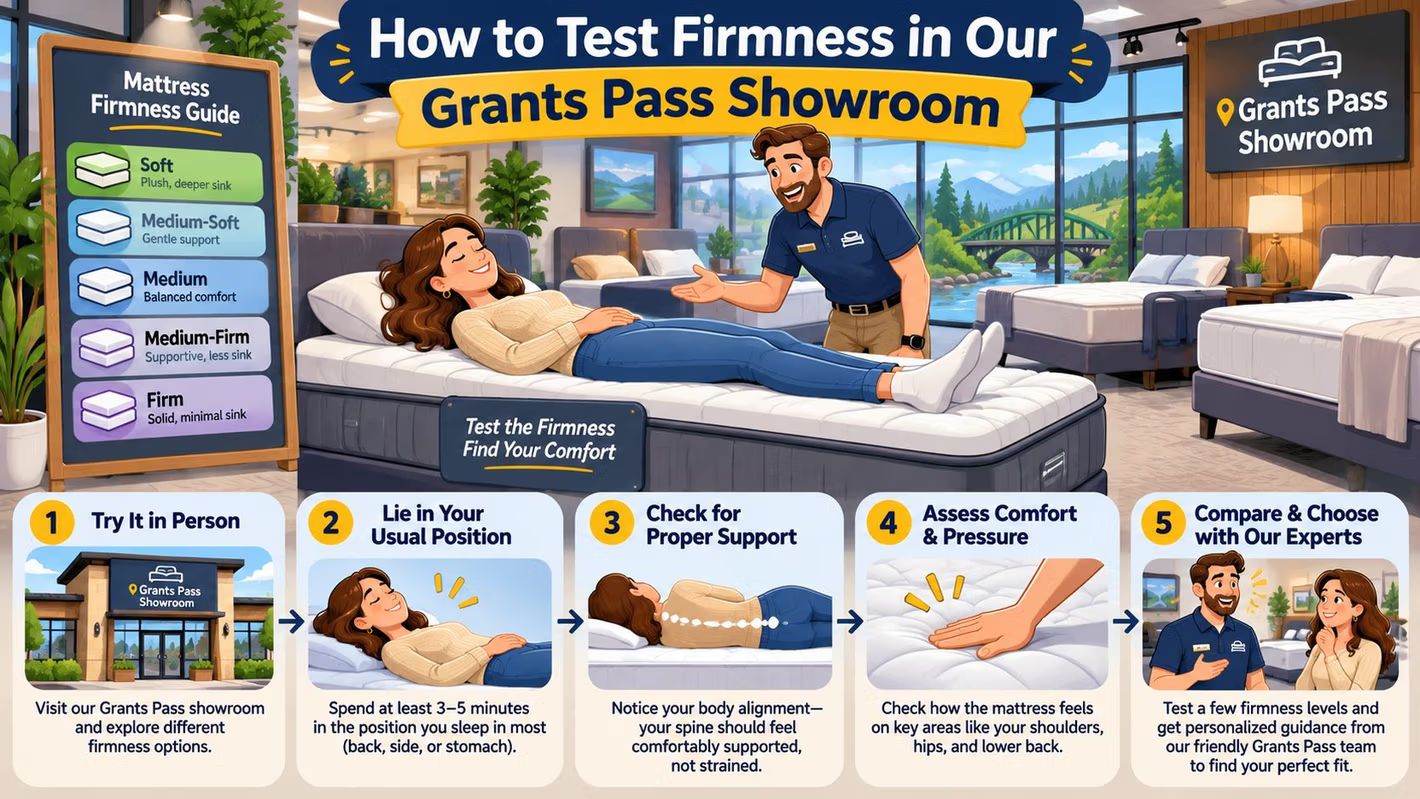
Our 30,000 sq. ft. Grants Pass showroom is set up for exactly this kind of comparison. Mattresses here are organized by comfort level across Ultra Plush, Plush, Medium and Firm, and the shop includes Gel, Memory Foam, Innerspring and Memory Foam Pillow Top constructions from brands we carry, including La-Z-Boy, Flexsteel, Ashley and Beautyrest. That range matters for step six above: comparing a Medium against a Firm in the same construction type isolates firmness as the variable, so the difference you feel is the difference that counts. Shoppers driving in from Medford, Ashland or elsewhere in the Rogue Valley can test a full shortlist in one visit rather than guessing from product photos.
Our team shows customers the features of each mattress and teaches them how to use it, so the test ends with a clear choice instead of a coin flip. If you'd rather prepare first, our how to buy a mattress guide covers sizing, foundations and what to bring to the appointment.
Confirm Your Firmness and Visit Our Showroom
A firmness label becomes useful only after you test it in your own sleep position. Support under the spine and pressure at the shoulders and hips decide the bed, not the word printed on the tag.
Come in with a short range already in mind, then lie down and confirm those two checks before you buy. If the spine stays level and the shoulders and hips feel eased rather than loaded, that surface is the one to take home. Ultra Plush, Plush, Medium and Firm are on the floor from Beautyrest, Ashley and other brands we carry, so the comparison happens in one Grants Pass visit.
Price should not push you onto the wrong surface. Gates Easy Pay offers $0 down and 6 equal payments, with no-interest options if paid in full within the promotional period, plus no-credit-needed financing.
White-glove delivery means our team assembles and sets up the new bed, then hauls away the old mattress when it is safe and sanitary to do so. The 14-day satisfaction guarantee works like this: notify the store within 14 days of delivery and you may re-select merchandise of equal or greater value or receive a full refund. Bedding is excluded, and delivery fees and bedding accessories are non-refundable.
Gates Home Furnishings has been locally owned and operated, serving Grants Pass since 1946, on George Gates Jr.'s promise of Service and Value. We are after the bed you stop noticing at night.
Testing in your own sleep position is how a label turns into a choice you can live with. Come visit Gates Home Furnishings in Grants Pass and spend ten minutes on two beds, or browse the collection online and start your shortlist from home.