What Is a Modular Sectional? Pieces, Layouts and Fit


A modular sectional is a sofa made of at least two separate, connectable upholstered seating units that can be rearranged, not just a multi-piece sofa. But if a sectional comes apart for delivery, does that mean it can change shape later?
Not necessarily. The useful distinction is what happens after the pieces enter the living room: whether they can form a different arrangement, stay securely connected, and remain repairable when a component wears out. For Southern Oregon households, those practical checks matter more than a modular label on a price tag.
What a Modular Sectional Is and How It Differs
A modular sectional works like a set of upholstered building blocks. Armless seats, corners, chaises, and ottomans connect into a larger seating system, but their defining feature is the ability to separate and recombine, as the sectional furniture glossary explains.
Think of a conventional sectional as a finished picture and a modular sectional as pieces that can form several pictures. A conventional design usually has a prescribed arrangement. A modular design offers alternative arrangements within that particular system.

Modular versus conventional sectionals
| Feature | Modular sectional | Conventional sectional |
|---|---|---|
| Layout | Reconfigurable into L, U, linear, or chaise shapes when the system permits | Usually built for one fixed arrangement |
| Delivery | Separate pieces can pass through tight doors and stairs if individually sized to fit | One assembled frame or fixed sections |
| Expansion | Extra modules can often be added later if available | Usually not expandable |
| Connectors | Brackets, hooks, or clips beneath or between units | Fixed-position connections or permanent joints |
| Best use | Changing rooms, moves, and shifting households | A settled room layout that won't change |
Multi-piece doesn't automatically mean reconfigurable. A sectional may separate into transportable sections yet still require the chaise on the same side. Buyers should request a component diagram showing the arrangements the manufacturer supports.
Renters, new movers, downsizers, and growing households have particular reasons to consider that flexibility. A seating arrangement that suits an apartment might need a different orientation in a house. However, a fixed sectional that fits a settled room well isn't automatically an inferior choice.
Separate construction from appearance
Modular describes construction, not a single decorating style. For visual inspiration, Chesterfield prints from Striped Circle offer a useful reminder that sofa imagery and decorative style are separate from the mechanics beneath the upholstery.
For shoppers still deciding between furniture categories, Gates Home Furnishings' sectional-versus-sofa comparison helps frame that broader choice. Customers from Grants Pass, Medford, and the Rogue Valley can also compare configurations and test comfort in the 30,000-square-foot Grants Pass showroom.
How the Modules Connect and Come Apart
Modules typically stay together through mechanical connectors beneath or between their frames. The connector comparison below outlines common approaches; the sectional connection guide distinguishes quick-release hook and clip systems from hardware that requires more effort to separate.
Common connector types and what they suit
| Connector | How it joins | Best for | Ease of changing layout |
|---|---|---|---|
| Hook-and-latch | Hooks lock adjacent frames, released by hand as directed | Households that rearrange often | Easy |
| Metal bracket | Brackets fasten modules at the side | Stable layouts kept for extended periods | Moderate |
| Alligator-style clip | A gripping clip joins adjacent frames | Lighter seating units with compatible hardware | Easy |
| Bolt-together hardware | Bolts fix frames in a rigid joint | Sofas separated mainly for transport | Slow, needs tools |
The hardware's appearance doesn't establish its strength. Buyers should watch a demonstration using the actual model, including how the release works and whether an adult can reach it without an awkward lift.
A careful reconfiguration routine
- Remove or lift cushions as directed. This exposes the necessary access points and reduces loose items during handling. Don't pull at attached cushions or upholstery panels.
- Release the connectors underneath. Support the frame and follow the manufacturer's release direction. Forcing movement before a connector releases can bend a bracket or damage its mounting point.
- Move the modules into position. Lift using approved frame locations rather than dragging by an arm or cushion. Watch for hardware that could catch the floor or an adjacent piece.
- Reconnect and check alignment. Bring compatible joints together without forcing them. If the seat tops don't align, check the feet, floor surface, and connection before pushing harder.
- Replace cushions and test each junction. Sit normally across adjoining seats and check for separation. Uneven cushions can indicate a misplaced cushion or a module sitting out of line.
Practical rule: A connection should release through its intended mechanism, not through extra force.
Hook and clip systems generally suit frequent changes, while bolted joints can feel more rigid but take longer to rearrange. Neither approach is universally better; the right choice matches how often the household expects to move the pieces.
Before purchase, confirm that the sectional separates for reconfiguration, rather than only for transportation. Gates Home Furnishings shows customers the features of their new furniture and teaches them how to use those features.
Layouts and Pieces You Can Combine
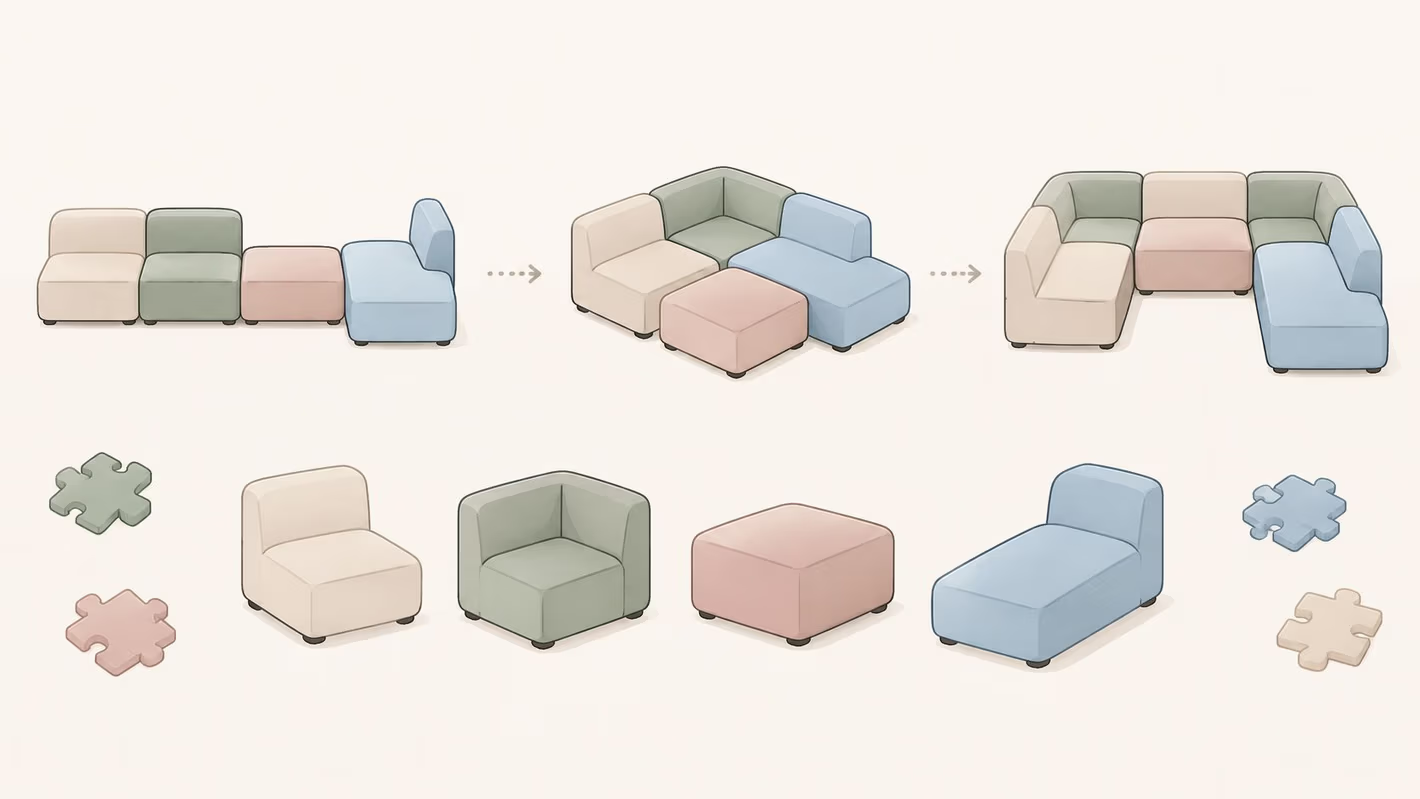
The first arrangement needn't be permanent. A modular set resembles a puzzle whose compatible pieces can form different pictures, although the manufacturer still determines which edges connect.
The modular-sofa construction guide describes independent upholstered units that can form straight, L-shaped, or U-shaped seating when connector placement and upholstery orientation permit.
Know the building blocks
- Armless seats extend the middle of a seating run without adding an arm between occupants.
- Corner units turn the seating around a room corner or into a return.
- Loveseat units provide paired seating within systems that include a wider shared module.
- Chaise sections support outstretched legs, typically with an extended cushion and an open side.
- Ottomans and end pieces add foot support or finish a run, subject to the model's design.
Match the shape to daily use
An L-shape suits an open living-room corner while leaving another side available for circulation. Count comfortable sitting positions rather than treating the corner as an automatic guest seat.
A U-shape groups people around a coffee table or television and can suit entertaining. Its additional return needs usable room around it, not merely empty floor inside the U.
A linear arrangement works along a wall or in a narrow room where a projecting return would interrupt movement. Check the space behind it if a console will sit there.
A chaise-ended arrangement favors lounging and leg support. Don't count the chaise as several independent conversation seats because its cushion is long.
As a planning exercise, size each option for regular household occupants, then consider an extra guest seat or a pair of occasional chairs. That prevents buying a large sectional solely for infrequent gatherings.
A module that connects in a new position still needs to look finished from every exposed direction.
Verify whether the chaise can switch sides and whether backs and sides are fully upholstered. Sketch alternative arrangements before shopping, using Gates Home Furnishings' sectional layout ideas for room-planning prompts.
The Grants Pass showroom allows side-by-side comparison of sectional configurations and their proportions.
Measuring Your Room and Doorways Before You Buy
Delivery fit and room fit are separate checks. A module can clear the entryway yet leave the assembled sectional blocking a door, while a perfect floor plan means little if the largest component can't reach the room.
Planning benchmarks for seat and room dimensions
These are planning values, not universal product specifications. The seat and circulation benchmarks below come from the LuxDeco sofa ergonomics guide, while the doorway and removable-leg benchmarks come from the Furniture Fair sectional measuring guide.
| Dimension | Planning benchmark | What it means for your choice |
|---|---|---|
| Seat height | 40-45 cm (15-17 in) | General ergonomic guidance; individual comfort still needs testing |
| Seat depth | 60-70 cm (23-28 in) | Deeper suits lounging; shorter users may need back support |
| Walking space around open edges | About 30-36 in | Helps preserve circulation and door swings |
| Doorway width with screw-in legs removed | About 32-34 in | Common for many standard sectionals; confirm with the maker |
| Profile reduction from removing legs | About 2-5 in | Can lower the sofa for tighter routes |
The manufacturer's actual module dimensions and approved disassembly instructions take priority. Standard-depth seating tends to suit upright conversation; deeper cushions favor lounging but may prevent a shorter occupant from using the backrest with feet supported.
Measure the route and the footprint
The sofa delivery measuring guide emphasizes measuring each component, the usable doorway opening, and the space needed to pivot.
- Measure the narrowest doorway fully open. Account for hinges, trim, handles, thresholds, and nearby walls. The nominal door size isn't the usable opening.
- Check hallway turns and stair landings. Record the space available to rotate a module, plus elevator dimensions where applicable. A straight opening doesn't establish turning clearance.
- Tape each module's footprint on the floor. Test door swings, coffee-table reach, and sightlines. Measuring only the assembled outside dimensions can hide awkward projections.
- Preserve a walking corridor around open edges. Favor the more generous end of the planning range, then walk the taped route while carrying a laundry basket.
- Check the largest piece's diagonal depth. Compare its turning requirements with the tightest access point rather than assuming all modules are equally manageable.
- Confirm removable legs or detachable backs. Only use manufacturer-approved removal methods, and include projecting connectors or packaging in delivery discussions.
Gates Home Furnishings' furniture measuring guide provides another practical planning reference.
White-Glove Delivery isn't a box drop. Gates Home Furnishings handles the heavy lifting, professional assembly, and room setup, along with mattress haul-away. If setup in the designated room isn't feasible, delivery is made to an accessible area instead.
If the furniture or installation doesn't meet expectations, customers should contact customer service before the delivery installers leave the home.
Checking Quality Beyond the Modular Label
Modular doesn't automatically mean sustainable, durable, or well made. A replaceable component only helps if a compatible replacement remains available and the surrounding frame is worth keeping.
The U.S. Consumer Product Safety Commission's upholstered-furniture standard applies to upholstered furniture manufactured, imported, or reupholstered since June 25, 2021, and requires a permanent compliance label. Its smolder-resistance requirements address cover fabrics, barrier materials, filling materials, and decking.
Test construction, then check support
- Connector strength and alignment: Sit at each junction, apply gentle sideways pressure, and check that adjacent units don't twist, lift, or separate. The sofa construction and dimensions guide identifies connector strength, frame rigidity, and alignment as useful inspection points.
- Finished exposed surfaces: Inspect the sides and backs that would become visible in an alternative arrangement.
- Safety documentation: Request the permanent compliance label and material specifications. Fire-performance compliance doesn't establish repairability.
- Component warranty coverage: Obtain written terms for frames, cushions, upholstery, and connectors rather than assuming every component receives identical coverage.
- Replacement compatibility: Ask how long compatible dimensions and hardware will be supported, and whether matching covers, cushions, and fabric remain available.
Gates Home Furnishings' sofa and chair quality checklist offers additional buying considerations. Keep the compliance information, material specifications, and warranty terms with the receipt.
Treat repair as part of the purchase price
A cheaper sectional with unavailable proprietary parts can cost more to maintain and create more waste if a failed module makes the remaining furniture unusable. Replacement cost belongs in the budget, alongside the initial price.
Gates Home Furnishings repairs or replaces a defective furniture component rather than replacing the entire product. That policy supports a component-focused approach, but it isn't a guarantee that every fabric or module will remain available indefinitely.
Check whether covers are removable and washable, since those aren't interchangeable claims. For leather upholstery, understanding different leather types from Eco Clean Solutions provides useful cleaning context; the furniture's own care instructions should determine treatment.
Ask whether fabric is sold separately, whether a worn module can receive a matching cover, and what availability the seller expects over the coming years. Finish with a concrete question: Could a replacement module be ordered in the same fabric next year?
Choose the Right Modular Sectional for Your Home
The strongest choice isn't necessarily the largest configuration or the softest cushion. It's the seating system that fits the household's room, comfort needs, access route, and expectations for future service.
A practical buying sequence
- Select a current layout and a plausible future arrangement. Consider a move, downsizing, or a change in how the room is used.
- Compare the recorded measurements with the module diagram. Keep both access clearance and usable walking space in the decision.
- Get the important commitments in writing. Confirm connector operation, replacement availability, and warranty coverage before committing.
- Set the complete budget. Include delivery, likely care needs, and financing terms rather than comparing sticker prices alone.
For a broader purchasing framework, consult Gates Home Furnishings' living-room sofa buying guide.
Local help with the complete room
Gates Home Furnishings offers Gates Easy Pay, including $0 down, 6-month interest-free terms, and no-credit-needed options for qualified buyers. Available programs have their own terms, so buyers should confirm the applicable payment schedule and promotional conditions.
The store carries brands including Ashley Furniture, La-Z-Boy, Flexsteel, and Beautyrest. Its Unique Finds, including reclaimed wood, teak, and one-of-a-kind statement pieces, offer ways to connect a sectional with the rest of the room without relying on a matching set.
Customers can speak with a qualified staff interior decorator about tastes, lifestyle, and budget. They can also choose delivery or free pickup at the local warehouse during checkout.
Established in 1946, the family-owned business continues George Gates' original promise of “Service and Value.” For households in Grants Pass, Medford, Central Point, Ashland, and the broader Rogue Valley and Southern Oregon region, that means making comfort, fit, and service part of the same conversation.
Visit the Grants Pass showroom at Gates Home Furnishings to test sectional comfort, compare configurations, and discuss room measurements with a knowledgeable local team. Bring a floor-plan sketch and doorway measurements, or browse the collection online to begin narrowing the options before visiting.