Dining Room Sets for 6 That Actually Fit Your Room

Does a table that seats six leave room for six people to sit, get up and move through the dining room? That's the question to answer before choosing a finish or matching chairs. A seating label describes capacity, not how the furniture will work beside a kitchen doorway, a sideboard or the main route through the house.
Shopping for dining room sets for 6 starts with the room's usable space and the household's daily habits. A fixed table can make sense for regular gatherings. For a smaller household, an extendable table may provide a better everyday fit without giving up space for guests.
Table Sizes That Seat Six Comfortably
Allow about 24 inches of table edge per diner as a practical starting point. The Everything Depot dining table size guide recommends that allowance, which puts a rectangular table with three diners along each long side at roughly 70 to 72 inches long, with a tabletop about 34 to 40 inches wide.
The Argos dining table buying guide gives broader planning ranges of 63 to 79 inches long for rectangular tables and 59 to 63 inches across for round tables intended for six. Those ranges help create a shortlist, but chair width, armrests and the table base determine whether the seating works.
Table size for six diners by shape
The following targets turn those sizing guidelines into practical layouts.
| Table type | Target size | Seating layout | Planning note |
|---|---|---|---|
| Rectangular, three per long side | 70-72 in (178-183 cm) long | 3 per side | Allow about 24 in of table edge per diner |
| Rectangular, two per side plus one per end | 60-72 in (152-183 cm) long | 2 per side, 1 at each end | Keep both ends clear for access |
| Round | 59-63 in (150-160 cm) across | 6 evenly spaced | Check that chair arms fit under the rim |
| Tabletop width | 34-40 in (86-102 cm) wide | Place settings on both sides | Leaves a central serving zone |
The seating arrangement matters as much as the overall length. Three chairs along a long side need an uninterrupted run of usable space. Moving a diner to each end changes that arrangement, but it also requires accessible head positions without legs or base supports in the way.
Table width deserves equal attention. A narrow top may accommodate plates while leaving serving dishes competing with glasses and elbows. A wider surface can make shared meals easier, but only if the room can accommodate it.
Check usable space, not just outside dimensions
Measure between the legs rather than assuming the entire tabletop edge is available. A broad corner leg can force a chair inward, while a deep apron can make a spacious-looking table feel restrictive once someone sits down.
Chair shape creates another trade-off. Upholstered arms may offer welcome support, yet their outside width can prevent adjacent chairs from fitting comfortably. A bench isn't automatically a solution, either, because diners still need elbow room and a practical way to get out.
For a farmhouse-style room, the dining table tips from Farmhouse World offer useful visual context when considering proportions and finishes. Keep that inspiration separate from the fit test: a table's appearance can suit the room even when its seating arrangement doesn't.
Practical rule: Treat the size chart as a shortlist, not permission to order. The right table must accommodate the actual chairs and the people using them.
Rectangular, Round and Extendable Table Shapes Compared
Shape determines how people sit and how the room functions, not just how the furniture looks. Rectangular tables generally suit long rooms, round tables support conversation in square spaces, and extendable tables let households reserve extra seating for the occasions that need it.
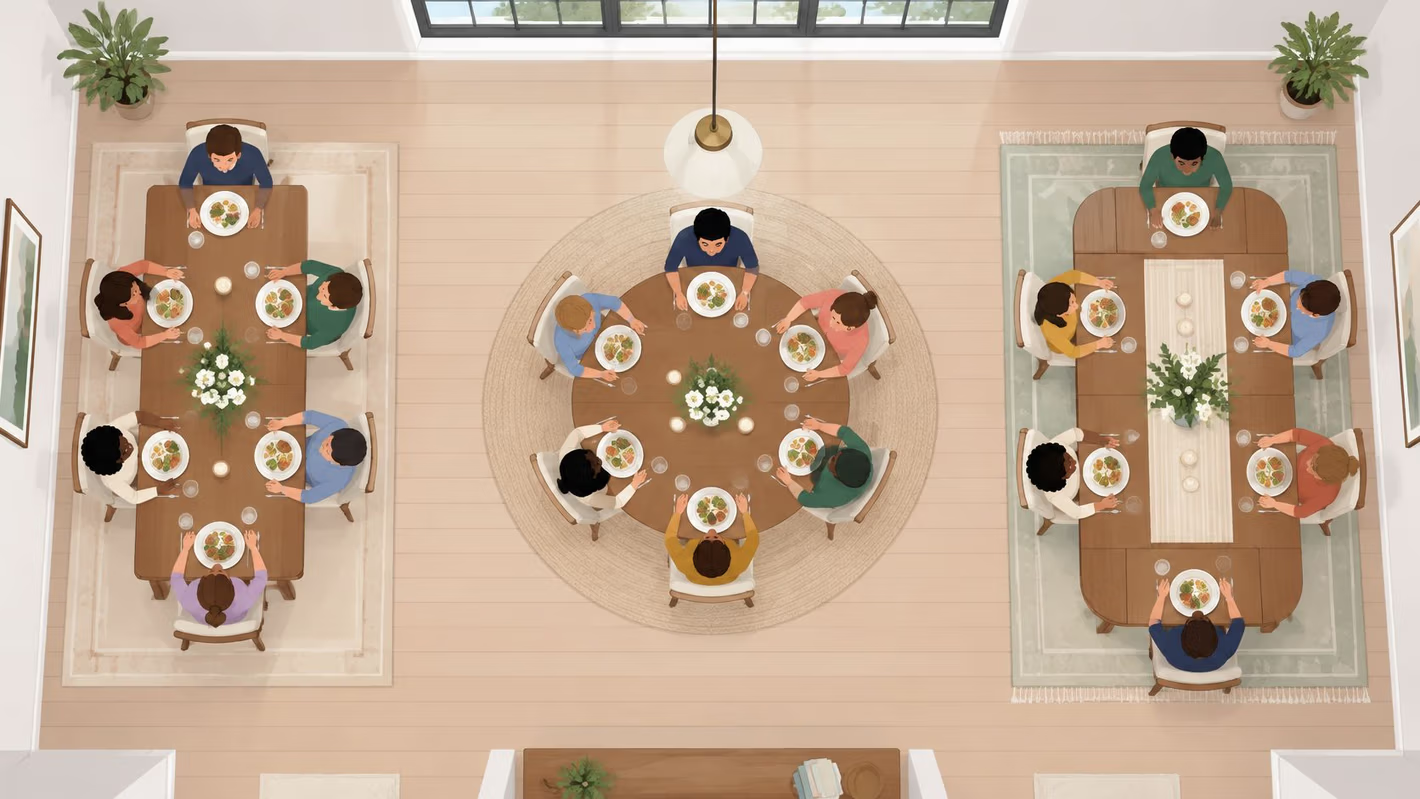
The Tyner Furniture guide to dining room sets for six emphasizes that nominal seating capacity doesn't establish whether the table, chairs and circulation fit a particular room. That distinction matters in Southern Oregon dining areas that also serve as passageways or entertaining spaces.
Table shapes compared for six-seat use
| Format | Seats six with | Best room | Trade-off |
|---|---|---|---|
| Rectangular | Three per long side, or two per side plus one per end | Long dining rooms and formal dinners | Needs a clear run along both sides |
| Round | Six evenly spaced around the rim | Square rooms and conversation | Footprint reads larger than its seat count |
| Extendable four-seat base | Four daily, six with a leaf | Apartments and open-plan spaces | Leaf storage space; confirm the maker's rated seating |
| Trestle or pedestal base | Six, if each seat clears the base | Farmhouse and rustic rooms | Base may block knees near the center |
A rectangle provides a clear orientation and often works naturally beneath a centered light fixture. It becomes less convenient when someone must squeeze past an occupied end chair to reach the kitchen.
A round table removes corners and keeps diners facing one another. It doesn't eliminate the need for circulation, though, and its broad footprint can be awkward in a narrow dining nook.
Choose for ordinary meals first
An extendable table is often the more useful choice when a household eats with fewer people most days. The leaf adds capacity for company without requiring the expanded footprint throughout the year. The expandable dining table guide can help narrow the choice between extension formats.
Test the mechanism before buying. Check whether the leaf needs separate storage, whether the extended top locks securely and whether the additional seats land beside a support.
A pedestal or trestle can remove corner-leg interference, but neither guarantees unrestricted legroom. Sit at the center and end positions rather than judging the base from standing height.
For households whose gatherings regularly exceed a small dinner party, MODERN LYFE's discussion of seating ten guests at one table offers a broader hosting perspective. Buy for the gathering pattern that happens, rather than keeping an oversized arrangement ready for an unlikely occasion.
Measuring Your Room for a Six-Seat Set
Can a six-seat table stay in this room on an ordinary weeknight, or only when extra seats are needed? Start with a tape measure, painter's tape and a sketch of the actual room. Include fixed obstacles and furniture that will remain, rather than measuring an empty rectangle and assuming everything else can move.
Homes across Grants Pass, Medford, Central Point and Ashland include compact older dining nooks and open-plan spaces connected directly to the kitchen. The same set can fit comfortably in one home and crowd another, so a typical floor plan isn't a substitute for measurements.
Mark the furniture and its working space
A fixed six-seat table that fills the room every day often leaves no honest path behind occupied chairs. An extendable four-seat table that opens to six only for company keeps the closed footprint inside the space you use most of the week. Measure both sizes before you decide.
Record the full table footprint. Write down the outside length and width, including any overhang. For an extendable model, record both the closed and open dimensions so the guest arrangement gets tested too.
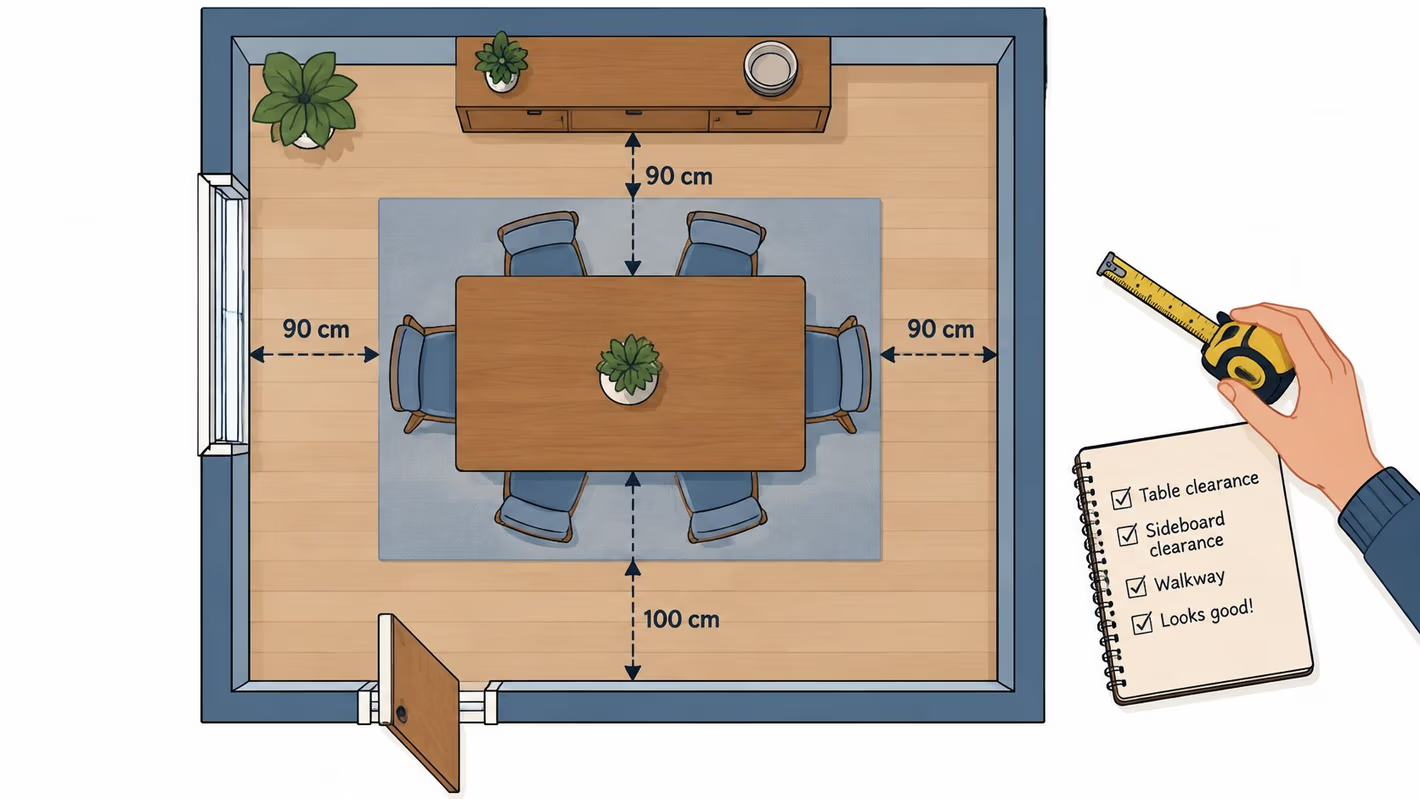
Mark the chair and circulation zones. Leave space beyond the tabletop for pulling chairs out, sitting down and passing behind diners. Use the minimum and walking-clearance measurements in the chair and table height checks in the next section to distinguish a seating area from a through-route.
Tape the layout onto the floor. Mark the tabletop outline and the outside working boundary separately. Position existing chairs as stand-ins, then have the intended diners sit and get up without moving neighboring chairs.
Test the room's normal activity. Open nearby doors, cabinets and appliances. Walk from the kitchen with a tray, check the route to the living area and confirm that a sideboard drawer can open without hitting a seated guest.
Don't tape only the table and call the job finished. That checks whether the furniture fits the room. It doesn't confirm that anyone can use it comfortably.
Keep the main route open
In an open-plan room, the dining area may share its circulation space with the living room. Pulling a table toward the sofa to gain kitchen clearance can transfer the obstruction to another route.
A compact nook often benefits from a table that expands into temporary entertaining space. A larger, dedicated dining room may accommodate a centered rectangle without borrowing space from another activity.
An attractive layout still fails if someone has to stand up whenever another person leaves the table.
The furniture measuring guide can also help organize the access measurements needed before delivery. Include door openings, tight turns and any stairway on the route to the dining room.
For layout help, customers can ask Gates Home Furnishings to speak with a qualified staff interior decorator. The decorator will discuss tastes, lifestyle and budget to help plan a living room, dining room or bedroom.
Write the room dimensions and tested furniture footprint on the same sketch. Bring both, along with photographs showing doorways and nearby furniture, to the showroom.
Chair Height, Comfort and Accessibility Checks
Table and chair heights must work together. The by Crea dining chair height guide provides these typical dimensions, including the seat-to-tabletop relationship and unobstructed space needed beneath the apron.
Chair and table height checks
| Measure | Typical range | Why it matters |
|---|---|---|
| Table height | 28-30 in (71-76 cm) | Sets the baseline for every chair |
| Seat height | 17-19 in (43-48 cm) | Must work with the table height |
| Seat-to-tabletop gap | 10-12 in (25-30 cm) | Room for knees and lap |
| Unobstructed space under apron | At least 8 in | Thigh clearance for each seat |
| Table edge to wall or furniture | About 36 in (91 cm) minimum | Working clearance for chair use |
| Table edge along a walking route | 42-48 in (107-122 cm) | More functional behind occupied chairs |
These are checks, not a guarantee that every combination will feel right. A thick apron, unusually high seat or cushion that compresses heavily can change the usable space.
Follow a seated test
- Sit fully back. The backrest should provide support without the front edge pressing into the backs of the knees. Feet should rest securely rather than hang above the floor.
- Check beneath the apron. Move the legs naturally and change position. Knees and thighs shouldn't depend on staying in a carefully chosen pose.
- Slide the chair inward. Confirm that armrests clear the underside without scraping. Test this while seated, not just with an empty chair.
- Move any bench independently. The intended user should be able to reposition it without needing another diner to lift or drag it.
For seniors and guests with mobility limitations, firm support can matter more than plushness. A sinking cushion may feel soft at first but make standing harder. Arms can assist with rising, provided the chair is stable and the armrests are comfortable to use.
Seat height needs a personal test as well. A chair that's easy for a taller diner to leave may be too high for someone whose feet can't reach the floor.
The dining room chair selection guide offers another way to organize those choices. Before ordering, measure the fully pulled-out chair, not just the tabletop footprint.
Materials, Styles and Unique Finds That Last
Choose construction that can tolerate daily meals, cleaning and chair movement. A finish that looks impressive under showroom lighting won't compensate for loose joints or upholstery that can't be renewed.
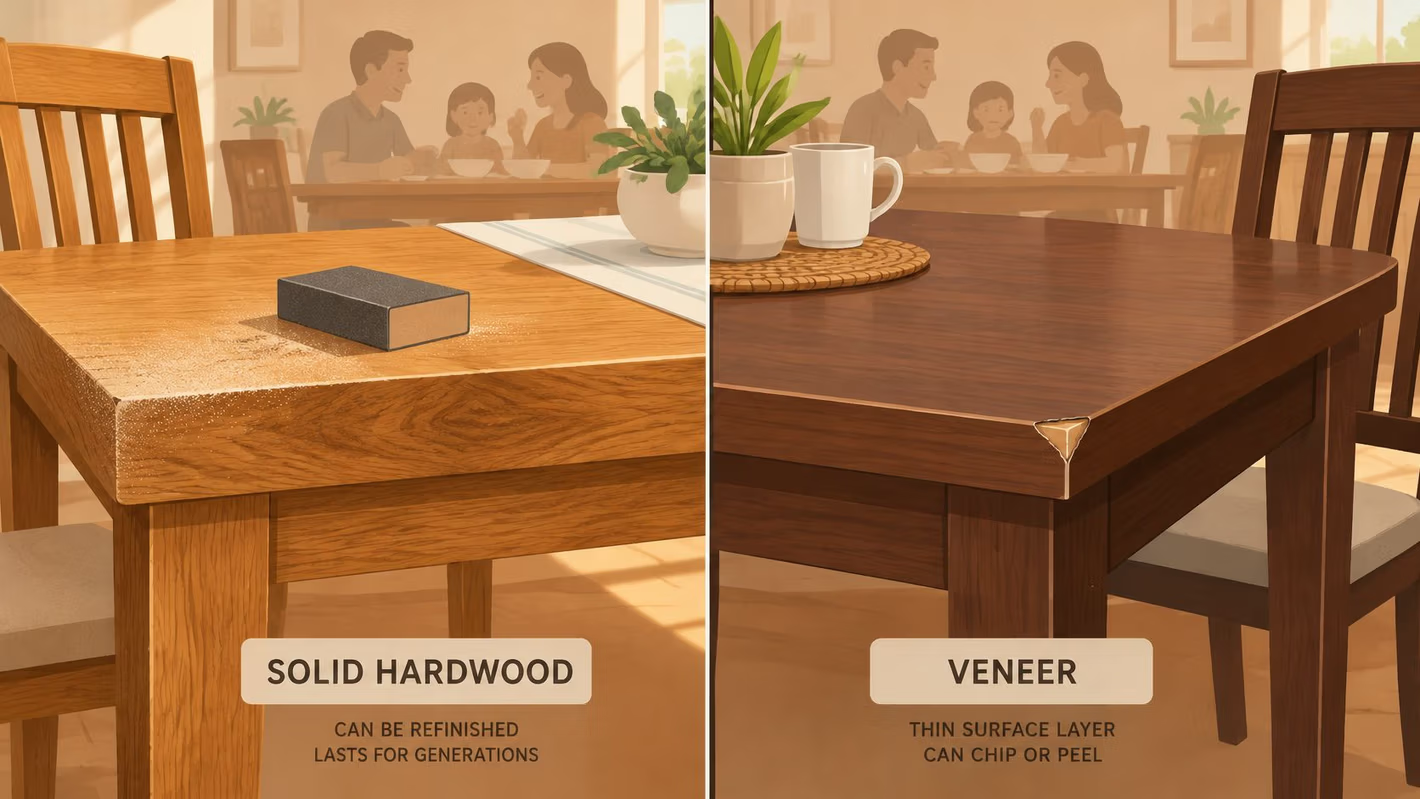
Solid hardwood and veneer both deserve a fair inspection. Solid wood can often be refinished, depending on its condition and finish. Veneer over a sound core can perform well, but chipped edges and damage through the thin surface layer are harder to repair.
Inspect repairability before decoration
Look beneath the top and turn a chair carefully to inspect its frame. Mortise-and-tenon joints, well-fitted corner blocks and secure fasteners provide more useful information than a heavy feel alone.
A furniture life-cycle assessment published in Scientific Reports found that heavier material use generally increased environmental impact. Weight alone isn't a reliable reason to call a set sustainable; repairability and the ability to keep using it deserve attention too.
- Check joints. Apply gentle pressure to the chair back and table corners. Movement at a joint warrants closer inspection.
- Inspect upholstery access. Removable seat pads can make recovering a chair more practical than replacing the entire frame.
- Operate moving parts. Leaves should align and lock flat; any drawers should travel smoothly.
- Confirm finish care. Check the maker's guidance for heat, spills and cleaning products. Use trivets and coasters rather than treating a finish as damage-proof.
The guide to wood furniture and hardwood longevity helps distinguish material choices from surface appearance.
Let the room guide the style
Farmhouse trestles suit rooms with textured wood and substantial architectural details. Craftsman pieces complement straightforward joinery, transitional designs bridge mixed furnishings, and modern lines can keep a compact room visually lighter.
For a more individual room, reclaimed wood and teak statement pieces offer alternatives to a fully matched look. Check reclaimed-wood provenance and surface texture, particularly where plates and glasses will sit. Character shouldn't make routine cleaning difficult.
Bridle Up Hope Shop's guide to horse-inspired home styling offers inspiration for pairing rustic furniture with restrained accents. Keep the table functional and let smaller decorative choices establish the theme.
Budget, Financing and Delivery Costs to Plan
A fixed six-seat table can cost more than the tag once six chairs, delivery, and walking room are all counted. An extendable four-seat table that opens to six only for company often spends less on chairs you use every day, and it can spare you storage you do not have.
Price the arrangement you live with on a Tuesday. Then price the one you need when guests come. If a leaf and two extra chairs sit in a closet most weeks, that storage has a cost even when the sticker looks lower.
Build an itemized total
Start with the table, then write down every chair. Some packages include a full six. Others sell chairs singly or in pairs, so a set price can still leave two seats unpaid.
Add the leaf if it is not already in the package, and decide where occasional chairs will live between meals. Get the delivery and assembly charge before you compare two totals. Optional protection is separate. Gates Care Shield covers accidental spills and tears, but read the exclusions and the claim process before you treat the plan as coverage for every accident.
Financing belongs on the same sheet. Gates Easy Pay includes $0 down and 6 equal payments, with no-interest options if paid in full within the promotional period. No-credit-needed and lease-to-own options are available, along with online-only approval. The furniture financing options guide is a starting point for comparing those payment paths. Confirm the promotional payoff requirement and the full lease-to-own obligation for the program you select. Compare each financing arrangement on its own terms.
The Gates Outlet rotates clearance pieces and special values, with new items added daily. A lower outlet price still needs chairs, a footprint that fits, and the return terms for that piece written into the total. Brands on the floor include Ashley, Flexsteel, La-Z-Boy and Beautyrest. Reclaimed wood and teak Unique Finds are usually single statement pieces, so budget chairs and delivery apart from the table.
Understand delivery and return terms
Gates Home Furnishings delivers to the room you choose, professionally unpacks and assembles the furniture, and places it where you want it. If setup in that room is not feasible, delivery goes to an accessible area instead. Share stairs, tight turns, and narrow openings before the truck is scheduled so the planned spot is realistic.
The store offers a 14-day satisfaction guarantee. Notify Gates within 14 days of delivery and you may re-select merchandise of equal or greater value or receive a full refund, excluding bedding.
Budget check: A manageable payment does not replace a clear total. Keep the purchase amount, delivery charge, optional protection, and financing terms together.
Before you commit, write down total cost, delivery, protection, return terms, and financing terms. Compare that list, not the advertised monthly figure alone.
Pick Your Six-Seat Set in Grants Pass or Online
Which table will you eat at on a Tuesday? Confirm the room measurements, choose the shape that suits daily use, and test the chairs before ordering. The best choice is the arrangement that stays comfortable during an ordinary meal and works when company arrives, not just the largest table that fits.
A fixed six-seat table can crowd a walkway you use every day. An extendable four-seat table that reaches six only when the extra chairs come out often leaves more room for the usual dinner. Bring a shortlist rather than relying on memory. Note the tested footprint, the doorway measurements, and whether gatherings happen weekly or only a few times a year. Those details separate an attractive table from one the household can live with.
Make the showroom visit a fit test
The 30,000-square-foot showroom in Grants Pass gives shoppers a place to check seat height, arm clearance, and support before buying. Sit at the table in a normal dining position, then stand, reposition the chair, and try another seat.
Bring the intended users when you can. Comfort changes with height, mobility, and how much clear space someone needs to stand. Record the finalist's table and chair dimensions together so mixed pieces are not ordered by the wrong numbers. Your measuring notes already cover the room sketch, nearby furniture, openings, and the route through the space. Bring that sheet with you.
Gates Home Furnishings serves Grants Pass, Medford, and the wider Rogue Valley. Call or text (541) 476-4627 with measurement questions or to prepare for a visit.
Choose with service in mind
George Gates opened the business in 1946 with a promise of “Service and Value.” Useful guidance should help a household avoid the wrong fit, not just pick a finish.
Talk through a tight layout and chair comfort in the showroom before you commit. I recommend the set that supports ordinary meals first, then still seats six when the leaf or extra chairs come out, without making the rest of the room harder to use.
Gates Home Furnishings offers dining furniture, distinctive reclaimed wood and teak pieces, and practical help with room planning and comfort. Visit the Grants Pass showroom at Gates Home Furnishings to test a six-seat arrangement against your measurements, or browse the collection online to build a shortlist you can check in person.