Round Dining Room Table with 4 Chairs: A Sizing Guide

The wall measures ten feet, the tape says a 42-inch round table will leave room to spare, and the set looks right in the photo. Then it arrives, someone pulls a chair out to sit down, and the chair back lands against the sideboard. The table fit the wall. The set didn't fit the room.
That gap between the tabletop and the full footprint is where most four-chair round sets succeed or fail, and it's the number size charts leave out. The order that works is diameter first, then chairs pulled out, then base and seat height, then the room around it.
Round Table Sizes for Four at a Glance
Almost every round dining room table with 4 chairs on a showroom floor comes in one of four diameters: 36, 42, 44 or 48 inches. The spread looks minor on a spec sheet. Around a table with four people eating, two inches of diameter decides whether the serving dish gets passed or somebody reaches across a plate to grab it.
Published guidance overlaps in a helpful way. Ashdeco's 2026 buying guide puts round tables for four at 42 to 48 inches in diameter, while Living Spaces treats 40 to 44 inches as enough to seat four. The shared ground, 42 to 44 inches, is where most rooms in Grants Pass and the Rogue Valley settle once a walkway is involved.
Round table diameters for four diners
| Diameter | Best fit | Footprint with 36 in clearance | Elbow room |
|---|---|---|---|
| 36 in (91 cm) | Breakfast nook or small apartment | 108 in (9 ft) | Tight; limited space for shared dishes |
| 42 in (107 cm) | Balanced midpoint for most rooms | 114 in (9 ft 6 in) | Comfortable for four place settings |
| 44 in (112 cm) | Dining room with a walkway | 116 in (9 ft 8 in) | Good room for a centerpiece |
Footprint assumes 36 in of clearance on every side of the table.
The Per-Diner Allowance, Checked Against the Top
A standard planning allowance is about 24 inches (61 cm) of table edge per diner, which for four people adds up to roughly 96 inches of combined perimeter (Homestyler). A circle spreads that edge continuously, so what matters is whether the arc in front of each chair holds a dinner plate, a glass and an elbow without crowding the next setting.
Size up and the extra inches go to serving space rather than seating. A 48-inch round seats four comfortably, and the surplus surface is what makes room for shared dishes and a centerpiece. That's the honest case for buying one step larger than the minimum.
At the small end, a 36-inch top earns its place in a breakfast nook or a tight apartment kitchen, where the alternative is no dining table at all. Accept that serving dishes will live on the counter rather than the tabletop.
The tabletop test: set out four dinner plates, one centerpiece and one serving dish. If anything touches, the size is too small for the way your household actually eats.
Measure the Full Footprint Before You Buy
The number printed on the product page describes the top, not the set. Every round dining room table with 4 chairs needs a second measurement, the circle that includes chairs pulled out and the space a person needs to walk behind them.
Clearance is the rule that gets skipped. Leave at least 36 inches (91 cm) from the tabletop edge to a wall or fixed obstruction so chairs can slide out, and about 44 inches (112 cm) wherever people walk behind seated diners (The Spruce). The walkway figure is the one that decides whether a dining room feels calm or crowded.
A worked example fixes the scale. A 39-inch round table with 36 inches of clearance on both sides needs a clear span of roughly 111 inches, or 9 feet 3 inches. The same guide notes that 48 inches is often treated as the standard four-person size, and that 42 to 48 inches suits a room where someone passes behind the chairs.
Comfort Costs Perimeter, Not Just Diameter
Comfort has its own allowance. Willis Furniture's spacing guide treats 30 inches of table edge per diner as the comfort standard rather than the 24-inch minimum, and puts a 42-inch top at about 132 inches of perimeter, enough for four standard chairs while keeping the footprint compact. Armchairs widen the requirement again, because the arms sit at exactly the height where one chair meets the next.
Here's the order to run before buying anything.
- Tape the diameter on the floor. Mark the circle the top will cover. The mistake here is measuring wall to wall and calling the difference spare room.
- Add clearance on every side. Tape a second, wider circle around the first. Skipping this is the most common reason a set goes back.
- Pull out each chair. Sit, slide back, stand up, then repeat at all four positions. Testing with a folding chair instead of the armchair you plan to buy hides an arm-versus-apron collision.
- Walk the main path. Carry something from the kitchen to the far side of the table. If that path crosses a door swing, a cabinet front or a floor vent, the table moves or shrinks.
Clearance by room and traffic case
| Case | Clearance from table edge | Suitable diameter | Notes |
|---|---|---|---|
| Chairs pulled out, no traffic behind | 36 in (91 cm) | 36–42 in | Minimum for chairs to slide out |
| Walkway behind seated diners | 44 in (112 cm) | 42–48 in | Recommended wherever people pass |
| Chairs with arms or thick upholstery | More than 36 in | 42–48 in | Arms need extra space to pull out |
| Walker or wheelchair approach | 30 in by 48 in clear floor space | 42–48 in | Check each seating position |
Two checks belong to the room rather than the furniture. Look for heating vents, floor outlets and door swings inside the taped circle. Then walk the delivery route from the front door to the dining room. Gates Home Furnishings asks customers to re-measure before delivery and to clear the room where the set will land, which is far easier a week early than on the morning of the truck.
Chair choice shifts the math more than any other decision, and the guide to choosing dining room chairs covers seat depth, arm height and how far a chair travels when someone stands up.
Choosing the Right Base and Chair Height
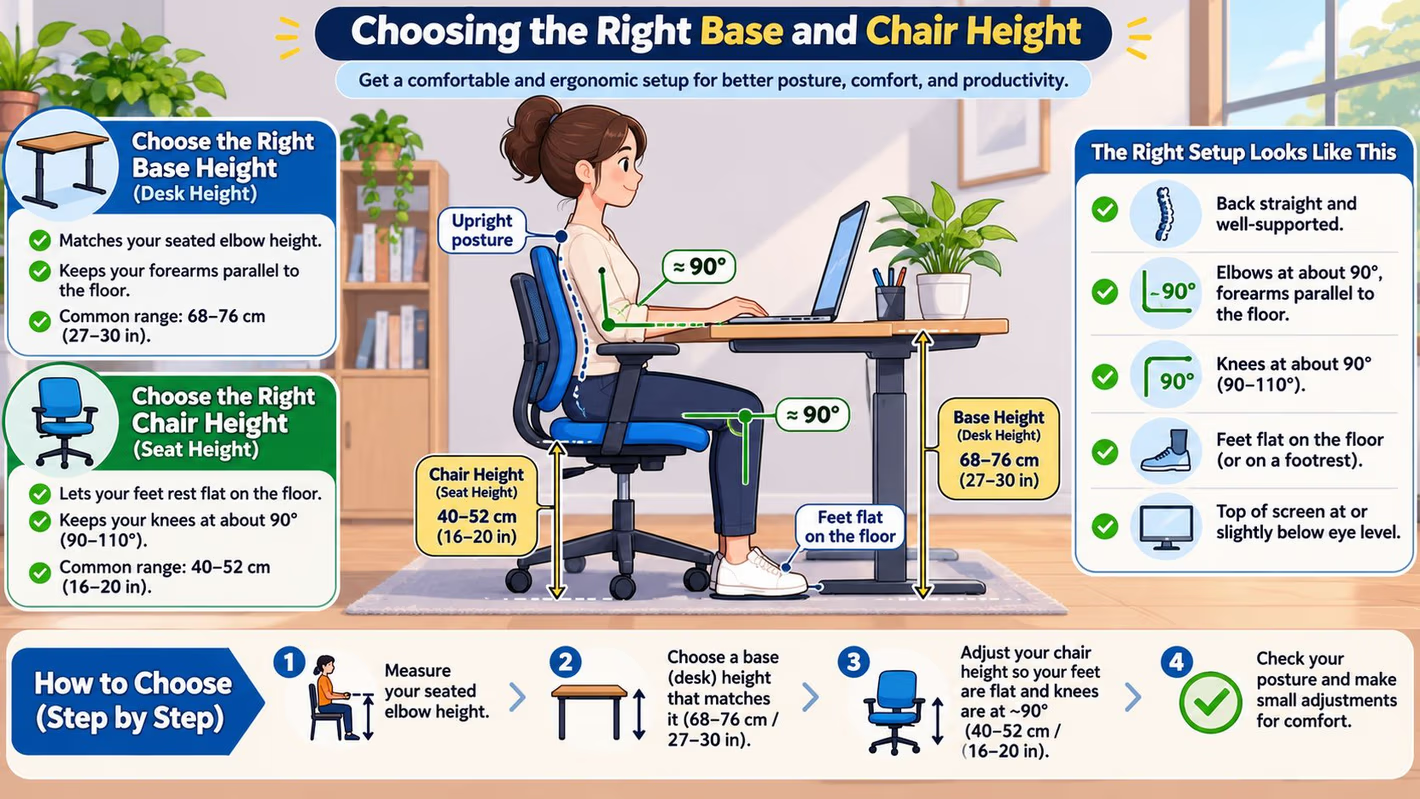
The top gets all the attention. What decides whether four people sit down without negotiating is underneath: the base, the apron depth and the distance from the seat to the table edge.
Ergonomics reduce to a few vertical measurements, and getting them wrong is felt long before it's seen.
Pedestal or Four Legs
A pedestal clears every seat. It makes it easier to position four chairs evenly around a round table because there are no corner legs to interfere with seating. For anyone who approaches from an angle, or pulls a chair in from the side, that matters more than the style difference between bases.
Four-leg tables aren't wrong. They often suit a traditional room and can sit steadier on an older, slightly uneven floor. The cost is a post at each corner that a chair leg and a knee both have to avoid.
The Seat-to-Top Gap
The gap between the chair seat and the underside of the tabletop is the measurement that predicts comfort. Guidance on dining table dimensions recommends roughly 10 to 12 inches of vertical clearance, with standard tables about 28 to 30 inches high (learnarchitecture). Apron thickness and leg position eat into that number more often than table height does.
Four steps settle it in the showroom.
- Measure the seat height of the chair you plan to buy. Use floor to seat, not the catalog's overall height.
- Add 10 to 12 inches. That sum is the table height you need. A 19-inch seat pairs with a 29 to 31-inch top.
- Check the pedestal foot against the knee zone. Sit down and look at where the column flares. If it widens into the space your knees occupy, the seat is decorative.
- Slide each chair in and out. Arms have to clear the apron, and stretcher bars catch shins on the way in.
When a Walker or Wheelchair Joins the Table
Accessibility numbers are stricter than comfort numbers, and worth planning for even if nobody in the house uses a mobility device today. U.S. Access Board guidance on accessible seating calls for knee space at least 27 inches (685 mm) high, 30 inches (760 mm) wide and 19 inches (485 mm) deep, clear floor space of 30 by 48 inches (760 by 1,220 mm) at an accessible position, and a table surface between 28 and 34 inches (710 to 865 mm) high (U.S. Access Board).
For a household with mobility needs, a central pedestal beats four corner legs, provided the flare stays clear of the knee zone. Confirm that at least one seating position meets the width and depth, and that chair arms slide under the top when the set is tucked in.
The rule that saves a return: "seats four" is a capacity claim. Whether four people can approach, pull out and sit down is a separate question, and only the base and chair dimensions answer it.
Height decisions get easier when the whole table is planned around one number, and the guide to dining table heights walks through pairing a top with the chairs you already own.
Layout Tips for Rugs, Lighting and Traffic
Once the footprint clears the walls, the table has to work with the room around it. Most of that gets decided before delivery day, not after.
- Center the table under the light. If the room has one fixture, the table goes under it, and the chairs get placed off that centerline.
- Test the pendant with paper. Tape a paper template at the height you're considering, sit down, and check the sightline to the person across the table. Guessing produces a lamp everyone ducks under.
- Size the rug for pulled-out chairs. All four chairs should stay on the rug at full extension, so no chair leg catches an edge every time someone stands. Rug dimensions for round tables from Lewis and Sheron Textiles lays out the sizing math for round tops, which behave differently from rectangular ones.
- Back the sideboard off. Leave room between it and the table for a chair to pull out and a person to stand behind it. A buffet you can't open during dinner isn't storage, it's furniture.
- Keep the kitchen path open. In open-plan Southern Oregon homes, the round table should anchor the space without becoming an obstacle between the sofa and the refrigerator.
- Lower the centerpiece. Anything tall enough to block eye contact across a 42-inch top gets moved to the sideboard.
Mark the final position with painter's tape a day before delivery. It takes two minutes and settles every argument about which wall the table belongs against.
Materials That Hold Up to Daily Meals
Material decides how a table ages, not how it photographs. A round dining room table with 4 chairs gets used three times a day, and the surface takes hot dishes, sweating glasses, homework and the occasional craft project.
Round table materials compared
| Material | Strengths | Watch for |
|---|---|---|
| Solid hardwood (oak, maple) | Durable and refinishable | Heavy; reacts to humidity |
| Reclaimed wood | Unique grain and character | Finish and stability vary by piece |
| Teak | Resists moisture; good for busy homes | Higher price point |
| Glass top on metal base | Light, clean look | Fingerprints show; edges can chip |
| Veneer over stable core | Affordable and stable shape | Deep scratches cannot be sanded out |
The key fork in the road is solid wood versus veneer. Solid oak or maple takes a dent and lives with it, and a refinish years later brings the top back. Veneer over a stable core holds its shape and costs less, but a deep scratch stays a deep scratch, and water sitting at an edge can lift the layer.
Finish matters as much as species. A lacquered top shrugs off spills, while an oiled top wants re-oiling when water stops beading instead of soaking in. Neither is fragile. They just ask for different habits.
Three care habits prevent most of the damage.
- Use placemats under anything hot. A dish straight from the oven can leave a white ring in a lacquer finish that never comes out.
- Wipe spills at once. Water sitting under a glass overnight is what lifts veneer edges and stains wood.
- Keep solid wood out of direct sun. A table sitting in a south-facing window will show a color shift across the top within a season.
Species selection drives longevity more than any other choice, and choosing the right hardwood for longevity and style explains how oak, maple and walnut behave under daily use in a Southern Oregon climate.
Styles and Unique Finds for Your Room
A dining room should feel like the room where people linger, and style is what sets that mood before anyone sits down. A farmhouse round table brings simple lines and natural wood, the kind of table that looks right with a bowl of apples and mismatched chairs. A craftsman table suits a room mixing handmade detail with traditional or metal seating.
A vintage round table with carved legs and dark varnish belongs in a formal dining room where dinner is an event. None of these styles requires a matched five-piece set, and the rooms that look best rarely have one.
Keep one dominant wood tone and vary the chairs. Four matching chairs around a table in the same finish can read as a showroom display, while four chairs in the same tone but different silhouettes read as collected. The table stays the anchor.

Some rooms want a piece nobody else has. That's where the Unique Finds at Gates Home Furnishings do their work: one-of-a-kind statement pieces in reclaimed wood and teak that separate a room from the big-box version of the same shape. A reclaimed wood round table with four matching chairs becomes the focal point of a small dining room, grain and patina doing the decorating. A teak top handles a sunroom or a dining area next to a patio door where humidity swings and drinks get set down wet.
Mixing eras works when the proportions agree. A heavier carved table wants chairs with some visual weight, not delicate spindle backs that disappear beside it. A slim pedestal top can carry bolder chairs without looking overloaded.
If a piece makes the room feel more like the people who eat in it, and the chairs stay comfortable through a long dinner, it's a good match. Style is the last decision, not the first, because no finish rescues a table that's the wrong size.
Rooms also have a starting vocabulary worth borrowing from, and seven dining room styles to fit every home maps the looks that work with round tables in the Rogue Valley.
Budget Routes to Your Four-Chair Set
A good round table for four doesn't have to be paid for in full on day one. Gates Easy Pay offers $0 down options, 6-month interest-free plans on qualifying purchases, and financing options that don't require credit, including lease-to-own. A designer at the Grants Pass showroom can match a plan to your budget before you commit to a specific table.
Spend in a deliberate order. Confirm the diameter from the footprint steps first, then settle chair height and base, because those three decisions determine whether the set works in the room. Everything after that is finish and detail, which is where money gets spent without improving daily use.
Here's how that plays out. A 42-inch set from a standard line and a 42-inch Unique Finds piece of similar size occupy the same circle on the floor, so both fit the same room. The difference is in the grain, the joinery and how many of that table exist. Either can be the right answer, but only after the chairs clear the sideboard.
Studio Contour's dining set cost guide is useful for seeing where the money goes in a four-seater versus a six-seater, which helps when a slightly larger top tempts you past the budget you set.
Gates Home Furnishings has served Grants Pass, Medford and the Rogue Valley since 1946 under the promise George Gates made of Service and Value, and that promise includes making a realistic budget work rather than talking someone into a table that doesn't fit. The financing side is worth reading before a showroom visit, and the furniture financing options page explains how the plans compare.
Test the Set in Our Grants Pass Showroom
The last measurement is the one a tape can't take, which is how a chair feels after forty minutes. Our 30,000-square-foot showroom in Grants Pass holds full dining displays, so a set can be sat in, pushed back from and walked around rather than judged from a photo.
The floor carries La-Z-Boy, Flexsteel, Ashley and Beautyrest alongside our Unique Finds in reclaimed wood and teak. If you'd rather not sort through it alone, ask to speak with a qualified staff interior decorator. They'll talk through your tastes, lifestyle and budget and help plan the dining room around the table you choose.
White-glove delivery is part of the deal, and it doesn't mean boxes on the porch. Our team delivers to the room you choose, professionally unpacks and assembles the set, places it where you want it and takes the packaging with them. We deliver across Grants Pass, Medford, Central Point and Ashland.
Four steps make delivery day uneventful.
- Re-measure the footprint. Run the clearance steps again with the table and chairs you bought, not the ones you first considered.
- Clear the room. Empty the space where the set will land before the truck arrives.
- Confirm the path. Walk the route through doorways, halls and stairs, and note any tight turn where maneuverability is limited.
- Schedule the visit. Pick a delivery window, or browse the collection first and come back with measurements.
Visit our Grants Pass showroom or browse our collection online, and we'll help you size the table for your room instead of guessing at it.
Gates Home Furnishings has been furnishing Rogue Valley dining rooms since 1946, and a round table with four chairs is one of the sets our team measures with customers most often. Bring your room dimensions, your walkway width and your chair measurements to the Grants Pass showroom, and we'll lay out the full footprint with you before anything is ordered. Visit Gates Home Furnishings to browse dining sets online or plan a visit.