
How Long Does a Sofa Last? Realistic Lifespans by Material


A sofa lasts about 8.8 years as a central planning estimate, within a realistic 7 to 15 year range under normal household use, with roughly a decade as the midpoint. The more useful question is which part will stop working first, because a tired cushion doesn't necessarily mean the whole sofa is worn out.
For Grants Pass households, comfort, repairability, and everyday use matter more than a birthday on a receipt. A sofa can remain structurally sound after its seats lose support or its upholstery no longer suits the room.
How Long Most Sofas Last and Why the Range Is Wide
About 8.8 years is a planning estimate, not an expiration date. The Dutch government-commissioned ecodesign review gives that estimated economic lifespan for a sofa, within broader furniture lifespan estimates of 5 to 20 years.
The practical household benchmark is broader because sofas don't receive equal treatment. A family-room sectional used throughout the day experiences different loading, spills, and abrasion than seating reserved for visitors.
Sofa lifespan benchmarks
| Benchmark | Years | What it measures |
|---|---|---|
| Economic lifespan estimate, Dutch ecodesign review | 8.8 years | Central planning figure for a sofa |
| Practical household range | 7 to 15 years | Normal use, influenced by construction and care |
| Consumer expected ownership | About 10 years | What buyers expect to keep a sofa |
| Expert feature range, Woman&Home, 2024 | 10 to 15 years | Materials, craftsmanship, and household use |
| Social lifespan, focus-group view | 5 to 10 years | When the sofa stops looking or feeling right |
| Foam at 3% compression set | About 10 years of service | Industrial polyurethane benchmark for cushion recovery |
| Foam at 5% compression set | About 4 years of service | Same benchmark after more permanent cushion deformation |
These benchmarks answer different questions. A U.S. furnishings-industry survey summarized by DSA Factors reported that consumers expected to keep a new sofa for about 10 years; that's an ownership expectation, not a durability test. The expert and foam benchmarks describe different aspects of construction and performance.
A sofa effectively has a structural clock and a comfort-and-style clock. The first concerns whether its frame and support system remain serviceable. The second concerns whether sitting on it still feels good and whether it still belongs in the household.
Practical rule: Diagnose the worn component before deciding that the entire sofa has reached the end.
A sofa inside the expected range can feel disappointing because its cushions have flattened or its cover looks tired, even while its frame remains useful. Conversely, a relatively new sofa with unstable joints needs attention regardless of its age. The range helps with budgeting; the condition determines the next step.
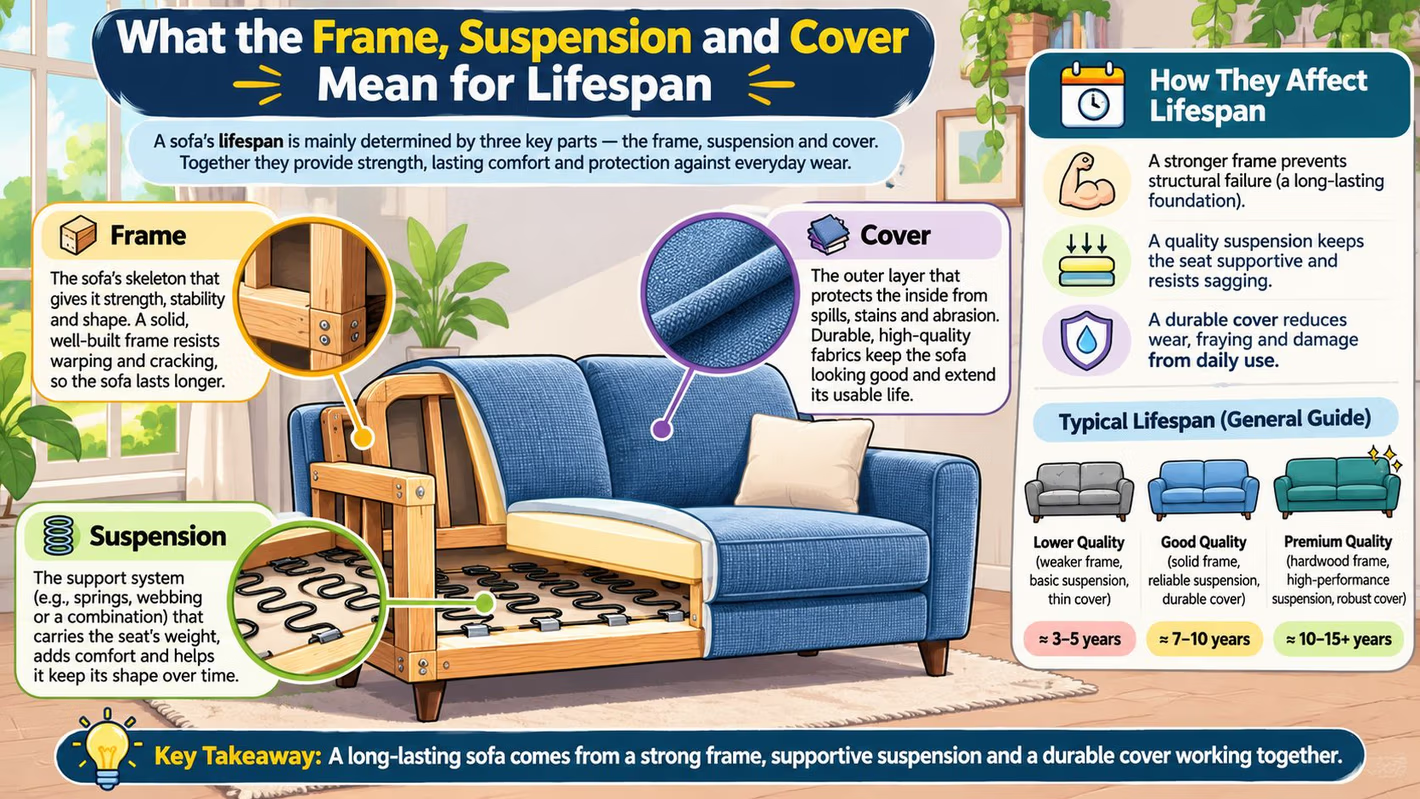
What the Frame, Suspension and Cover Mean for Lifespan
The frame is the skeleton, the suspension is the shock absorber, and the cover is the skin. Each performs a different job, so a durable fabric can't compensate for weak joints or inadequate seat support.
A 2024 Woman&Home furniture-expert feature gives an expected sofa lifespan of 10 to 15 years, depending on materials, craftsmanship, and household use. That qualification matters more than treating a material name as a guarantee.
Start underneath the upholstery
Kiln-dried hardwood, reinforced corners, and properly glued and screwed joints are strong construction signals. A frame assembled mainly from staples and weak board material deserves closer inspection, particularly around arms, legs, and other load-bearing connections.
Still, construction matters more than a hardwood label. Poorly executed hardwood joinery can loosen, while a thoughtfully engineered frame can perform well. Sit down, shift position, and listen for movement; the sofa shouldn't rack sideways or feel unstable.
Sinuous springs and properly installed hand-tied coil springs can both provide lasting support. Neither label automatically establishes superiority. Spring attachment, spacing, and the surrounding frame matter, while elastic webbing should be assessed for its quality, tension, and replacement access.
Judge the cover separately
Inspect seams where people slide across the seat edge or lean against an arm. Look for even stitching, secure seam allowances, and fabric that isn't already pulling around corners.
Leather, woven fabric, and performance upholstery have different maintenance needs, but the available evidence doesn't establish dependable per-material lifespan figures. The upholstery materials guide helps separate cover choices from the construction beneath them.
A useful purchase inspection includes:
- Rigid joints: Arms and the back should remain stable during ordinary movement.
- Replaceable cushion inserts: A serviceable seat is easier to refresh than a sealed assembly.
- Removable, cleanable covers: Confirm the permitted cleaning method; removable doesn't automatically mean washable.
- Accessible springs or webbing: Repair access matters when the support system eventually needs work.
The frame is usually the most disruptive component to replace. Buying a sound foundation with serviceable parts gives the household more options than buying attractive upholstery wrapped around an inaccessible structure.
Matching Fabric Rub Ratings to Your Household
How much traffic will the sofa receive? Occasional guest-room seating and a family-room sofa shared with pets shouldn't be judged by the same upholstery requirements.
The American Leather explanation of upholstery testing describes the Wyzenbeek method: one complete back-and-forth motion counts as one double rub, and testing continues until defined wear, commonly two broken yarns or noticeable pile loss. The result measures abrasion resistance, not years of household service.
Fabric rub ratings by household traffic
The Your Colors upholstery durability guide gives the light-, medium-, and heavy-duty Wyzenbeek bands below, including 15,000 double rubs as a practical everyday family-room minimum and approximately 30,000 or more for heavier traffic.
| Traffic level | Wyzenbeek double rubs | Martindale cycles | Typical use |
|---|---|---|---|
| Light duty | 3,000 to 9,000 | Confirm the fabric's intended-use category | Guest room, occasional sitting |
| Medium duty | 9,000 to 15,000 | Confirm the fabric's intended-use category | Light everyday household use |
| Heavy duty, family-room minimum | 15,000 | About 20,000 | Everyday family use |
| High traffic, children or pets | 30,000 | About 40,000 | Heavy daily use, pets and children |
| Everyday domestic sofa | Compare within the Wyzenbeek method | 15,000 to 25,000 | Typical household sofa |
| High-use household furniture | Compare within the Wyzenbeek method | 25,000 to 40,000 | Frequent daily use by several people |
The Vinson Fine Furniture durability guide provides the Martindale domestic-use ranges and approximate cross-references: 15,000 Wyzenbeek double rubs to 20,000 Martindale cycles, and 30,000 to 40,000, respectively.
Those cross-references aren't a universal conversion formula. Different test motions and procedures mean a shopper shouldn't calculate missing values or assume the larger number identifies the better fabric.
What a high rating doesn't establish
An abrasion machine doesn't reproduce claws catching a loop, sunlight bleaching an arm, or body oils accumulating on a headrest. A tightly woven fabric with suitable cleaning instructions may be a more sensible household choice than a delicate texture with an impressive test result.
The pet-friendly furniture fabric guide can help narrow choices when snagging and cleanup matter alongside abrasion.
Keep the decision grounded in these rules:
- Compare the same method: Wyzenbeek against Wyzenbeek, Martindale against Martindale.
- Confirm intended use: Match the fabric's stated category to actual household traffic.
- Inspect beyond abrasion: Consider seams, sunlight exposure, stain care, and texture.
Independent Association for Contract Textiles guidance cautions against treating abrasion results alone as a reliable predictor of real-world durability. Rub ratings are comparison tools, not sofa warranties.
Why Cushion Foam Usually Gives Out First
A seat can feel wonderful on purchase day and become the reason the household stops enjoying the sofa. The upholstery may remain intact while the foam underneath no longer supports the person sitting on it.
Compression set means the foam stays partly deformed after the load is removed. Instead of returning to its original shape, it retains a dent, allowing the occupant to sink farther toward the support system.

An industrial polyurethane-furniture report hosted by UNIDO relates 3% compression set after 90% compression to nearly 10 years of service, compared with about 4 years at 5% compression set. These are industrial benchmarks, not promises for a particular living-room cushion, but they demonstrate why a modest increase in permanent deformation matters.
When a cushion bottoms out, more impact reaches the suspension and frame. That can make an otherwise sound sofa feel exhausted.
Protect support, not just softness
Seat depth, occupant weight, daily sitting time, cushion thickness, and humidity all influence how foam performs. Density and firmness aren't interchangeable, and a firm showroom seat isn't automatically the more durable choice.
- Distribute wear. Rotate cushions between compatible positions and flip them only when both faces are designed for sitting. Fixed or shaped cushions shouldn't be forced into another orientation.
- Request meaningful specifications. Ask for foam density and available compression-set or fatigue-test information rather than accepting only a high-density description.
- Check insert access. A zippered cover may allow replacement, but confirm that a correctly sized insert can be obtained.
The sagging sofa cushion guide helps distinguish tired filling from support problems underneath. For pet households, J.G. Carpet Cleaning LLC's guidance on choosing scratch resistant couch fabric addresses the separate issue of protecting the cover.
A simple home check starts with an unloaded seat. Press into it, release it, and observe whether it recovers or retains an indentation; then compare neighboring cushions under the same conditions.
Household Habits That Shorten or Extend Sofa Life
A sofa resembles a good pair of work boots: regular cleaning and sensible use preserve it better than waiting for visible damage. Indoor furniture doesn't face outdoor weather, but grit, moisture, heat, and concentrated loading still take their toll.
The goal isn't to keep the living room untouched. It's to prevent avoidable wear while letting the household use the furniture comfortably.
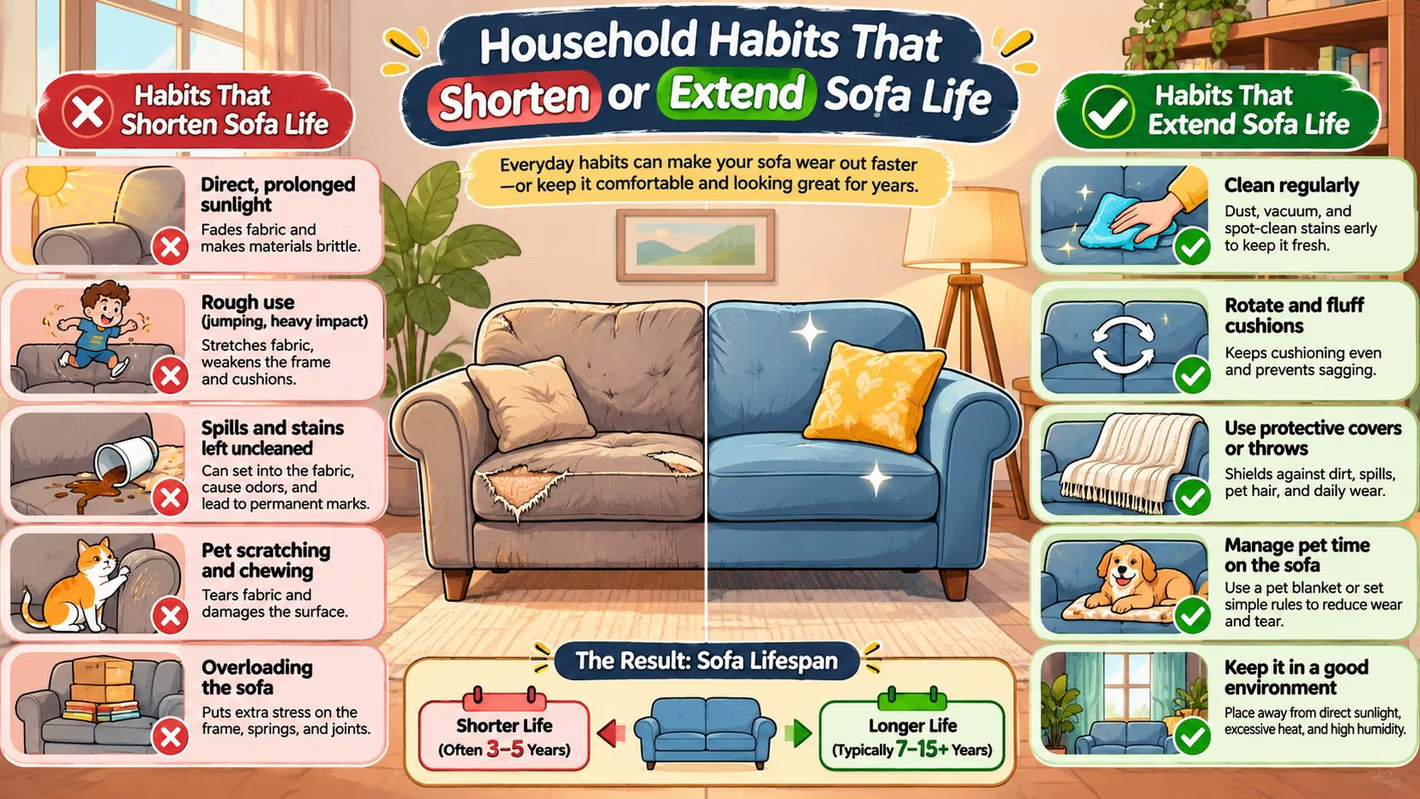
Habits that accelerate wear
- Concentrated loading: Everyone choosing the same seat leaves other cushions comparatively unused.
- Jumping and climbing: Children landing on seats or adults stepping on arms apply loads the furniture wasn't designed to handle.
- Claws and rough objects: Pet scratching, sharp buckles, and abrasive clothing can damage an otherwise durable cover.
- Sun and heat exposure: Direct sunlight and nearby fireplaces or radiators can fade or dry upholstery.
- Delayed cleaning: Spills and body oils become harder to address when they remain in the material.
A manageable care routine
- Vacuum weekly: Use an upholstery attachment along seams, under cushions, and inside crevices. Avoid dragging a sharp attachment across the cover.
- Blot spills promptly: Lift liquid with a clean, absorbent cloth rather than scrubbing it deeper.
- Check the cleaning code: W permits water-based products, S calls for solvent-based methods, WS permits either approved approach, and X generally means vacuuming or professional assessment.
- Protect exposed areas: Washable throws on arms and headrests can intercept oils and dirt without covering the whole sofa.
- Place furniture thoughtfully: Keep upholstery clear of direct heat and reduce sustained sunlight with appropriate window coverings.
Cushion rotation belongs alongside these habits, provided the cushion design allows it. Never stand on the frame or use a sofa arm as a step.
For leather seating, the leather sofa care guide helps identify appropriate maintenance instead of treating leather like washable fabric. Renue Systems Four Points' hotel asset protection guide offers a useful commercial perspective on planned upkeep rather than reactive cleaning.
Maintenance can slow wear. It can't restore the strength of a broken frame.
Stop using unstable seating until the structure has been assessed. Cleaning makes furniture cleaner, not structurally safe.
Signs Your Sofa Needs Repair or Replacement
Age alone is a poor replacement test. A younger sofa can have a serious structural fault, while an older one may need only a targeted repair.
Research discussed in a University of Limerick repository paper describes a social lifespan of roughly 5 to 10 years in consumer focus groups. That helps explain why households sometimes replace furniture that remains physically usable: appearance, comfort, and changing needs influence the decision.
Problems worth pricing as repairs
- Loose joints: Accessible fasteners may be tightened, while failed glued connections may require professional rebuilding.
- Flattened cushions: New inserts or suitable replacement filling can restore support when the underlying suspension remains sound.
- Damaged webbing: Re-webbing can be worthwhile if the frame and attachment points remain serviceable.
- Worn fabric: Reupholstery can preserve a well-built sofa, particularly when its size and seating position suit the household.
- Localized stains: A professional cleaner can assess treatment options, although complete removal isn't guaranteed.
A repair quote should identify the failed part, the work required, and what condition will remain afterward. Replacing cushion foam won't correct a loose spring attachment; cleaning a cover won't remove wear through the fabric.
Gates Home Furnishings repairs or replaces a defective component rather than replacing the entire product. That component-based approach is useful when the rest of the furniture remains sound, although applicable warranty terms still determine coverage.
Signals to consider replacement
- Cracked or split framing: Structural damage needs a safety assessment, particularly around load-bearing joints.
- Unserviceable springs: If suitable parts or repair access aren't available, the practical options narrow.
- Persistent widespread sagging: Depressions that remain after suitable cushion replacement suggest a deeper support problem.
- Unresolved wobbling: Movement that persists after proper tightening may indicate failed joinery.
- A poor household fit: A structurally sound sofa can still be too deep, too low, too large, or unsuitable for changing mobility needs.
Replacement for style isn't a structural necessity, but it can still be a legitimate household decision. Keeping usable furniture in service through resale or donation may be possible when its condition permits.
Decision check: Is the frame sound, does the cushion recover, and does the fabric still suit the household?
Repair makes sense when it restores the comfort and function needed. Reupholstering a sofa that was never comfortable preserves the wrong seat at additional cost.
Budgeting for a Sofa by the Years It Serves
The useful comparison isn't just the price tag. It's the purchase price divided by the years of comfortable service, with repair expenses considered alongside it.
Consider a hypothetical $1,200 sofa. If it provides 12 years of comfortable use, the purchase cost works out to $100 a year; replacing that same sofa after 5 years raises the purchase cost to $240 a year. This is planning arithmetic, not a forecast for any model.
Protect the value calculation
A cheaper sofa can be sensible for a short tenancy or lightly used room. It isn't automatically better value for heavily used seating if its cushions are inaccessible or its structure can't be repaired economically.
Compare these practical costs before purchasing:
- Serviceable cushions: Confirm whether replacement inserts are available and how their cost is determined.
- Repair access: A repairable support system provides options that sealed construction may not.
- Cleaning requirements: Choose a care routine the household can realistically maintain.
- Warranty expenses: Separate parts coverage from labor, transportation, and ordinary wear.
Gates Home Furnishings provides parts at no charge for warranted defects or workmanship. After the one-year free service period expires, transportation and labor charges apply to repairs or installation of warranted parts. Parts coverage therefore shouldn't be mistaken for free service throughout the sofa's ownership.
The living-room sofa buying guide can help organize the broader purchase decision, including size and everyday function.
Financing doesn't replace a budget
Gates Easy Pay includes $0 down, six-month interest-free options, and no-credit-needed financing. Compare the applicable terms and payment obligations before choosing an option; spreading payments doesn't change whether the sofa fits the household budget.
The sensible target is a manageable purchase with construction appropriate to its workload. Spending more is useful only when it buys comfort, durability, or repairability the household will benefit from.
Test Your Next Sofa in Our Grants Pass Showroom
A specification sheet can't establish whether a seat supports someone's back or lets their feet rest comfortably on the floor. Gates Home Furnishings' 30,000-square-foot showroom in Grants Pass provides space to test comfort in person rather than choose by appearance alone.
Bring a practical checklist
Sit in a normal resting position, try the arm height, and check how easily standing feels. For shared seating, have the household compare positions rather than letting a single quick sit determine the purchase.
- Ask about construction: Frame joinery, foam density, and available fatigue-test information.
- Confirm serviceability: Cushion inserts, cover care, and access to support components.
- Review fabric specifications: Test method, intended use, and cleaning requirements.
Founded in 1946, the family-owned business carries forward George Gates' original promise of “Service and Value.” That philosophy supports practical decisions for neighbors across Grants Pass, Medford, Central Point, Ashland, and the broader Rogue Valley and Southern Oregon region.
For a move or room refresh, measure doorways and the intended furniture location before arranging delivery. Gates Home Furnishings advises re-measuring and clearing the placement area, which helps prevent an otherwise suitable sofa from becoming an access problem.
Comfort should be tested patiently. A seat that looks right but makes standing difficult isn't the right long-term choice.
Gates Home Furnishings offers sofas, sectionals, and recliners from brands including La-Z-Boy, Flexsteel, and Ashley, plus Beautyrest mattresses and Unique Finds in reclaimed wood and teak, including one-of-a-kind statement pieces. White-glove delivery goes beyond dropping boxes, with professional assembly and mattress haul-away. Visit Gates Home Furnishings at the Grants Pass showroom to compare comfort and repairability in person, or browse the collection online before planning a visit.
