Lift Chairs That Swivel: How to Choose the Right One


The Centers for Disease Control and Prevention reports that more than 14 million adults aged 65 and older, over 1 in 4, fall each year, that falls are the leading cause of injury death for this age group, and that in 2024 those falls led to about 4.5 million emergency-department visits and more than 43,000 deaths. No chair erases that risk. A bigger cushion or a softer seat is not automatically the safer one, either. What matters is whether a chair fits your body, your transfer ability, and the room around it. That is the test worth running before you buy.
Swivel Lift Chairs at a Glance and Who Benefits
Say you're in a living room near the Rogue River, and the sofa sits a little low. Standing takes a push from both arms, and turning toward the side table means twisting through your knees. Lift chairs that swivel answer those two jobs separately. A powered seat rises and tips you forward so standing takes less strength. The base turns so you can face a table, a doorway, or a helper before you stand.
We have walked Grants Pass families through that test since 1946, when George Gates Jr. opened the shop on a promise of Service and Value. The same promise still shapes how we talk about seating. A swivel lift chair is a comfort-and-transfer piece, not just a recliner with an extra motor.
Match the feature to the problem
A bigger cushion isn't the fix if the problem is direction, and a full turn isn't the fix if the seat is too deep to get your feet down. Use this as a first sort, then confirm it on the floor.
| Your Need | Feature to Prioritize | What to Verify |
|---|---|---|
| Getting up from a low or deep seat | Powered lift with forward tilt | Seat height and lift trajectory |
| Turning toward a side table or doorway | Swivel base | Full rotation range and lock positions |
| Caregiver-assisted transfers | Supportive, well-placed armrests | Armrest height and clearance to stand |
| Long hours of sitting | Recline and lumbar controls | Footrest reach after the chair turns |
| Limited room space | Compact base with wall clearance | Full swivel footprint in the room |
Practical rule: Rotate toward a stable direction, plant both feet, and finish the stand with the lift. Don't twist, and don't pull yourself up on a nearby table.
Transfers don't stop at the chair. If you're also reworking a bathroom so a shower is easier to enter, Trademaster Construction's accessible shower guide is a useful companion for the wet room, while the chair decision stays in the living room.
Homeowners and renters in Medford, Central Point, Ashland, and the rest of the Rogue Valley run into the same split. Some people mainly need help rising. Others can stand once they're pointed the right way. Our guide to lift chairs for older adults walks through standing help in more detail. The short version is this. The lift handles standing. The swivel handles direction. Buy for the problem you have.
How the Lift and Swivel Work Together
Think of the lift as a short ramp under the seat, and the swivel as turning a bar stool so you face the counter. They aren't the same motion, and a strong motor doesn't make up for a path that pitches you forward too fast.
A powered lift raises and tilts the seating surface so your hips and knees don't have to generate as much force. Clinical coverage guidance that summarizes a biomechanical review, published through EviCore seat-lift criteria, found that assisted transfers significantly reduced peak hip and knee joint moments and lowered overall muscle activity compared with standing on your own. Ankle demand went up. Your feet, ankle strength, and balance still have to do their share.
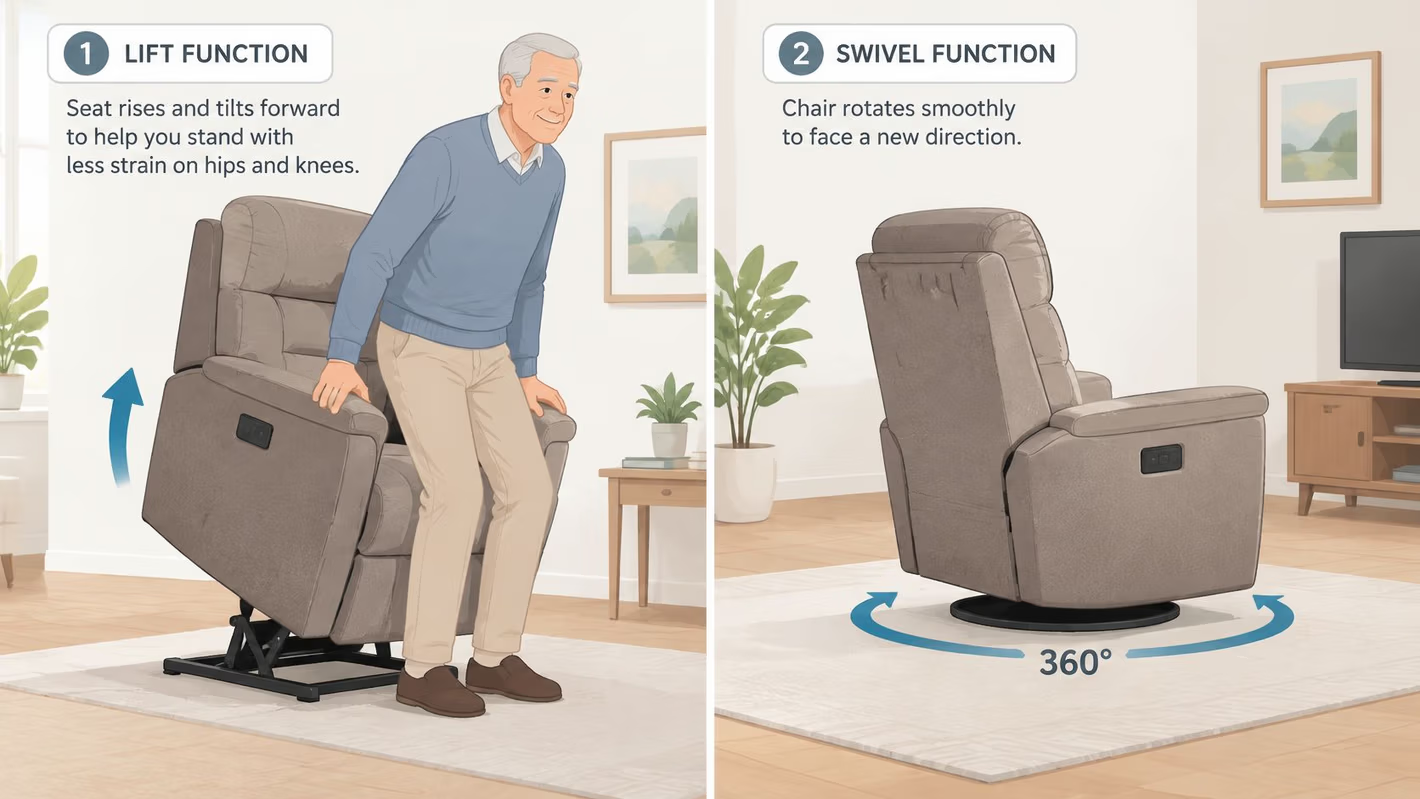
What the lift path should feel like
The seat should bring you far enough forward that both feet sit under your body, with your center of mass staying controlled. If the torso snaps forward, the motor is doing the wrong kind of work. Judge seat height, lift trajectory, and footrest position, not horsepower on a tag.
In the showroom, try this sequence and don't rush it.
- Feet flat: Both soles stay on the floor through the rise, not on tiptoe and not hooked behind the footrest.
- Neutral pelvis: You aren't slumped back or pitched onto your toes.
- Hands quiet: You reach a stable stand without hauling on the armrests.
Lift help can lower the load on your hips and knees. It isn't a stand-in for a transfer assessment when someone has substantial weakness, dizziness, or a balance problem that already makes walking unsafe. In those cases, ask a clinician how the person should transfer, then come back and test only chairs that match that plan.
If you can't keep your feet flat and your pelvis quiet on the way up, that chair's path isn't yours, no matter how soft the cushion feels.
Swivel Range, Locks and Power Options
Swivel doesn't always mean a full circle. Many lift chair manuals set a stop well short of 360 degrees, and 270 degrees is a common limit in manufacturer instructions, because a wider turn can strain or damage the power connectors. Cable length and base design decide how far the chair will travel.
Ask whether the turn is full-circle or restricted, then confirm the limit in the manual while you're still sitting in the chair. A salesperson's "it spins" isn't a spec. The arc you need also depends on your floor plan: a full-circle base needs clear space all the way around, while a restricted one can work tucked closer to a wall or end table.
Lock it before you move your body
The seat should be locked before you sit, rise, or recline. The base has to stay planted through the whole turn, and transferring while the chair is still moving is how a helpful feature becomes a tip risk. If your balance is unsteady, a lock you can find and set without standing matters more than how many positions the chair advertises.
After the chair is pointed where you want it, the handset still has to be in reach. Some controls end up behind a hip or under a cushion once the seat has turned. Trace the cord around the base while you're shopping. A short lead that snags on a leg stops the chair before the room does.
Power loss is the other quiet limit. Motors don't lift during an outage unless the model carries a backup, so read the specification instead of assuming one is built in. Our notes on lift chairs with battery backup spell out what that add-on covers.
We show customers the features of their new furniture and teach them how to use it, so the floor demonstration is the right place to fail a control on purpose. Try the lock, the turn, and the handset with the chair already rotated.
Before you leave the floor, confirm five things:
- Rotation spec: Full circle, or a stated stop such as 270 degrees.
- Lock locations: You can find and set the lock without standing up first.
- Control reach: Buttons still face you after the turn you need.
- Cord length and routing: The cable clears the base at that same angle.
- Outage plan: Backup power is listed, or you've decided how you'll stand if the lights go out.
Measuring for Seat Height, Depth and Clearance
Research in aged-care seating, published in PMC, found that higher seats were preferred because they shorten the distance and the effort of sit-to-stand. Armrests were essential for getting in and out. The same work found that overly deep seats can keep feet off the floor and push people into a slump.
That's the part that surprises shoppers. A larger or softer chair isn't automatically safer or more comfortable. A swivel can cut twisting on the way in. It doesn't fix a seat that's too tall, too deep, too narrow, or unsteady.
Numbers to bring with you
Measure at home on a firm chair of similar height. Have a helper use a tape, write each number down, and set those figures next to the spec sheet. Our lift chair dimensions page is the place to line your notes up with listed sizes before you drive in.
| Measurement | How to Measure | Target |
|---|---|---|
| Seat height | Floor to the back of the knee while seated | Knees at or slightly below hip height |
| Seat depth | Seat back to the back of the knee | 2 to 4 inch gap between the seat edge and the back of the knee |
| Armrest height | Seat cushion to the elbow, upper arm relaxed at your side | Armrest top at a comfortable elbow height for standing |
| Swivel clearance | Full footprint through the complete rotation | Clear floor arc with no walls, tables, or rugs in the path |
| Maximum user weight | Manufacturer label and specification sheet | Above the user's body weight |
A simple routine that catches bad fits
Sit the way you sit, shoes on, not perched on the edge for the photo. If your feet dangle, the seat is too high for you even if a taller seat helped someone else in that aged-care research. If the cushion hits the back of your calf, it's too deep, and you'll slide forward every time you try to stand.
Elbows should bend near a right angle when your forearms rest on the arms. Arms that sit too low make you shrug on the way up. Arms that sit too high block a caregiver who needs to get close.
Then mark the turn on the floor with tape, not just the chair's parked footprint. The arc is the space the base sweeps, including the footrest if it stays out. Compare that circle with the manufacturer's maximum user weight last, not first. A rating above body weight is required, and it still doesn't tell you whether your knees clear the seat.
Bring the sheet to the showroom and test the chair against those numbers, not against how the fabric looks from the aisle.
Room Layout and Safety Checks Before You Buy
Swivel gets sold as a convenience, a way to face the television without standing up. Placement is a mechanical requirement. A lift chair works like a small crane: the motor shifts your weight forward and up, and the base has to stay planted while it does. If one corner rests on a rug edge or a soft spot in the floor, the turn, the recline, and the lift all run less stable.
The setup sheet packed with these chairs is plain about the foundation. The chair sits on a flat, level, stable surface, with every part of the base or feet contacting the floor. An unstable base raises the chance of tipping while the chair swivels, reclines, or lifts under power. The operating area stays clear of walls, tables, rugs, pets, and people so the legrest and back never strike anything mid-movement.
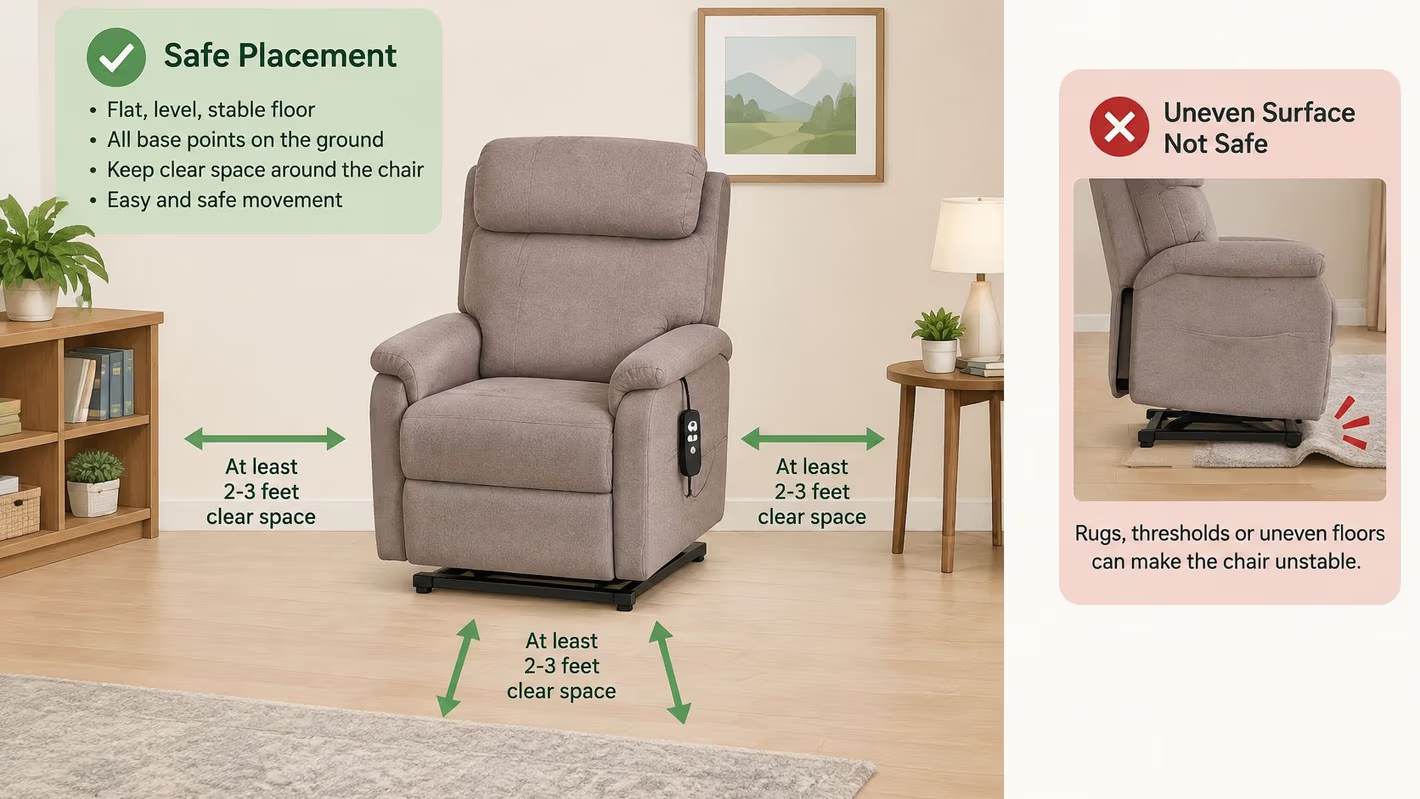
Loose rugs and cords at the base catch a foot or a wheel. Before each use, check for loose fasteners and any damage to the frame, upholstery, or swivel mechanism, and rotate gently rather than spinning. A smooth turn matters because many owners steady themselves on the chair while lowering in. If your balance is already limited, treat the armrest as a guide for your hand, never a post to haul yourself upright.
Hands, kids, and pets
Moving parts pinch. Keep hands and fingers out of the lift mechanism, the openings, and the underside while it runs, and keep children and pets clear of those same gaps. Only the person seated in the chair should operate it. Sit down slowly, because dropping your weight into the back is a common way these chairs start to tip. Nobody stands on the arms, the back, or an open legrest, and nothing heavy gets set there either.
If you transfer from a walker or wheelchair, the chair's most useful feature is the open floor beside it. Leave room on your stronger side for the device to park, and enough space for a helper to stand at your elbow without crowding the legrest. A wider, softer chair squeezed into a tight corner is less safe than a smaller chair with clean transfer room. Our guide to living room furniture placement helps with the rest of the room so the chair isn't fighting the sofa.
If you live alone, family can still keep an eye on things from a distance, and our senior monitoring app guide for 2026 walks through the options. An app can't level a floor or move a rug, though. That part happens in the room.
Before you commit to a corner, do one slow lap around the spot:
- Kneel at the base and rock the chair gently. Every foot should touch with no wobble.
- Stand at each nearby wall and confirm the full turn and raised legrest clear it.
- Follow the power cord from outlet to motor. It should never cross a walking path.
- Lift the corners of any rug in reach. If it can slide under the base, secure or remove it.
- Have your helper stand where they'd assist. If they can't reach your elbow, shift the chair.
Delivery, Assembly and Protection Coverage
A swivel lift chair arrives heavy, and the heavy parts are the wrong places to grab. The manufacturer's assembly instructions call for two adults on every lift and carry, because a solo attempt is how backs get strained. Those same instructions warn against moving the chair by its mechanism, legrest, handle, reclining back, or swivel base. Grip stable, non-moving parts, or leave it assembled and let the delivery crew do the work.
What happens on delivery day
Gates Home Furnishings delivers to the room you choose, unpacks and assembles the furniture, and places it where you want it. We also walk you through the chair's features and show you how the lift and swivel controls work before we leave. If setup in that room isn't feasible, we deliver to an accessible area instead. We aren't responsible for damage that can result from moving furniture through narrow halls, doorways, or stairwells when maneuverability is limited, so measure those turns before the truck is on the way. A tight staircase needs the same clearance numbers as the chair itself, plus room for the person carrying it.
Tell the crew which side you transfer from and where a caregiver stands. The chair's facing and distance from the wall get set once, and repositioning a powered base afterward is a two-person job all over again.
If you'd rather move it yourself, warehouse pick-up is free, and you choose delivery or pick-up at checkout. Bring a vehicle that can safely haul the chair, plus your ID, the sales order, packing material, padding, and rope. If you're moving the rest of the house too, secure furniture safely in the moving truck before anything else goes in the trailer. A lift chair's base and motor don't ride well loose, and a strap across a cushion isn't the same as a strap on the frame.
Coverage after it's in place
The Gates Care Shield protection plan covers accidental spills and tears. Ask for the terms in writing before you add it, and read what is covered and for how long. Don't rely on a spoken summary at the counter.
One detail surprises people. Service works differently for the small stuff: unattached cushions, removable drawers, lamps, and accessories get returned by you to our service department. The chair itself is another matter, which is why the delivery route matters so much up front.
You can see how furniture delivery and assembly is set up, then confirm two things before you order: the path from the truck to the chair's final spot, including any stair, and whether the protection plan goes on that piece.
Choose Your Swivel Lift Chair at Gates
Decide the problem first. Measure second. Test the chair in person third. That order keeps a soft, oversized seat from winning just because it looks easy.
Our Grants Pass showroom is 30,000 sq. ft., so you can sit, lift, and turn more than one model on the same visit. Online, our catalog can be filtered by features such as power recline, power lumbar, and storage, and lift chairs sit alongside recliners and sofas. We carry La-Z-Boy, Flexsteel, Ashley, and Beautyrest, plus Unique Finds in reclaimed wood and teak when the rest of the room needs a piece with its own character.
Bring your measurements from home. A chair that swivels smoothly on our floor still has to clear your side table and match the seat height your knees can manage.
A standard recliner generally costs about $400 to $500, a range reflected in Popular Science's 2025 roundup of swivel recliners, which listed one model at $424. A swivel feature doesn't automatically mean a premium price. Lift chairs add a motor and a stronger base, so confirm the current price on the model you're testing. Gates Easy Pay includes $0 down and 6 equal payments, no-interest options if paid in full within the promotional period, and no-credit-needed financing if you want the payments spread out. Ask us to confirm those terms while you're here, because promotions change.
Shoppers from Medford, Central Point, Ashland, and across the Rogue Valley are welcome. George Gates Jr. founded the business in 1946 on a promise of Service and Value, and we still work that way. We show you the features of your new chair and teach you how to use it before you take it home.
Gates Home Furnishings helps Southern Oregon households choose lift chairs that swivel by matching the lift path, the turn, and the room, then delivers and sets the chair in place. If standing, turning, or both have gotten harder at home, bring your measurements and try the motion before you decide. Visit Gates Home Furnishings in Grants Pass, or browse the collection online and set a time to test a chair on the floor.