Solid Wood vs Veneer: Your Furniture Choice Guide


A lot of shoppers in Southern Oregon end up in the same spot. They're standing in front of two beautiful pieces of furniture, often a dining table or dresser, and both look like wood. One is solid wood. The other is veneer. The price tags are different, the weight feels different, and the long-term ownership experience can be very different too.
That question comes up often in the Grants Pass showroom. A family might love the warmth and heft of a solid wood table, but they also like the clean surface and lower upfront cost of a veneered piece. In the Rogue Valley, that choice matters even more because furniture has to fit real life. Kids, pets, dinner spills, dry summers, damp stretches, moving day, and budget realities all play a part.
Since 1946, George Gates' promise of Service and Value has shaped the way this topic gets explained. The goal isn't to push one material every time. It's to help people understand what they're buying, what trade-offs come with it, and what will suit their home best. Families comparing styles may also find practical buying tips in Ocodile furniture for families, especially when daily use is part of the equation. Once the right piece is home, wood furniture care tips can help it stay looking good longer.
Table of Contents
- Choosing Furniture That Lasts a Lifetime
- The Timeless Appeal of Solid Wood Furniture
- Understanding Modern Veneer Furniture
- A Side by Side Comparison of Solid Wood and Veneer
- Which Material Is Right for Your Furniture
- How to Spot the Difference When You Shop
- Making the Right Choice at Gates Home Furnishings
Choosing Furniture That Lasts a Lifetime
Furniture buying usually starts with a simple question. It doesn't stay simple for long.
A couple from Medford might want a dining set that can handle weeknight meals, holiday gatherings, and school projects. A renter in Ashland may want a stylish media console that looks polished without stretching the budget. A family in Central Point may be replacing a worn coffee table and wondering whether this is the time to invest in something they'll keep for decades.
That's where solid wood vs veneer gets confusing. Many people hear “veneer” and assume it means fake. It doesn't. Others hear “solid wood” and assume it's always the right answer. It isn't always.
Practical rule: The better material is the one that matches how the piece will be used, how long it's expected to last, and how much maintenance the household is willing to take on.
The most helpful way to think about it is ownership. Not just how the furniture looks on day one, but how it behaves after years of dinners, cleaning, sunlight, moving, and small accidents. A dining table has one job in a showroom and another job in a busy home near Grants Pass High School or out toward the wider Rogue Valley.
A good decision usually comes down to four questions:
- How hard will the piece be used: Daily family use puts very different stress on furniture than occasional decorative use.
- What matters most, price now or value later: Some households need a lower entry price. Others want something that can stay in the family.
- Does the piece need broad flat stability: Large tops, drawer fronts, and cabinet panels often benefit from stable construction.
- Would future repair matter: Some buyers don't mind replacing a piece later. Others want the option to refinish and keep it going.
That framework makes the rest of the comparison much easier.
The Timeless Appeal of Solid Wood Furniture
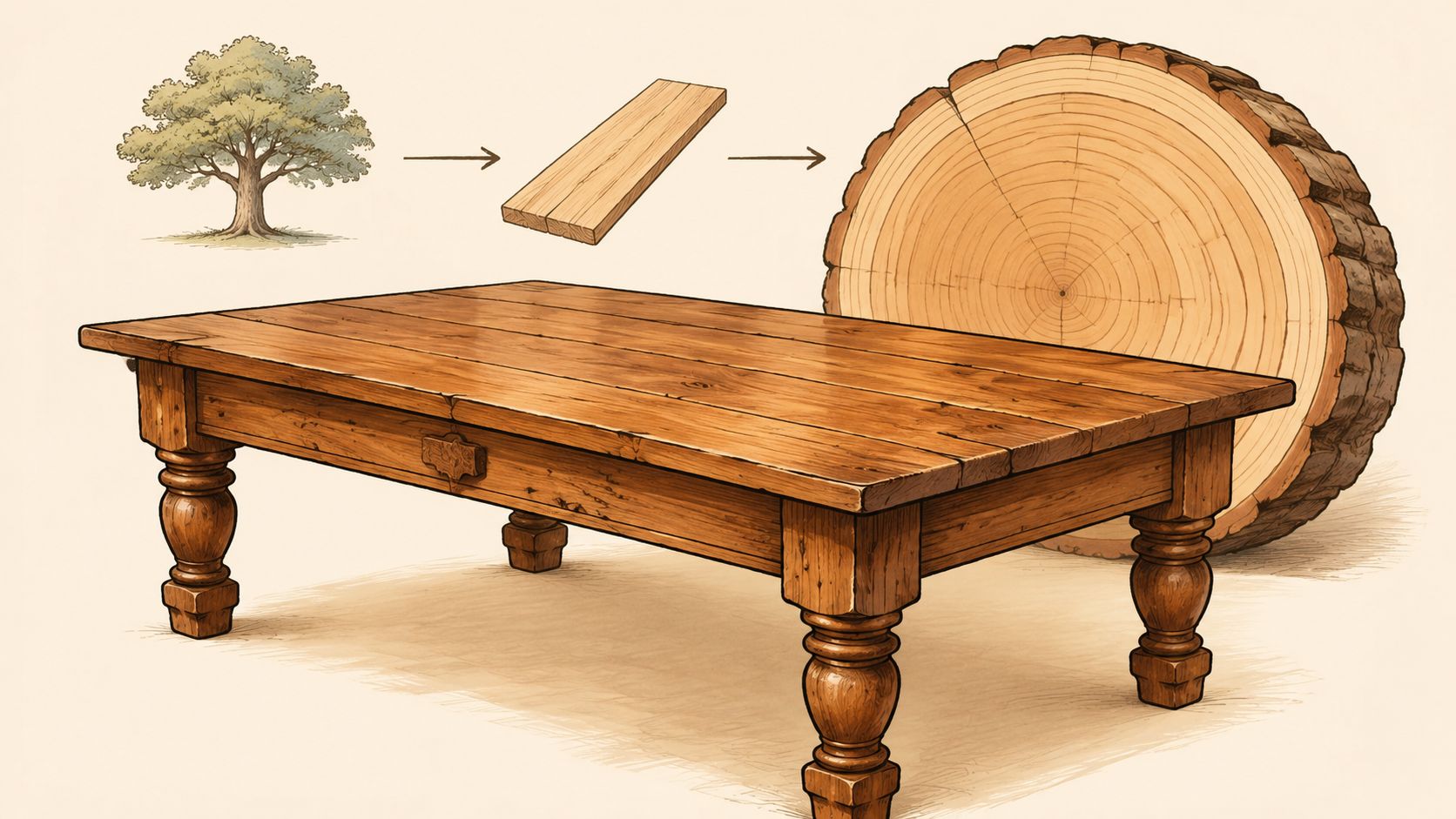
Solid wood furniture is what many people picture when they think of an heirloom dining table, a bedroom chest handed down through family, or a sturdy bench that gets better with age. It's made from lumber milled from trees, with boards joined together to create larger surfaces.
How solid wood is built
A wide tabletop usually isn't one giant slab. It's often several boards joined side by side. That's normal, and it's part of what gives solid wood its character. Grain shifts slightly from board to board, color varies, and the surface looks alive in a way many people immediately recognize.
Those natural differences are also why no two solid wood pieces are exactly alike. One table may have subtle variation and a calm look. Another may show knots, mineral streaks, or more dramatic grain.
For buyers who want to understand wood species better before they commit, this guide to choosing the right hardwood for longevity and style helps connect appearance with long-term use.
Why families keep choosing it
The biggest long-term strength of solid wood is repairability. Solid wood furniture can be refinished, while veneer is more vulnerable to peeling, chipping, water damage, and scratches that are harder or impossible to restore cleanly. That difference affects lifecycle cost more than sticker price, which is why solid wood is often viewed as the better long-term value despite a higher initial cost, as noted in this discussion of solid wood durability and refinishing value.
That matters in real homes. A dining table used for years may collect dents, finish wear, and scratches from everyday life. With solid wood, those signs of use often don't mean the table is done. They mean it may be ready for refinishing.
A solid wood piece often asks for more money up front, but it gives back options later.
There's another side to the appeal. Solid wood has presence. It usually feels heavier, more grounded, and more traditional, though it can work in modern spaces too. In a Southern Oregon home with a farmhouse dining room, a classic bedroom, or a collected look that mixes old and new, that substance matters.
Solid wood tends to make the most sense for buyers who want:
- A long ownership window: The piece is meant to stay for many years.
- A family-use surface: Meals, homework, hosting, and regular wear are expected.
- A piece with story and age: Small marks over time don't ruin the appeal.
- A future refresh option: Sanding and refinishing may matter later.
For many households, that's what “buy once, buy well” really means.
Understanding Modern Veneer Furniture
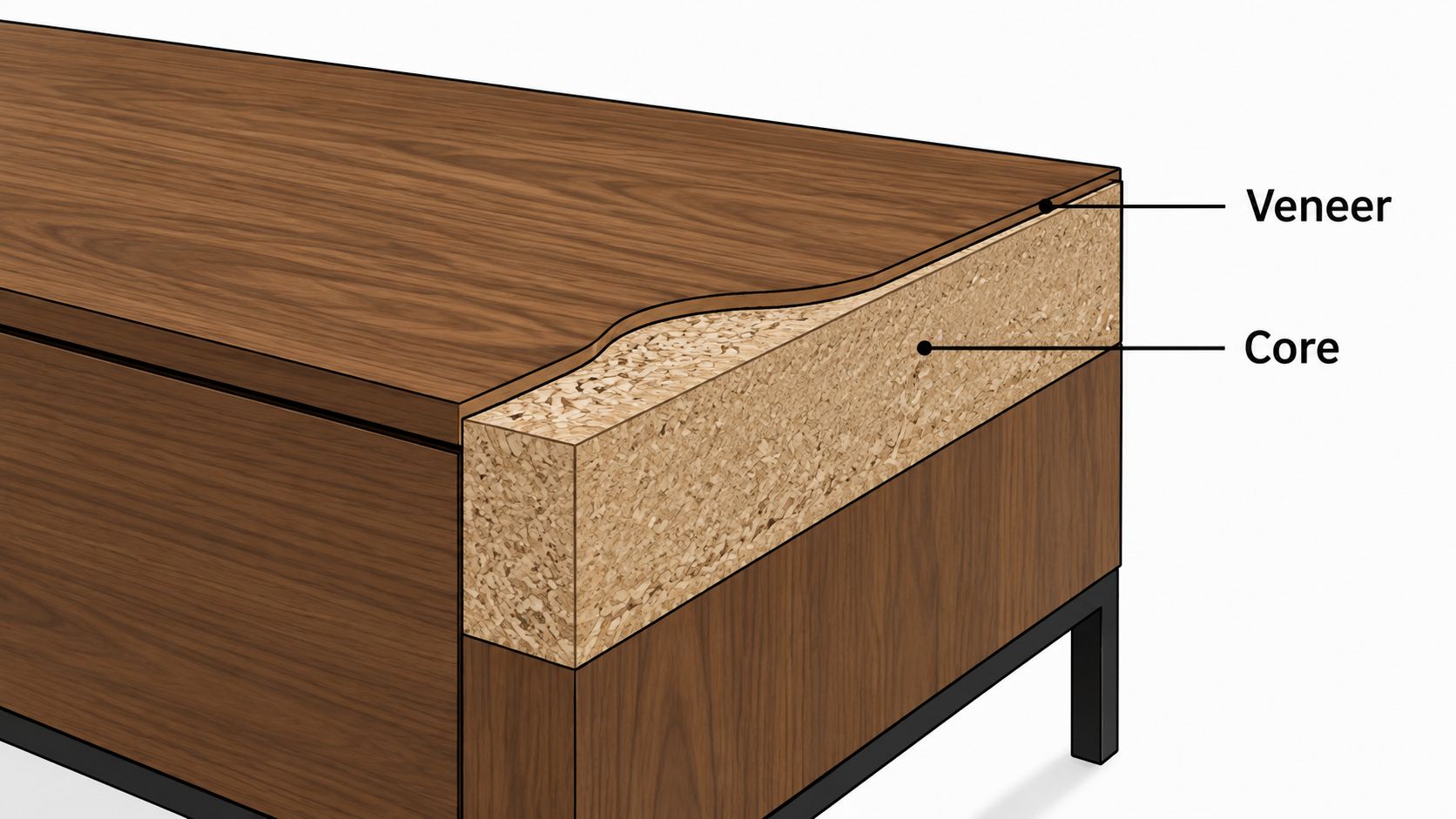
Veneer furniture gets misunderstood all the time. The word sounds like a shortcut, but veneer is real wood on the surface. The difference is in how that wood is used and what sits underneath it.
What veneer actually is
A major historical reason veneer became commercially important is material efficiency. A piece of veneer is typically only about 1/42 inch thick, which means a single log can be sliced into many more usable surfaces than if it were sawn into solid boards. Modern veneer production also uses a stable substrate such as plywood or MDF, which adds manufacturing steps but reduces the amount of high-grade face wood needed. That's a big reason veneer became a practical lower-cost alternative when appearance matters but full-thickness hardwood is too expensive or scarce, as explained in this article on why veneer became commercially important.
That point clears up one common misconception. Veneer isn't “plastic wood.” It's wood used in a thinner, engineered way.
Why veneer works so well on some pieces
The benefit isn't only price. Veneer can also create smooth, broad, visually consistent surfaces that are hard to achieve the same way with solid boards. That's especially useful on case goods such as dressers, nightstands, entertainment pieces, and large cabinet-style furniture.
A veneered top can look sleek and polished. It can also make highly figured wood looks more accessible. In modern and transitional spaces, many homeowners prefer that cleaner, more uniform look.
Veneer makes sense when the goal is wood beauty, stable panels, and a more approachable entry price.
In Southern Oregon homes, that can be a good fit for design-forward rooms where the furniture doesn't take the same abuse as a family dining table. A media console in a living room, a bedroom chest, or an entry cabinet often benefits from a flatter, more controlled panel construction.
Veneer also helps buyers stretch the budget without giving up the look of wood. For many families furnishing an entire room, that trade-off is reasonable. It can free up budget for other priorities, whether that's a better mattress, additional seating, or a larger rug.
The key is using veneer where its strengths matter and its weaknesses won't become a daily frustration.
A Side by Side Comparison of Solid Wood and Veneer
Solid Wood vs. Veneer At a Glance
| Feature | Solid Wood | Veneer |
|---|---|---|
| Construction | Made from joined boards of lumber | Thin real wood surface over a core such as plywood or engineered panel |
| Surface character | Natural variation from board to board | Often more uniform across large panels |
| Upfront cost | Usually higher | Often lower |
| Long-term repair | Can often be refinished | Surface damage is harder to restore cleanly |
| Large flat panels | Can move with conditions | Often chosen for panel stability |
| Best fit | Heirloom-minded buyers and heavy-use pieces | Design-focused rooms and budget-conscious projects |
Durability and daily wear
For households with kids, pets, frequent guests, or lots of everyday use, durability usually means more than “doesn't break.” It means how the piece ages.
Solid wood tends to win that part of the comparison because wear can often be addressed later. A scratch on a solid wood table may be annoying, but it doesn't automatically end the life of the piece. Veneer can look excellent for years, but if the thin surface gets chipped at an edge or damaged by moisture, repair is often more limited.
That's why dining tables, benches, and other touch-every-day pieces often lean solid wood.
Appearance and design style
This category is more personal than technical.
Solid wood usually shows more natural variation. That variation is part of the charm for people who like organic character. It works beautifully in rustic, farmhouse, traditional, lodge, and many transitional interiors.
Veneer often creates a more controlled look. If a homeowner wants a sleek bedroom set, a clean-lined media cabinet, or a dresser with a polished surface and balanced grain, veneer may look closer to the goal.
Neither one is “more beautiful” in every room. They're beautiful in different ways.
Cost and long-term value
For many shoppers in Grants Pass, Medford, and Ashland, this is the heart of the decision.
Veneer often carries a lower upfront price because it uses far less premium face wood. That can make it easier to furnish a room without overextending the budget. Solid wood usually costs more at the start, but buyers are often paying for a material that can stay in service longer and be restored later.
A useful way to frame it:
- Choose veneer when: Lower entry price and visual style matter most.
- Choose solid wood when: The piece is expected to stay through many seasons of use.
- Pause before deciding if: The piece is in the middle ground, such as a coffee table or sideboard that gets some use but not daily punishment.
Movement in Southern Oregon conditions
Wood reacts to the environment. That's especially relevant in the Rogue Valley, where homes may see seasonal shifts in dryness, indoor heating, and day-to-night temperature changes.
Wood veneer is typically a thin slice of real hardwood, most commonly about 0.5 mm to 1 mm thick, and because it is bonded to a stable core such as plywood or engineered panel, it is generally less prone than solid wood to expansion, contraction, warping, bending, and bowing under temperature and humidity changes, according to this explanation of veneer thickness and panel stability.
That technical advantage matters most on broad flat parts and moving components. Drawer fronts, cabinet doors, and large tops often benefit from that stability.
In local conditions, “stable” and “repairable” aren't the same thing. Veneer often offers the first. Solid wood often offers the second.
Maintenance and repair
A solid wood owner usually has more room for future correction. That doesn't mean neglect is fine, but it does mean accidents are often less final.
Veneer owners need to be more mindful about edge damage, standing water, and aggressive refinishing attempts. With veneer, prevention matters more because deep restoration options are narrower.
For shoppers thinking through care, the practical difference is simple:
- Solid wood: Better for households that want a piece they can revive later.
- Veneer: Better for households willing to protect the finish and avoid rough treatment.
This is the practical difference between solid wood and veneer. One often ages with repair in mind. The other often performs best when protected and used where its strengths shine.
Which Material Is Right for Your Furniture
The best answer changes by furniture type.
A dining table in a busy home near Central Point doesn't live the same life as a decorative console in Ashland. A bedroom dresser has different demands than a coffee table that hosts feet, board games, and snack bowls. Material should follow use.
Best uses for solid wood
Solid wood usually makes the strongest case on pieces that take repeated impact, pressure, and wear.
A family dining table is the classic example. It gets wiped, bumped, leaned on, and occasionally treated like a craft station. Solid wood makes sense there because long-term repair matters. The same logic applies to kitchen chairs, benches, and many bed frames.
Solid wood is often a smart fit for:
- Dining tables and benches: Heavy daily use rewards durability.
- Bedroom pieces meant to stay for years: Especially if the buyer wants heirloom potential.
- Coffee tables in active family rooms: More forgiving when life gets messy.
- Unique reclaimed or teak statement pieces: Character is part of the appeal.
Best uses for veneer
Veneer often shines on case goods and flatter, larger surfaces where stability and appearance are a big part of the value.
Dressers, nightstands, entertainment consoles, and sideboards are common examples. These pieces often benefit from broad, even panels and a clean finish. A veneered media center can be a very sensible purchase for a home that wants wood beauty, a sleek appearance, and a more manageable price.
Buyers sorting through related material questions may also find this article on choosing between wood and MDF useful, especially when cabinets or panel construction are part of the conversation.
For homes with children, pets, or frequent entertaining, protection matters either way. This guide to protecting wood furniture from scratches and stains is a good next step before choosing a finish-sensitive piece.
A simple decision pattern helps:
- If the furniture is a workhorse, solid wood often earns the extra cost.
- If the furniture is a style piece with moderate use, veneer can be a smart value.
- If the furniture needs smooth doors, drawers, and large flat panels, veneer construction often has real practical benefits.
That's why the right answer isn't one material for every room. It's matching the construction to the job.
How to Spot the Difference When You Shop
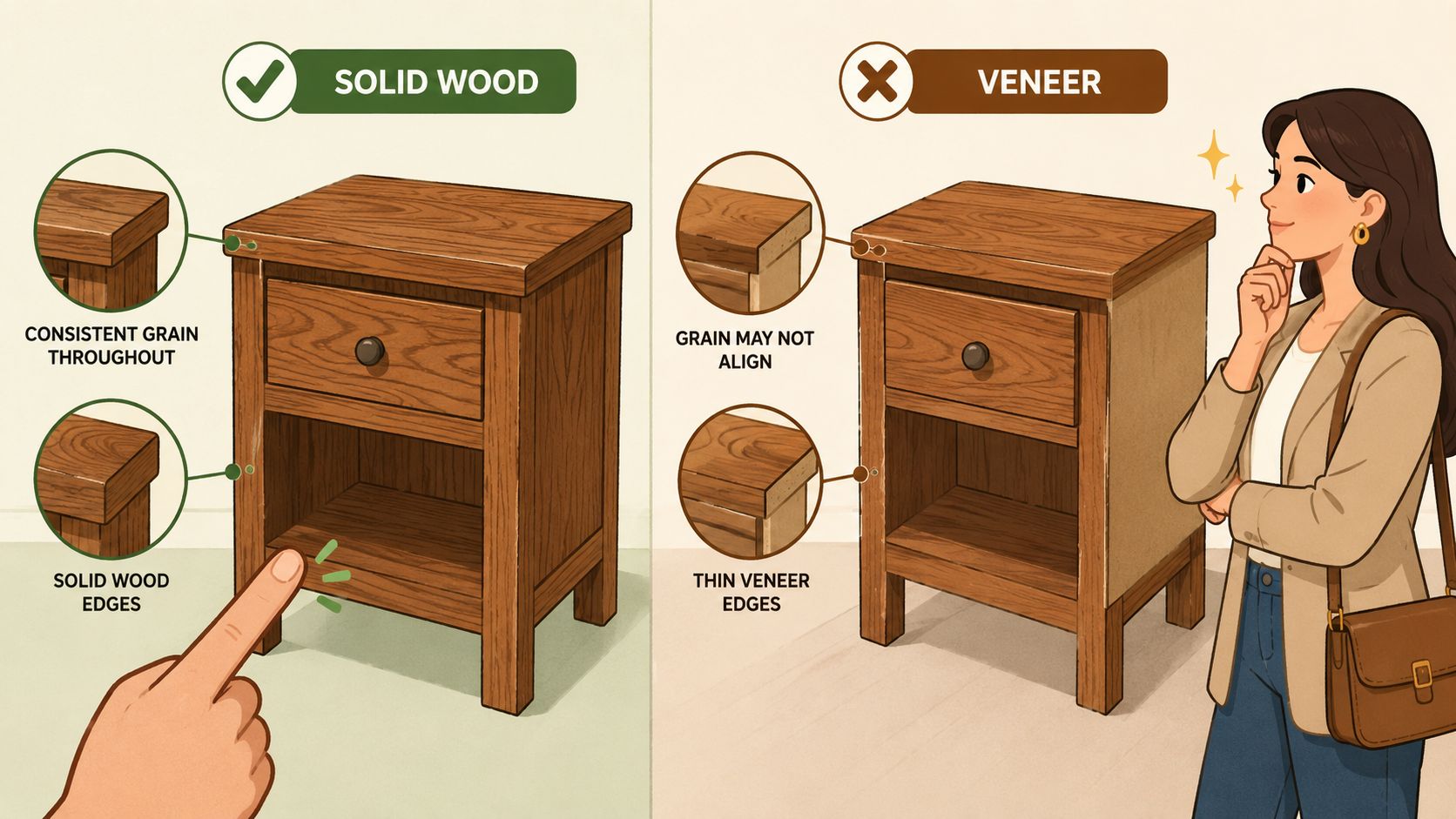
Most shoppers can learn to spot solid wood and veneer in just a few minutes. It's not magic. It's observation.
Solid wood furniture is usually identified by continuous end grain at edges and corners, non-repeating grain variation, and visible glue lines spaced roughly 10 inches apart where boards are joined. Veneer often shows repeated or mirrored grain across large panels and lacks true end grain on the surface, as described in this guide on how to tell solid wood from veneer.
Check the edges and corners
Edges tell the truth fast.
On solid wood, the grain should look like it continues naturally around the piece. At a corner, the wood has depth and continuity. On veneer, the top surface may look convincing, but the edge can reveal a different material, a thin band, or a visual break in the grain.
If the piece has a broad top, kneel down and look at the side profile. That's often where the difference becomes obvious.
Look for pattern clues
Large surfaces can give veneer away.
A mirrored or repeated grain pattern often points to veneer. That isn't a flaw. In many cases it's done intentionally and can look very elegant. But if the same grain movement appears in a way that seems too symmetrical across a large area, it's worth taking a closer look.
A practical read on moisture-prone spaces can also help sharpen the eye for material choices. This article on the right wood for laundry rooms offers useful context for how people evaluate wood products in tougher environments.
Ask the right questions
A good shopper doesn't just ask, “Is this real wood?”
Better questions are:
- What is the top made of: Solid boards or veneer over a core?
- What are the sides and drawer fronts made of: Construction often varies by part.
- Can this surface be refinished later: That answer changes ownership expectations.
- How should this be cared for in everyday use: Care tells a lot about the material.
For anyone who wants a quick primer before visiting a showroom, this guide on how to tell if furniture is real wood is worth reading first.
Making the Right Choice at Gates Home Furnishings
The most useful part of this decision usually happens in person. Photos can show color and style, but they don't show heft, edge detail, surface feel, or how a drawer glides.
In a 30,000 sq. ft. showroom in Grants Pass, shoppers can compare a reclaimed wood dining table from the Unique Finds selection with a cleaner-lined bedroom or media piece built with veneered panels. That side-by-side experience matters because solid wood vs veneer is easier to understand when the hand can trace the grain, the eye can study the corners, and the household can picture where the piece will live.
What matters most in the showroom
The strongest buying conversations usually focus on lifestyle, not labels.
A household furnishing a forever dining room may lean toward solid wood. A buyer refreshing a guest room or wanting a sleek entertainment setup may prefer veneer. Brands carried in-store, including La-Z-Boy, Flexsteel, Ashley, and Beautyrest, help give shoppers a range of construction styles and price points to compare without guessing.
For buyers who feel uncertain reading tags and specifications, how to read furniture product descriptions and buy with confidence can make the shopping process much clearer.
The right furniture choice isn't the one with the louder label. It's the one that fits the room, the budget, and the way the household actually lives.
Ownership after the purchase
The decision doesn't end at checkout.
Flexible payment matters for many Southern Oregon families, which is why Gates Easy Pay includes $0 down, 6-month interest-free options, and no-credit-needed pathways. Delivery matters too. Professional white-glove service means the team assembles furniture in the home rather than dropping boxes at the curb, and mattress haul-away is available when needed.
That approach reflects the same promise George Gates made back in 1946. Service and Value still means helping people buy with open eyes, whether they're coming from Medford, Central Point, Ashland, or anywhere else in the Rogue Valley.
For anyone comparing solid wood vs veneer in real life, the easiest next step is to see both side by side, ask questions, and test what feels right for the home. Visit Gates Home Furnishings in Grants Pass to explore the showroom, compare materials in person, and browse design-forward pieces, heirloom-minded options, Unique Finds, and flexible financing for homes across Southern Oregon.