Chairs with Ottoman: Setups, Comfort and Room Fit


A chair and ottoman look simple in a photograph. Then the pair arrives, the ottoman gets parked beside the sofa because it blocked the walkway to the kitchen, and the chair ends up used with a throw pillow jammed behind the lower back and a footstool nobody touches.
That gap between the showroom and the living room is rarely about style. It comes down to four measurable things: seat height, arm support, ottoman distance, and the floor space the whole setup claims. Get those right and the pair earns a spot in daily use. Get them wrong and it becomes the most expensive decoration in the house.
There's a fifth question hiding under all of it, and it matters more as a household ages: can the person sitting in that chair get out of it without help?
Chairs with Ottoman Setups Compared at a Glance
The right chair-and-ottoman setup depends on what the room needs to do. A separate ottoman gives you a movable footrest, a recliner keeps its footrest attached, and a power lift chair uses a motor to tilt the seat forward and assist the sitter when standing. These options serve different purposes, so compare how each works in the room before choosing by appearance.
A 2024 U.S. consumer survey published by Furniture Today Strategic Insights in 2025 found that about 14% of shoppers considering or having recently purchased upholstered sectionals said their configuration included a chair, recliner, or ottoman.
| Setup | How It Works | Best For | Watch For |
|---|---|---|---|
| Matching club chair and ottoman | Separate ottoman sized to the chair and pulled up in front | Reading corners and living rooms | Ottoman can drift out of place |
| Swivel club chair with ottoman | Chair turns on a base and the ottoman pairs for lounging | Conversation areas | Swivel base needs floor clearance |
| Recliner with footrest | Built-in footrest extends as the chair reclines | Daily TV watching | Needs space behind the chair to recline |
| Power lift chair | Motor tilts the seat forward to help you stand | Easier standing and mobility support | Needs an outlet and space behind the chair |
| Storage ottoman with accent chair | Ottoman stores blankets or games and seats an extra guest | Small and multipurpose rooms | Open lid can block the seat |
Start with the row that matches the room's main use. For reading, a separate ottoman can be positioned where your feet rest, then moved when the room needs more open floor. In a conversation area, a swivel chair can turn toward another seat without shifting its base. For regular TV watching, a recliner keeps the footrest aligned as it extends.
The practical trade-off is flexibility versus the space needed to operate. A separate ottoman can be moved aside or used as extra seating, but it takes clear floor space in front of the chair and can drift from its intended position. A recliner keeps the footrest in place, but needs clearance behind the chair when reclining. In a compact room, that fixed clearance may make a separate chair and ottoman less space-efficient than expected.
A fast way to decide: Name the room's main use, then choose the setup that fits it. If someone at home needs help rising from a seat, consider the power lift chair row. A footrest supports lounging, while the lift mechanism addresses standing.
Choose by the activity the pair must support most often. Reading depends on a separate ottoman's placement; movie watching favors a footrest that stays aligned with the chair. For a multipurpose room, consider whether moving the ottoman or preserving clearance behind a recliner will be easier day to day.
Comfort Features That Make a Pair Worth Keeping
Softness is the easiest thing to demonstrate in a showroom and the worst thing to buy on. A deep, overstuffed seat feels wonderful for ninety seconds, then it takes two pushes off the arms to stand and the lower back rounds into the gap behind the cushion. A firmer seat with a shaped back holds you through an entire film and still feels right in year three.
Seat Support Before Softness
Look at the deck under the cushion before you look at the fabric. A webbed or sinuous spring deck with a dense foam core keeps its shape. A low platform with a thin cushion bottoms out under a 200-pound sitter within a season, and no amount of fluffing brings it back.
Seat depth decides whether the backrest can do its job. Shallow seats leave the thighs hanging. Deep seats push shorter sitters forward until the lumbar support sits behind the hips instead of behind the lower back. Sit with feet flat and check that a hand fits behind the calves without a stretch.
Cushions, Foam and What You Can Replace
High-resilience foam runs from a soft sink-in feel to firm support, and the grade matters more than the marketing name on the tag. Loose back cushions and boxed seat cushions both compress over time, so ask whether the covers reverse and whether replacement cushions can be ordered. A pair whose seat cushions can't be replaced has a service life measured in years, not decades.
The matching ottoman follows the same logic, and the format has a clear benchmark. Charles and Ray Eames introduced their Lounge Chair and Ottoman on NBC's Home program on March 14, 1956, manufactured by Herman Miller in Zeeland, Michigan, as Model 670 for the chair and Model 671 for the ottoman. The Henry Ford Museum record describes the ottoman as completing the intended reclining posture rather than decorating the chair, and New York's Museum of Modern Art added the pair to its permanent collection in 1960. That's the standard to hold any pair to: the footrest should finish the posture, not just sit there.
Upholstery and Mechanism Trade-Offs
- Leather shrugs off spills and builds a patina, but it feels cold on first contact and shows scuffs on lighter hides.
- Performance fabric handles pets, sippy cups and sunscreen with far less worry, at the cost of a slightly stiffer hand.
- Microfiber cleans more easily than a nubby natural weave that grabs and holds a stain.
Mechanisms carry their own trade-offs. Manual recline needs a few inches of push-back room and decent leg strength. Power recline needs an outlet within reach plus clearance behind the chair, and the motor is one more part in the chain. Power lumbar and power headrest help some sitters and add complexity for everyone else. Pay for power only when someone in the household will adjust it every day.
Practical rule: a feature that needs a demonstration to explain is a feature that will go unused by the third week.
The Three-Point Test
- Sit for ten minutes. Bring a phone or a book. The chair that's still comfortable at minute ten is the one that gets used.
- Lean back fully. Test the recline or the lounging angle at the ottoman distance you'll use, not half-reclined in the middle of the floor.
- Stand up without help. No hands on a display table, no push off the ottoman. If that's a struggle in the showroom, it gets worse at home on carpet.
For a deeper look at frame construction, cushion fills and fabric grades across seating, our guide to what to look for in a new sofa or chair walks through the same checks in more detail.
Checking Posture and Safe Transfers Before You Buy
A chair can feel comfortable while you are seated and still make standing difficult. If arthritis, a replaced hip, or reduced arm strength affects someone in your household, a low, soft chair may be harder to leave than a firmer, higher one. Seat height and usable arm support matter because they help determine how much effort a transfer takes. Cushion softness cannot make up for a seat that is too low or arms that are difficult to grip.
Gates' chair and ottoman collection offers a starting point for considering the pair, but fit should be judged by the person who will use it. Test the chair and ottoman together, not as separate pieces. The ottoman can support the legs when lounging, but its position should not block the approach to the seat or interfere with standing.
A Five-Point Sit Test, In Order
- Approach from the front. Walk to the chair without stepping around or over the ottoman. If the footrest occupies the natural path to the seat, move it before sitting. A comfortable lounging position is not worth an obstructed approach.
- Sit with a controlled descent. Use the arms as you would at home. Notice whether the seat supports your weight throughout the movement or drops you during the last part. If you have to fall into place, the chair may be too low or too soft for easy transfers.
- Check the feet. Place your heels on the ottoman or the floor and check whether your knees sit comfortably in relation to your hips. If the ottoman is too low, your legs may slope downward and your lower back may round.
- Find the lower back. Lean back and check that the lumbar area remains supported. A gap between your back and the cushion can leave you slouching, even if the chair feels soft at first.
- Stand without pulling. Rise using the chair's arms and your legs. If you reach for a side table or another object to get up, the seat height or arm support may not suit you.
Try the chair in shoes similar to those worn at home, and consider the floor surface where it will sit. Plush carpet can make the chair feel lower and make it harder to push up from the seat. For an easier test, place the ottoman where you expect to use it, then check that you can still approach and leave the chair without shifting it out of the way.
Why a Footrest Isn't a Mobility Aid
A lounging ottoman supports the calves while you read or relax. A lift chair uses a motor to tilt the whole seat forward, helping the feet move under the body before standing. Those functions are different. If standing is difficult, a separate ottoman may take up space without addressing the transfer problem.
Decision rule: If any part of the sit test is difficult, reconsider the seat height, arm support, or chair type. A softer cushion alone will not solve a transfer problem.
If standing is the main concern, compare lift chairs for older adults and treat the footrest as a secondary choice. The right setup supports safe sitting and standing first. Choose an ottoman only if its position and height work for the person using the chair.
Sizing and Placing Your Chair and Ottoman
A chair may fit neatly against the wall, yet its ottoman can turn the route across the room into a squeeze. Measure the pair in the position you plan to use, then check the path around it. Fit depends on the occupied footprint, not the chair's dimensions alone.
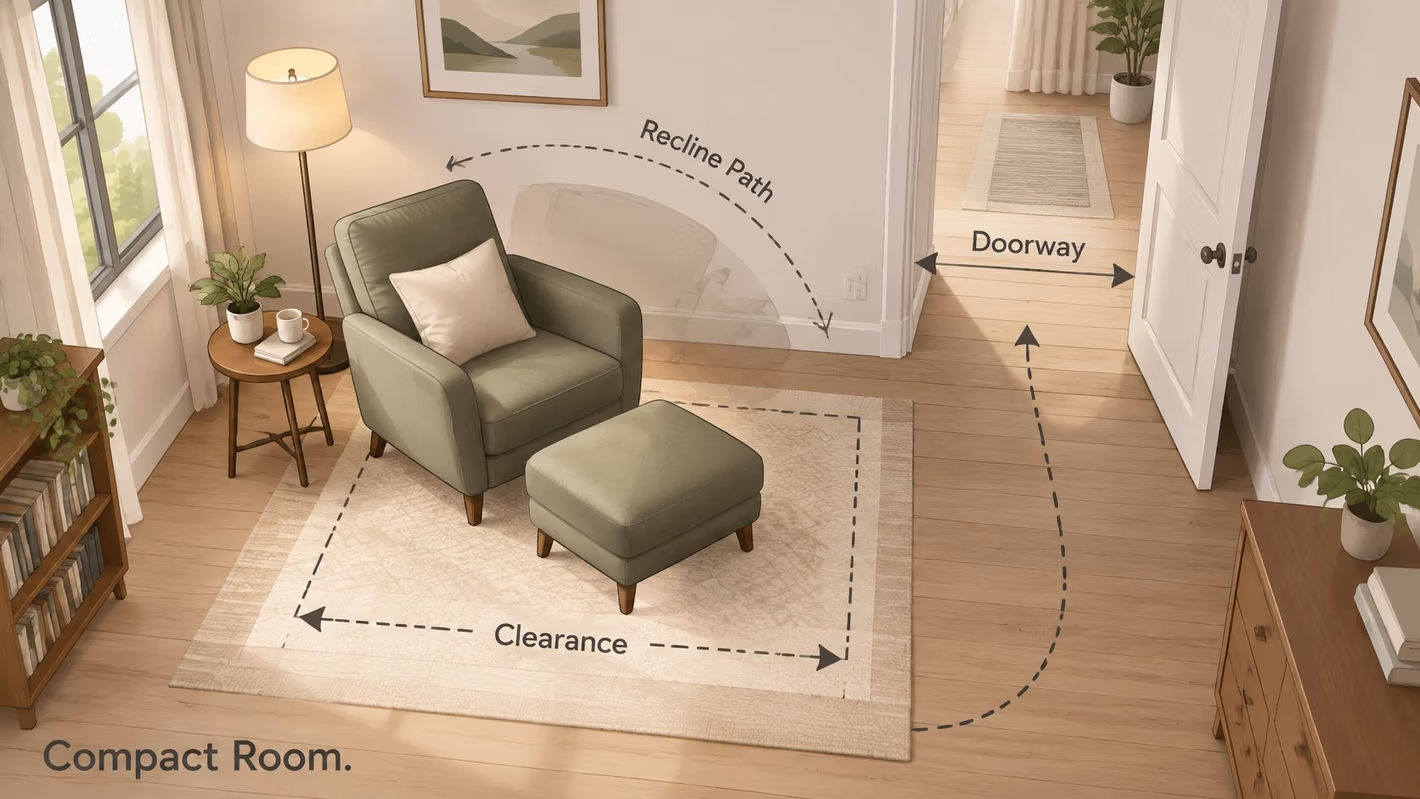
Smaller-scale seating can suit tighter rooms, where preserving a clear route matters as much as choosing a chair that fits. Homes & Gardens coverage of furniture trends recommends roughly 30 inches of clear path through a room. Treat that as a planning guide, then check how the route works around your doors, furniture and daily traffic.
Clearance Numbers to Write Down
The dimensions below are rule-of-thumb guidance for planning a layout, not specifications for every chair or ottoman. Check the actual piece and the way you intend to sit before buying.
| Measurement | Typical Reference | What to Check |
|---|---|---|
| Clear walkway | 30 in minimum | Keeps the route through the room open |
| Chair seat height | 17-19 in typical | Sets how easily you sit down and stand up |
| Ottoman top height | 16-18 in typical | Should sit near the seat cushion level |
| Lounging gap between chair and ottoman | 12-18 in typical | Keeps the ottoman reachable without crowding |
| Recline clearance behind chair | Model spec, often listed as wall clearance | Confirm it against your wall and baseboard depth |
Three Layouts That Work
- Fixed lounge position. Angle the chair into the room and keep the ottoman in front. This suits a reading corner away from a main route. Check that the ottoman does not block a doorway, floor vent or light switch.
- Movable ottoman as occasional seating. Keep it in front of the chair for lounging, then move it against a wall when guests need another seat. This layout works only if there is a practical place to put it and someone can move it.
- Ottoman tucked beside the chair. Set it beside the chair to preserve a walking route in a narrow room. You give up the full lounging position, so plan to use the chair as the main seat and the ottoman as an extra perch.
The Order to Measure In
Start with the chair's full footprint in use, including its reclined position if applicable, and place the ottoman where you expect to rest your feet. Add room for people to pass on the sides they use. Then try the ottoman at several distances, checking that you can reach it without sliding forward. Mark doors, vents, rugs and pathways on the floor with painter's tape before buying. Follow our guide to how to measure furniture with a tape measure and a notepad.
Ottoman position also affects how easily you sit down and stand up. Keep it close enough to reach without scooting forward, but clear of the route your feet need when rising. If the chair has arms, make sure the ottoman does not force an awkward turn before you can use them for support. Recheck the layout with the room's usual rug in place.
The Case Against Assuming Separate Is More Efficient
A separate ottoman can cost more floor space than an attached recliner. Its advantage is flexibility: it can move aside or serve as extra seating. That only helps when the room has a place to park it; otherwise, a loose footstool may clutter a narrow route. A recliner with a footrest that folds away can make better use of a tight room.
Outlet and one-of-a-kind pieces may differ in size, so measure the specific item rather than relying on a similar floor model. If you are renting or downsizing, tape the intended footprint on the floor and live with the layout before deciding.
Bring your measurements to the Grants Pass showroom and check whether the chair, ottoman and walking route fit together. A few minutes spent marking the footprint can prevent a pair from taking over the room.
Styling a Pair with Reclaimed and Teak Pieces
A matching chair and ottoman read as a set the moment someone walks in. That's either the goal or the problem, depending on the room. The same fabrication on both pieces looks calm and deliberate in a small living room, and a little flat in a large one where nothing else repeats.
Match, Contrast, or Break the Set on Purpose
An ottoman in a contrasting leather or a pattern gives the eye somewhere to land and keeps the pair from reading like a catalog page. The risk is drift: two unrelated finishes plus a busy rug and the corner looks assembled rather than designed. Mix sources only when one element repeats through the room, such as a wood tone on the side table and the chair frame, or a black metal finish on both a lamp and the ottoman base.
The Rule of Three and the Visual Triangle
Group decorative items in odd numbers, three being the reliable default. A single vase on an ottoman looks accidental. Three objects of different heights look considered.
Then think in a triangle. A tall lamp or a floor plant at one end, the chair in the middle, a lower ottoman or side piece at the other. The eye moves across the group instead of stopping dead at one edge. That triangle is also what keeps a pair from blocking a walkway, because it forces you to give each height its own spot.
Reclaimed, Teak and One-of-a-Kind Anchors
The room stops looking like everyone else's. A reclaimed wood ottoman can pull double duty as a coffee table in front of a sofa, and the rough grain softens the formality of a classic club chair. A teak swivel chair brings warm, honeyed grain to a room built on grey and cream. Side tables and consoles in reclaimed wood do the same work for a smaller budget.
Our unique home decor pieces are where most of these one-of-a-kind pieces live, and they're the reason a Southern Oregon living room doesn't have to look like a showroom floor anywhere else.
Three Finish Pairings That Hold Up
- Walnut with cream upholstery. Warm, dark wood against a light fabric. Best in a room with north-facing light that runs cool.
- Black iron with grey fabric. Sharper and more urban. Keeps a small room from feeling sweet, and hides wear on high-traffic arms.
- Natural teak with rust or olive. The pairing that suits a sunroom or a room with a lot of plants. Rust leans warm, olive leans calm.
Choose one anchor finish before shopping and repeat it at least twice in the room. A pair that agrees with its side table looks intentional. A pair that agrees with nothing looks new.
Choose Your Pair Within Your Budget
Start with the chair. It determines the fit, arm support and ease of standing, and usually takes the largest share of the budget. Choose the ottoman afterward, matching the finish or using a deliberate contrast. It is often the easier piece on which to save.
Where Budget Actually Goes
Frame construction, foam grade and reclining mechanism affect how a chair holds up and feels in use. Fabric is more visible and can be a practical place to reduce cost without changing the chair's basic support. A well-built chair in a modest fabric is a better long-term choice than an inferior chair dressed in expensive upholstery.
The Gates Outlet carries clearance items and special values, with new pieces added regularly. The trade-off is a changing selection: if a piece fits your room and budget, waiting may mean it is no longer available. Measure the chair's footprint and check the ottoman's placement before deciding, especially if the separate pieces could crowd a walkway.
Financing That Fits the Way People Buy
Financing options include $0 down with six equal payments, no-interest plans when paid in full within the promotional period, no-credit-needed financing and lease-to-own programs. An online-only application is also available. Review the furniture financing options before settling on a chair, and compare the full purchase cost with the monthly commitment.
Delivery That Ends With a Ready Room
Professional in-home delivery includes heavy lifting, assembly and setup. For a recliner or lift chair, setup matters: the chair needs room to operate, and the ottoman must sit where it supports the feet without obstructing the approach or path through the room.
Gates Home Furnishings serves furniture shoppers in the Grants Pass, Ashland and Medford area. The Grants Pass showroom displays pieces including the Barolo Vintage Whiskey Swivel Club Chair, Tahoe Harvest Coffee Table with Drawer and Kalispell Harvest End Table. A qualified staff interior decorator can discuss your tastes, lifestyle and budget to help plan a living room, dining room or bedroom. Gates also matches a lower price on Flexsteel, Beautyrest, La-Z-Boy or Ashley furniture offered in the Grants Pass, Ashland or Medford area.
The Final Checklist
- Confirm clearance. Allow for the walkway, recline space behind the chair and an ottoman position that does not block the approach.
- Check the fit. Sit back with your feet supported, then stand without pulling on nearby furniture. Arm support and seat height affect how easy that transfer feels.
- Choose the setup. A separate ottoman offers flexible placement. An attached recliner can take less room, while a lift chair may suit someone who has difficulty standing.
- Set the budget. Price the chair first, then the ottoman, and arrange financing and delivery before delivery day.
Choose a separate ottoman when its flexibility is useful and the room has space for it. If it crowds the walkway or is awkward to move aside when standing, an attached recliner may be the more practical fit. Gates Home Furnishings carries recliners and lift chairs from La-Z-Boy, Flexsteel, Ashley and Beautyrest. Bring room measurements and photos, and compare the chair, ottoman and recline positions in person at the Grants Pass showroom. Visit Gates Home Furnishings to browse the collection online or plan a showroom visit.