Loft Bed with Desk: 2026 Southern Oregon Buying Guide

A bedroom gets small fast when it has to do two jobs. In Grants Pass, Medford, Ashland, and across the Rogue Valley, that usually shows up the same way, a kid needs a study spot, a college student needs a bed and desk in one room, or a renter needs floor space that can't disappear under bulky furniture. A loft bed with desk solves that problem by stacking sleep and study into one footprint, which is exactly why this category keeps showing up in compact homes and student rooms. Market data for loft beds points to rising demand for multifunctional furniture, with the residential segment making up over 60% of demand and online channels estimated at around 35%.
That pattern fits what Southern Oregon families already know. Since Est. 1946, Gates Home Furnishings has helped households sort out the hard part, not just picking furniture, but making sure it fits daily life, room height, and budget. George Gates' original promise of “Service and Value” still matters because a loft setup that looks smart on a screen can turn into a bad buy if the ceiling is tight, the desk is too low, or the bed is awkward to climb every night.
Why Southern Oregon Families Are Choosing Loft Beds with Desks
A common scene plays out in homes from Grants Pass to Central Point. One child needs a quieter place to do homework, another wants more room for toys or hobbies, or a young adult is moving into a smaller space and does not want a separate bed and desk taking over the entire room. A loft bed with desk answers all three problems at once, and that practicality is why it has moved from a niche idea to a mainstream furniture choice.
One footprint, two real jobs
The strongest appeal is simple. One frame handles sleeping above and work or study below, so the room stops feeling crowded by duplicate furniture. That matters in apartments, dorm-style rooms, shared bedrooms, and compact Southern Oregon homes where every square foot has to earn its keep.
Families in the Rogue Valley also care about how a room functions after the furniture is in place. Ceiling height, mattress thickness, and under-loft clearance decide whether the setup feels open or awkward. A frame that looks tidy in a showroom can turn into a tight fit if the mattress sits too high or the desk zone leaves too little headroom.
The broader market trend matches what local shoppers are already choosing. Analysts at A market analysis of loft beds have pointed to rising demand for multifunctional furniture because it fits modern rooms better than single-use pieces. That pattern matters here because Southern Oregon families are not buying for looks alone, they are buying for daily use.
Practical rule: If a bedroom needs both a bed and a desk, a loft setup is usually more efficient than squeezing in separate pieces and hoping the room still feels usable.
That same logic explains why families comparing dorm ideas and kid-room setups often prefer a loft bed with desk over a traditional bed frame. If you are pulling together a smaller room, stylish dorm essentials on a budget can help finish the space without adding visual clutter.
At Gates Home Furnishings, the conversation starts with the room, the sleeper, and the daily routine. That order matters. A good-looking loft bed is not a good buy if the ceiling is too low, the mattress is too thick, or the person using the desk cannot sit comfortably underneath it.
Measuring Your Room for a Loft Bed with Desk
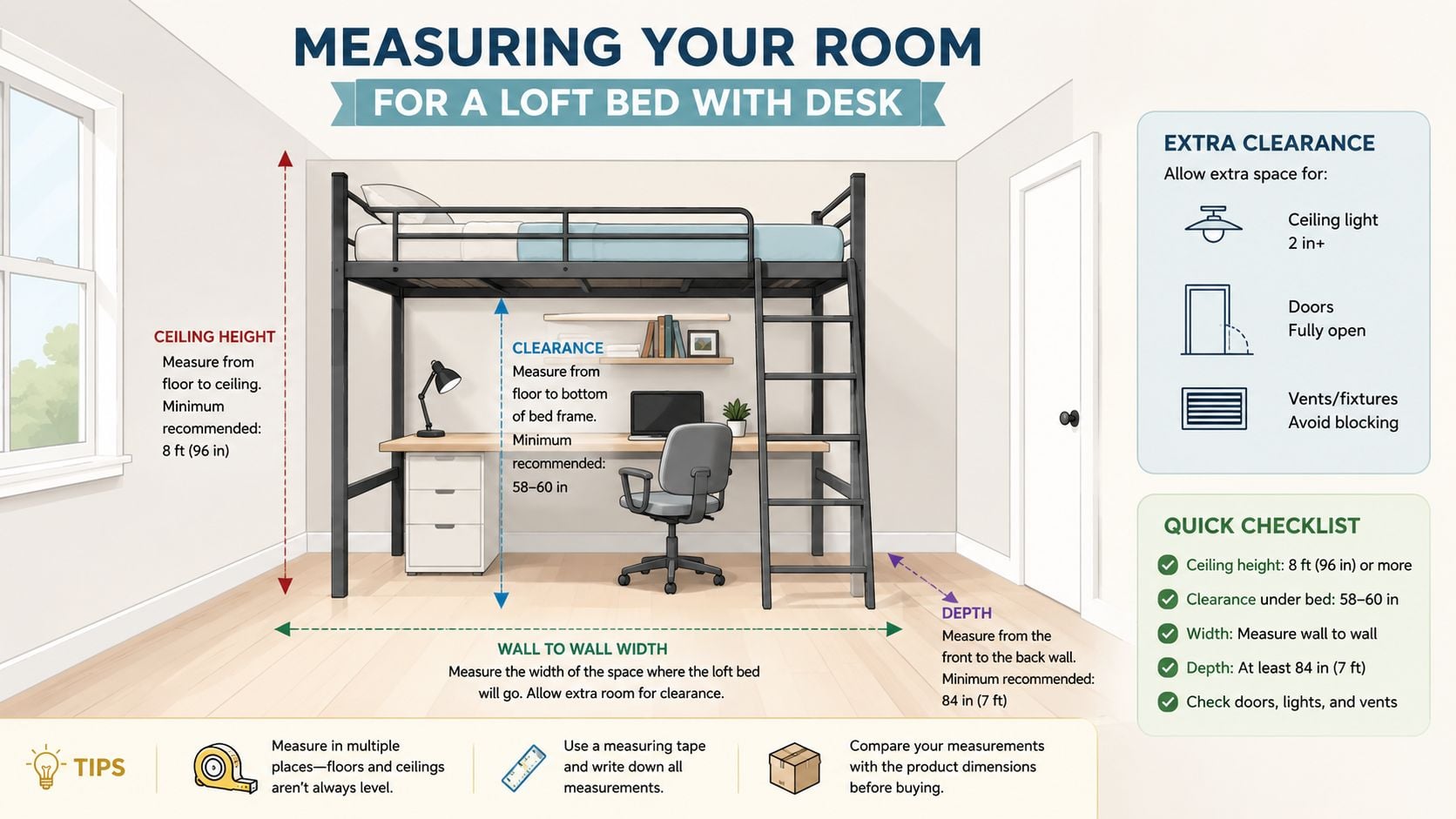
Measure the room first, then shop. That's the cleanest way to avoid a return, because a loft bed with desk can look compact in a store and still feel oversized once it lands in a real bedroom. The first check is ceiling height. Standard 8-foot ceilings can work for many designs, but only if the frame height and mattress thickness are matched carefully, and that's where many buyers get tripped up.
The three measurements that matter most
Start with the full ceiling height, then measure the planned bed location from floor to ceiling, not from a guess. Next, check the space above the mattress platform, because the sleeper typically needs about 30 to 36 inches of clearance between the top of the mattress and the ceiling. Under the bed, the desk zone usually needs about 48 to 52 inches of vertical space for comfortable use, which is why a tall frame in a short room can feel cramped even when the floor plan looks generous.
A simple tape-measure check beats assumptions every time. The internal guide on how to measure furniture is useful because the same logic applies here, measure the room, then measure the delivery path, then measure the assembled item, not just the box.
A loft bed can fit in one room and fail in another for one reason, mattress thickness. A thicker mattress raises the sleeper closer to the ceiling and can steal the very headroom that makes the bed comfortable. The room hasn't changed, but the usable space has.
Read the product spec, not just the headline size
The best product sheets list under-loft height, mattress thickness limits, and the total assembled footprint. Some beds also have desks that slide or tuck inward, which changes how much room the furniture needs during the day. If the desk can't open fully without hitting a dresser or wall, the setup won't feel practical.
Good fit means the bed and desk both work at the same time, not just one after the other.
That's the key test. If a room has low ceilings, a tall mattress, or a narrow walkway, the purchase should be reconsidered before money changes hands. A loft bed with desk is a fit-first product, and room measurements decide the outcome.
Weight Limits and Safety Standards You Cannot Ignore
Safety comes before style, because a loft bed with desk is a structural product, not a decorative one. The frame, guardrails, ladder, mattress thickness, and age guidance all work together. If one part is off, the whole setup is less secure.
Start with age and mattress limits
The U.S. Consumer Product Safety Commission says children under 6 years old should not use the upper bunk or loft sleeping surface. That age guidance matters more than marketing photos, because a low-looking frame is still a raised sleep surface. For families, that should be treated as a hard stop.
Mattress thickness matters just as much. Published product examples and buying guides commonly cap mattresses around 6 to 10 inches, and some designs require 8 to 10 inches or less to preserve guardrail exposure. One common loft-bed buying guide also stresses age suitability, ladder access, and room safety in the same decision process, which is why our own guide to choosing kid-friendly and pet-friendly furniture is a smart place to start before you buy. For families comparing kids' study setups, ergonomic homework desks for children is a useful reference for keeping the workspace itself practical.
Compare the structure, not just the style
A higher weight rating usually points to a sturdier frame, often with thicker steel or reinforced wood construction. The desk itself does not carry the sleeping load, but it still has to fit the overall system, so the unit needs to be built correctly from top to bottom. That is why one bed feels rigid and stable while another wobbles under normal use, even when they look similar in photos.
| Loft Bed Weight Capacity Comparison | Model Type | Weight Capacity | Max Mattress Thickness |
|---|---|---|---|
| Basic adult or combined-use model | Mainstream loft frame | 220 lb to 350 lb | 6 to 10 inches |
| Family-focused wood loft | Twin wood loft with desk and storage | 250 pounds | 6 to 10 inches |
| Heavy-duty specialty frame | Reinforced loft structure | 600 lb | 6 inches |
A cheap loft bed is expensive if it has to be replaced early. Safety and durability are the part of the budget that matters most.
Desk Configurations and Ergonomic Considerations
A loft bed with desk is not automatically a good workspace. The desk can fit under the bed and still be awkward to use every day, especially for older teens and adults who need more knee room, better lighting, or a monitor setup that doesn't feel buried under the frame. A lot of shoppers get disappointed, because “it fits” is not the same as “it works.”
Clearance decides comfort
Published models show under-loft clearance from about 52 inches to 58 inches on higher configurations, while common integrated desk heights sit around 28.7 to 28.8 inches. That leaves usable seated room, but the ratio matters. If the bed platform sits too low or the user is tall, the knees, shoulders, and head start fighting the frame.
A good rule is to treat the under-bed zone as a secondary task space, not a full office. That means laptop work, reading, school assignments, and light organization usually make sense. Long desk sessions, dual monitors, or stand-up desk use usually don't.
A motorized standing desk is usually a poor match under a loft bed, because the vertical adjustment it needs rarely plays nicely with the limited space above it.
That's why many families do better with a simple chair, a low-profile task lamp, and clean cable routing instead of trying to recreate a full office under the bed. For shoppers comparing chair fit and lumbar support, office chairs with lumbar support can help narrow the seating choice without overbuying for a compact room.
Students and adults need different setups
Younger students can often live happily with a smaller desk surface, especially for homework and art projects. Adults and older teens usually need more clearance, better chair movement, and a more forgiving desk layout. The same loft bed can feel efficient for one person and cramped for another, depending on posture and height.
For parents looking at school-focused spaces, ergonomic homework desks for children is a useful reference point for the desk side of the equation. It reinforces the same idea, the work surface has to support the user, not just fit under the bed.
Lighting deserves its own mention. Under-loft spaces can feel dim if the bed blocks the overhead light, so buyers should plan for a task lamp or wall-mounted light source. Airflow matters too, because tight vertical spaces can feel warmer and more closed in than a normal desk nook.
Professional Delivery and Assembly Makes the Difference
A loft bed with desk has too many safety-critical parts to treat like a casual weekend project. The frame has to go together square, the guardrails need proper alignment, and the ladder or stairs have to feel solid every time someone climbs up or down. If one connector is loose, the whole bed can feel off.
Assembly is part of the product
DIY assembly often sounds manageable until the pieces are on the floor and the room is already crowded. Loft beds usually have more hardware, more alignment points, and more steps than a standard bed frame. That's before the mattress, desk, and storage pieces get involved.
Professional in-home delivery handles the part that most families don't want to manage alone. Gates Home Furnishings offers furniture delivery and assembly so the frame gets set up, the components get placed correctly, and the old mattress can be hauled away when needed. That matters because a loft bed with desk is only useful when it's assembled correctly from day one.
Practical rule: If the frame is elevated, the assembly should be done with the same care as any other safety-related household install.
That's also where a protection plan can make sense. The Gates Care Shield plan adds peace of mind for long-term ownership, especially in homes where furniture gets real daily use from kids, guests, and busy routines. Families who want the delivery experience to be part of the purchase, not an afterthought, usually appreciate that approach.
Why the service layer matters
White-glove delivery saves time, but the bigger value is accuracy. The bed gets installed by people who work with furniture every day, which lowers the chance of missing a guardrail step or misaligning a desk piece. For a product this tall and this functional, that's not a luxury. It's good ownership.
The company philosophy goes back to 1946, and the original promise of Service and Value still shows up in the delivery process. That's the kind of support a family notices when a heavy frame has to go upstairs, through a narrow hall, or into a small bedroom that doesn't have much room for mistakes.
Choosing the Right Loft Bed for Your Household
The right loft bed with desk depends on who's using it and how often. A student with a small room needs different features than an adult in a studio apartment, and both need different things than a parent shopping for a child's first loft bed. Good buying happens when the bed matches the household, not when the marketing photo wins the argument.
Match the frame to the user
For school-age children, the first question is safety, then climbability, then desk usefulness. If the child is under the age guidance for upper sleeping surfaces, the purchase is off the table. If the child is older but small, a lower loft or a more open ladder design may be the smarter call.
For teens, the workspace starts to matter more. That means checking under-loft clearance, desk width, and chair fit before choosing a frame. A setup that works for quick homework can still fail if the teen needs long study sessions or larger books and supplies.
For renters and adults, disassembly and durability rise to the top. If the room may change soon, the frame should come apart without drama. If the bed will stay in place for years, sturdier construction and higher weight capacity deserve attention.
Use this decision filter
- Choose a loft bed with desk when floor space is scarce and both sleep and study must happen in the same room.
- Choose a lower or simpler setup when ceiling height is tight, the mattress has to be thicker, or the sleeper needs more headroom.
- Choose stronger construction when the bed will see daily use, heavier weight, or older teens and adults.
- Choose a separate desk when the under-bed work area would be too cramped to use comfortably.
The honest contrarian take is this. Some loft-bed-with-desk setups are poor value for younger children or long-term adult use unless the room height, circulation space, and durability specs are unusually good. A lower loft or a separate compact desk can be the better buy when the room doesn't support a raised system.
That's the kind of judgment Southern Oregon families usually appreciate. The best choice is the one that fits the room, the user, and the daily routine without forcing the furniture to do too much.
Visit Our Grants Pass Showroom or Browse Online
The fastest way to buy confidently is to see the scale in person. Gates Home Furnishings has a 30,000-square-foot showroom in Grants Pass where shoppers can test comfort, compare layouts, and see how different bedroom pieces feel in person. That matters with loft furniture, because photos can't show clearance, access, or how a frame changes the feel of a room.
Our showroom also includes Unique Finds, including reclaimed wood, teak, and one-of-a-kind statement pieces that stand apart from standard big-box selections. We also carry trusted brands like La-Z-Boy, Flexsteel, Ashley, and Beautyrest, so families can compare styles and quality across more than one room in the home. Financing helps too, with Gates Easy Pay options that include $0 down, 6-month interest-free, and no-credit-needed programs.
For shoppers who prefer to research first, how to use online furniture photos to make smarter buying decisions can help bridge the gap between browsing and buying. That's useful when a loft bed with desk has to fit a specific room and a specific budget.
Since 1946, George Gates Jr.’s promise of Service and Value has shaped how this business helps local families. The goal is simple, give Southern Oregon a place to find practical furniture, careful guidance, and real service after the sale.
Visit our Grants Pass Showroom to compare loft bed options in person, or browse online when you're ready to narrow the choices from home. Gates Home Furnishings can help you find a loft bed with desk that fits the room, the sleeper, and the budget, with delivery and assembly available to make setup easier. Start with Gates Home Furnishings and take the next step toward a room that finally works the way it should.