Home Office Furniture Luxury: A Buying and Design Guide


A spare bedroom in a Grants Pass house sits quiet most of the week, then turns into a laptop station for a couple of days. The desk has to sit comfortably beside the sofa and the dining table, not look like a cubicle that landed in the guest room. That's the true test of home office furniture luxury. A piece has to earn its place on workdays and still feel like part of the home when nobody is logged in.
Why a Luxury Home Office Is a Part-Time Investment
Say the spare room gets used two or three days a week. An oversized executive desk can look impressive on delivery day and then crowd the walkway the rest of the month. Before spending at that level, it helps to see how big the category has become and how little of the week many rooms work.
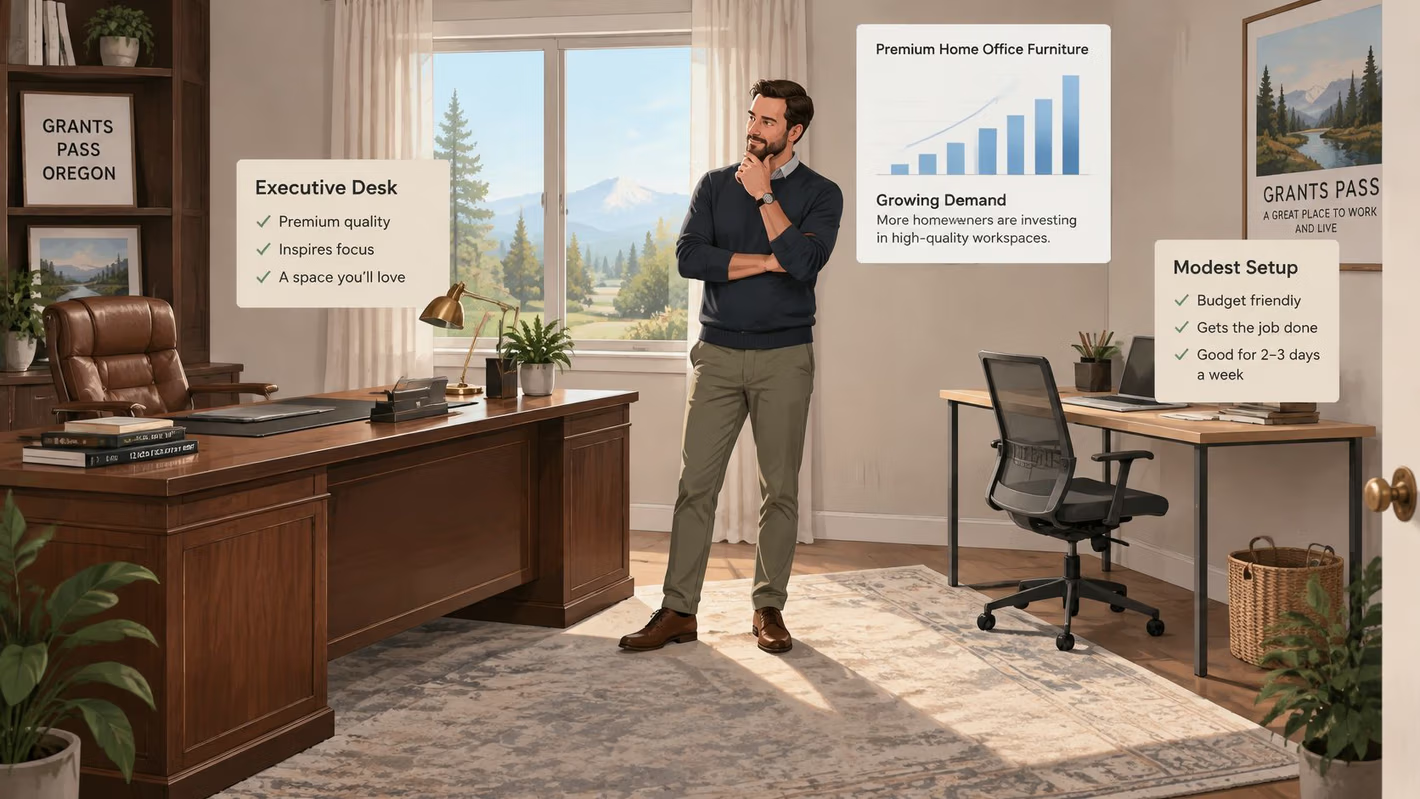
The Mordor Intelligence luxury furniture market report records that Grand View Research valued the global luxury furniture market at approximately USD 31.1 billion in 2024 and projected USD 39.8 billion by 2030, a 4.2% compound annual growth rate from 2025 through 2030. Those figures shift with methodology, so treat them as direction, not a price tag for one desk.
Work patterns tell a tighter story. Workers average about 1.27 days working from home, and Cisco's 2025 hybrid work study of 21,513 employers and employees in 21 markets found that 45% had hybrid arrangements. A room used that lightly shouldn't be furnished like a full-time suite.
Part-time luxury means the room looks refined when it isn't working, and it still supports a laptop, a video call, storage, and posture on the days it does. A desk that closes into a console, hidden cables, and a lamp you can move will outperform a fixed executive wall.
The checks ahead cover materials, the pieces worth buying, fit and layout, color, spend and financing, local delivery, and a short list to confirm before you commit. By the end you'll know how many days the room works, which pieces earn their price, and what to buy first.
What Makes Home Office Furniture Truly Luxury
Luxury here is performance over decades, not a logo or a large price. Three layers decide it, and they have to line up together.
Materials, joinery, and finish
Solid hardwoods such as oak, walnut, and cherry give a top that can be refinished. Teak brings dense grain and a warm tone that holds up in a room with seasonal humidity swings. Reclaimed wood carries its own grain and history, so two consoles from the same lot won't match like a catalog pair, and that's the point.
Craftsmanship shows in the places hands touch every day. Look for dovetailed drawers, mortise-and-tenon joints, grain that continues across panels, and tight, even gaps around doors. A drawer that racks on day one will only get worse.
Finishes should match the wood. Catalyzed lacquer stands up to cups and keyboards. A hand-rubbed oil on solid wood can be renewed at home. On seating, full-grain leather outlasts bonded leather, which is scraps glued together and tends to peel at the arms.
Indoor air, not just the shine
A glossy top doesn't prove the panel underneath is clean. The U.S. Environmental Protection Agency identifies pressed-wood products bonded with urea-formaldehyde adhesives as important indoor formaldehyde sources, including particleboard, hardwood plywood, and medium-density fiberboard. MDF has a high resin-to-wood ratio and is generally recognized as the highest-emitting of these common categories.
Ask for low-emitting panel documentation. Favor solid wood or a well-sealed veneer where it fits the budget. Ventilate after new furniture arrives, and keep temperature and humidity moderate, because those conditions change how much formaldehyde stays in the air. On a reclaimed or teak piece, also check moisture stability, odor, finish condition, and whether hidden parts are composite.
Our guide to solid wood versus veneer walks through how those constructions differ in daily use.
| Element | Luxury standard | Care routine |
|---|---|---|
| Solid hardwood | Oak, walnut, or cherry; dovetailed drawers; grain matched across the top | Dust weekly; wipe with a barely damp cloth; keep out of direct sun |
| Veneer over solid core | Quality veneer with consistent edge banding and no visible delamination | Avoid soaking edges; watch for lifting during humidity changes |
| Reclaimed wood | Documented source, stable moisture content, and a sealed surface | Oil or wax periodically; expect small seasonal movement |
| Teak | Dense grain, natural or oil finish, and even color | Mild soap and water; oil yearly if you want the warm tone |
| Leather upholstery | Full-grain or top-grain hides with even dye | Condition every six months; keep away from heaters |
| Performance fabric | High rub-test rating and stain-resistant finish | Blot spills at once; follow the manufacturer's cleaning code |
| Metal hardware | Solid brass or steel with smooth, quiet action | Dry dust; check and tighten fittings after every move |
A well-built veneer desk with documented low-emission panels can outperform a solid-looking piece built on unlabeled composites.
Must-Have Pieces for a Luxury Workspace
Buy for the room's full day, not just the hours spent working. A desk should support the equipment you use, while storage and lighting should still make sense when the room serves as a living space. Set the desk and storage first, then choose lighting and the smaller pieces. Leave chair selection for a proper sit test.
Desk. Plan for 60 to 72 inches of width and 24 to 30 inches of depth, enough to hold two monitors and a laptop without crowding the keyboard. A cable grommet and rear channel keep cords contained. In a room that doubles as a sitting space, a convertible desk that closes into a console can hide work equipment when the workday is over.
Storage. A credenza or console about 60 inches long, with soft-close drawers and one closed cabinet, gives a printer and files a place out of sight. Reclaimed wood or teak can make the storage piece feel at home as living-room or dining furniture, and some consoles can serve as bar cabinets after work. Skip shallow decorative drawers that cannot fit a file box. A desk so wide that it blocks the walkway is also a poor fit.
Light. Combine an ambient ceiling or wall fixture with an adjustable task lamp. As a practical rule of thumb, aim for roughly 300 to 500 lux on the work surface at 3000K to 4000K, and use a dimmer for evening work. A movable lamp gives you more control over glare on video calls than a fixed light aimed at the desk.
Small tools. A monitor arm or riser frees desk space, while a cable tray keeps cords out of sight. A wool rug under the desk zone softens echo during video calls. These finishing pieces should support the work area without making the room feel like a dedicated office when the workday ends.
| Piece | Practical guide | Why it earns its place |
|---|---|---|
| Desk | Allow room for two monitors and a laptop; include cable management | Keeps equipment and cords orderly |
| Storage credenza or console | About 60 inches long | Hides printers and files while fitting a living space |
| Task lamp | Adjustable, with a dimmer | Directs light where needed and reduces evening glare |
| Monitor arm or riser | Choose a setup that frees desktop space | Keeps the work surface less crowded |
| Wool rug | Place under the desk zone | Softens echo on calls |
Ergonomics and Layout for Long Workdays
If the office doubles as living space, the chair has to support a full workday without taking over the room. Start with fit and adjustability, then choose a finish and shape that sit comfortably alongside the rest of the furnishings. A thick executive cushion may look substantial, but appearance alone says little about support.
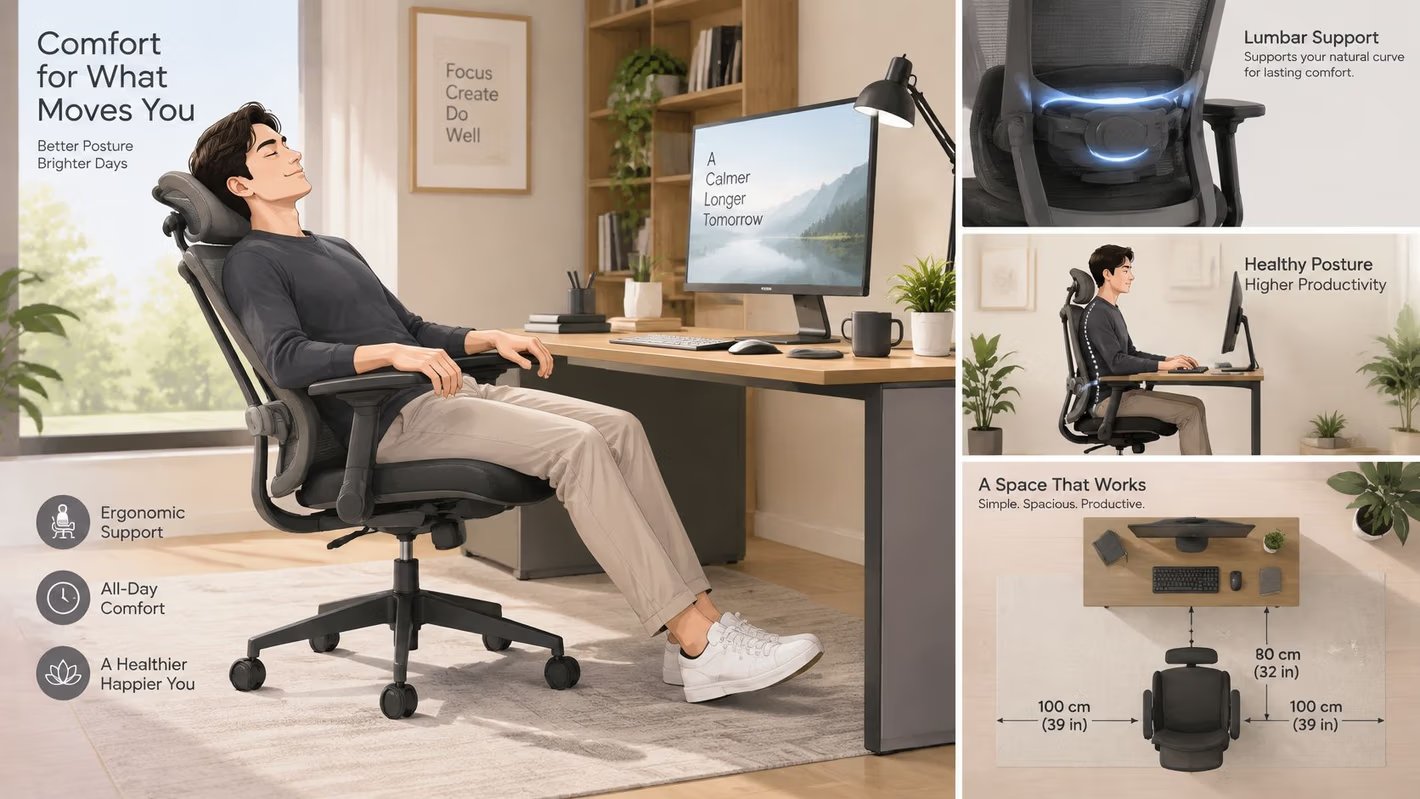
Cornell ergonomics guidance links supported reclining at about 110° to 130° with lower lumbar-disc pressure and less back-muscle activity. Adjustable lumbar support can help maintain the spine's natural curve. Research on 123 office workers found that preferred lumbar-support settings varied widely. The study's reported measurements include a mean preferred height of about 190 mm above the compressed seat and a mean preferred depth of about 387 mm from the seat front. The study also found that older workers adjusted lumbar height more often than younger workers.
What the chair has to adjust
Look for independent controls for seat height, seat depth, recline tension, and lumbar height and depth. A seat that is too deep can keep your back from reaching the backrest, put pressure under your thighs, and leave the lumbar support out of reach. Fixed cushions offer less room to adjust for differences in body shape. For a closer look at the features to consider, read our guide to office chairs and lumbar support.
| Setting | Target range | Why it matters |
|---|---|---|
| Desk height | 28 to 30 in fixed, or a sit-stand range of about 26 to 50 in | Helps keep forearms and wrists level with the keyboard |
| Chair seat height | Adjust so feet rest flat and thighs are roughly level | Supports steady posture and circulation |
| Seat depth | Leave two to three finger widths between the seat edge and the back of the knee | Lets the back stay in contact with the backrest |
| Recline angle | Supported recline of about 110° to 130° | Cornell guidance links this range with lower lumbar-disc pressure |
| Lumbar height | Mean preferred height about 190 mm above the compressed seat | Adjustable support accommodates different preferences |
| Lumbar depth | Mean preferred depth about 387 mm from the seat front | Adjustable depth helps support the spine's natural curve |
| Monitor top | At or just below eye level, about an arm's length away | Helps limit neck flexion during long workdays |
The rest of the posture
A fixed desk at 28 to 30 inches, or a sit-stand desk with a range of about 26 to 50 inches, can put the keyboard at a workable height. Keep elbows near 90 degrees and leave enough knee clearance to sit back rather than perch forward. Set the monitor top at or just below eye level, about an arm's length away. Side daylight is easier on the eyes than a window straight ahead, and a simple shade helps manage afternoon glare on calls.
Sit fully back, keep the pelvis and lumbar area in contact with the chair, plant both feet, and check that the seat edge does not press behind the knees.
If a partner, an older adult, or someone with back or neck discomfort shares the room, have each person adjust the chair and monitor separately. Write down those settings so they are easy to restore. For renters, a chair on a movable base and a monitor arm that clamps to the desk can make setup changes without altering the walls.
Styling and Color Palettes for a Refined Room
Styling is what makes the workspace read as a room in the house. A good palette does more for that than another gadget on the desk.
Start with 60-30-10. Give about 60 percent to walls and the largest pieces, 30 percent to secondary furniture and textiles, and 10 percent to accents such as brass hardware or a painted lamp. Our guide to a working color palette shows how those shares play out across a whole room, not just one wall.
Warm neutral. Oatmeal walls, greige upholstery, a walnut desk, and linen drapery. It pairs with existing living-room woods. Avoid cool gray paint that makes walnut look muddy.
Moody study. Deep green or navy walls, brass fixtures, a leather chair, and dark teak storage. It pairs with evening use and a closed door. Avoid glossy black on every surface, which turns the room into a cave on video.
Soft modern. A white oak desk, a black metal frame, and an ivory wool rug. It pairs with lighter bedrooms nearby. Avoid adding a second metal finish that fights the black frame.
Warm heritage. A reclaimed-wood top, cream walls, a teak console, and a brass task lamp. It pairs with dining pieces in the same woods. Avoid matching every item to one stain, which flattens the grain that makes reclaimed wood worth having.
Closed storage and concealed cable management keep printers and cords out of the room's off hours. Hang art with its center near 57 to 60 inches so it reads from a seated view, not only from the doorway. One reclaimed-wood piece can be the focal point. The rest of the room should stay quieter.
Tape paint and fabric samples to the wall and look at them in morning and late-day light before you commit.
Budget Tiers and Financing Options That Fit
A home office that also serves as living space needs a budget with priorities. Put the chair and desk first, since they carry the daily work. Add task lighting next, then storage. Leave the statement piece until those everyday needs are covered.
Material, brand, and size all affect the price, so use these tiers as planning guides rather than quotes. For example, an essential setup pairs an in-stock desk with a task chair and one lamp. A refined setup could combine a quality veneer or solid desk, an adjustable chair, and closed storage. Premium spending covers a full suite with upholstered or leather seating and custom-ordered pieces. At the statement tier, the budget centers on one distinctive reclaimed-wood or teak piece.
| Tier | Relative spend | What it usually covers | Financing fit |
|---|---|---|---|
| Essential | Lower spend; in-stock specials and outlet options | Desk, task chair, and one lamp | $0-down options and special values |
| Refined | Mid-range spend; desk and chair package | Quality veneer or solid desk, adjustable chair, and closed storage | Six equal payments, interest-free if paid within the promotion |
| Premium | Higher spend; full custom-ordered suite | Upholstered or leather seating and custom-ordered pieces | Review written lease-to-own terms and total cost |
| Statement | Varies by piece and material | One-of-a-kind reclaimed-wood or teak piece from Unique Finds | Check the terms available for the specific purchase |
Two financing routes, not one
Gates Easy Pay includes separate payment arrangements. $0-down options reduce what is due at purchase. The six-month interest-free promotion uses six equal monthly payments, with no interest if the balance is paid within the promotional period. No-credit-needed or lease-to-own programs serve shoppers with limited or rebuilding credit.
These options have different terms. Promotional financing depends on meeting the written payoff conditions. Lease-to-own is a separate program, with its own conditions and total cost. Read the terms before committing, and remember that approval can vary by applicant. Review the available furniture financing options before choosing a payment route.
Pair a premium chair with a mid-range desk rather than spreading the budget thin across pieces you barely use.
If the room is used only one or two days a week, a premium tier for every item may not make sense. Spend where long work sessions meet the chair and writing surface. Keep storage simpler, especially in a room that needs to feel comfortable as living space when work is done.
Buying Locally in Grants Pass With Delivery Included
A desk or chair can look right online and still feel wrong in the room. At the Grants Pass showroom, you can sit, open doors and drawers, check finishes, and compare proportions with the space you have at home. The showroom covers 30,000 sq. ft., giving you room to assess pieces in person. The white-glove delivery notes explain what to expect when arranging delivery.
What you'll find on the floor
Unique Finds include reclaimed wood, teak, and one-of-a-kind statement pieces. Each piece has its own grain, proportions, and signs of the material's history. For a room that also serves as living space, a console or other distinctive piece can add character while remaining useful beyond work hours.
A home office should work with the rest of the home. Compare seating and surfaces in person, then consider how the materials and scale will fit the room when it is not being used for work.
Delivery that finishes the job
White-glove delivery includes in-home assembly and setup. For a heavy desk or a complex seating piece, that service can make delivery easier to plan and leave the furniture ready to use. Custom orders can provide configurations that are not on the showroom floor.
Before setting a delivery window, confirm what the service includes for the pieces you are buying. The furniture stores handle white-glove delivery page explains how to compare delivery services and what to ask before booking. The goal is a workspace that feels considered in daily use and still belongs in the room as a whole.
Confirm These Checks and Visit Our Grants Pass Showroom
A 2025 university study of remote IT workers reported persistent physical discomfort, improvised furniture, and weak adaptations at home. Looks won't catch that. Run this list before you buy.
- Measure the path. Include door widths, hallway turns, and stairs so a desk or credenza arrives in one piece.
- Map the spot. Confirm wall space and the traffic path, then test desk and chair fit in that exact place.
- Check repair. Drawer slides, hardware, and loose parts should be replaceable or reattachable.
- Ask for provenance. On reclaimed wood, request paperwork and confirm hidden parts aren't undisclosed composite panels.
- Read the protection plan. Ask what it covers for spills and tears.
- Book the window. Set delivery around your work hours, not the other way around.
Bring a tape measure and a note of how many days a week the room works. Visit our Grants Pass Showroom to sit in the chair, open the drawers, and test the desk height, or browse our collection online.
Gates Home Furnishings has furnished Rogue Valley homes since 1946, with seating, reclaimed and teak pieces, and whole-room setups you can test in person. If a spare room has to work a few days a week and still feel like part of the house, our team can help you sort the chair, the desk, and the financing before anything is delivered. Visit Gates Home Furnishings in Grants Pass, or browse the collection online and bring your room measurements with you.