Lift Chairs with Battery Backup: What It Really Covers


At 2 a.m., the lights go out while the footrest is raised. The remote suddenly matters, and the person in the chair may need help reaching a safe position. For a Southern Oregon household, the useful question is whether the backup can complete the movement the sitter needs.
On most lift chairs with battery backup, the batteries provide a limited emergency movement toward a seated or semi-upright position. They do not power hours of ordinary reclining. A common setup uses two 9-volt batteries, while the position reached depends on the chair's model. Like an emergency exit, this feature is meant to help someone get out of a difficult position, not keep the chair operating as usual.
Before choosing a chair, consider the sitter's weight, transfer needs, and the position they need to reach. The backup's purpose and limits should fit that situation.
What Battery Backup Does in a Lift Chair
During a power cut, backup is an emergency exit: one controlled return toward a seated position, not ongoing operation. Knowing that limit helps you plan for what the chair can realistically do when the lights go out.
The mechanism varies by model. In a common system, two nonrechargeable 9-volt batteries in the external transformer provide limited power to move the chair toward an upright or semi-upright position. The batteries are not a rechargeable pack hidden inside the seat. Check the chair's manual for the exact procedure and the position its backup is designed to reach. Pride Mobility's emergency-operation instructions
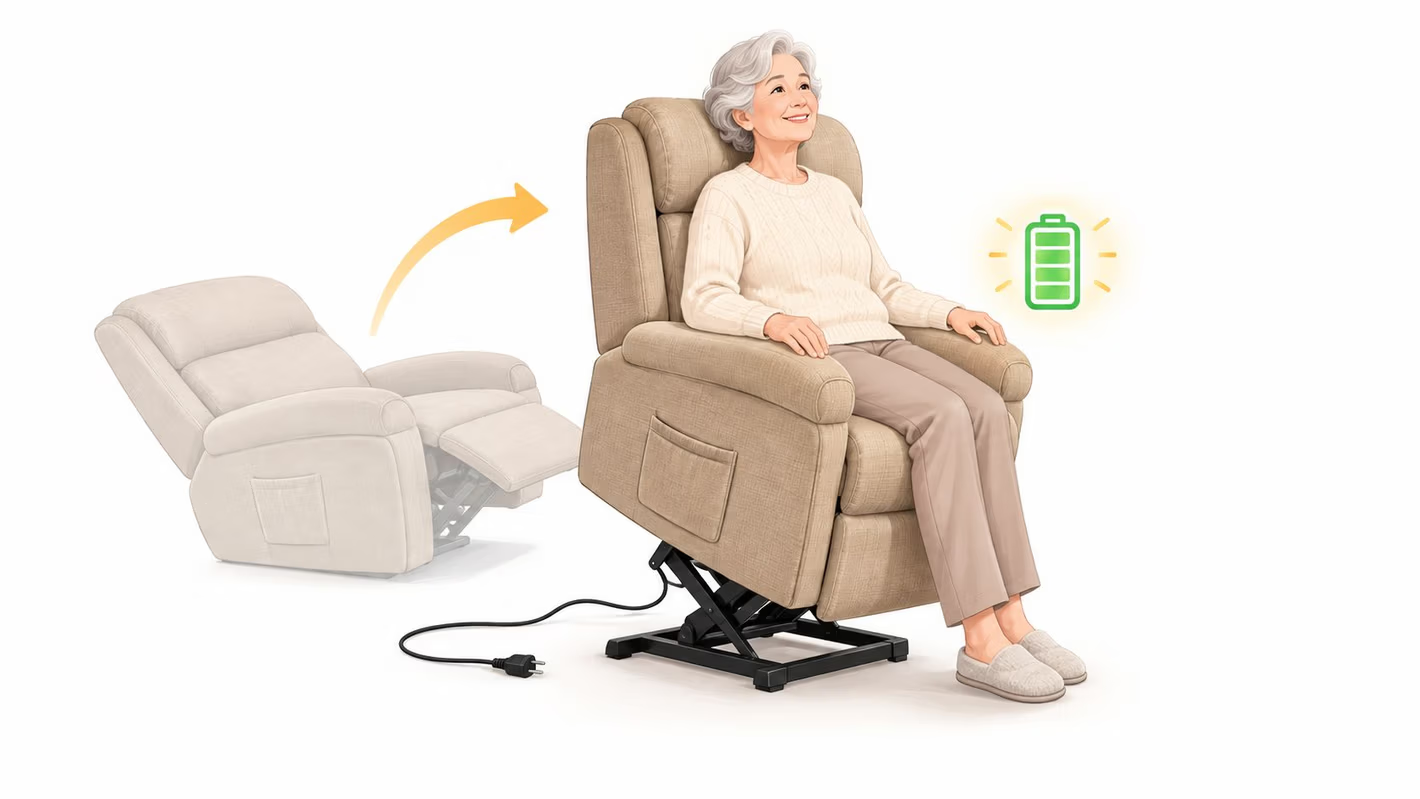
What Happens When the Power Drops
When electricity stops, the chair stops too. The person using it then follows the model's emergency procedure. For the system described in its manual, that means pressing and holding the upward control with steady pressure. Repeated taps or extra adjustments may use up the limited reserve without helping the chair reach its intended position.
What a Lift Chair Can Do on Battery Backup
Use this as a cautious guide to basic emergency systems. The movement and functions available depend on the chair and its backup design.
| Function | On battery backup | What to know |
|---|---|---|
| Return from reclined to seated | Usually one emergency movement | This is the main purpose of many basic 9-volt systems |
| Lift to a fully upright position | Not guaranteed | Backup may not raise the user completely |
| Recline or change position at will | Not ordinary use | Plan on wall power for regular adjustments |
| Massage or heat | Don't assume support | Check the model's manual |
| USB charging | Don't assume support | Check the model's manual |
| Repeated lift cycles | Limited with 9-volt alkaline batteries | Other battery systems vary |
The chair's everyday operation does not prove its backup is ready. A chair may work normally while plugged in even if its emergency batteries are old or missing. The model's manual explains the correct operation and limits; Pride's U.S. lift-chair manual is one example of model-specific guidance.
For a clearer distinction between powered everyday adjustments and manual operation, see our guide to power recliners versus manual recliners. Before an outage, read your chair's instructions and confirm which position the backup can reach.
Backup Types and How Many Movements Each Gives
Backup designs range from disposable emergency batteries to rechargeable reserves. More stored energy can help, but compatibility and the position reached matter more than the battery label. A backup is best understood as an emergency way to move the chair, not a miniature generator for ordinary use.
Lift Chair Backup Types Compared
| Backup type | Power source | Typical movements | Best fit |
|---|---|---|---|
| Two 9-volt alkaline batteries in the transformer | Disposable batteries | Often one emergency return toward seated | A brief exit movement during an occasional outage |
| External UPS | Plug-in battery unit recharged by wall power | Depends on chair requirements and the UPS rating | Households needing more than a single emergency movement |
| Rechargeable backup pack | Rechargeable pack | Product-specific motor coverage | Buyers seeking a larger outage reserve |
| Built-in lithium backup | Integrated lithium system | Model-specific; confirm movements in writing | Buyers preferring an integrated rechargeable design |
Some chair manuals recommend a 300-volt-ampere UPS for continued lift function during an outage. Check the chair's manual for the required UPS rating and confirm whether its backup can raise the occupant fully upright. A movement toward safety may end in a different position than expected.
Rechargeable packs may advertise 24 hours of motor coverage, while integrated lithium systems may list a chair's weight capacity. These specifications describe different things. Motor coverage is not a stated number of occupied lift cycles, and weight capacity does not show how many emergency movements the battery can provide.
Questions That Make the Comparison Useful
- Movement count: How many emergency movements does this exact configuration support?
- Ending position: Does it reach seated, semi-upright, or fully raised?
- Starting position: Can it return safely from each available recline setting?
- Compatibility: Is the proposed UPS or rechargeable pack approved for this chair?
- Battery details: Are batteries included, and what charging or replacement schedule applies?
Ask for the answer in terms of the actual movement and its endpoint. A household that needs one safe return to seated may be served by a basic backup. Another setup may call for an approved external reserve. In either case, the chair's manual and the battery's condition shape what the system can do.
Who Needs Battery Backup and When It Pays Off
A Grants Pass retiree recovering from hip replacement settles into a chair before bed. In this illustrative situation, a 2 a.m. outage raises a practical concern: can the chair reach the position specified in the recovery plan without an unsafe attempt to climb out?
A Medford caregiver faces a different task. In another illustrative household, the caregiver keeps a printed emergency card near the outlet, with the correct control sequence, battery installation date, and service contact information.
An Ashland household on a wooded lot might plan for an extended winter outage. Its illustrative emergency plan treats the chair's return movement as the first step toward another safe seat, not permission to keep reclining until power returns.
Households With More to Plan For
- Limited leg strength: The occupant needs assistance moving from sitting toward standing.
- Living alone: Help might not be immediately available during an outage.
- Surgical recovery: Transfers need to follow the treating clinician's guidance.
- Prescribed positioning: Breathing or heart-related needs require an individualized seating plan.
For those managing joint discomfort alongside seating decisions, MEDISTIK's resource on topical pain relief for aging joints offers a separate topic to discuss with a clinician or pharmacist. Comfort products don't replace an appropriate transfer plan.
When a Smaller Backup May Be Enough
- Independent standing: The occupant can stand unaided from the chair's emergency ending position.
- Clear exit route: The room provides an unobstructed path to another safe place to sit.
Our guide to choosing lift chairs for older adults can help families organize those everyday needs. In the showroom, we can talk through the household's actual routine rather than assuming every shopper needs the same backup system.
Size, Lift Capacity, Upholstery and Warranty Checklist
At the showroom, a chair may look spacious and still feel too deep or high once someone sits down. Have the intended user try the seat, controls, and movement toward standing, with appropriate assistance. Roomy-looking does not guarantee comfort; the sitter should test it.
| Factor | What to check | Example or benchmark |
|---|---|---|
| Seat width and depth | Compare the sitter's hips and thighs with the listed seat dimensions | Ask for the complete seat-dimension sheet |
| Lift capacity | Choose a rating above the user's weight, with an appropriate margin | Use the capacity information for the model being considered |
| Seat height | Match the seat to the sitter's knee height and transfer needs | Check foot placement and standing comfort in person |
| Wall clearance | Confirm the space needed throughout the recline | Review the model specifications before delivery |
| Motor count | Check whether motors control lifting, reclining, or separate adjustments | Ask which function each motor operates |
| Doorways and stairs | Measure the delivery route for the boxed chair | Review tight turns with the delivery team |
| Warranty | Separate mechanism coverage from upholstery coverage | Ask about Gates Care Shield for accidental spills and tears |
Capacity and fit are separate checks. A chair can meet the user's weight requirement yet feel too deep, too high, or awkward during transfers. Check both the specifications and the person's experience in the chair.
Compare Upholstery Under the Same Light
- Performance fabric: Consider it for homes with pets, children, or frequent spills. Check the specific fabric's cleaning instructions.
- Leather: Review its care requirements and how its appearance may change with use.
- Microfiber: Compare its feel, available options, price, and care label with other materials.
Our guide to upholstery materials is a useful starting point. Bring fabric samples together under the same light. A showroom swatch and a phone photograph taken elsewhere can look different, much like paint colors under different bulbs.
We carry major recliner and sofa brands in our Grants Pass showroom. Families can sit in different chairs and compare materials in person.
Get Warranty Answers Before Delivery
Ask for the terms in writing, and check each part separately:
- Mechanism coverage: What applies to the lifting assembly and related components?
- Motor and electronics: What coverage applies to the lift motor, controls, and transformer?
- Battery coverage: Do emergency batteries or rechargeable packs have separate terms?
- Fabric protection: How does manufacturing coverage differ from accidental-damage protection?
Our Gates Care Shield protection plan covers accidental spills and tears, subject to its terms. Review it separately from the manufacturer's warranty, since the two cover different things.
Fit rule: Choose a chair for the person who will use it, while allowing for suitable capacity and enough room.
Replacement Rules and Safety Habits That Keep Backup Ready
At 2 a.m., a power cut can leave a lift chair partway through a movement. Its battery backup is an emergency way to help the occupant reach the position the system supports, not a source of ongoing power. Keep the batteries fresh so that exit option is ready when needed.
| Battery setup | Replacement or charging rule |
|---|---|
| Two 9-volt alkaline batteries | Replace after each power-failure activation, or annually if unused, as specified in this manual. |
| Two 9-volt alkaline batteries | Replace every six months and after each power-failure use, as specified in this manual. |
| Two 9-volt PP3 batteries | Replace annually or after emergency operation, as specified in this manual. |
| Rechargeable battery pack | Follow the product's charging guide for its interval and instructions. |
Schedules vary by model, even when battery setups look alike. Use only the schedule printed in the model's own manual. Check that the specified battery type is installed with the correct polarity. Disposable batteries do not recharge while the chair is plugged in.
Make Maintenance Easy to Remember
Record the installation date on a suitable label near the battery compartment, keeping warnings and electrical information clear. Set a calendar reminder for the replacement date, too. After an outage activation or planned test, follow the manual's directions before relying on the backup again. Depending on the system, that may mean replacing disposable batteries or recharging a pack.
Keep the Setup Safe
- Normal operation: Keep the chair connected to its approved wall-power setup.
- Cord routing: Keep cords out of walkways and away from rugs, where damage or a tripping hazard could go unnoticed.
- Power connections: Don't daisy-chain power strips.
- External backup: Use a UPS only if the chair manufacturer approves compatibility.
- Ventilation: Give external power equipment the ventilation its instructions require.
- Emergency instructions: Store the manual and assistance contacts near the chair.
Safety accessories need separate consideration. Families reviewing a chair with a seat belt can discuss restraint questions with an appropriate care professional.
The practical takeaway is simple: a dead backup battery can remove the chair's emergency way to return toward a safer position. Keep its maintenance on the household outage-preparation list, alongside other tasks you check regularly.
How to Test Battery Backup Before an Outage
At two in the morning, a power cut can leave a lift chair partway through a movement. A controlled test shows what the backup can do, and where it stops. Start with the model manual, since the procedure below applies only if the manufacturer permits this type of test.
If the occupant may not safely tolerate incomplete movement, arrange a retailer or service demonstration instead. Don't use a vulnerable person as the test load without an appropriate assistance plan.
A Controlled Backup Check
Safety first: Never disconnect power while someone is sitting in a moving chair. Stop all movement, then handle the plug, not the cord. Keep hands clear of the mechanism.
Check that the specified fresh batteries are installed with the correct polarity and a recent installation date. If the system uses two 9-volt batteries, check both rather than assuming the compartment was filled at delivery.
Clear the floor around the chair. Have a capable helper within reach, and keep pets, children, and loose objects away from the mechanism.
With wall power connected, recline the chair partway if the manual permits that starting position. Stop the chair before continuing.
With the chair stationary and unoccupied, unplug it at the wall outlet to simulate a power failure. Don't reach beneath moving parts.
Press and hold the manual's designated upward or emergency-return control with steady pressure. Stop at the permitted endpoint. Note whether the chair reaches a seated, semi-upright, or other specified position.
With the chair stationary, restore wall power and confirm normal operation. Replace disposable batteries or recharge the reserve as the manual directs after testing.
Record the test date, starting position, ending position, and any unusual behavior. Keep the record with the emergency instructions.
If the Result Isn't What Was Expected
Slow or absent movement usually points to depleted batteries or a loose connection. Check those first. Inspect only user-accessible connections identified in the manual, and install the specified fresh batteries if appropriate. Repeat the test only if it is safe.
A chair that stops short of fully raised may be working as designed. Compare its endpoint with the position specified for emergency use. Backup power is an exit option, not a miniature generator, so don't expect the same range of movement as normal plugged-in operation.
If the chair fails again, stop testing and contact the manufacturer or our team for service guidance. Don't open electrical housings or keep cycling a struggling mechanism.
A successful test confirms the backup works at that moment. It cannot confirm how the batteries will perform later, so follow the manual's replacement guidance.
Our guide to power lift recliner chairs can help you prepare questions before a demonstration.
Frequently Asked Questions About Battery Backup
Outage Operation
Will the backup run the chair for hours?
Basic disposable-battery systems are meant to provide a limited number of emergency movements, not power the chair for hours. Some rechargeable models may offer longer motor backup, but that does not mean continuous reclining, accessory use, or unlimited transfers. Treat the backup like an exit route, not a miniature generator.
Can the backup always raise the occupant fully upright?
No. The chair may stop at a specific emergency position, which can differ from its normal raised position. Check the model's documented endpoint and make sure it allows the occupant to leave safely.
How often do the batteries need replacing?
Follow the manufacturer's replacement schedule. A battery used during an outage may need replacing sooner, much like a flashlight battery after an extended emergency.
Can an external UPS be added?
Only if the manufacturer confirms it is compatible. Have the electrical requirements, UPS rating, cord arrangement, and intended chair operation reviewed before connecting one.
Buying and Setup
Does the delivery team set up the chair?
Ask the showroom team what delivery includes for your order, including in-home assembly and setup. If a bed is part of the purchase, ask whether mattress haul-away is available.
Can a chair be financed without traditional credit?
Gates Easy Pay's current terms include financing options; ask the showroom team about $0 down, 6-month interest-free, no-credit-needed, eligibility, and lease-to-own choices before purchasing.
Should a caregiver attend the showroom visit?
It can help if the caregiver assists with transfers or maintains the chair. They can review the controls, emergency procedure, and battery access alongside the intended user. The battery's key job is to help the occupant reach its designed emergency position, so discuss that endpoint together.
Choose Your Lift Chair and Visit Our Grants Pass Showroom
At two in the morning, a power cut can make the chair's next movement matter more than its feature list. Choose a model whose documented backup movement and ending position fit the user's needs, then make sure the batteries can be kept fresh. The aim is to help a household choose comfortable seating with clear limits and a workable outage plan.
Bring measurements and questions to the showroom. A little preparation makes it easier to compare fit and discuss how the chair may be used during an outage.
Bring a Practical Shopping Plan
- Note the user's weight, height, and transfer needs.
- Match the backup type to the household's outage plan.
- Measure wall clearance, doorways, stairs, and tight turns.
- Ask for written details on backup movements, warranty, and battery maintenance.
- Have the intended user test the chair's comfort before buying.
Service Beyond the Sale
Our approach dates to Est. 1946, when WWII veteran George Gates Jr. founded the business with a promise of “Service and Value.” Today, that means answering practical questions, checking a delivery path, and explaining what emergency backup can and cannot do.
Gates Easy Pay offers financing choices, including lease-to-own programs and easy online-only approval. Our team can explain current conditions and help plan professional in-home delivery, assembly, and setup. If a bed is included, ask about mattress haul-away when arranging delivery.
We welcome neighbors from Medford, Central Point, Ashland, and across the Rogue Valley, including people traveling along I-5. For the rest of the room, our Unique Finds include reclaimed wood, teak, and one-of-a-kind statement pieces.
A useful showroom visit leaves you with more than a chair to try. You should understand the backup's limits, know how the user fits and transfers, and have a battery maintenance routine that suits the household.
At Gates Home Furnishings, we offer lift-chair shopping guidance, hands-on comfort testing, flexible payment options, and professional setup. Bring the intended user's measurements and questions about emergency movements so we can talk through the choices together. Visit our Grants Pass Showroom or browse our collection online.