Best Power Lift Recliner Chairs: A Complete Guide


A lot of families start looking for a power lift recliner after the same moment. Dad rocks forward three times and still can’t get out of his chair. Mom stops sitting in her favorite spot because standing back up hurts her knees. Nobody wants to make a big deal out of it, but everyone in the room notices.
That’s why the best power lift recliner chairs matter. They aren’t just recliners with extra buttons. They can make daily life easier, safer, and far less tiring for someone who wants to stay comfortable at home in Grants Pass, Medford, Central Point, Ashland, or anywhere across the Rogue Valley.
We’ve been helping Southern Oregon families furnish their homes since 1946, when George Gates Jr. built this business on a promise of Service and Value. That promise still shapes how we talk about lift chairs today. We don’t see them as clinical equipment. We see them as practical, dignified seating that helps people stay independent in the homes they love.
An Investment in Comfort Independence and Peace of Mind
A power lift recliner often becomes a topic of subtle consideration.
A daughter notices her mom avoiding movie night because getting out of the recliner has become the hardest part. A husband recovering from surgery starts sleeping in a chair for a while because it’s easier than getting in and out of bed. A neighbor with arthritis says, “I’m fine,” but braces on the armrests every time he stands.
Those are real-life furniture problems, not abstract shopping questions.
The good news is that a lift chair can solve several of those problems at once. It gives someone a supportive place to sit, a comfortable place to recline, and a powered lift that helps with the toughest part of the motion: standing up. For many families, that changes the whole mood of the house. The person using the chair feels less dependent, and everyone else worries less.
The right chair doesn’t take over for a person. It supports the part of the movement that’s become difficult.
That’s why we encourage people to think of a lift chair as an investment in everyday peace of mind. It can help with sore knees, a healing back, reduced balance, or the fatigue that comes from repeating the same hard motion all day long. If you’re comparing options, our guide to lift chairs for elderly comfort and mobility is a useful place to start.
Why people often wait too long
Many shoppers delay because they think a lift chair means “giving in.” We hear that a lot.
In practice, the opposite is usually true. A good lift chair helps someone keep doing more on their own. They can sit down with confidence, stand with less strain, and stay part of everyday routines without asking for help every single time.
What makes this purchase different
A sofa can be chosen mostly for style. A lift chair can’t.
With this kind of seating, comfort and fit affect safety. The chair has to match the person using it, the space it’s going into, and the way they move day to day. That’s why the best power lift recliner chairs aren’t always the ones with the longest feature list. They’re the ones that fit the body and the routine.
How a Power Lift Chair Works to Help You
A power lift chair works a bit like a steady hand under your elbows. Instead of asking your legs and core to do all the work, the chair helps tip and raise you forward so standing takes less effort.
Under the upholstery, these chairs use heavy-duty steel lift mechanisms and dual-motor systems to lift users up to 27 inches in as little as 33 seconds. The mechanism runs on 24V DC motors drawing 150 to 300 watts, and this setup can reduce the risk of falls by 40 to 60 percent for users with mobility impairments, according to Consumer Reports lift chair guidance.

What that motion feels like in real life
If you’ve never tried one, you might picture something abrupt or mechanical. It’s usually much gentler than people expect.
The seat rises and tilts forward in a controlled motion. That helps move body weight over the feet so the person can stand with less pushing, less rocking, and less stress on painful joints. For someone dealing with sore hips, this outside guide on treating hip pain when standing also helps explain why that transition from sitting to standing can be so uncomfortable.
The basic chair types
Shoppers often get confused by terms like two-position, three-position, and infinite. The easiest way to think about them is by how many everyday needs they solve.
Two-position chairs
These are the simplest models. They lift, and they recline back a little for reading, watching TV, or short rests.
They can work well for someone who mainly needs help standing and doesn’t plan to spend long stretches reclining. If your loved one wants a familiar chair feel without lots of adjustment, this style may be enough.
Three-position chairs
These give you more recline than a two-position model and usually make napping easier.
For many households, this is the middle ground. The chair still feels straightforward, but it’s more flexible for afternoon rests, swelling in the legs, or evenings when someone wants to lean back longer without moving to another seat.
Infinite-position chairs
Lift chairs offer substantially more customization. These models usually let the back and footrest move more independently, so users can fine-tune comfort instead of settling for one preset angle.
That matters if someone spends many hours in the chair, has back pain, or wants more control over leg elevation and posture. It also matters for couples, because one person’s “comfortable” can be another person’s “my neck hurts after ten minutes.”
Zero-gravity models
Zero-gravity is less about a flashy feature and more about body positioning. These chairs are designed to place the body in a reclined posture that many users find easier on the back and legs.
People recovering from strain, dealing with swelling, or wanting a pressure-relieving lounge position often gravitate toward this style. If you want to compare broader seating categories before narrowing down models, our overview of types of power reclining seating can help.
Practical rule: Buy for the hardest part of the day. If standing is the only problem, a simpler chair may work. If pain, swelling, rest, and long sitting hours are also part of daily life, more adjustability usually pays off.
Key Features to Evaluate for Your Needs
Feature lists can get noisy fast. Heat. Massage. USB. Cup holders. Extra padding. Power headrest. Hidden storage.
Some of those features matter a lot. Some are nice but secondary. The trick is to judge each one by what it changes in daily use.
Start with reliability and power outage planning
This is the feature area many people overlook until they need it.
Long-term reliability and battery backup matter because a lift chair is often part of a person’s mobility routine, not just their relaxation routine. Feature-heavy models can be attractive, but many shoppers worry about what happens during an outage. As noted in Popular Science’s power lift recliner roundup, users do worry about power failures, and top brands like Pride Mobility now include battery backups. Gates Care Shield plans can also cover mechanical failures.
If you live in the Rogue Valley, that question is practical. Storms happen. Rural properties lose power. A chair that supports someone safely during normal days should also be considered with interruptions in mind.
Remote control design matters more than people think
A beautiful chair isn’t useful if the person using it struggles with the remote.
Look for:
- Large buttons that are easy to see and press
- Simple layout so the user doesn’t have to memorize a sequence
- Comfort in the hand if arthritis affects grip
- Consistent response so the chair feels predictable
A remote can be the difference between independence and frustration. If someone hesitates to use the controls, the chair won’t help as much as it should.
Upholstery should match the household
Many buyers focus only on color. We’d start with daily life.
A household with pets, grandchildren, or lots of snack-time TV may need easier-clean materials. Someone who runs warm may prefer a cover that doesn’t feel sticky after long sitting sessions. Another person may care most about softness because they spend many hours in the chair.
Here’s the test we use in the showroom: if a fabric seems nice for ten minutes but questionable for six hours, keep looking.
Power headrest and lumbar support
These features can make a big difference for people who read, watch television, or sit upright for long stretches.
Without enough support, many users slide forward, crane the neck, or bunch a pillow behind the low back. That’s a clue the chair isn’t doing enough work on its own. A powered headrest and lumbar adjustment can help fine-tune the chair to the user instead of forcing the user to adapt.
Heat and massage
These are popular for a reason. They can make a chair feel more soothing after a long day.
But they should be viewed as comfort add-ons, not the starting point. If the chair is the wrong size, the wrong shape, or awkward to exit, heat and massage won’t fix that. Comfort features work best after the fundamentals are right.
A lift chair should first help you sit well, recline well, and stand safely. Extras come after that.
USB ports and convenience extras
USB charging, cup holders, side pockets, and storage arms can be useful. They help keep essentials close by, which matters for someone who doesn’t want to get up repeatedly for a phone, remote, glasses, or medication log.
These details don’t make a chair safer by themselves, but they can make life easier and reduce small daily frustrations.
Weight capacity and frame confidence
This is not a detail to gloss over. The chair needs to match the user, full stop.
Some shoppers feel awkward bringing up body size, but it’s one of the most important safety questions. A chair that’s too narrow, lightly built, or unstable for the user won’t feel secure during lifting or reclining. The right frame should feel steady and supportive, not strained.
A simple checklist to use while shopping
| Feature | What to Look For | Why It Matters |
|---|---|---|
| Lift mechanism | Smooth, controlled rise and lower | Helps the user stand with less effort and less anxiety |
| Battery backup | Backup option for outages | Adds peace of mind during power interruptions |
| Remote control | Large, clear, easy-to-press buttons | Supports independent use |
| Upholstery | Comfortable, durable, easy for the household to live with | Affects long-term satisfaction |
| Power headrest and lumbar | Adjustable support where the body needs it most | Improves posture and comfort |
| Heat and massage | Comfort features that feel pleasant without replacing core support | Best used as a bonus, not a fix |
| Seat dimensions | Measurements that match the user | Prevents poor posture and awkward lifting |
| Weight capacity | Appropriate support for the person using the chair | Improves stability and confidence |
If you’re comparing seating quality more broadly, our article on what to look for in your new sofa or chair gives a helpful framework for judging construction and comfort.
Why a Perfect Fit is a Non-Negotiable
Most online lists of the best power lift recliner chairs spend more time on motors than on fit. That’s backwards.
A lift chair can be packed with features and still be wrong for the person using it. If the seat is too deep, the user may slide and lose low-back support. If it’s too high, their feet may not rest comfortably. If it’s too wide, the chair may feel roomy in the wrong way, with arms too far away and less stable body support during the lift.
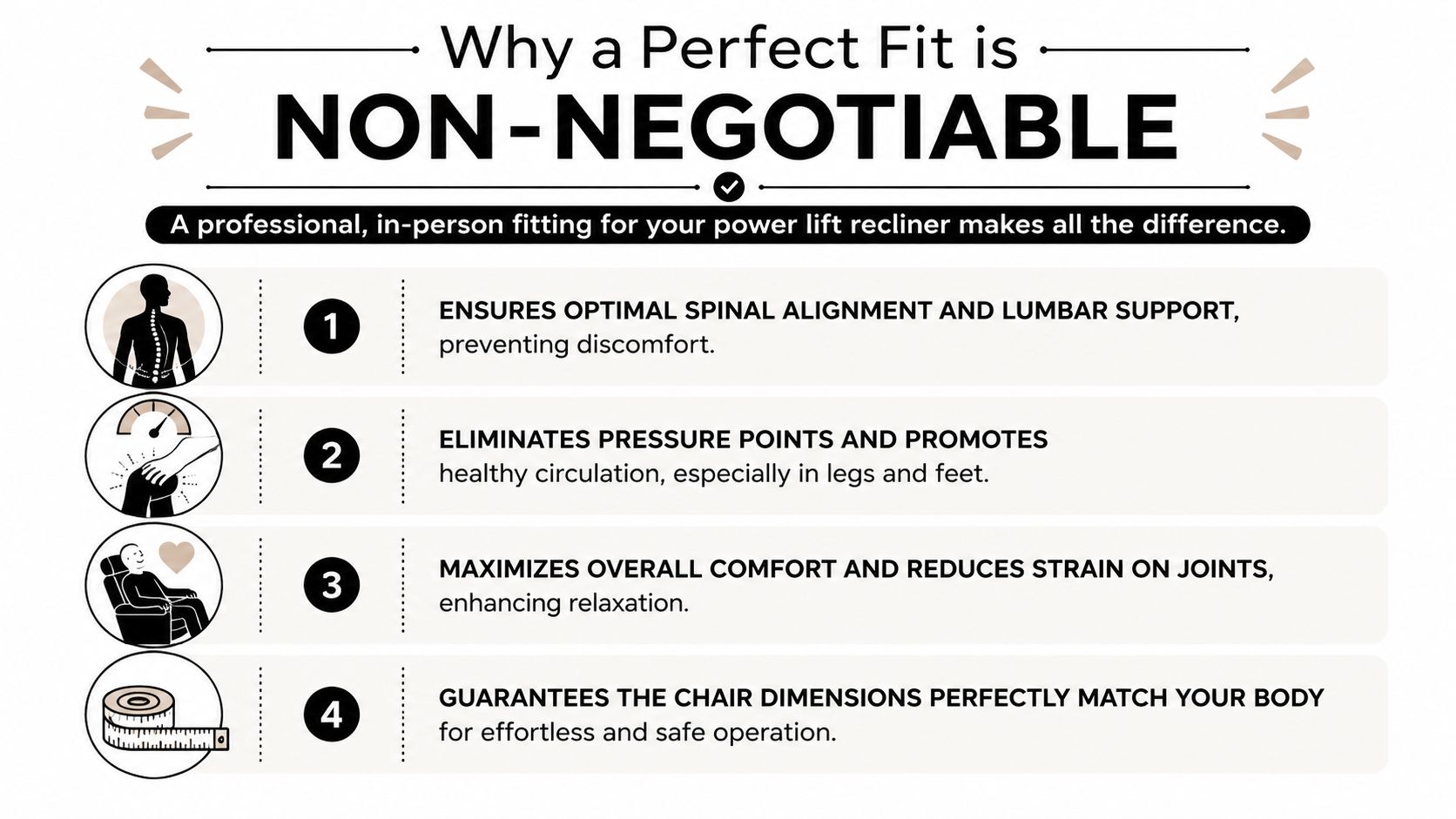
Proper sizing matters for health as well as comfort. Matching seat depth, width, and back height to the user’s measurements can reduce pressure ulcers by 30 to 50 percent, while undersized seats increase peak pressures and oversized seats reduce lumbar support, according to Golden Technologies lift recliner guidance.
What a good fit looks like
When someone sits back in the chair, a few things should happen naturally.
- Feet rest comfortably on the floor when upright, without dangling or tucking too far back.
- Knees bend comfortably rather than lifting too high or stretching too far.
- Lower back feels supported without needing an extra pillow.
- Head support lands in the right place instead of pushing the chin forward or missing the head entirely.
- Arms rest easily on the arm pads, which helps during both sitting and standing transitions.
That sounds simple, but it’s hard to judge from a product photo.
Why online dimensions aren’t enough
A spec sheet can tell you the seat width. It can’t tell you how the cushion compresses, where your shoulders will land, or whether the lift angle feels secure.
That’s why in-person fitting matters so much, especially for petite seniors, taller users, and people with heavier builds. A chair that looks right on paper can feel completely wrong after three minutes of sitting.
Fitting advice: If the user has to scoot forward to get the lift to “catch” them properly, the chair likely isn’t the right fit.
What to measure before you shop
If you’re starting at home, take a few basic measurements:
- Seat height need from floor to the back of the knee
- Seat depth need from the back to the bend of the knee
- Seat width comfort based on body shape and preferred arm spacing
- Back height need based on where the head and shoulders need support
A measuring tape won’t choose the chair for you, but it will narrow the field. Our guide on how to measure furniture can help you prepare before visiting a store.
Why the showroom matters
This is the part online-only sellers can’t really replace. A person needs to sit in the chair, recline in it, and let it lift them.
In a 30,000-square-foot showroom in Grants Pass, families can compare how different chairs feel side by side. That’s especially helpful when trying supportive seating from brands people already know, like La-Z-Boy and Flexsteel, and when checking whether a chair feels secure during the full movement, not just comfortable for a minute.
The Life-Changing Health and Accessibility Benefits
A lift chair helps with more than standing up. It can change how someone moves through the whole day.
For many households, the primary value is that one chair can support several needs at once. It can be the easier chair to rise from in the morning, the comfortable place to rest in the afternoon, and the safer seat to use at night when legs are tired and balance isn’t at its best.
Less strain during a hard movement
Power lift recliners are considered an accessible investment in health, with prices typically ranging from $500 to $1,500, and they can significantly reduce strain on core and leg muscles when standing. They can also reduce fall risks by up to 50 percent, based on the lift chair information summarized in this guide to recliner lift chairs for the elderly and handicapped.
That’s especially relevant for people with knee pain, arthritis, or weakness after illness. The difficult part of the motion gets easier, which can make someone more willing to sit where they’re comfortable instead of perching somewhere less supportive just because it’s easier to get out of.
Recovery and aging in place
Lift chairs can be especially helpful after surgery or during periods of reduced mobility. A person who doesn’t feel strong enough to push out of a low seat may still be able to stand with the chair’s support.
They also fit into the bigger picture of staying at home safely. Families thinking beyond one piece of furniture may also find this guide to home modifications for independent living useful as they look at lighting, flooring, grab points, and room layout together.
Everyday comfort has health value too
People sometimes treat comfort like it’s a luxury add-on. It isn’t.
If a person can sit with better support, rest with less pressure, and stand with less pain, they’re more likely to keep using the spaces in their home normally. That supports independence, confidence, and routine. For shoppers also comparing seating for spinal support, our page on recliners for back pain may be helpful.
The Gates Promise Service Value and Lasting Support
A lift chair isn’t a purchase one wants to figure out alone. It has moving parts, fit questions, room-placement issues, and often a family decision behind it.
That’s where George Gates’ original promise of Service and Value still matters. Since 1946, that promise has meant helping people choose furniture that works in real homes, not just looks good in a catalog.
The purchase is only part of the experience
A lot of stress happens after the sale.
People wonder whether the chair will fit through the doorway, whether assembly will be difficult, and whether the setup will feel intimidating for an older parent. That’s why support around the product matters almost as much as the product itself.
What practical support looks like
For this kind of purchase, families usually need a few things working together:
- A place to test comfort in person so the user can compare lift feel, seat shape, and support
- Flexible payment options so cost doesn’t force a rushed decision
- Delivery and assembly help because these chairs are not simple box-drop items
- Protection planning for a chair that may be used every day
That’s why options like Gates Easy Pay matter. Shoppers can use $0 down, 6-month interest-free, and no-credit-needed options, which can make a necessary comfort purchase more manageable. Professional White-Glove Delivery also matters because the team doesn’t just leave a box at the curb. They handle assembly and setup, and mattress haul-away is available for sleep purchases as part of that broader service model.
A local showroom adds something websites can’t
In Grants Pass, a large showroom creates room for comparison. Families can try different seat heights, arm styles, recline feels, and upholstery types in one trip instead of guessing from thumbnails.
That in-person experience also matters because shoppers often come in for one item and discover related needs. Someone choosing a lift chair may also realize they need a better side table height, a sturdier lamp for reading, or a calmer room layout. Along the way, they might also spot the store’s Unique Finds, including reclaimed wood, teak, and one-of-a-kind statement pieces that give a home more personality than a standard chain-store setup.
Good service isn’t only about answering questions. It’s helping people leave with a setup that works on day one.
Brand familiarity helps build confidence
Known names can help narrow the field. In broader home furnishings, many shoppers already recognize brands like La-Z-Boy, Flexsteel, Ashley, and Beautyrest.
That kind of familiarity doesn’t replace fitting and testing, but it does give families a more grounded starting point when comparing comfort, styling, and household durability.
Your Next Step to Greater Comfort and Independence
The best power lift recliner chairs do more than recline. They help people keep living normally at home.
The most important takeaway is simple. Don’t judge a lift chair by features alone. Motor type matters. Reliability matters. Battery backup matters. But fit is what turns a chair from “pretty good” into safe and comfortable.
If you’re helping a parent, spouse, or yourself, start with the daily problem that needs solving. Is it standing up without pain? Sitting longer with better support? Resting comfortably during recovery? Once you know that, the right chair becomes much easier to identify.
For families around Grants Pass, Medford, Central Point, Ashland, and the rest of Southern Oregon, there’s real value in testing chairs in person. Sit in them. Recline in them. Feel the lift motion. Bring the person who’ll use the chair. That one step can prevent the most common buying mistake, choosing a chair that looks right but doesn’t fit the body.
A good lift chair should feel reassuring from the first sit. It should support the back, place the feet well, and make standing feel smoother and less stressful. If it doesn’t do those things, keep looking.
And while you’re shopping for practical comfort, it doesn’t hurt to enjoy the experience a little. A showroom visit can also spark ideas for the rest of the home, whether that’s a new living room layout, a better mattress setup, or a look at handcrafted accents that make a room feel more personal.
Visit Gates Home Furnishings to browse lift chairs online or stop by our Grants Pass showroom to test comfort in person. We’re proud to serve the Rogue Valley with the same promise George Gates started with in 1946: Service and Value.