Finding the Best Recliners for Back Pain

Back pain is a frustratingly common problem for so many of our neighbors here in Southern Oregon, from Medford all the way up to Grants Pass. The good news? A high-quality, ergonomic recliner can be one of the best tools for finding real, lasting relief. The best recliners for back pain aren't just comfortable—they're specifically built to take pressure off your spine and support your body's natural shape.
How We Evaluated Recliners for Back Pain
When a customer walks into our 30,000-square-foot showroom looking for one of the best recliners for back pain, we don't just hand them a spec sheet and walk away. We evaluate each model against a small set of hard criteria that matter for spinal support.
The first thing we check is lumbar adjustability. A recliner that has only one static lumbar position often fails larger or shorter customers because the support lands in the wrong spot on their spine. We prefer models where the lumbar depth and firmness can be dialed in, ideally with power controls, so a customer can match the support to their own lower-back curve.
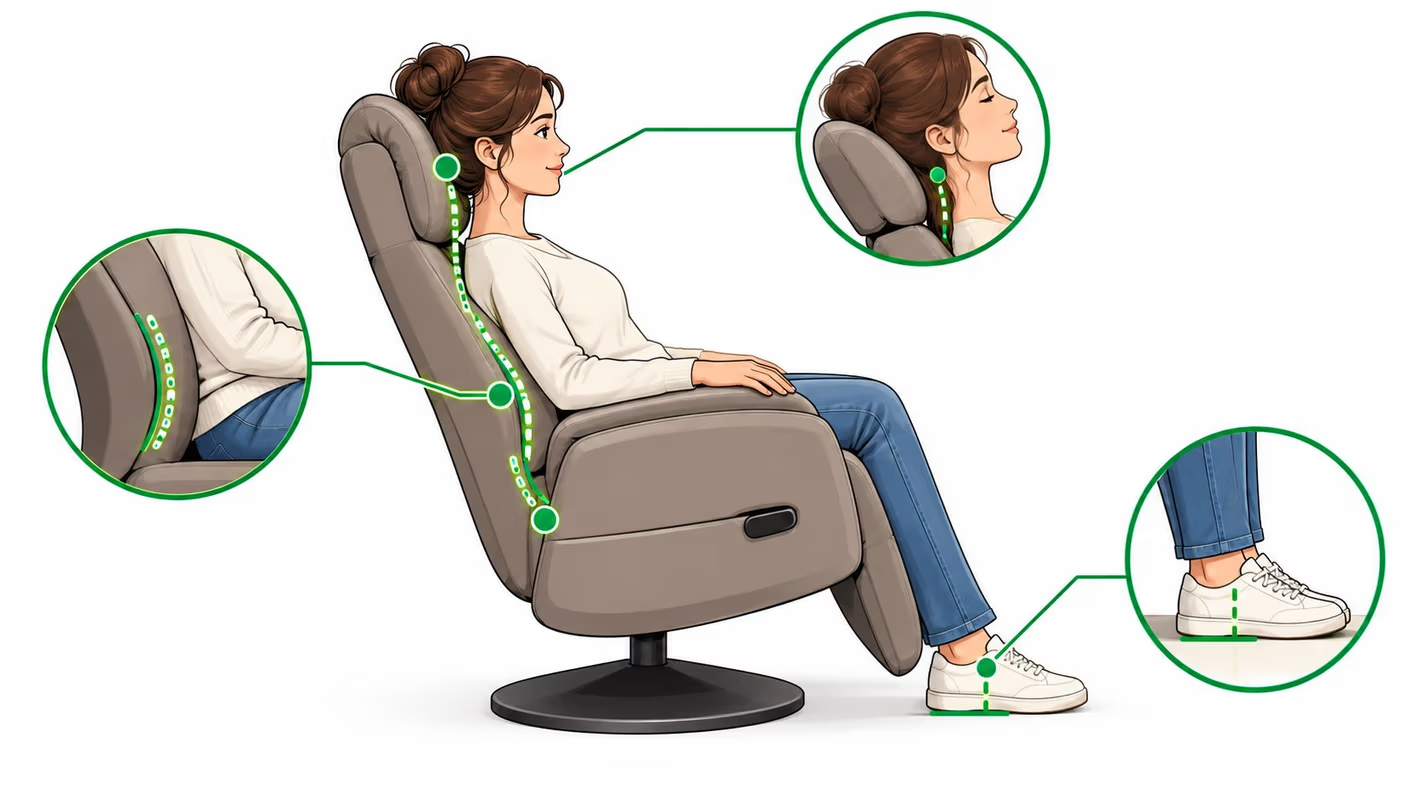
Next, we test seat depth and seat height, because online shopping can leave people vulnerable. If the seat pan is too deep, the customer's lower back loses contact with the lumbar cushion and they start sliding forward. If it is too shallow, pressure builds behind the knees. We look for models with adjustable seat depth or at least a clear range of sizes. We also verify that feet can rest flat on the floor when the legs are extended, because dangling feet change hip angle and increase lower-back strain.
Then we examine recline range and control independence. Zero-gravity positioning is useful, but only if the customer can reach it smoothly and hold it without fighting a manual mechanism. We want independent power controls for the headrest, backrest, and lumbar zone, because those three areas often need different angles to keep the spine neutral.
Finally, we rule out models that cannot support a safe sit-to-stand transition for customers with limited mobility. For that group, a power lift recliner is not a luxury; it is a necessity. A weak lift mechanism or one with too much tilt can make getting up harder and increase fall risk.
In practice, this means our team watches how a recliner performs on bodies of different heights, how quickly lumbar adjustments change perceived support, and whether the chair encourages a relaxed spinal curve or pushes the customer into a slouched posture. That hands-on filtering is what lets us recommend options with some confidence, rather than just listing features.
Why a Recliner Might Be Your Best Ally Against Back Pain
For many folks in the Rogue Valley, back pain is more than a minor annoyance. It's a constant ache that gets in the way of everyday life, whether it's from an active lifestyle spent hiking our beautiful trails or from long hours sitting at a desk. To someone who spends long hours at a desk, a recliner may seem like just a cozy living room chair, but we see it as a vital piece of wellness equipment.
Ever since our founder, George Gates, opened our doors in 1946 with his original promise of "Service and Value," our mission has been to help our community find genuine solutions for a better life. That means looking beyond just how a piece of furniture looks and understanding how it can improve your well-being. A standard sofa or chair often encourages slouching, which puts a ton of strain on the lower back. An ergonomic recliner does the exact opposite.
A well-designed recliner helps your back by:
- Taking the Pressure Off Your Spine: When you recline and put your feet up, your body weight gets distributed more evenly. This takes the load off the compressed discs in your spine, giving them a much-needed break.
- Supporting Your Natural Curves: A good recliner is built to fill in that gap in your lower back (the lumbar region). This helps maintain the spine's natural S-curve and prevents the muscle fatigue that so often leads to pain.
- Promoting Deep Relaxation: It allows the muscles in your back, neck, and shoulders to fully let go and relax. That state of relaxation is essential for recovery and pain reduction.
More Than Just a Local Problem
This search for comfort isn't just happening here in Grants Pass; it's a nationwide issue. Low back pain is not a niche comfort concern; it is a global health issue that helps explain why shoppers increasingly evaluate recliners for lumbar support rather than appearance alone. The World Health Organization reported that approximately 619 million people experienced low back pain in 2020—about 1 in every 13 people worldwide. That total was 60% higher than the estimated number of cases in 1990, and WHO projects that the figure could reach 843 million by 2050 as populations grow and age. Low back pain also accounted for 8.1% of all years lived with disability globally in 2020, making it one of the leading causes of disability worldwide https://www.who.int/news-item/07-12-2023-who-releases-guidelines-on-chronic-low-back-pain.
The sheer number of people dealing with back pain across North America has made recliners an essential piece of furniture for millions. In fact, low back pain remains one of the most common complaints affecting adults in the United States.
This widespread problem is why the North American patient recliner market holds the highest revenue share in the world. You can discover more insights about these market trends and their drivers, but for us, these numbers just confirm what we've seen for decades: helping our neighbors find the right recliner for back pain is one of the most important things we do.
The Science of Support in an Ergonomic Recliner
To find real, lasting relief from back pain, you have to look past the puffy cushions and understand what makes certain recliners for back pain therapeutic. It's not just about feeling soft, it's about a science-backed design that supports your body the right way. The first step is getting a handle on the basics of ergonomics, the science of fitting a product to the person. In fact, learning about better workplace ergonomics can help you spot what makes a recliner supportive for your home.
Here at Gates Home Furnishings, we still stand by that original 1946 promise of "Service and Value." For us, that means giving our neighbors in Grants Pass and Medford the knowledge they need to make a great choice. Let's break down the essential features that turn a simple chair into a powerful tool for your well-being.
The Cornerstone of Comfort: Lumbar Support
Think of lumbar support like the arch support in a good pair of running shoes—without it, your whole body is thrown off balance. Your lower back, known as the lumbar region, has a natural inward curve. When you sink into a chair that lacks proper support, you tend to slouch, which forces this curve to flatten or even reverse into a "C" shape. This posture puts a ton of strain on the muscles, ligaments, and discs in your lower back.
A high-quality recliner with great lumbar support is engineered to fill that gap perfectly, holding your spine's natural alignment even while you're kicked back and relaxing. This isn't just a pillow stuffed behind you. It's a built-in, often adjustable, component designed to provide firm yet gentle counter-pressure right where you need it. Brands we trust, like La-Z-Boy, Flexsteel, and Ashley, have spent decades perfecting this because they know it's the foundation of true, all-day comfort.
This simple diagram shows the pathway to relief that the right recliner can provide.
As you can see, a well-designed recliner acts as that critical bridge between nagging back pain and genuine physical relief.
To help you know exactly what to look for when you're shopping, we've put together a quick guide to the most important features.
Essential Recliner Features for Back Pain Relief
| Feature | How It Helps Your Back | What to Look For |
|---|---|---|
| Adjustable Lumbar Support | Maintains the natural curve of your lower spine, preventing slouching and reducing strain on back muscles and discs. | Look for models with power-adjustable lumbar support that lets you dial in the exact firmness and position. |
| Zero-Gravity Recline | Elevates your legs above your heart, creating a "weightless" feeling that takes all compressive force off your spine. | Test the recline function to ensure it achieves a true zero-gravity angle. Power controls make this much easier. |
| Independent Adjustability | Allows you to move the headrest, backrest, and footrest separately to find your perfect, pain-free position. | Ask about power recliners with independent controls for the headrest and lumbar areas. |
| Articulating Headrest | Prevents your head from being pushed forward, which can cause neck strain that radiates down your back. | Make sure the headrest supports the natural curve of your neck, keeping your head, neck, and spine aligned. |
Having these features work together is what provides the best possible support and comfort.
Beyond the Basics: Advanced Ergonomic Features
While great lumbar support is the starting point, a few other key features work in tandem to create a therapeutic experience. When you visit our 30,000-square-foot showroom in Grants Pass, you can feel for yourself how these elements combine for superior comfort.
One thing our team notices quickly is how much independent adjustment changes the experience. When a customer can raise the headrest, lift the lumbar zone, and extend the footrest separately, they can usually find a position within minutes that removes pressure from their lower back. When controls are linked and move everything at once, it often takes much longer to get close to a neutral spine, and some positions cannot be reached.
Zero-Gravity Recline: This position, where your legs are elevated slightly above your heart, is the gold standard for relieving pressure. It was actually developed by NASA to reduce the intense forces astronauts feel during takeoff. In a recliner, this angle makes you feel almost "weightless," taking all the compressive stress off your spine and allowing your back muscles to completely let go.
Power Controls and Adjustability: A power recliner controlled by a button offers much more than just convenience. It allows for tiny micro-adjustments, helping you find the exact angle that gives you maximum relief for your specific pain. Many models we carry also offer independent power headrest and lumbar controls, giving you total command over your comfort. You can learn more about the different types of power reclining seating and how they can benefit you.
Proper Headrest Alignment: A poorly designed headrest can be a sneaky source of pain, pushing your head forward and creating neck strain that can radiate all the way down your back. A good recliner, on the other hand, supports the natural curve of your neck. It ensures your head, neck, and spine are all in proper alignment, whether you're watching TV, reading a book, or just resting your eyes.
Ergonomic seating guidance gives shoppers a measurable way to compare recliners for back comfort. The U.S. National Institute for Occupational Safety and Health recommends a seated position in which the feet can rest flat on the floor and the hips and knees are at—or slightly greater than—a 90-degree angle. It also advises supporting the lower back in a position that preserves the spine’s natural inward lumbar curve and recommends changing posture regularly instead of remaining fixed in one position. Although this guidance addresses seated work rather than living-room recliners, its principles remain a useful benchmark for home seating https://www.cdc.gov/niosh/bulletin/2020/working-from-home.html.
Finding a recliner with these ergonomic principles built right in is an investment in your well-being. And with our Gates Easy Pay options, including $0 down and 6-month interest-free financing, that investment is more accessible than ever. We believe everyone in the Rogue Valley deserves to live without constant pain, and the right recliner is a fantastic place to start.
When Getting Up Is as Painful as Sitting Down
For many of our neighbors in Grants Pass and Medford, back pain isn't just about the ache you feel while you're sitting. It's also about the dread that comes with the simple act of getting up or sitting down. That transition can put a ton of pressure on an already sore back, not to mention your hips and knees, turning what should be a moment of rest into a painful chore.
This daily struggle is exactly why power lift recliners were invented. They're so much more than a comfortable chair. For many, a power lift recliner is a vital aid for maintaining independence, and it embodies the promise our founder George Gates made back in Est. 1946: to provide real "Service and Value" that improves our customers' lives.
How Power Lift Recliners Work
At first glance, a power lift recliner looks just like any other luxurious, high-quality recliner. But it's hiding a powerful secret. Tucked inside its sturdy frame is a quiet motor that does all the heavy lifting for you. With just the push of a button, the entire base of the chair smoothly and gently tilts forward and up.
This controlled movement guides you into a near-standing position, taking almost all the stress off your joints. Instead of straining your back, arm, and leg muscles to heave yourself up, the chair gives you the momentum. This single feature can be life-changing, reducing the risk of a fall or re-injury and letting you move with confidence.
Dispelling a Common Myth
We often hear from folks who assume lift chairs are only for the elderly or for a hospital-like setting. That couldn't be further from the truth. Not long ago, we helped a younger gentleman from Grants Pass who was recovering from back surgery. He found he couldn't get out of his favorite chair without help. His new lift recliner wasn't just furniture; it was the tool that gave him his freedom back during a tough recovery.
These chairs are for anyone, regardless of age, who has pain or difficulty getting up from a seated position. They help you remain independent in your own home. If you want a broader look at the category, this outside guide to Best Lift Chairs for Elderly helps show why lift models are often evaluated around mobility and ease of transfer, not just age. Power lift recliners deserve separate consideration because back comfort and safe movement are often connected, particularly for older adults and people with limited strength. A widely cited U.S. fall statistic is that approximately 1 in 4 adults age 65 and older falls each year; after one fall, the likelihood of falling again can double. About 1 in 5 falls causes a serious injury, and more than 3 million older adults are treated in emergency departments annually for fall-related injuries. These figures do not prove that a lift chair prevents falls, and a power mechanism must be used correctly https://rehabpub.com/gait-balance/assistive-devices/fall-risk-and-fall-prevention-in-older-adults/.
Key Benefits of a Power Lift Chair
Choosing a power lift recliner is really an investment in safety, comfort, and self-reliance. The core benefits are simple but powerful:
- Reduces Physical Strain: By lifting you to your feet, the chair takes the pressure off your back, hips, and knees.
- Increases Safety and Stability: The smooth, gentle motion helps prevent the jerky movements that can cause dizziness or a loss of balance.
- Promotes Independence: It removes the need to rely on others for help getting up, restoring a strong sense of autonomy.
We invite you to come and learn more about these incredible chairs. In our guide to the best lift chairs for elderly, we dig deeper into how these chairs can make a huge difference in daily life. But the best way to understand is to visit our 30,000-square-foot showroom in Grants Pass and experience one for yourself. Our friendly team can show you exactly how they work and help you find a model that fits you perfectly.
Why You Must 'Test Drive' a Recliner in Person
Buying one of the best recliners for back pain online without ever sitting in it is a huge gamble. It might seem convenient, but the fit of a recliner is personal. What feels like a supportive dream to one person could be a source of new aches and pains for another. When you're making an investment in your long-term health and comfort, you can't afford to get it wrong.
This is exactly why we've always believed in the importance of our 30,000-square-foot showroom right here in Grants Pass. It's more than a store—it's a place where our neighbors from all over the Rogue Valley, from Ashland to Central Point, can come to "test" true comfort and find that perfect fit. Ever since George Gates founded our business in 1946 on a simple promise of "Service and Value," our approach has always been hands-on and neighborly.
Your Personal Recliner 'Test Drive' Checklist
Think of shopping for a recliner like getting fitted for the perfect pair of shoes. It has to support you in all the right places. When you visit our showroom, we want you to take your time. Go ahead and run through this simple checklist on a few different models.
Check Your Foundation (Feet and Knees): Sit all the way back, so your lower back is snug against the backrest. Your feet should rest flat on the floor, with your knees bent at a natural 90-degree angle. If your feet are dangling or your knees are pushed up toward your chest, that chair isn't the right scale for you.
Feel the Lumbar Fit: This is the most important step. Really pay attention to how the lumbar cushion feels against the small of your back. It should nestle into your natural curve, offering firm but gentle support. It shouldn't push you forward or leave an awkward gap.
Assess the Headrest Support: As you recline, the headrest should cradle the base of your head and neck. A common mistake is a headrest that pushes your chin down towards your chest, which can create a whole new kind of strain that radiates down your spine.
Our non-commissioned team is here to guide you, not rush you into a decision. We'll help you feel the difference between top brands like La-Z-Boy and Flexsteel, making sure you find the one that feels like it was built just for you. This commitment to finding the perfect fit is a core part of the trust we've built in Southern Oregon.
The Growing Demand for True Comfort
The need for supportive and comfortable furniture has never been more apparent, especially as more of us feel the effects of prolonged sitting. In fact, the global recliner chair market hit USD 3.9 billion in 2022 and is expected to climb to USD 5.4 billion by 2028. This boom is being driven by a growing understanding that furniture should do more than just look good, and it should actively improve our well-being by boosting circulation and reducing pain.
To help you get ready for your visit, check out our guide on what to look for when buying a recliner, which digs even deeper into these concepts. Then, come see us in Grants Pass to put that knowledge to the test. Let our family help you find a recliner that delivers real, lasting relief.
Integrating Comfort Without Sacrificing Style
One of the biggest worries we hear from our neighbors in Grants Pass is that choosing one of the best recliners for back pain means bringing home a clunky, oversized piece of furniture. A lot of people feel like they have to pick between a chair that feels good and a living room that looks good. We're here to tell you that's a total myth.
The days when a therapeutic recliner had to stick out like a sore thumb are long gone. Today's designs from trusted brands like Flexsteel and Ashley have completely changed the game, offering sleek silhouettes, premium fabrics, and clean, modern lines that blend right into any home décor. You can absolutely have a space that's both unbelievably comfortable and beautifully stylish. It's a promise we've stood by since George Gates first offered "Service and Value" way back in 1946.
What Kind of Recliner Is Best for Back Pain?
Choice depends on fit, mobility needs, and pain triggers, not upholstery or style. Different recliner types solve different problems, and matching the type to the person usually matters more than chasing a single "best" label.
- Standard recliner: Best for people who primarily need lumbar support and a comfortable seated angle for reading or watching TV. It works when mobility is fine and the main goal is reducing spinal load while seated.
- Zero-gravity recliner: Often the strongest option for lower-back pain because elevating the legs above heart level reduces disc pressure and opens the hip angle. It suits people whose pain improves when the spine is unloaded.
- Wall-hugger recliner: Useful for smaller rooms and tight spaces, but also worth considering when a customer wants full recline without moving the chair far backward. Support quality still depends on the specific model.
- Power recliner with adjustable lumbar and headrest: Usually the best choice when precise positioning matters. Independent controls let users fine-tune neck support, lumbar depth, and leg elevation separately, which often provides real relief.
- Lift recliner: The right choice when getting up is painful or unsafe. Back comfort and safe movement are closely linked for many customers, especially older adults or post-surgery patients.
The best option is rarely the one with the fanciest fabric. It is the one that keeps the feet flat, supports the natural lumbar curve, keeps the head and neck aligned, and lets the user change positions easily. A model that looks perfect in a catalog can still worsen back pain if the seat depth, back height, or recline path does not match the user's body.
Creating a Cohesive, Stylish Space
Styling a room around your new recliner is all about balance. Your recliner doesn't have to be the star of the show; it can be a harmonious part of a larger, curated look. The goal is to make your space feel intentional and inviting, not like you're decorating a physical therapist's office.
A great way to do this is by surrounding your recliner with complementary pieces that share a similar style or color palette. If your recliner is a soft, modern fabric, try pairing it with a sleek metal floor lamp or a glass-topped side table for a clean, contemporary feel.
The Power of Unique, Personal Touches
Our love for Unique Finds really shines. To avoid that sterile, big-box-store look, it's essential to mix in pieces with real character and warmth. A one-of-a-kind reclaimed wood end table or a rich, teak bookshelf can provide the perfect organic contrast to the clean lines of a modern recliner. These are the pieces that add personality and tell a story, differentiating us from the typical furniture store.
Here are a few quick tips for tying it all together:
- Anchor with a Rug: An area rug can connect the recliner to your other seating, like a sofa or loveseat, creating a unified conversation area.
- Coordinate with Throws and Pillows: Toss a few accent pillows and a soft throw blanket on your recliner that pick up colors from other furniture or artwork in the room.
- Add Functional Art: Pair your recliner with a beautiful, handcrafted end table from our Unique Finds collection. It's not just a spot for your cup of tea; it's a piece of art that elevates the whole space.
Creating a home that supports your well-being is also a fantastic way to lower daily stress. To learn more, check out our guide on how to design your home to reduce stress. With a little planning, your new recliner will become your favorite spot for both its incredible comfort and its stylish good looks.
Protecting Your Investment in Comfort
A high-quality recliner isn't just a piece of furniture; it's a real investment in your daily comfort and long-term health. Here at Gates Home Furnishings, we believe peace of mind should come standard with that investment. Ever since George Gates first opened our doors back in 1946 on a promise of "Service and Value," we've been taking care of our neighbors long after they leave the showroom.
That promise means making your purchase possible, getting it to your home safely, and protecting it for years to come.
Making Comfort Accessible with Gates Easy Pay
We get it—a therapeutic recliner is an important purchase. That's exactly why we created Gates Easy Pay. It's our way of making sure that budget worries never have to stand in the way of finding relief from back pain.
Our flexible financing options are simple and transparent, designed to help you bring home the perfect recliner for back pain today. We offer plans with $0 down, 6-month interest-free options, and even no-credit-needed solutions. Whether you're in Grants Pass, Medford, or anywhere in the Rogue Valley, our goal is to make comfort accessible to everyone in our community.
Our Signature White-Glove Delivery Service
Once you've found the perfect recliner, our job is just getting started. We don't just drop a heavy box on your doorstep and wish you luck. Our signature White-Glove Delivery team provides a professional, full-service experience across Southern Oregon, from Ashland to Central Point and beyond.
Our experienced delivery pros will:
- Carefully transport your new recliner to your home.
- Bring it inside and place it in the exact room you want it.
- Handle all professional assembly, making sure every part is put together correctly and safely.
- Haul away all the packaging, leaving your space clean and ready for you to relax.
This kind of care is a huge part of the Gates difference. We do the heavy lifting so you can start enjoying the benefits of your new recliner right away. It's a neighborly approach that makes the whole process effortless.
Long-Term Protection with Gates Care Shield
To make sure your investment is safe from life's little accidents, we also offer the Gates Care Shield protection plan. This plan gives you years of coverage against accidental spills, stains, rips, and tears. It's the confidence you need to live with and enjoy your new furniture without constantly worrying.
It's the final piece of the puzzle, completing the full circle of "Service and Value" that has defined our family business for generations. You can learn more about how we stand behind every piece we sell by exploring our warranties and protection plans.
Choosing Gates Home Furnishings means you're not just buying a recliner; you're joining a family that's dedicated to your comfort for the long haul.
Frequently Asked Questions About Recliners for Back Pain
When you're on the hunt for a recliner that can finally bring you some relief, it's normal to have a few questions bubble up. As a family business that's been part of the Grants Pass community since 1946, we've heard just about all of them. George Gates' original promise of "Service and Value" still drives us today, and that means giving our neighbors honest answers to help them find what works.
Here are some of the most common questions we hear on our showroom floor.
Can a Recliner Make My Back Pain Worse?
In a word, yes. An ill-fitting recliner can absolutely make your back pain worse. If a chair doesn't match your body's proportions or—even worse—lacks proper lumbar support, it can push your spine into an awkward, unnatural position. Instead of relief, you get more strain.
Think about it: a recliner that's too deep might force you to slouch just to feel the backrest, while one that's too tall could leave your feet dangling uncomfortably. This is exactly why we always say you have to "test" a recliner in person. There's no substitute for sitting in the chair yourself, which is why our 30,000-square-foot showroom is the best place in Southern Oregon to find your perfect fit.
What Kind of Recliner Is Best for Back Pain?
The best recliner for back pain is usually one with adjustable lumbar support, independent headrest and footrest controls, and a recline path that lets you reach a zero-gravity-like position. Adjustable lumbar is the single feature that changes support the most, because it keeps the lower spine from flattening out. Independent controls matter next, since they let you fine-tune neck alignment and leg elevation separately. Zero-gravity positioning helps many people by unloading the spine, but the exact angle that works depends on the person.
If getting up is painful, a power lift recliner is often the smartest starting point. If space is tight, a wall-hugger can work, but only if it still delivers strong lumbar and headrest support. Style should never be the deciding factor; fit and adjustability are what determine whether a recliner helps or harms the back.
What Recliner Position Is Best for Lower Back Pain?
For many individuals with lower back pain, a slight recline with the legs elevated is the most forgiving position. Lying completely flat can strain the lower back for some customers, while sitting fully upright usually places the most pressure on the lumbar discs. A mid-range recline, often close to the zero-gravity position, tends to spread weight more evenly and reduce spinal compression.
That said, there is no single best angle for everyone. Some people feel better with a gentler recline, while others prefer a deeper position. The practical rule is to choose a position that keeps the feet supported, the knees at or slightly above hip level, and the lower back pressed gently into the lumbar cushion. If a position makes pain radiate into the legs or increases stiffness, it is probably too deep or too far forward.
What to Prioritize in Recliners with Lumbar Support?
When shopping for recliners with lumbar support, the priority should be adjustability, not just the presence of a lumbar cushion. Static lumbar pads often sit in the wrong place for shorter or taller customers. Power-adjustable lumbar that can change depth and sometimes firmness is far more useful, because it lets you match the support to your own spine.
You should also check how the lumbar system interacts with the recline mechanism. A good design keeps the lumbar support engaged as the backrest moves, so the lower back does not lose contact when you recline. If the support drops away or pushes too hard at certain angles, the recliner is likely poorly tuned for back care.
How Long Should I Sit in a Recliner?
Even the most supportive, therapeutic recliner isn't a substitute for moving your body. It's best to avoid sitting in any single position—chair, sofa, or otherwise—for more than an hour or two at a time.
Listen to your body. Use the recliner for periods of rest and relief, but make it a point to get up, stretch, and walk around regularly. A little movement goes a long way for long-term spinal health.
Is Leather or Fabric Better for Back Pain?
This one is purely about personal preference and your lifestyle, not ergonomics. Genuine support for your back comes from what's inside the recliner, the frame, the springs, the foam, and the lumbar system. The upholstery is just the finishing touch.
- Leather is durable, a breeze to clean, and has a classic look that never goes out of style.
- Fabric often feels a bit cozier and comes in a much wider range of colors, patterns, and textures.
Pick the material that you find most comfortable and that fits your home's decor. If you're also trying to reduce daily lower-back flare-ups outside the chair itself, there are a few practical recovery ideas collected via Thermo Recovery Wear. And with our Gates Easy Pay options, including $0 down financing, you can get the recliner that's right for your back and your living room without having to compromise.
At Gates Home Furnishings, our main goal is to help you find lasting relief and comfort. Come visit our Grants Pass showroom to find the perfect solution for your needs or Browse Our Collection of Supportive Recliners Now.