Expandable Dining Tables: A Southern Oregon Buyer’s Guide


A lot of homes in Grants Pass and across the Rogue Valley live this same little drama. On a normal Tuesday, the dining table feels just right for dinner, homework, and a cup of coffee in the morning light. Then a birthday, holiday, or last-minute family visit rolls around, and suddenly everyone is scooting elbows, borrowing folding chairs, and trying to balance plates in a space that wasn't built for a crowd.
That's why expandable dining tables keep showing up in more homes. The global market for extendable dining tables is growing by about 6.2% annually, driven by households in smaller spaces needing room for larger gatherings, according to the verified market data provided above. That growth makes sense in Southern Oregon, where many homeowners want one dining area that works for both daily life and special occasions.
Families around Southern Oregon have been solving that problem with thoughtful furniture choices for generations. Since 1946, George Gates built his business on a promise of Service and Value, and that same idea still matters when a family is trying to choose one table that has to work hard every day, then stretch gracefully for the moments that matter most.
Table of Contents
- From Cozy Dinners to Holiday Feasts
- What Exactly Is an Expandable Dining Table
- A Guide to Extension Mechanisms
- Sizing for Your Room and Your Guests
- Choosing Materials and Discovering Your Style
- The Gates Difference Buying with Local Confidence
- Create Your Gathering Place with Us
From Cozy Dinners to Holiday Feasts
Shopping for an expandable table typically isn't initiated by an affection for hardware. Instead, the need arises when real life encounters the limits of a fixed table.
A couple in a smaller Medford bungalow might only need a compact table most of the year. Then Thanksgiving comes, or the grandkids stop by after a soccer game, and the room has to do something different. A table that stays modest most days, then opens up when needed, solves that problem without forcing a large footprint year-round.
That's the appeal in plain language. Expandable dining tables let a room change with the occasion. Quiet dinner for two on Wednesday. Full house on Saturday. No folding card table dragged out from the garage.
Why this matters in Southern Oregon homes
Many homes around Grants Pass, Central Point, and Ashland weren't designed around oversized dining rooms. Older ramblers, eat-in kitchens, and open-plan living spaces often need furniture that earns its floor space.
A good expandable table doesn't just add seats. It gives a home breathing room when guests aren't there.
That flexibility is one reason so many households keep choosing this style. It also fits the way people host now. Gatherings tend to be occasional, but when they happen, people want them to feel comfortable and intentional.
For families thinking ahead to seasonal hosting, a helpful companion read is this holiday hosting guide, especially for planning how a dining space needs to function when the guest list grows.
The everyday benefit people sometimes miss
The smartest part of these tables isn't the holiday photo moment. It's the ordinary day after.
- More open floor space: The table stays compact when the extra seats aren't needed.
- Less furniture clutter: One piece can handle daily meals and larger gatherings.
- Better flow: Chairs, walkways, and nearby cabinets get a little more breathing room during regular use.
That's why expandable dining tables tend to feel so practical once they're in the home. They answer two different needs at once, and they do it without asking the room to become something it isn't.
What Exactly Is an Expandable Dining Table
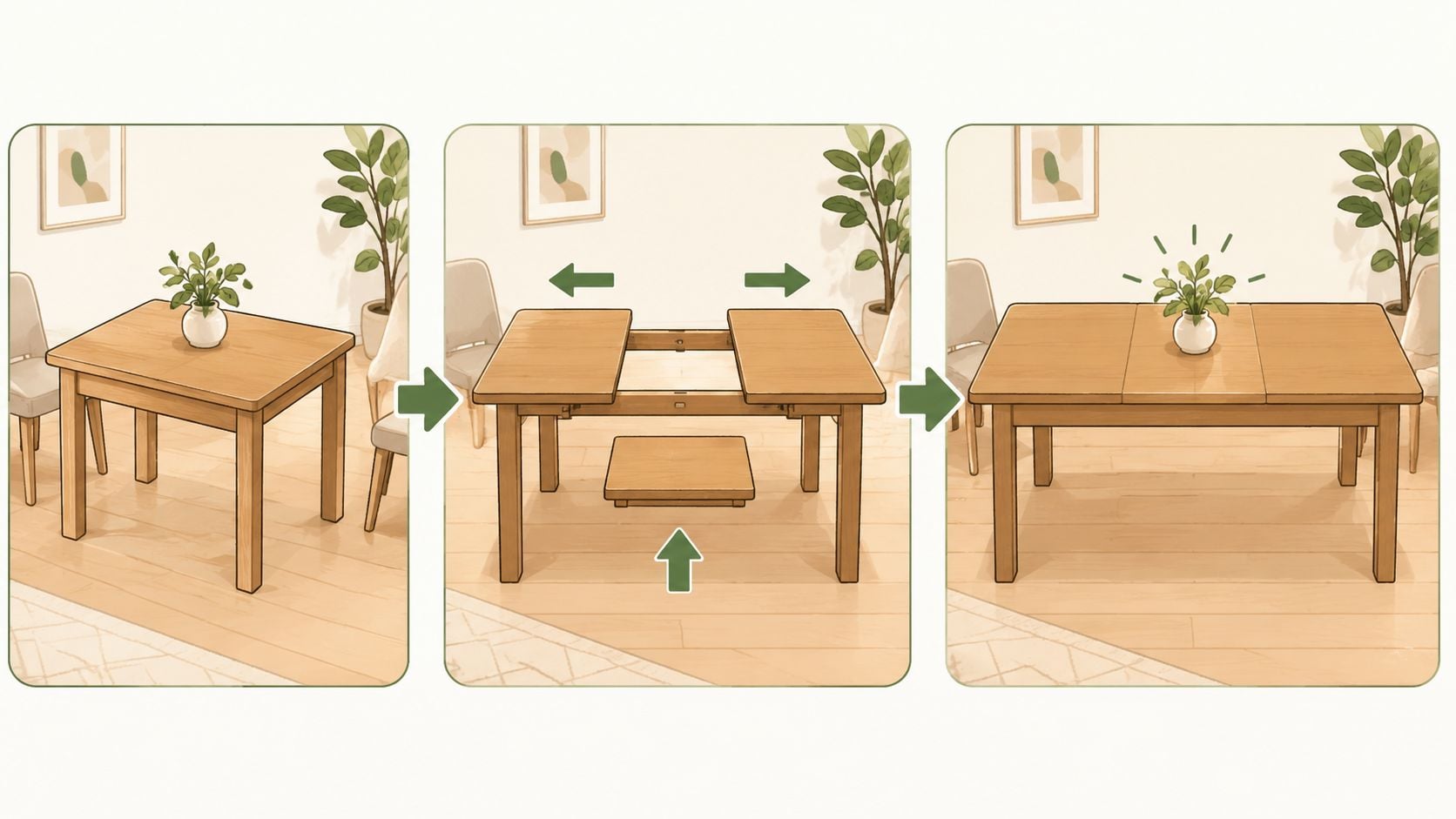
At the simplest level, an expandable dining table is a table that changes size. Part of the top opens, slides, folds, or separates so an extra section can create more surface area and more seating.
Some tables hide that extra section inside the table itself. Others use separate leaves that are added when company comes over. Either way, the idea is straightforward. The table stays compact when daily life is quiet, then grows when the room has more work to do.
A design with a long history
Some shoppers assume this is a modern invention. It isn't. The concept of the extendable dining table dates back to 17th century Elizabethan England, with a standard height of 34 inches. By the Stuart period (1603–1714), that height had shifted to around 30 inches, which lines up with the standard people still recognize today, based on the verified historical data above.
That history matters because it shows this isn't a gimmick. It's a furniture idea that has been refined for centuries.
What confuses buyers at first
Many people use the terms extendable, expandable, and extending as if they mean different products. In everyday shopping, they usually point to the same basic category. The distinctions, however, lie in the mechanism, the shape, and how the table fits the room.
A simple way to think about it is this:
- Closed position: This is the size used most days.
- Open position: The table expands to host more people.
- Storage method: The leaf either stores inside the table or somewhere else.
If a buyer understands those three pieces, the category stops feeling complicated very quickly.
Another common point of confusion is whether all expandable dining tables look obviously mechanical. They don't. Some designs read as traditional farmhouse wood tables, some feel clean and modern, and some barely reveal their moving parts until they're opened.
That's part of their appeal. A practical piece doesn't have to look utilitarian. It can still feel warm, finished, and right at home in a carefully designed dining room.
A Guide to Extension Mechanisms
Mechanism is where many buyers either gain confidence or get overwhelmed. The good news is that the basics are easy to understand once they're compared side by side.
A table's extension system is a lot like a good drawer slide or a well-built door hinge. When it's made well, it feels smooth, stable, and almost effortless. When it's made poorly, it sticks, wobbles, or creates uneven seams that become annoying every single time the table is used.
The main mechanism types people see most often
Some extension styles are better for frequent hosting. Others work well for occasional use in tighter homes.
| Comparing Extendable Table Mechanisms | |||
|---|---|---|---|
| Mechanism Type | How It Works | Best For | Considerations |
| Butterfly leaf | The leaf folds and stores inside the table, then opens as the table slides apart | Households that want convenience and no separate leaf storage | Can show seam lines when opened |
| Traditional center leaf | The table separates in the middle and a leaf is inserted between both halves | Buyers who want a familiar, classic system | Leaf may need to be stored elsewhere |
| Drop leaf | Hinged sides lift up or fold down depending on use | Small kitchens and everyday compact use | Usually changes width rather than full length |
| Self-storing slide-out leaf | Extension panels pull out from within the table structure | Homes that want flexibility without hunting for stored parts | The internal mechanism should feel sturdy and well-aligned |
| Draw leaf | Leaves slide out from the ends of the table | Buyers who want a quick setup with a more traditional look | The support system underneath matters a lot |
One practical product example is a butterfly table design that shows how a built-in leaf can simplify setup for daily households.
A useful detail from the verified data is that slide-out leaves that self-store under the main top can seat up to 8 people, which helps explain why this mechanism is so appealing for smaller homes where separate leaf storage is inconvenient.
What quality feels like in real life
The key test isn't just whether the table opens. The key test is whether it opens well.
High-quality tables keep the extension leaf perfectly level, with a height difference of less than 1 mm, which is part of what experts describe as level-locking synchronization. That tiny detail matters because it helps prevent plates from sliding and supports long-term structural integrity.
Here's what shoppers should notice when they test a table:
- Smooth motion: The top should open without a wrestling match.
- Flat surface: The leaf and main top should feel like one plane, not a speed bump.
- Positive lock: The table should feel secure in both closed and extended positions.
- Tight seams: Small, clean seams usually signal better joinery and alignment.
The best mechanism feels boring in the best possible way. It opens, locks, and disappears into the experience of the meal.
One more detail often overlooked is leg movement. Some expandable tables change the position of the legs when extended. That can affect both stability and how comfortably people sit at the corners or near the ends. It's not automatically a problem, but it's worth noticing before buying.
Sizing for Your Room and Your Guests
The biggest sizing mistake happens before anyone sits down. Buyers measure the table in its closed position because that's the version sitting on the showroom floor or shown in the product photo. For expandable dining tables, that's only half the story.
A key consideration is whether the table works in its largest form. The primary purchasing metric must be the maximum extended length, not the nominal size, and there should be 90 to 100 cm, about 36 inches, of clearance around the table in its fully extended state for seating and foot traffic, as explained in this clearance planning reference.
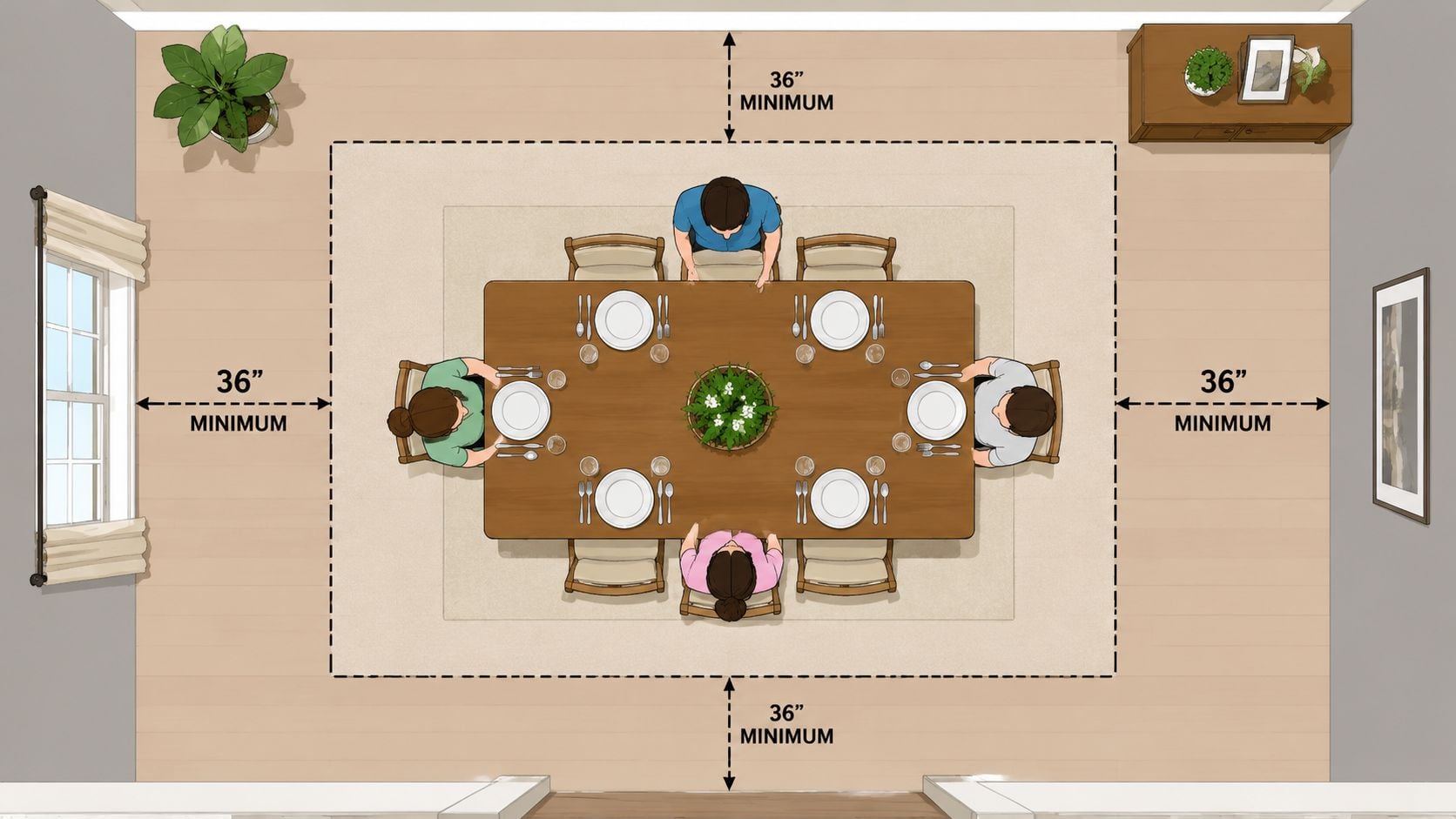
Measure for the biggest version of the table
A simple measuring routine clears up most confusion.
- Measure the room first: Note the usable space, not just wall-to-wall dimensions. Buffets, radiators, cabinets, and traffic paths count.
- Map the fully open table: Use painter's tape on the floor if needed. That gives a realistic footprint.
- Check chair movement: Make sure chairs can pull back and people can pass behind them.
- Think about regular traffic: The path to the kitchen, patio door, or hallway shouldn't get pinched off on hosting days.
For anyone trying to picture how many guests can realistically fit around a rectangular table, this guide for party table seating arrangements offers a helpful visual reference.
A second useful planning resource is this dining table size guide, especially for matching room dimensions to likely table shapes.
A practical Southern Oregon exception
Textbook advice is helpful. Older homes don't always behave like textbooks.
In Southern Oregon's small-home market, 68% of buyers prioritize multi-functional furniture, yet only 12% of dining guides discuss the infrequent-extension clearance compromise in older homes, according to the verified local-angle data tied to this reference URL. That gap matters in post-war ramblers and tighter eat-in spaces around Grants Pass and Medford, where the full 36-inch clearance may not always be realistic.
Practical rule: For rare gatherings in a snug older home, a 30-inch clearance can be workable if everyone understands it will feel tighter and traffic will be slower.
That's not the ideal daily setup. It's a conscious compromise for occasional use.
Rectangular expandable tables often make the most sense in narrow rooms because they follow the room's natural lines. Round tables can feel friendly, but in many small living rooms and eat-in kitchens, rectangular expandable tables use space more efficiently when retracted and still handle a group when needed.
Choosing Materials and Discovering Your Style
Once the mechanics and measurements make sense, the enjoyable part begins. Material changes the mood of the whole room.
A table in solid wood usually feels grounded and familiar. A mixed-material table with metal details can lean more urban or modern. Glass or lighter finishes can help a dining area feel visually open, especially when the room already carries a lot of cabinetry or darker flooring.
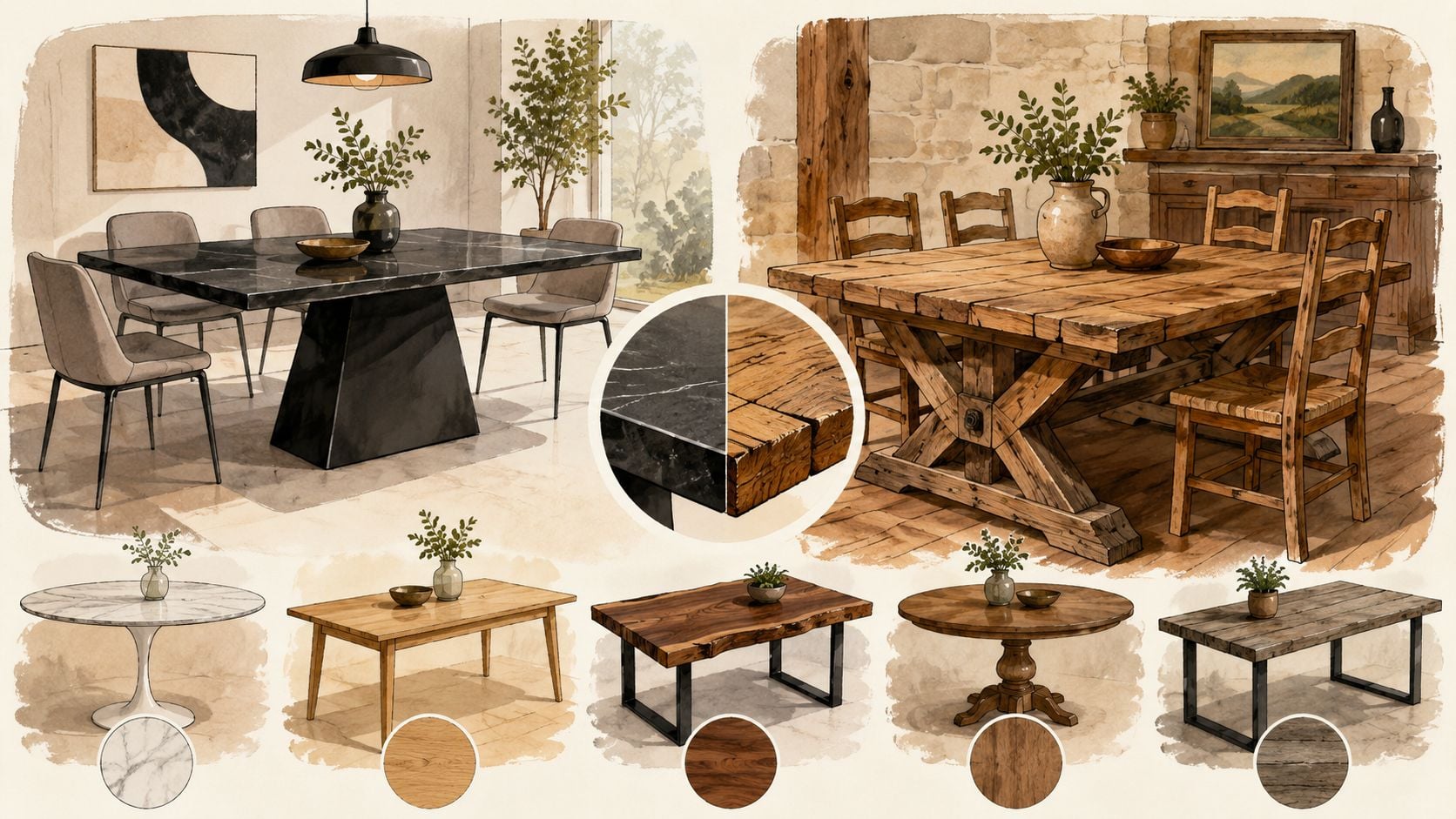
Matching material to the way a home feels
Style usually becomes clearer when the material is matched to the home's personality.
- Traditional spaces: Rich wood tones, shaped legs, and warm finishes often sit comfortably here.
- Farmhouse rooms: Oak, distressed textures, and visible grain help the table feel relaxed and lived-in.
- Modern interiors: Cleaner lines, simpler profiles, and restrained finishes keep the room from feeling busy.
- Industrial-leaning spaces: Wood paired with darker metal can add contrast without making the room cold.
For readers comparing wood species and long-term durability, this hardwood furniture guide can help narrow the choice.
The local context matters too. In Southern Oregon's small-home market, 68% of buyers prioritize multi-functional furniture, which helps explain why so many shoppers want a table that works hard without looking purely practical, based on the verified data connected to the earlier local housing trend reference.
Where one of a kind pieces fit in
Mass-produced shopping often comes up short on adaptable solutions. An expandable table can solve a practical problem, but it can also become the visual anchor of the room.
Reclaimed wood and teak have a different presence than generic surfaces. Grain variation, age marks, and natural character give the table some story. That's why Unique Finds matter so much in a showroom setting. One-of-a-kind statement pieces in reclaimed wood or teak often appeal to homeowners who want function and personality in the same piece.
For anyone thinking ahead to centerpieces, linens, and overall presentation when guests come over, this article on styling your event tables offers useful inspiration without overcomplicating the look.
Some of the most successful dining rooms don't chase a trend. They choose a table with enough character to carry the room for years.
The Gates Difference Buying with Local Confidence
Furniture like this is easier to judge in person. Photos can show shape and finish, but they can't tell someone whether the extension glides smoothly, whether the table feels solid when leaned on, or whether the wood tone works with the floor back at home.
That's one reason a large showroom still matters. In Grants Pass, a 30,000-square-foot showroom gives shoppers room to compare table sizes, test expansion mechanisms, and see how different styles read under real lighting. It's also easier to notice practical things such as leg placement, seam visibility, and chair spacing when standing in front of the piece.
Why seeing the table in person matters
A shopper near downtown Grants Pass, the Redwood area, or coming over from Medford or Central Point can learn more in a few minutes of testing than from hours of scrolling.
A well-curated floor carries familiar names such as La-Z-Boy, Flexsteel, Ashley, and Beautyrest, which helps establish confidence in quality across the store, even when the focus is dining. For expandable dining tables specifically, Gates Home Furnishings offers in-person comparison of different dining room options, including styles that fit compact homes and larger gathering spaces.
Support beyond the sale
Budget is part of the decision for many households, especially after a move or remodel. Gates Easy Pay helps keep a quality purchase within reach with $0 down, 6-month interest-free, and no-credit-needed options.
Delivery matters too. Plenty of people don't want a heavy box left at the front door with confusing hardware inside. White-Glove Delivery means professional assembly and setup in the home, and the team doesn't just drop boxes. The company also provides mattress haul-away, which reflects the broader service model customers have come to expect.
Since Est. 1946, that local service approach has been tied to George Gates' original promise of Service and Value. For a major dining purchase, that promise still means something practical. The process should feel guided, not rushed.
Create Your Gathering Place with Us
A strong expandable table does more than add seating. It lets a home stay comfortable on ordinary days and ready on fuller ones. That matters in Southern Oregon, where many homes need furniture that adapts without overwhelming the room.
The right choice usually comes down to three things. The mechanism should operate smoothly. The fully extended size should fit the room honestly. The material and shape should feel right with the rest of the home, not like a compromise that happened to solve a math problem.
Families in Grants Pass, Medford, Ashland, and across the Rogue Valley often need that balance of practicality and warmth. A well-chosen table can support weeknight dinners, homework sessions, holiday meals, and the occasional gathering that runs longer than planned.
Since 1946, that search for the right fit has always been about more than furniture alone. It has been about helping neighbors create homes that work for real life, with the same commitment to Service and Value that started with George Gates and still shapes the experience today.
Visit Gates Home Furnishings to browse the collection online or stop by the Grants Pass showroom to test expandable dining tables in person, compare finishes, explore Unique Finds in reclaimed wood and teak, and ask about Gates Easy Pay and White-Glove Delivery.