3 Drawer Desks: A Southern Oregon Buying Guide


A lot of folks around Southern Oregon reach the same point with their home office. The kitchen table isn't cutting it anymore. Papers drift from one chair to another. The laptop charger disappears. What started as a temporary setup turns into a daily frustration.
That’s usually when a 3 drawer desk starts to make sense.
It gives you a real work surface, but it also solves the quiet problem underneath most home office clutter. You need a place for the things you use every day, a place for the things you need sometimes, and a place for the things you don’t want spread across the room. For many homes in Grants Pass, Medford, Central Point, and Ashland, that balance is exactly what makes this desk style so useful.
We’ve been helping neighbors furnish their homes since 1946, when George Gates Jr. built our business on a promise of Service and Value. That history matters when you’re shopping for something practical like a desk. A good desk isn’t only about appearance. It has to fit your room, support your routine, and hold up over time.
Finding Your Perfect Workspace in Southern Oregon
One of the most common stories we hear goes something like this. A customer starts with a spare bedroom plan, then real life steps in. One wall needs to hold a guest bed. Another has a window with a good view. Then the printer, notebooks, bills, and headphones all need a home.
That’s where 3 drawer desks earn their place.
They’re often the middle ground between a tiny writing table and a bulky executive desk. You get enough surface for a laptop, a lamp, and a working stack of papers, plus enclosed storage that helps the room stay calm when the workday ends.

Why organized workspaces still matter
People haven’t lost interest in organized workspaces. If anything, they’ve become more important as more work happens at home. The global desk and drawer organizer market reached USD 6,101.8 million in 2024 and is projected to grow steadily, which tells us buyers still see organized furniture as a long-term investment, according to Grand View Research’s desk and drawer organizer market data.
That aligns with what we see in our showroom every day. People aren’t only asking, “Will this fit?” They’re asking, “Will this make daily life easier?”
What that looks like in a real home
In a Central Point apartment, a 3 drawer desk might sit in the living room and double as a work station by day and a tidy furniture piece by evening.
In a Medford home, it might anchor a guest room where the drawers hold office supplies, mail, and charging cables.
In a Grants Pass house, it might become a homework station for one season of life and a bill-paying desk for the next.
A desk works best when it supports the room after work hours, not just during them.
If you’re trying to build a space that feels focused but still comfortable, our guide on creating an inspiring home office is a helpful next step. It pairs well with the practical desk advice in this article.
Why local guidance helps
A national furniture blog can tell you a desk has storage. It usually can’t tell you whether that storage makes sense for the kind of homes we see around the Rogue Valley.
That’s where a local, family-run perspective matters. Since George Gates Jr. opened our doors in 1946, we’ve tried to keep the process simple. Listen first. Ask good questions. Help people choose furniture they’ll still be happy with later.
Is a 3-Drawer Desk Right for You
A 3 drawer desk isn’t a niche furniture piece. It’s one of the more adaptable desk types because it blends two needs that rarely go away. You need room to work, and you need a place to put things away quickly.
That idea isn’t new. The modern 3-drawer desk traces back to the bureau desk, a form that emerged around 1700 and paired a writing surface with three or four drawers, showing that integrated storage has been useful for centuries, as documented in the Wayword Radio bureau desk history PDF.
The remote worker
If you work from home in Medford or across the Rogue Valley, you probably need more than a laptop perch.
A 3 drawer desk can separate your day into usable zones:
- Top surface for active work. Laptop, monitor, notebook, coffee.
- Upper drawer for fast access. Pens, sticky notes, chargers, reading glasses.
- Lower drawers for support items. Files, paper, tech accessories, manuals.
That setup helps when your office also serves as a bedroom, den, or shared family space.
The student
Students in Ashland or Grants Pass usually need flexibility more than formality. Some nights it’s a laptop and textbook. Other nights it’s art supplies, lab notes, or a stack of printed readings.
A 3 drawer desk works well because it keeps school supplies close without making the room feel like a classroom. One drawer can hold current coursework, one can hold cables and accessories, and one can catch the miscellaneous things that otherwise spread across the floor.
The hobbyist or household organizer
Not every desk is for office work.
We regularly see people use 3 drawer desks for:
- Craft storage such as scissors, thread, sketchbooks, and tools
- Household paperwork like bills, receipts, and appointment folders
- Shared family stations for calendars, mail, charging cords, and school forms
That’s where this style stands apart from a plain table. The drawers do a lot of the heavy lifting.
Who may want something different
A 3 drawer desk isn’t perfect for everyone.
You may want another style if:
- You mostly need an extra-large surface for spreading out plans or multiple displays
- You store oversized items that fit better in one deep file drawer
- You prefer a very open, minimal desk with legroom on all sides
Practical rule: If your clutter is mostly small-to-medium items, three drawers usually help. If your clutter is mostly bulky equipment, look harder at the storage layout.
For many homes, though, 3 drawer desks hit a sweet spot. They feel established without looking oversized, and they carry forward a design idea people have valued since the early days of the bureau desk.
Choosing the Right Size and Configuration
Most desk mistakes happen before the desk arrives. The finish may be right. The drawers may be useful. But if the scale is off, the whole room feels awkward.
That’s why measurement comes first.
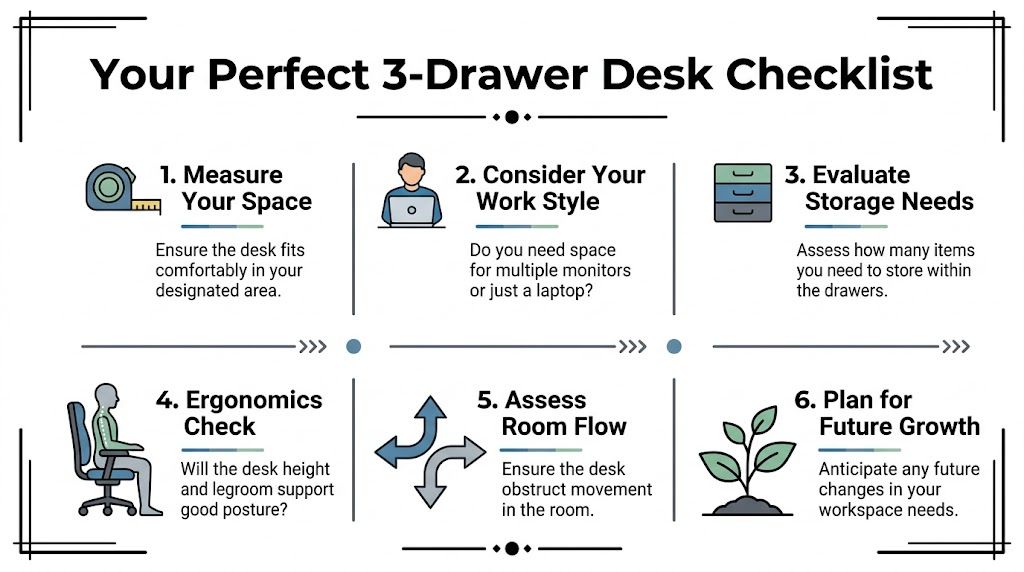
Standard 3-drawer desks often average 48 to 60 inches wide, and that footprint can overwhelm compact rooms if you don’t measure carefully, as noted in Target’s three-drawer desk listings overview.
Start with the room, not the desk
Before you shop, choose the exact wall or corner where the desk will live. Then measure that area with the chair in mind, not just the desk itself.
Check these three dimensions:
- Width of the available wall
- Depth from wall to walking path
- Space needed for the chair to pull back comfortably
A desk can technically fit and still feel wrong if it blocks a doorway, crowds a bed, or turns a walkway into a squeeze point.
Think about how you move in the room
In older homes around Grants Pass, room layouts can be a little quirky. Windows land where you wish a desk could go. Closets open into tight corners. Floor vents and baseboards steal a bit of usable depth.
In newer builds, the challenge is often different. The room may be cleaner-lined, but it may still need to serve more than one job.
Use this quick check before you buy:
- Door swing. Make sure the door can open fully without clipping the desk corner.
- Chair clearance. Sit in the chair and slide back in your mind before committing.
- Outlet access. Don’t trap your only outlet behind a fully enclosed desk side.
- Natural light. Window light is helpful, but glare on a screen gets old fast.
Choose the drawer layout with purpose
Not all 3 drawer desks are arranged the same way.
Some have three drawers stacked on one side. Others use two smaller drawers over one larger drawer. Some place the drawer bank under one pedestal, while others distribute storage differently.
Here is a simple breakdown:
| Configuration | What it feels like | Good match for |
|---|---|---|
| Three equal or near-equal drawers | Balanced and general-purpose | Everyday office supplies, mail, notebooks |
| Two small plus one larger lower drawer | More structured storage | Home office users with files and accessories |
| Side pedestal layout | Traditional and grounded | Dedicated work rooms |
| Lighter frame with drawer bank | More open visually | Bedrooms, apartments, multi-use spaces |
Check comfort before style
A desk can look perfect online and still feel cramped once you sit down.
Pay attention to:
- Legroom. You shouldn’t feel boxed in by the drawer bank.
- Reach. Daily items should be accessible without twisting.
- Chair fit. Arms and seat height need to work with the desk opening.
- Work surface depth. A monitor and keyboard setup needs different depth than a laptop alone.
If you’re buying for daily use, sit at something similar before deciding. A desk isn’t just décor. It’s a tool.
That’s one reason many customers like seeing desks in person. In our 30,000 sq. ft. showroom in Grants Pass, you can compare proportions, test seating positions, and get a clearer sense of what feels right in your own home. If you want a measuring refresher before you come in, our guide on how to measure furniture walks through the process.
Plan for the next version of your routine
A desk that works today should still make sense if your routine shifts.
Maybe you start with a laptop and later add a monitor. Maybe the guest room becomes a shared work room. Maybe a student desk turns into a household command center.
That’s why we often encourage people to avoid buying at the absolute smallest possible size if the room can support a little more breathing room. A desk should fit your current life, but it helps when it can stretch with you.
A Guide to Desk Materials and Finishes
Material changes everything about a desk. It affects how the piece feels, how it ages, how much maintenance it needs, and whether you still like it after the first few months.
A desk may look similar in a photo whether it’s made from particleboard, veneers, metal, or solid wood. In daily use, those differences become obvious.
Why material deserves a closer look
Material choice has a direct impact on long-term satisfaction. Consumer data from 2025 showed particleboard desk models had a 22% drawer slide failure rate within two years, compared with 8% for solid wood alternatives, according to Office Depot’s 3-drawer desk category reference used in the verified data.
That doesn’t mean every engineered desk is a bad buy. It does mean buyers should understand what they’re trading for a lower price point.
Desk Material Comparison
| Material | Pros | Cons | Best For |
|---|---|---|---|
| Particleboard or MDF with laminate | Budget-friendly, easy to clean, widely available | Can feel less substantial, hardware stress shows sooner, repairs are limited | Light-duty use, temporary spaces, guest room offices |
| Veneer over engineered wood | Better appearance than basic laminate, can mimic wood well | Surface damage can be harder to repair, core quality varies | Style-focused buyers with moderate daily use |
| Metal and mixed-material | Clean-lined, often modern, sturdy frame feel | Can feel colder visually, may show scratches, less warmth in bedrooms | Industrial or contemporary spaces |
| Solid wood | Durable, repairable, ages with character | Higher upfront cost, heavier to move | Daily use, long-term home offices, heirloom-minded buyers |
| Reclaimed wood or teak | Distinct grain and character, statement-making, often visually rich | Natural variation isn’t for everyone, piece-to-piece differences matter | Buyers who want furniture with personality |
How finishes change the look of the room
A finish isn’t only a color. It changes the visual weight of the desk.
Dark finishes feel grounded and traditional. They work well in rooms with warm paint, bookshelves, and classic seating.
Light finishes help a desk blend into a smaller room. They often feel better in apartments or multi-use bedrooms where a heavy look would crowd the space.
Natural wood tones offer flexibility. They can lean farmhouse, modern organic, or transitional depending on the hardware and chair you pair with them.
Where craftsmanship shows up first
When customers compare desks side by side, they usually notice these details before anything else:
- Drawer glide feel. Does it open smoothly or wobble?
- Edge treatment. Are corners crisp, soft, thick, or thin?
- Back panel quality. Can the desk float in a room, or does it need to face a wall?
- Finish depth. Does the surface look flat, or does it have grain and character?
Brands matter here. We see shoppers respond well to the different looks and construction approaches found across collections from names like Ashley, La-Z-Boy, and Flexsteel, especially when they can compare them in person rather than guessing from a product thumbnail.
A note on reclaimed wood and teak
Some people want a desk that blends perfectly into the room. Others want one that gives the room identity.
That’s where Unique Finds often stand out. Reclaimed wood and teak pieces tend to bring texture, variation, and a sense of substance you don’t usually get from mass-market office furniture. If you’re weighing wood options, our article on choosing the right hardwood for longevity and style gives a useful foundation.
Better material doesn’t always mean you need the most expensive desk. It means the construction should match how hard you’ll use it.
A practical buying shortcut
If the desk will get daily use, focus less on the marketing description and more on these questions:
- Will the drawers open several times a day?
- Will kids use it for homework?
- Will it hold electronics, files, and charging gear?
- Do you want to keep it for years, not just for one lease term?
If the answer is yes, material quality becomes much more important than the first price tag.
Smart Storage and Organization Strategies
Three drawers sound simple until you try to decide what goes where. Most clutter problems aren’t caused by a lack of drawers. They come from using every drawer for everything.
A good setup gives each drawer a job.
Use the three-zone method
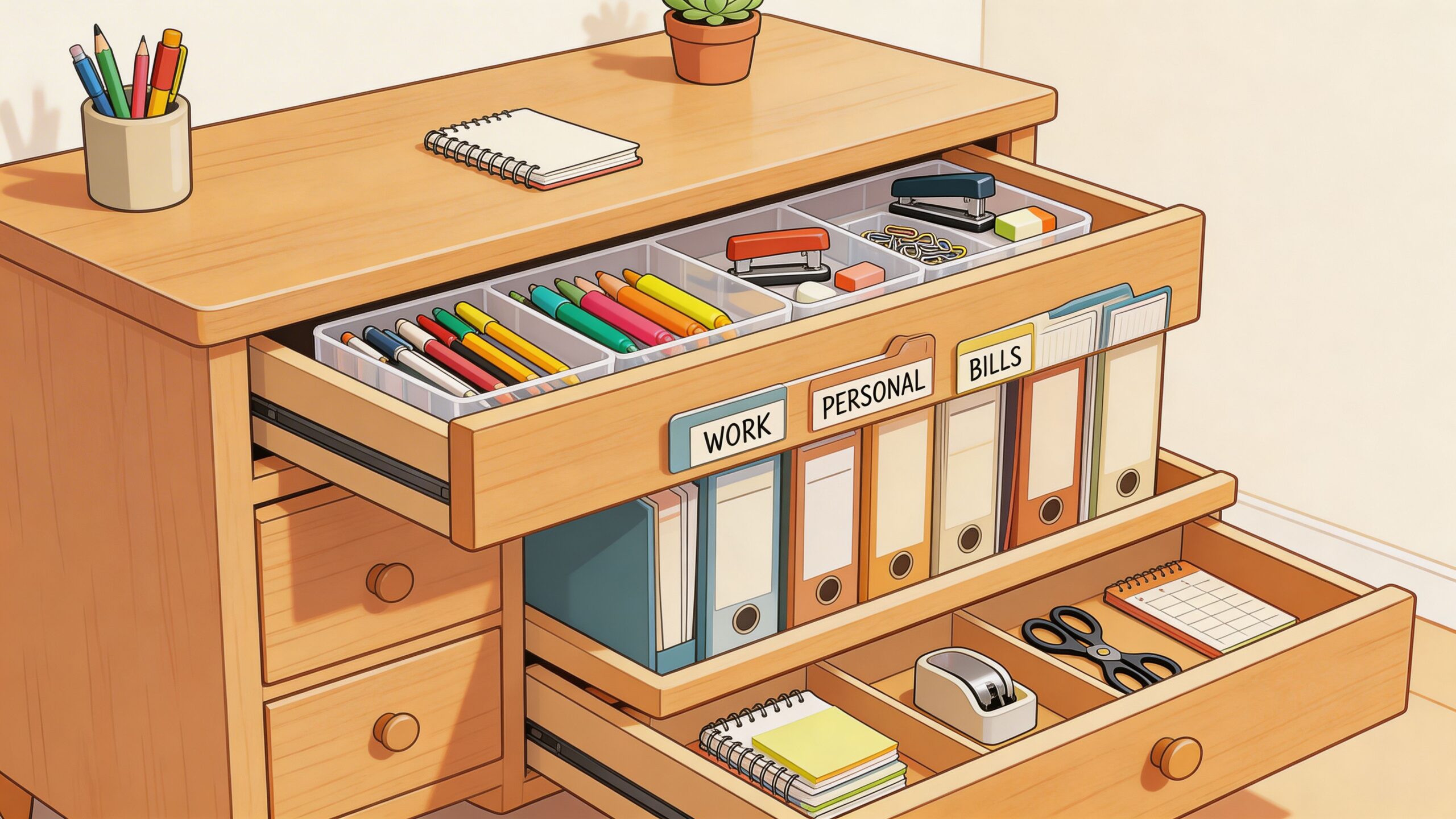
We often recommend organizing a 3 drawer desk in layers of use.
Drawer one is daily access.
Pens, sticky notes, charging cables, reading glasses, earbuds, your planner.
Drawer two is active support.
Notebook refills, printer paper, folders, stamps, extra supplies, a calculator.
Drawer three is long-term or bulky storage.
Archived paperwork, manuals, warranties, backup tech accessories, items you need but not every day.
That structure keeps the top drawer from becoming a junk drawer because it has clear limits.
Match the organization to your routine
The best setup depends on how you work.
If you’re mostly digital, your drawers may hold accessories and very little paper.
If you manage a household from your desk, one drawer might become the family admin drawer with bills, school forms, and appointment notes.
If you create or craft, small trays inside the drawers matter more than folders do.
Try this simple reset:
- Empty one drawer at a time so you don’t create a bigger mess
- Group like with like before anything goes back in
- Use small containers to prevent loose items from sliding around
- Remove duplicates such as extra pens, dead chargers, and old notes
One strong habit: if an item doesn’t support your work this week, it probably doesn’t belong in the top drawer.
Keep the desktop working, not crowded
The desk surface should carry only what you use regularly. That usually means a lamp, your current device, and maybe one active notebook or tray.
Everything else should earn its place.
As desk design evolves, buyers are also showing more interest in refined features. Demand for smart-drawer desks, often with soft-close mechanisms, surged by 35% in major markets in early 2026, which signals stronger interest in user-friendly details and smoother everyday function. You can see more ideas for compact office organization in our post on small home office storage.
If your setup keeps expanding, pair the desk with nearby support pieces such as a bookcase, lateral file, or closed cabinet. That keeps the desk useful instead of overloaded.
Placing and Styling Your Desk at Home
Desk placement changes the way a room feels. The same 3 drawer desk can read as crisp and intentional in one spot, or crowded and accidental in another.
In Southern Oregon homes, that choice often comes down to what the room already needs to do.
By the window
A desk near a window can make work feel easier. Natural light helps the room feel open, and in many Rogue Valley homes it turns a plain desk corner into one of the best spots in the house.
The catch is screen glare. If the monitor faces the wrong direction, the nice view becomes a daily annoyance.
A side-angle placement usually works better than putting the screen directly in front of the brightest glass.
If you want to soften that setup, a small plant helps. For ideas that suit a desk surface without taking over, this guide to Top Indoor Plants for Your Office Desk offers practical picks.
Against a wall
This is the most common solution, and often the smartest one.
A wall placement keeps the room open, leaves clear traffic flow, and gives you easy options for artwork, shelving, or a pinboard above the desk. It’s especially useful in bedrooms, apartments, and guest rooms where every inch needs to pull its weight.
A light-finish desk tends to blend in here. A darker or reclaimed wood piece tends to anchor the room more visibly.
Floating in the room
Some homes have enough space for a desk to sit away from the wall. That can work beautifully in a dedicated office or a large bedroom with a sitting area.
But it only works if the desk looks finished from the back and the room still moves well around it. This is also where professional placement helps. Our white-glove delivery team doesn’t just drop boxes at the door. They handle assembly and help place furniture where it makes the most sense in the room.
Matching the desk to the home’s style
A 3 drawer desk can lean in very different style directions depending on its material and hardware.
- Modern farmhouse often pairs well with painted finishes, warm wood, and simple lines.
- Industrial rooms usually look right with metal accents and darker surfaces.
- Traditional homes often call for fuller wood tones and a more substantial silhouette.
- Collected, one-of-a-kind spaces are often where reclaimed wood or teak feels most at home.
That last category is where statement furniture can do more than store office supplies. It can set the tone for the entire room. A desk with visible grain, texture, or aged character often becomes part of the room’s personality instead of just another utility piece.
Our Commitment to Service and Value Since 1946
Buying a desk should feel straightforward. Measure the room. Choose the layout. Pick the right material. Get it home and get it set up.
What complicates the process is everything around the furniture itself. Budget. Delivery. Assembly. The question of whether the desk will really work once it’s in the room.
That’s why our business has tried to stay grounded in the same promise George Gates Jr. made in 1946. Service and Value.
What that means in practice
It means a desk purchase isn’t finished when the receipt prints.
For many shoppers, financing matters. Gates Easy Pay includes $0 down, 6 equal payments, interest-free promotional options when paid in full within the offer period, and no-credit-needed paths for customers who need more flexibility.
It also means service after the sale matters. Our professional in-home delivery includes assembly and setup, which is a very different experience from wrestling a heavy box through the front door and sorting hardware on the floor.
Why this still matters for a desk
A 3 drawer desk seems manageable until it arrives in pieces.
Drawers need alignment. Placement matters. A bedroom office may need the desk rotated two or three different ways before it feels right. For shoppers building out a fuller workspace, it can also help to look at a broader planning resource such as this ultimate desk setup guide, especially if monitors, lighting, and accessories are part of the project.
We also know that not every customer shops the same way. Some want a one-of-a-kind reclaimed wood piece. Some want outlet value. Some want to special order a finish that fits the rest of the room. Some want to compare office furniture with seating from brands they already know, such as Flexsteel, Ashley, La-Z-Boy, or even bedroom and support products like Beautyrest elsewhere in the home.
The local advantage
Our history is part of why people trust us with these decisions. You can read more about that story on our company history page.
That local history matters because furniture buying is personal. You’re not ordering a desk into a vacuum. You’re placing it in a home, with real walls, real budgets, and real routines.
The only direct mention we’ll make here is simple and factual: Gates Home Furnishings offers 3 drawer desk options for home office spaces, along with in-store viewing, financing choices, delivery, and access to one-of-a-kind reclaimed and teak pieces.
Furniture service should reduce work for the customer, not create more of it.
That idea hasn’t changed since 1946, and it still shapes how we help neighbors in Grants Pass and across Southern Oregon.
Frequently Asked Questions About 3-Drawer Desks
Can I special order a 3 drawer desk in a different finish
Often, yes. Availability depends on the brand and collection. If you’re trying to match an existing bedroom set, bookcase, or chair, bring photos and room measurements so the comparison is easier.
Are 3 drawer desks good for small spaces
They can be, but the footprint matters. Some are compact enough for a bedroom corner, while others feel much larger once you add a chair and walking space. Measuring first is the difference between “fits” and “functions.”
Is solid wood worth it for a desk
If the desk will see daily use, many buyers find that it is. Solid wood usually feels more substantial, and it tends to be a better match for households that want something to keep long-term rather than replace after a short stretch.
What should go in each drawer
A simple system works best. Keep everyday items in the top drawer, active supplies in the middle, and less-used documents or bulkier items in the bottom drawer. Most drawer problems come from mixing all three categories together.
Are outlet desks worth checking
Yes, especially if you’re flexible on finish or style. Outlet shopping can be a smart route for guest rooms, first apartments, or anyone trying to stretch a furnishing budget without giving up function.
How do I care for reclaimed wood desks
Dust regularly with a soft cloth and avoid soaking the surface with water or harsh cleaners. Reclaimed wood usually looks best when you respect its natural variation instead of trying to make it look factory-perfect.
Do you deliver and assemble desks
Yes. Professional delivery and assembly are often the easiest way to avoid damaged parts, missing steps, or a desk that ends up in the wrong place after hours of work.
If you’re ready to compare 3 drawer desks in person, explore finishes, or get help choosing a layout that fits your home, visit Gates Home Furnishings in Grants Pass or browse our collection online. We’re proud to serve Southern Oregon with the same Service and Value George Gates Jr. promised back in 1946.