Mastering Office Chairs Quality in 2026


A lot of home offices in Southern Oregon didn't start as real offices. They started as a corner of the dining room, a spare bedroom, or the end of the kitchen table. The laptop worked. The old chair seemed “good enough.” Then the afternoon slump showed up, followed by the stiff lower back, sore shoulders, and legs that didn't feel quite right after a long stretch of sitting.
That pattern is familiar in homes from Grants Pass to Medford, Central Point, and Ashland. A chair can feel fine for ten minutes and still be the wrong chair for a full workday. That's where many people get stuck. They shop by looks, padding, or price, when office chairs quality really comes down to how well a chair supports the body hour after hour.
Since 1946, this kind of practical guidance has been part of the job at Gates. George Gates Jr. built the business on a promise of Service and Value, and that promise still matters when a neighbor is trying to figure out why a chair at home feels so different by 3 p.m. than it did at 9 a.m. Anyone building a more comfortable workspace can also pick up extra ideas in this guide to creating an inspiring home office.
For readers dealing with tingling legs or soreness after long stretches at a desk, this pain relief guide for sitting discomfort offers useful background on what prolonged sitting can feel like in the body. A better chair isn't the only part of the answer, but it's often one of the biggest.
Table of Contents
- Welcome to Your New Home Office… and Your New Back Pain?
- The Three Pillars of Office Chair Quality
- Understanding the Anatomy of an Ergonomic Chair
- Why Materials and Construction Mean Everything
- How to Test a Chair in Our Grants Pass Showroom
- An Investment in Your Well-Being Made Easy
Welcome to Your New Home Office… and Your New Back Pain?
A common story goes like this. Someone starts working from home a few days a week. The dining chair seems fine at first. A month later, that same person notices a tired lower back by lunch and starts shifting around all afternoon trying to get comfortable.
The confusion usually comes from the word quality. Many shoppers think quality means thick padding, a sharp profile, or a chair that looks expensive on a screen. In practice, a quality office chair earns that label after hours of real use, when the body still feels supported instead of compressed, hunched, or tense.
In homes across the Rogue Valley, the problem isn't laziness or bad posture alone. Often, the chair gives the body no real chance to sit well. A seat may be too deep. The arms may be too high. The back may push in the wrong place. Those small mismatches add up over a workweek.
A chair doesn't have to look complicated to be helpful. It has to match the person using it.
That's why experienced furniture people still talk about chair shopping as a test, not just a transaction. A supportive office chair should fit the way a person works, whether that means typing for hours, jumping in and out of calls, or leaning back to read and think.
For many local households, the smartest first step isn't chasing trends. It's learning what quality looks like in a chair, then trying that knowledge in person.
The Three Pillars of Office Chair Quality
Shoppers can simplify office chairs quality by judging every chair on three pillars. If one pillar is weak, the whole chair usually feels weak over time.
Ergonomics is the fit
Ergonomics is the relationship between the chair and the human body. It answers simple questions. Do the feet rest flat? Do the shoulders stay relaxed? Can the back make contact where support is needed?
Poor seating ergonomics is tied to measurable musculoskeletal risk, and the U.S. Bureau of Labor Statistics reports that these disorders are a leading cause of workplace injury. Guidance summarized by Consumer Reports on ergonomic office chair basics also notes that a quality chair should have a five-point base for stability and adjustable seat height.
Materials shape daily comfort
A chair's covering and cushion affect how it feels at hour one and hour six. Breathable surfaces may feel cooler. Softer seats may feel welcoming at first. Firmer, better-built seats often hold their shape better through daily use.
Many buyers get tripped up. They press the seat once with a hand and assume they've learned enough. They haven't. Materials reveal themselves over time, especially during long sitting sessions.
Mechanisms reveal how the chair works
Mechanisms are the moving parts that let the chair adjust, tilt, recline, and lock into useful positions. If those controls are clumsy or limited, a stylish chair can still be a poor chair.
A practical way to compare models is to ask whether the chair can adapt to the user instead of forcing the user to adapt to it. Helpful starting points appear in this local guide to office chair prices and value considerations, where shoppers can compare what different categories tend to offer.
| Pillar | What to look for | Why it matters |
|---|---|---|
| Ergonomics | Fit to body and posture | Reduces strain from awkward sitting |
| Materials | Breathability, cushion feel, surface quality | Affects comfort and wear |
| Mechanisms | Smooth, useful adjustments | Helps the chair stay supportive during real work |
Practical rule: If a chair looks good but can't be adjusted to the body, it isn't a high-quality work chair for daily use.
Understanding the Anatomy of an Ergonomic Chair
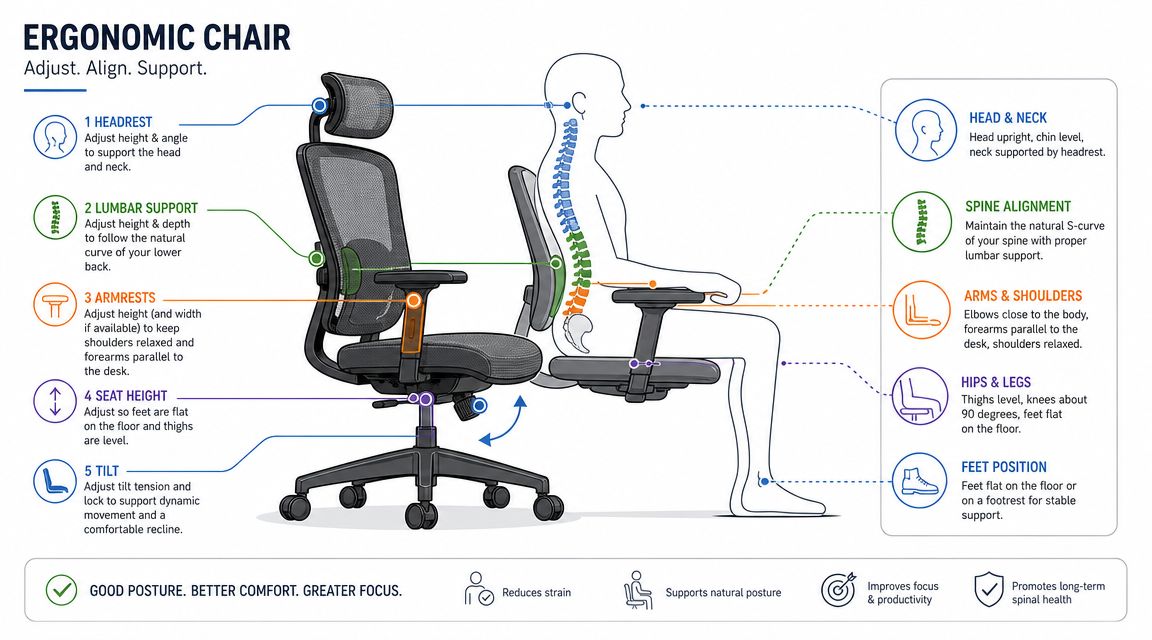
The word ergonomic gets tossed around so loosely that it can lose meaning. In plain language, an ergonomic chair is one that can be adjusted so the body stays in a more natural working position instead of fighting the chair all day.
What neutral posture really means
A quality chair supports neutral posture. According to guidance on judging office chair quality, the key features are adjustability in seat height, seat depth, armrests, backrest angle, lumbar support, and tilt. That same guidance says a chair should help keep the user's feet flat, knees at 90 to 100 degrees, and forearms horizontal during work.
That sounds technical, but the everyday version is simple. The body shouldn't have to shrug upward, slide forward, or perch on the front edge of the seat to get through the day. When the setup is right, the body feels settled rather than braced.
A helpful local reference for these features is this page on office chairs with lumbar support, especially for shoppers trying to understand what lower-back support should feel like.
What each adjustment does
Lumbar support fills the natural curve of the lower back. If it sits too high, it can feel pokey. If it sits too low, it misses the target and the lower back rounds out.
Seat height changes more than leg position. It affects how the hips, knees, and feet share body weight. If the seat is too high, the user may dangle or press too much weight into the thighs. If it's too low, the hips may feel cramped.
Seat depth controls thigh support. Too much depth pushes people to slide forward. Too little depth can make the seat feel small and concentrated.
Armrests should support the forearms without forcing the shoulders upward. Many people misunderstand this feature. Armrests aren't there to trap the elbows in one spot. They're there to reduce unnecessary shoulder tension.
Backrest tilt matters because a fixed upright position isn't ideal for every minute of the day. A chair that allows a gentle recline gives the body a chance to vary its posture instead of holding one rigid angle.
- During typing: the forearms should rest comfortably, not reach upward.
- During reading: a slight recline often feels better than sitting bolt upright.
- During long calls: lower-back support should still contact the spine when posture relaxes a bit.
The best ergonomic chair doesn't force one “perfect” pose. It supports several healthy working positions.
Why Materials and Construction Mean Everything
A chair can have decent adjustments and still disappoint if the materials wear poorly or the structure feels flimsy. After a few months of use, office chair quality becomes more obvious.
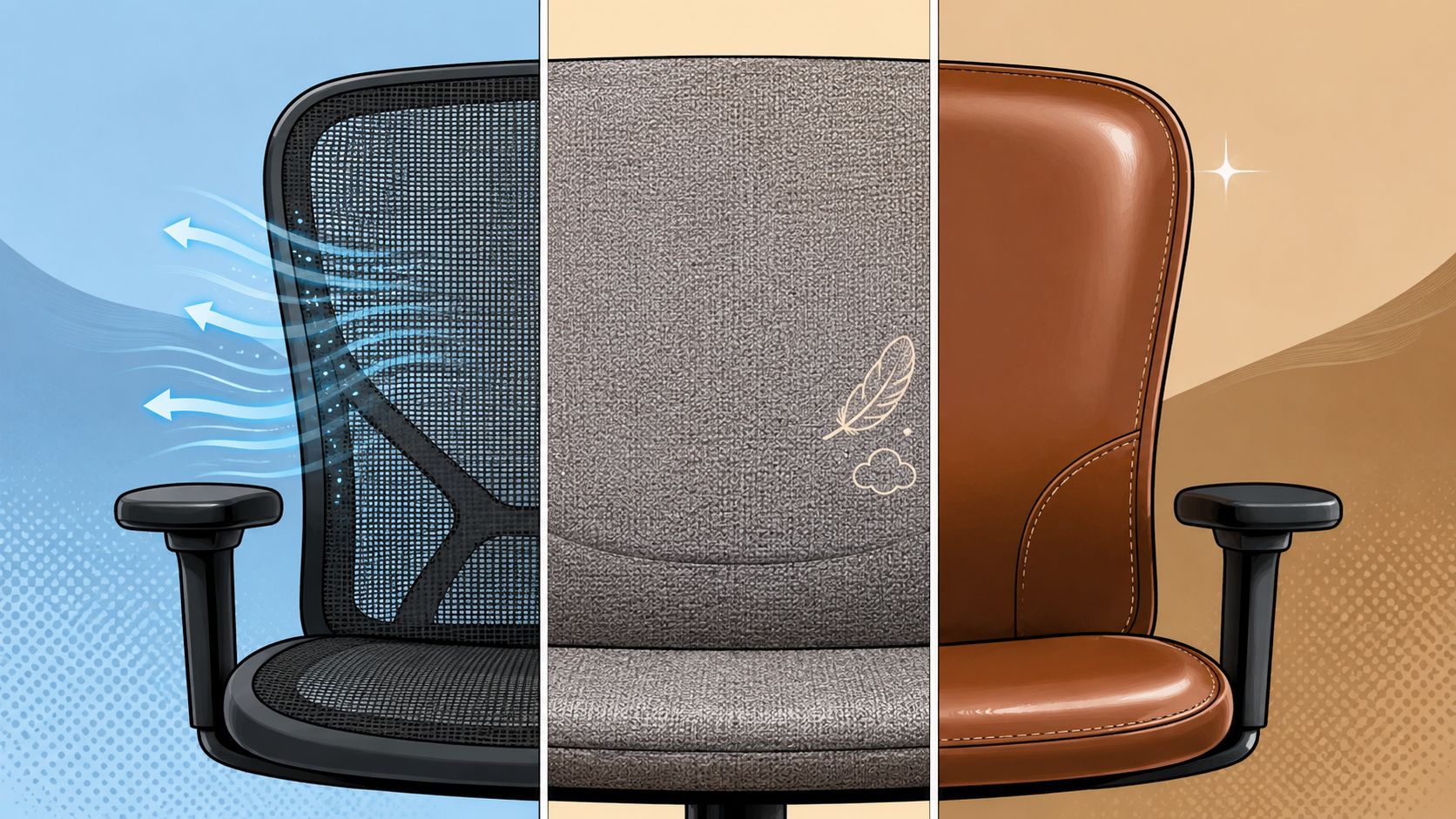
Mesh, fabric, and leather feel different over time
Material choice isn't just about looks. Desky's chair material discussion highlights a real tradeoff between breathable mesh and long-term support. Mesh is popular for airflow, but lower-end mesh can sag over time. By contrast, high-density foam or quality upholstered seats may provide better pressure distribution and durability, depending on climate and how long someone sits.
That's why there isn't one universal “best” material. A warm upstairs office in summer may benefit from airflow. A person who dislikes concentrated pressure may prefer a well-upholstered seat with more even support.
Here's a simple comparison shoppers can use:
| Material | Often appreciated for | Possible drawback |
|---|---|---|
| Mesh | Airflow and lighter feel | Lower-quality mesh may lose support |
| Fabric | Softer touch and broad style range | Can feel warmer depending on weave |
| Leather-look or leather seating | Smooth feel and easy cleanup | May feel warmer during long sessions |
What to check under the seat
The smartest buyers don't stop at the surface. They check the base, the controls, the frame feel, and how solid the chair seems during movement. A chair that wobbles when leaned into usually doesn't inspire long-term confidence.
A few practical checks help:
- Base stability: look for a broad, steady stance that doesn't feel tippy during normal movement.
- Casters: make sure the chair rolls smoothly for the floor surface at home.
- Seat cushion recovery: sit for a moment, then stand up and see whether the cushion quickly returns to shape.
- Control feel: adjustment levers should work cleanly, not feel loose or uncertain.
For shoppers comparing component styles and frame details, this page on plastic office chair elements and design choices helps translate what those materials mean in practical use.
A warranty also tells part of the story. It doesn't guarantee a perfect fit, but it often shows how much confidence a maker has in the chair's construction.
How to Test a Chair in Our Grants Pass Showroom
Buying a chair online often leaves out the most important part. The body never gets to vote until the box arrives. A real showroom changes that.
In a 30,000 sq. ft. showroom in Grants Pass, shoppers can do something the internet can't provide. They can sit, adjust, compare, and notice how one chair supports the back differently from another. That matters, because office chairs quality is easiest to understand when the body can feel the difference instead of guessing from product photos.
A simple sit test anyone can use
One of the most useful checks is seat depth. Eureka Ergonomic's guidance on seat depth says a quality chair should let the user sit fully back with roughly 2 to 3 fingers of clearance between the seat edge and the back of the knees. If the seat is too deep, users tend to slide forward and lose lumbar support. If it's too shallow, the thighs can develop pressure points.
That single test clears up a lot of confusion.
When trying chairs in person, this checklist helps:
- Sit fully back: don't perch on the edge.
- Check the feet: they should rest flat on the floor.
- Use the finger test: confirm that small gap behind the knees.
- Adjust the arms: shoulders should stay relaxed, not lifted.
- Lean back briefly: the chair should still feel supportive during recline.
- Pretend to type: elbows and wrists should land in a natural working position.
A useful companion for research before visiting is this page of office chair reviews and buying insights, which helps shoppers narrow down what they want to test.
How a real showroom helps
In-person testing also reveals things shoppers rarely catch online.
A chair may look plush but feel too soft after a few minutes. Another may look simple but support the lower back better. One set of armrests may line up naturally for typing, while another may force the elbows too wide. Those differences become obvious on the floor.
This is also where a local store environment helps people compare task chairs, executive styles, and home-office seating without rushing. Some shoppers come in focused only on function. Others want a chair that coordinates with a desk, bookshelf, or one of the reclaimed wood or teak pieces found among the store's Unique Finds. Both concerns are fair. The right chair should work well and look at home in the room.
Sit in a chair the way work actually happens. Type, lean, pause, and reset. A ten-second test won't tell the truth.
An Investment in Your Well-Being Made Easy
A quality office chair isn't just another household purchase. For anyone working from home, it becomes part of the daily routine in the same way a mattress or a good pair of shoes does. If the chair supports the body well, the workday usually feels steadier. If it doesn't, the body pays for it repeatedly.
That's why value matters more than sticker shock alone. A cheaper chair that never fits right can feel expensive fast. A better-built chair that adjusts properly can support comfort, focus, and a more workable home office over the long haul.
Since Est. 1946, Gates has tied that idea back to George Gates Jr.’s promise of Service and Value. The practical side of that promise matters just as much today. Shoppers in Grants Pass, Medford, Ashland, Central Point, and across Southern Oregon can test chairs in person, compare styles from names such as La-Z-Boy, Flexsteel, Ashley, and Beautyrest across the store's broader furniture selection, and ask straightforward questions without dealing with boxed guesswork.
The purchase side can be made easier too. Gates Easy Pay includes $0 down, 6-month interest-free options, and no-credit-needed programs. Delivery isn't a curbside drop-off, either. White-Glove Delivery means professional assembly and setup in the home, and the team also handles mattress haul-away when that service applies to a purchase.
For some homes, the right office chair is the start of a full room refresh. For others, it's one carefully chosen piece. Either way, comfort should be tested, not assumed.
Visit the Gates Home Furnishings showroom in Grants Pass to test office chairs in person, or browse the collection online to start comparing styles, comfort features, and home office options for any space in Southern Oregon.