Perfect Buffets and Servers for Your Southern Oregon Home


You’ve got the table, the chairs, maybe even the rug and the light fixture. But the room still feels unfinished.
That’s a common spot for homeowners around Grants Pass, Medford, and across the Rogue Valley. The dining room looks close to done, yet every holiday meal turns into the same shuffle. Serving bowls land on the kitchen counter, extra napkins disappear into random drawers, and the one platter you need is always buried somewhere else.
That’s where buffets and servers earn their place. They’re not just extra furniture. They’re the piece that helps a dining room work the way people live.
At our store, we’ve spent decades helping families think through purchases like this in a practical way. Since 1946, George Gates built this business around a simple promise of Service and Value. A well-chosen buffet or server fits that promise perfectly because it adds something useful every day, not just on special occasions.
The Essential Finishing Piece for Your Dining Room
A dining room often needs one last piece to bring everything together. Not louder. Not bigger. Just smarter.
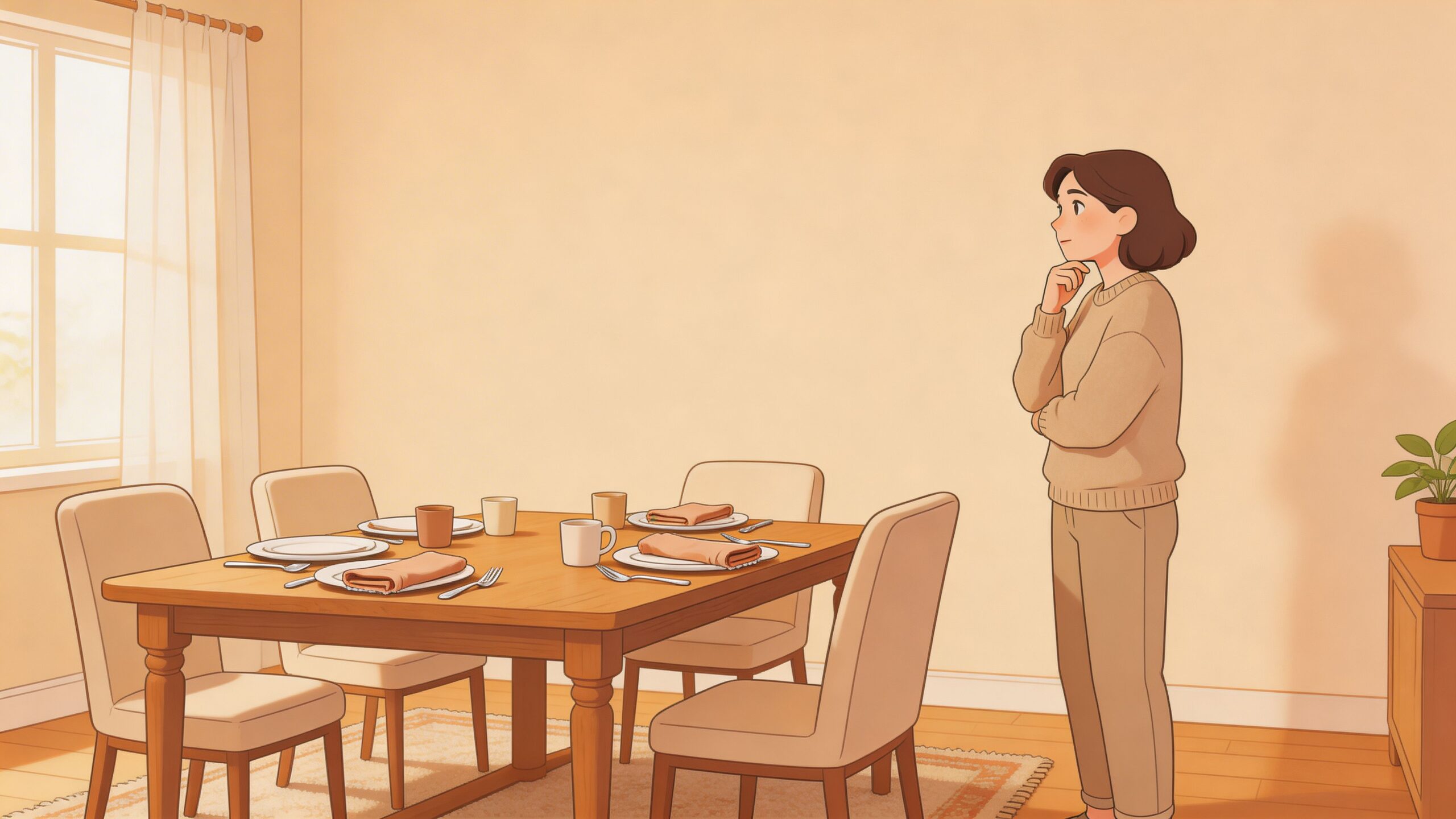
Why the room still feels incomplete
We see it all the time. A family has a beautiful table, comfortable chairs, and enough room to gather. But the space still doesn’t feel settled because nothing is handling the support work.
A buffet or server can change that quickly. It gives you:
- A landing spot for serving dishes so the table stays less crowded
- Closed storage for linens and tableware that don’t need to stay out
- A surface for everyday display like lamps, framed photos, or seasonal decor
- A visual anchor that makes the room feel intentional instead of pieced together
Some customers come in thinking they need “more storage.” After a short conversation, they also want easier entertaining, a cleaner room, and a better place to stage food when family comes over. One piece can solve all three.
Everyday value, not occasional value
The best dining furniture works hard even when no one is hosting. On a normal week, a server might hold placemats, candles, and the good salad bowl. On Thanksgiving, it becomes the pie station. In December, it turns into the hot cocoa setup. In spring, it displays a vase and keeps clutter out of sight.
Practical rule: If a piece improves both storage and flow, you’ll use it far more often than you expect.
That’s why this category matters so much. You’re not buying filler. You’re buying function that also adds beauty.
Some homeowners prefer a more substantial look, especially in traditional dining rooms. Others want something a little cleaner and simpler. If you want to see one example of a classic dining storage piece, this Kalispell dining buffett shows the kind of presence many people are after when they want their dining room to feel complete.
The piece that helps hosting feel easier
A lot of people think buffets and servers are only for large homes. That’s not really true. In many Southern Oregon homes, they’re useful because they reduce back-and-forth trips to the kitchen and give the room a clear place for serving.
If you’ve ever balanced a stack of plates in one hand while clearing space on the counter with the other, you already understand the point. The right piece doesn’t just decorate the room. It makes dinner feel calmer.
Decoding the Lingo Buffet Server Sideboard or Console
These words get mixed together all the time. That’s normal.
Customers regularly tell us, “I think I need a buffet. Or maybe a sideboard. I’m not sure.” Much of the confusion comes from the fact that retailers, designers, and manufacturers don’t always use the terms the same way. The good news is that the differences are usually simple once you see them side by side.
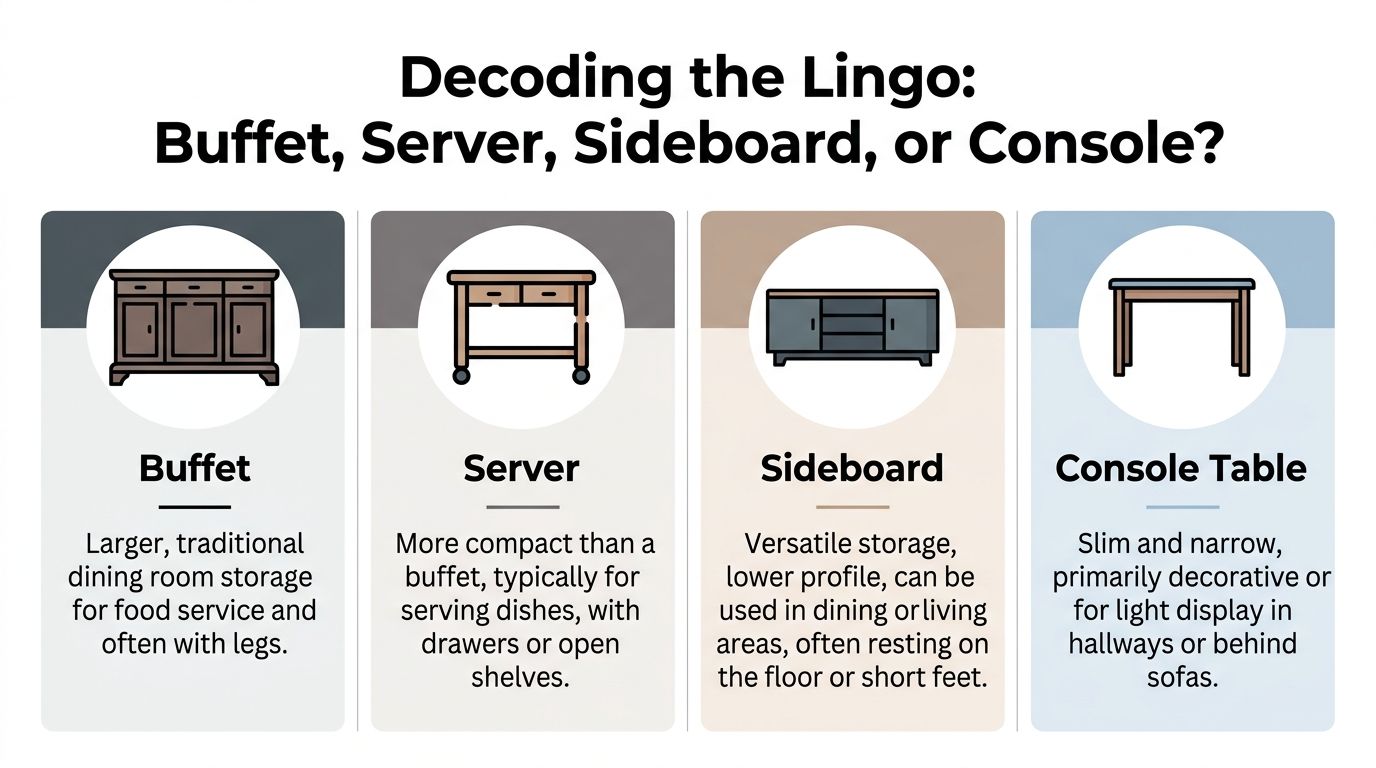
The simplest way to tell them apart
Here’s the plain-language version.
| Term | Usual look | Common use |
|---|---|---|
| Buffet | Longer, dining-focused piece with drawers and cabinets | Serving food, storing dishes, anchoring a dining wall |
| Server | Often a bit lighter in feel, sometimes slightly smaller | Extra surface space and flexible dining storage |
| Sideboard | Low, broad cabinet style, often more solid to the floor | Storage in dining rooms, living rooms, or entry spaces |
| Console table | Narrow and shallower, with lighter storage or display use | Hallways, behind sofas, entry walls, decorative display |
If that still sounds fuzzy, think about the room first.
A buffet usually belongs in a dining room by instinct. A console usually doesn’t start there. A sideboard can go either way. A server often lands in the middle and borrows features from the others.
Why the buffet name became so familiar
Part of the reason people use “buffet” so broadly is that buffet-style dining became part of American culture in a very visible way. The all-you-can-eat buffet concept grew from earlier “free seconds” traditions and Depression-era restaurant service, peaked in the 1980s, and by 1998, 26% of U.S. buffet restaurants had closed as the market became saturated, according to this history of all-you-can-eat buffets in America. That same source notes that food waste became one of the challenges tied to the format.
Furniture names and food-service names aren’t identical, but they’ve overlapped in everyday speech for a long time. That’s why many shoppers use “buffet” as the catch-all term.
The practical differences that matter most
When you’re shopping, focus less on the label and more on the job the piece needs to do.
- Need more enclosed storage? A sideboard or larger buffet may fit best.
- Need a serving station near the table? A server often handles that well.
- Need a narrow profile for a hallway or tight wall? A console is usually the better match.
- Need one piece that looks substantial? A buffet often gives you that grounded dining-room feel.
If the name is confusing, measure the space and list what you need to store. That will point in the right direction faster than the label will.
A quick showroom shortcut
When you’re walking a showroom floor, look at the legs and the depth first. Pieces with a lighter, taller stance often read more like servers or consoles. Pieces with a broader body and more cabinet presence tend to read as buffets or sideboards.
That’s usually enough to cut through the jargon and shop with confidence.
Finding the Perfect Fit A Sizing and Measurement Guide
The fastest way to make a good-looking piece feel wrong is to buy the wrong size. A buffet that’s too deep crowds the room. One that’s too small can look disconnected from the table and wall.
This part is less about design taste and more about avoiding frustration.
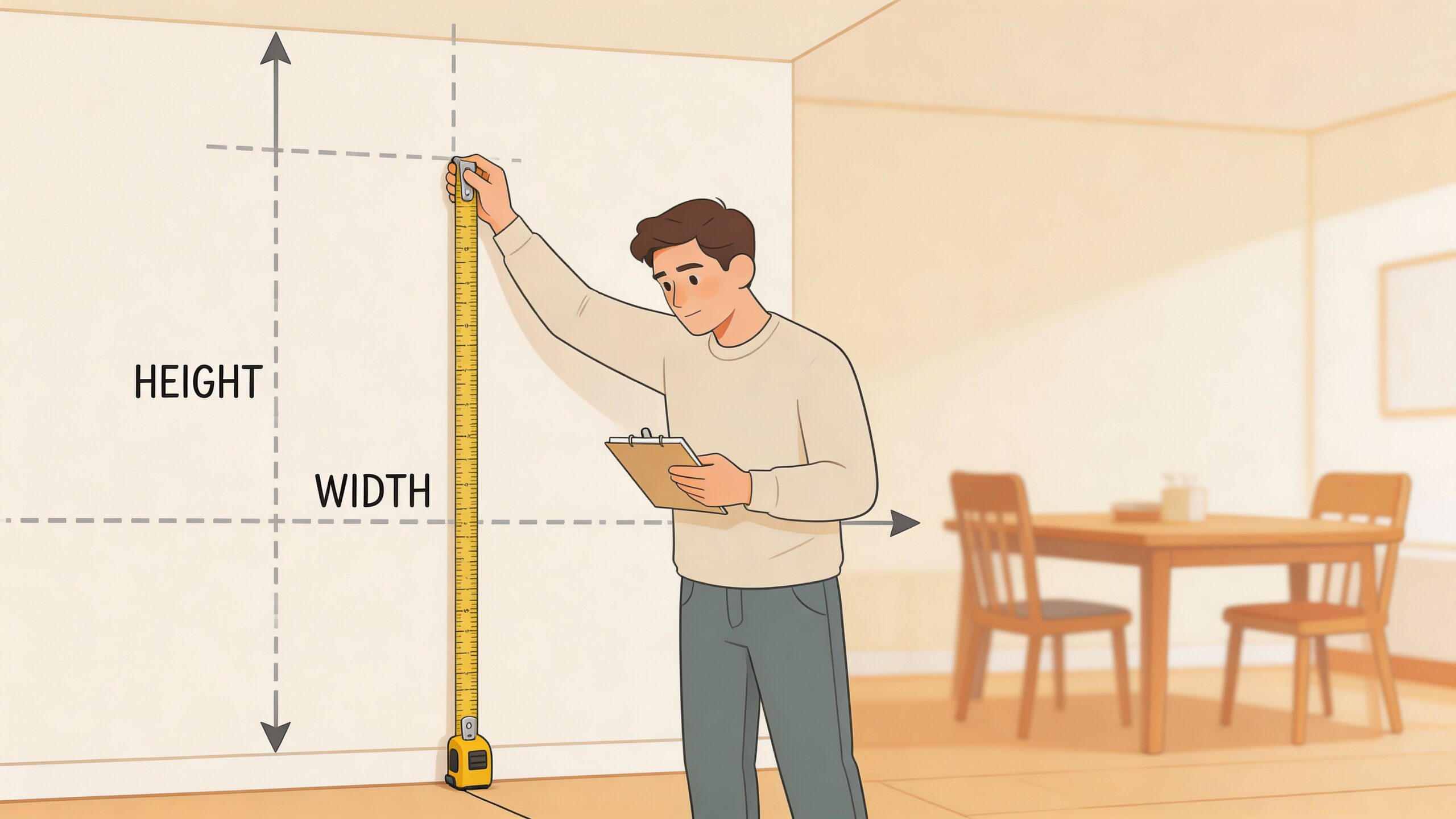
Start with accurate dimensions
A helpful benchmark comes from a common dining storage format. The homestyles Buffet-Of-Buffets server measures 36.5 inches high, 41.75 inches wide, and 16.75 inches deep, while the hutch version reaches 72.25 inches high with the same 16.75-inch depth, as listed on this product dimension reference.
That 16.75-inch depth matters. It’s a common benchmark because it can handle standard dinner plates without sticking too far into the room.
A simple measuring routine
Use this order. It keeps mistakes to a minimum.
Measure the wall width
Start with the full wall, then subtract space needed for doors, vents, outlets, or trim.Measure the depth you can spare
Don’t just measure to the back of a chair. Pull the chairs out the way they are used and check the walking space.Check height against nearby furniture
A buffet around the height of many dining surfaces usually feels natural. If you’re considering a hutch, think about how that added height will sit with windows, art, and light fixtures.Mark it on the floor
Painter’s tape helps. Seeing the footprint is often more useful than reading the dimensions on paper.
Where people usually get tripped up
Most sizing mistakes come from focusing only on width. Depth is often the bigger issue.
A piece can look slim online and still feel bulky in person. That’s why we always tell people to think about movement first. Can someone open a cabinet door and still let another person pass by comfortably? Can chairs slide back without the room feeling pinched?
Bring your measurements with you, including baseboards, outlet locations, and any nearby doorway swing. Those details save time.
If you want a broader planning method, this guide on how to measure furniture gives a useful outside perspective on checking room dimensions before you buy. We also keep our own local reference handy with this practical page on measuring furniture for your home.
Think about scale, not just fit
A piece can technically fit and still feel off. That’s where scale comes in.
A narrow wall may call for a cleaner, simpler server. A larger dining room can usually handle a wider buffet or a taller hutch without the wall looking empty. In many Rogue Valley homes, especially open-concept layouts, the right buffet helps define the dining zone without adding visual clutter.
When customers bring dimensions into our spacious showroom in Grants Pass, the conversation gets much easier. We can compare pieces in person and judge whether the proportions feel balanced, not just possible.
Discovering Your Style From Reclaimed Wood to Modern Lines
You walk into the dining room after dinner, look at the empty wall, and realize the room doesn’t need more furniture. It needs the right furniture. This is usually the moment when style starts to matter, because a buffet or server often sets the tone for the whole space.
Style is not only about whether a piece looks rustic or modern. It also affects how settled, warm, relaxed, or refined the room feels in a Southern Oregon home. After nearly 80 years of helping families furnish homes since 1946, we’ve seen one pattern again and again. Customers may start by asking what looks good, but the better question is why a certain piece feels right once it’s in the room.
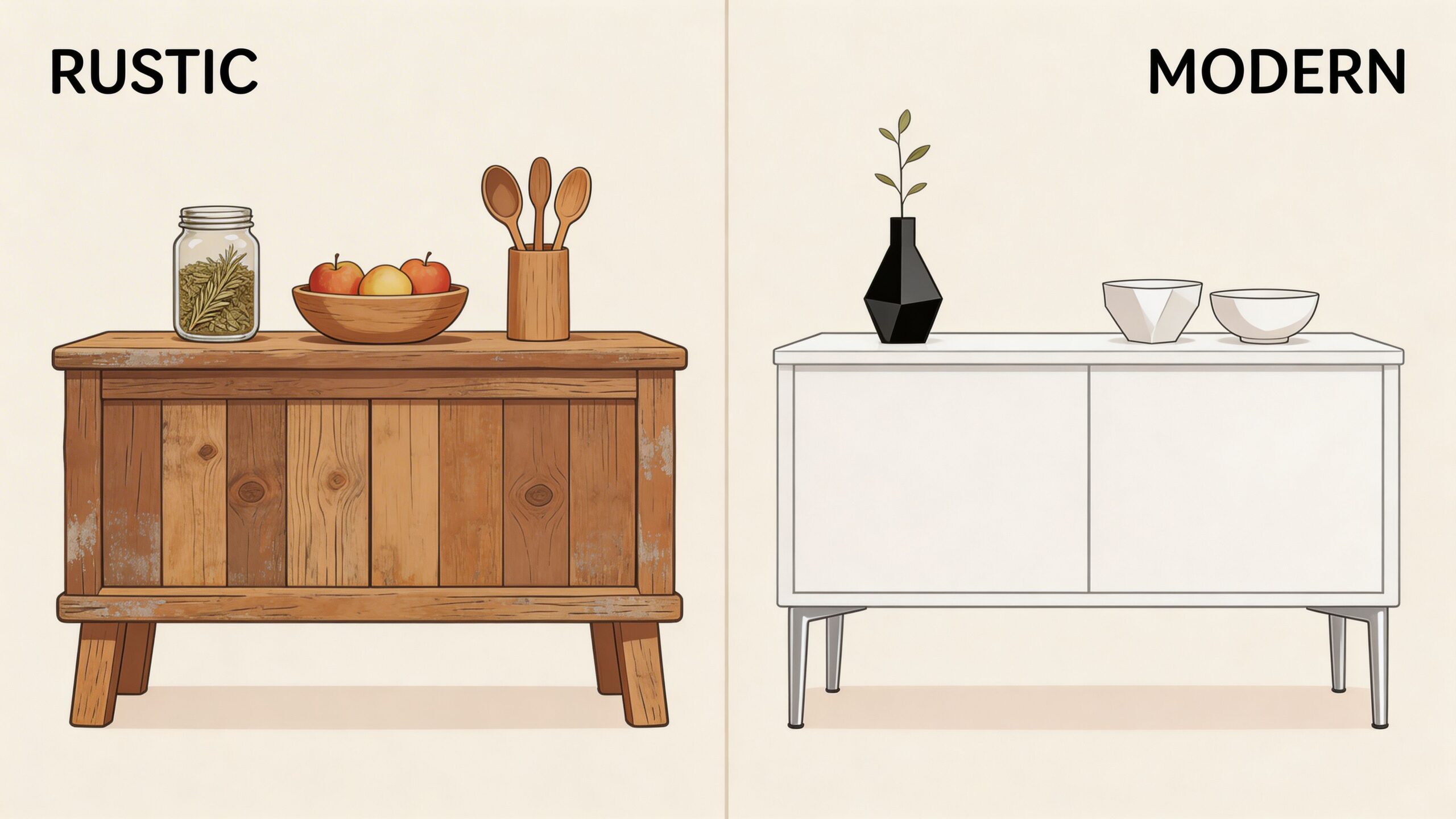
What different materials tend to say
Materials speak in different voices.
Reclaimed wood usually feels warm, relaxed, and full of history. Saw marks, knots, grain shifts, and color variation give it the kind of character that works well in farmhouse homes, casual dining rooms, and spaces that need a little softness. In person, reclaimed wood often answers a question online photos cannot. Is the texture charming, or is it too rough for how you live? That is one reason customers in our Grants Pass showroom like to see these pieces up close.
Teak has a cleaner, more sculpted look, but it still brings natural warmth. It suits homes that want organic material without a heavy or overly rustic feel. We often recommend teak to shoppers who like modern lines but do not want their dining room to feel cold.
Painted finishes and smoother wood surfaces usually read a little more formal. They can fit coastal, transitional, or modern homes, especially when you want the shape of the piece, not a busy grain pattern, to lead the design.
Matching the piece to the home
A buffet does not need to match every chair leg, table edge, or finish in the room. It needs to make sense with the home around it.
That sounds subtle, but it matters. A traditional Southern Oregon home with crown molding and warmer floors often looks comfortable with deeper wood tones, framed doors, and classic hardware. A casual family home may feel better with plank textures, a slightly timeworn finish, and less formal detailing. In a cleaner, more modern setting, simpler profiles and lighter visual weight usually keep the room from feeling crowded.
Here is a helpful way to sort through the options:
- Traditional homes often suit richer stains, more detail on the doors, and hardware with a classic shape.
- Farmhouse or casual interiors usually pair well with reclaimed wood, visible texture, and a more relaxed finish.
- Modern rooms often benefit from crisp edges, simpler drawer fronts, and restrained hardware.
- Transitional spaces usually work best with balance. A familiar shape, a lighter finish, or a cleaner base can tie old and new together.
Some of the pieces customers respond to most strongly in our showroom are the ones that do not look mass-produced. Our Unique Finds selection, especially in reclaimed wood and teak, gives people something many online searches cannot. A piece with individual grain, hand-finished detail, and real presence.
Mixing styles without making the room feel uncertain
A dining table and buffet can come from different collections and still look like they belong together.
In fact, a little contrast often makes a room feel more lived-in and personal. If you're trying to combine old and new pieces, our guide on how to mix furniture styles walks through practical ways to connect shapes, materials, and finishes without forcing a match.
The easiest rule is to repeat two or three traits. You might echo the wood tone, the hardware finish, or the curve of a leg or door frame. That works like a thread running through a quilt. Every patch is different, but the stitching ties it together.
An example helps. A sleek dining table can sit comfortably with a reclaimed wood buffet if both pieces share a similar warmth in color. A more formal table can also pair well with a simpler server when the hardware or overall scale feels related. Exact matching often feels stiff. Shared details usually feel collected.
Rooms tend to feel natural when a few details connect. They tend to feel overdone when every surface matches.
Think about Southern Oregon light
Light changes furniture more than many shoppers expect.
Homes in Grants Pass, Medford, Ashland, and nearby towns can have very different daylight depending on window direction, tree cover, and how open the floor plan is. A darker buffet may feel grounded and handsome in a bright dining room with plenty of sun. That same finish can feel heavier in a shaded corner. Reclaimed wood often softens a room with stone, metal, or other hard finishes. Painted pieces can help a smaller dining area feel brighter and calmer.
This is one of those places where showroom shopping still has real value. A phone screen can show color. It usually cannot show depth of finish, movement in the grain, or whether teak feels smooth and sculptural or whether reclaimed wood feels too rugged for your everyday use. We help customers sort through that difference every day, then talk through the practical side too, including delivery to Southern Oregon homes and financing if that helps make the right piece doable now instead of later.
More Than Just Good Looks A Look at Storage and Functionality
A buffet can be beautiful and still be wrong for your home.
The interior layout matters just as much as the exterior. We encourage customers to stop thinking in broad terms like “extra storage” and get more specific. Extra storage for what?
Match the interior to your habits
Start by naming what you want inside the piece.
For everyday dining tools
Drawers are useful for placemats, napkins, serving utensils, candles, and coasters.For bulky items
Cabinets handle larger bowls, platters, small appliances, and stackable dishes better than drawers.For flexible storage
Adjustable shelves help when your needs change through the year.For entertaining pieces
Open shelves or divided areas can be handy if you like to keep trays, baskets, or bottles easy to reach.
Some people need a buffet for holiday dishware. Others need it to tame daily clutter. Those are different jobs, and the inside should reflect that.
Think through one real use case
A practical way to shop is to build one realistic scenario.
Say you host extended family a few times a year. You may want drawers for linens, a cabinet for serving bowls, and enough top surface for dishes before they go to the table. If your household uses the dining room daily, you may care less about formal storage and more about convenience.
That kind of thinking keeps you from paying for features you won’t use.
Heated buffet servers need planning
Furniture and food warming equipment can overlap, but they’re not the same thing. If you’re considering a heated buffet server for entertaining, pay attention to the operating requirements.
The Kitchen Tek buffet server uses a 120V electrical configuration and is designed to hold food in the 140°F to 165°F range, according to this heated buffet server specification. That matters because these units need proper ventilation and a suitable electrical setup.
Shoppers sometimes get confused. A dining buffet furniture piece may look like it could hold warming equipment anywhere, but heat, cords, and airflow need to be considered before you place one permanently.
Don’t buy the outside first and assume the inside will work. List the items you need to store, then check drawer depth, shelf clearance, and door swing.
If you want a practical checklist for comparing these features, this page on selecting a dining storage piece covers the kinds of details worth checking before you decide.
Placing and Styling Your New Furniture Masterpiece
Once the piece is in the house, placement does a lot of the heavy lifting. Styling comes second.
The best setup usually feels obvious after the fact. Traffic moves well, doors open easily, and the top surface looks intentional instead of crowded.
Where to place it
In a dining room, the most common location is along the longest uninterrupted wall. That gives the piece room to breathe and creates a natural serving zone.
Other good placements can work too:
- Across from the dining table if you want traditional balance
- On a side wall near the kitchen opening if function matters most
- In an open-concept space to visually define the dining area
- In an entry or living room if the piece reads more like a sideboard or console
If the piece has cabinet doors or deep drawers, test the swing before final placement. This sounds basic, but it’s one of the easiest things to overlook during delivery day.
How to style the top without overdoing it
Individuals often style these pieces better when they use fewer items, not more.
Try a simple arrangement with varied height:
- One taller item such as a lamp, vase, or branch arrangement
- One medium visual anchor like framed art or a mirror above
- One lower object such as a bowl, stack of books, or tray
That mix usually looks balanced. If everything is the same height, the top can feel flat.
Use the room, not just the furniture
A buffet should connect to the wall around it. Artwork, a mirror, or sconces can help it feel integrated.
Some homeowners prefer a practical top surface that stays mostly clear for serving. Others want a decorative setup year-round. Both are valid. The key is leaving enough open space that the furniture can still do its job when guests come over.
Keep at least part of the top easy to clear. A buffet that can’t become a serving station on short notice loses half its usefulness.
Our White-Glove Delivery team often helps customers think through final placement because setup is part of how the piece succeeds. We don’t just drop boxes. We assemble, place, and help the furniture start its life in the room the right way.
Your Buying Checklist The Gates Home Furnishings Advantage
A customer walks into our Grants Pass showroom with photos on a phone, measurements on a sticky note, and one practical question: “How do I know I’m buying the right piece?”
After serving Southern Oregon homes since 1946, our answer is usually pretty simple. The right buffet or server should fit your room, match the way you live, and arrive in your home without creating a second project for you to manage. Online research helps narrow the field. Seeing the piece in person, opening the drawers, and checking the finish under real light usually answers the final questions.
Buffets and servers also have a practical history behind them. The modern buffet server gained traction during the Great Depression, and in 1933 the Chase Brass & Copper Co. introduced a chromium buffet server while buffet-style entertaining was becoming more common. To help promote it, the company commissioned Marjorie Post’s booklet “How to Give Buffet Suppers,” which described the buffet supper as a “happy result of the depression,” according to the Connecticut Museum of Culture and History’s account of the buffet server’s origins. That background explains why these pieces still make sense today. They started as hardworking furniture, and the best ones still are.
The checklist we’d use in our own homes
Before you choose a piece, stop and ask a few grounded questions.
Will it fit the room and still let people move comfortably?
A buffet should support the room, not pinch traffic around the table or doorway.Does the storage match what you plan to put inside?
Deep cabinets work well for serving bowls and platters. Drawers are better for linens, flatware, and smaller items.Does the style make sense with the rest of your home?
In many Southern Oregon homes, that might mean warm wood tones, reclaimed wood character, or cleaner modern lines that do not fight with nearby furniture.Have you seen the finish in person?
A wood finish on a screen is a little like paint on a brochure. It points you in the right direction, but it rarely tells the whole story. Grain variation, board texture, hardware color, and sheen are easier to judge in the showroom.What happens after you buy it?
Delivery, assembly, placement, and payment options matter more than many shoppers expect, especially with larger dining pieces.
Why a showroom still answers questions a screen cannot
This category rewards hands-on shopping. One drawer can tell you a lot. If it slides poorly, feels thin, or rattles, you learn something in five seconds that a product photo will never show.
That is one reason customers from Medford, Ashland, Central Point, and across Southern Oregon still make the drive to our Grants Pass store. They want to compare reclaimed wood against teak, see how a finish behaves in natural light, and get a feel for whether a piece has the weight and construction to last. After 80 years in business, we have seen the same pattern again and again. The purchase gets easier once the furniture is right in front of you.
For shoppers drawn to older pieces or timeworn character, this guide with tips for finding and buying the perfect antique furniture is a helpful outside reference. It gives you a good framework for inspecting craftsmanship, wear, and condition before you commit.
The Gates advantage is practical, not flashy
The service side of the purchase matters, too.
George Gates built this business on a promise of Service and Value, and that standard still shapes how we help customers shop today. A buffet may look straightforward on the sales floor, but the actual purchase involves budget, timing, delivery access, and setup in the room where it will live.
Here is what shoppers often appreciate most:
- Flexible payment options through Gates Easy Pay, including no down payment options, interest-free financing for a period, and no-credit-needed options
- White-Glove Delivery with professional assembly and in-room placement
- Unique Finds in reclaimed wood and teak for homes that need warmth, texture, and a little individuality
- Trusted brand selection that may include familiar names such as La-Z-Boy, Flexsteel, Ashley, and Beautyrest across the store
Delivery is a critical part of the experience, especially with heavy case goods that need careful handling through doorways, hallways, and dining spaces. If that part of the purchase is on your mind, our page explaining what White-Glove Delivery includes in a real home setting walks through the process clearly.
If you’re ready to compare buffets and servers in person, visit Gates Home Furnishings in Grants Pass and walk our extensive showroom. We’ll help you sort through size, materials, storage, financing, and delivery so you can choose a piece that fits your Southern Oregon home for the long haul.