Statement Mirror for Living Room: Elevate Your Space


A living room can be fully furnished and still feel unfinished. The sofa fits. The rug works. The lamp light is warm enough at night. But the room still doesn't have that one piece that pulls everything together and gives it presence.
That's usually where a statement mirror earns its place. In homes across Grants Pass, Medford, Ashland, Central Point, and the wider Rogue Valley, a well-chosen mirror often does what another chair or side table can't. It adds light, scale, and a focal point without making the room feel crowded.
The Finishing Touch Your Living Room is Missing
A common situation shows up in Southern Oregon living rooms. A homeowner has the seating in place, the coffee table is right, and the wall over the sofa still feels flat. Artwork can work, but sometimes the room needs something with more shape, more reflection, and more presence.
A statement mirror for living room spaces solves that problem because it does two jobs at once. It decorates the wall, and it changes how the room feels when daylight moves across it. For homes that need a little more brightness or a stronger focal point, that combination is hard to beat.
Since 1946, Gates Home Furnishings has been part of Grants Pass. George Gates Jr. founded the business here with a promise of “Service and Value,” and that promise still shows up in how customers are treated, from careful guidance in the store to White-Glove Delivery in the home, as described on the Gates Home Furnishings White-Glove Delivery page.
A mirror works best when it feels intentional, not like a last-minute filler for an empty wall.
Some rooms need a bold arch. Others need a warm reclaimed wood frame that brings in texture the rest of the room is missing. In houses near downtown Grants Pass, in newer neighborhoods outside Medford, and in established Ashland homes with plenty of character already built in, the right mirror often becomes the piece that makes the room feel designed instead of just furnished.
For homeowners looking beyond mirrors, there are also smart ways to transform your living room walls so the space feels layered without getting busy. And for anyone building a room around a standout focal point, it helps to look at a few statement furniture pieces before deciding what belongs on the wall and what belongs on the floor.
Choosing Your Mirror's Personality and Style
A mirror isn't just a reflective surface anymore. Market research projects that living room demand will keep rising as mirrors are used as “sculpture” rather than just functional items, especially thick wooden frames and minimalist metal finishes projected for 2026, according to wall mirror market reporting.

Start with the frame
The frame usually tells the room what kind of piece this is.
- Minimal metal works well in cleaner spaces with straight lines, simpler upholstery, and a quieter palette.
- Thick wood brings weight and warmth. It's often the better choice when the room feels a little cold or needs more natural texture.
- Reclaimed wood or teak adds history. Those pieces often suit homeowners who don't want their room to look copied from a catalog.
That's where Unique Finds matter. Reclaimed wood, teak, and one-of-a-kind statement pieces bring character that standard wall decor often can't. In a living room with a Flexsteel sofa or a La-Z-Boy recliner, that kind of texture can keep comfort-focused furniture from looking too uniform.
Then choose the shape
Shape changes the tone of the room faster than expected.
Rectangular mirrors feel structured and dependable. They're often the easiest fit over consoles and sofas.
Round mirrors soften a room full of square cushions, rectangular tables, and straight wall lines.
Arched mirrors add a bit of architecture, especially useful when the room itself doesn't offer much of it.
Design cue: If the furniture has a lot of hard edges, a softer mirror shape often brings better balance than another sharp rectangle.
A quick style check helps too. Modern rooms usually respond well to black or brass metal. Rustic and collected interiors often benefit from reclaimed wood. Transitional spaces can go either direction, depending on whether the room needs more warmth or more contrast.
The best way to judge texture, finish, and presence is in person. That's why many shoppers still want a showroom visit before making a final call. A mirror that looks modest online can feel dramatic in real life, and one that seems bold on a screen can disappear against a larger wall. Browsing contemporary and traditional design styles can also help narrow the look before stepping into a room full of options.
Getting Scale and Proportion Right
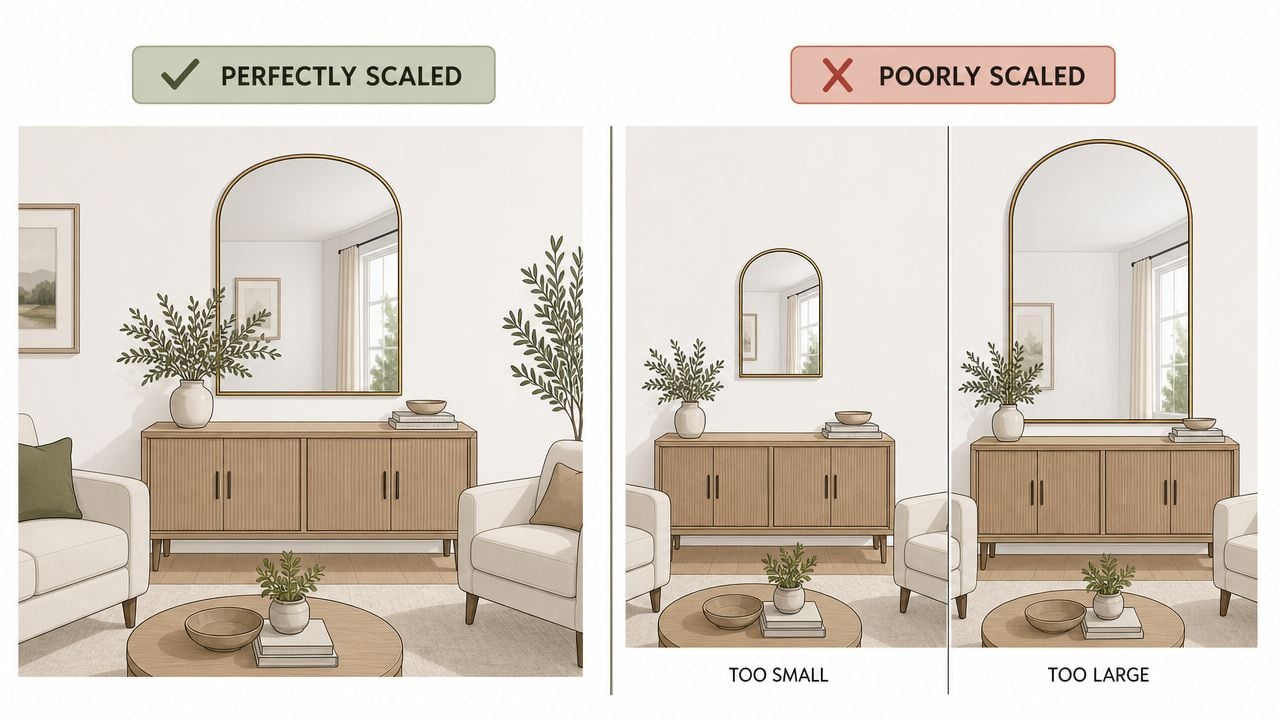
Most mirror mistakes come down to size. Not style. Not finish. Size.
A beautiful mirror that's too small looks accidental. One that's too large can swallow the furniture below it and make the wall feel top-heavy. Scale is what turns a statement piece into a balanced one.
The first measurement to remember
A practical benchmark matters here. When hanging a statement mirror above furniture, leave 6 to 8 inches of space between the furniture top and the mirror bottom to keep visual balance, based on wall-mounted mirror market guidance.
Measurement to keep in mind: Leave 6 to 8 inches between the top of the furniture and the bottom of the mirror.
That one rule prevents a lot of problems. Hang it lower and the piece feels cramped. Hang it much higher and the mirror starts drifting away from the furniture, which breaks the connection between the two.
How to judge width and height
A few principles help before anyone reaches for hardware:
- Match the furniture below it. Over a sofa or console, the mirror should feel related to the width beneath it, not isolated in the middle of the wall.
- Respect the wall around it. If the mirror nearly touches shelves, sconces, or trim, the room starts feeling crowded.
- Watch the ceiling line. Tall walls can handle more height. Lower ceilings usually need cleaner proportions and less visual heaviness at the top.
Real furniture scale matters. With deeper, more substantial seating from brands like Flexsteel and La-Z-Boy, smaller decor often looks undersized. A mirror has to stand up to the visual weight of the room.
A simple test before buying
Before choosing the final size, take these steps:
- Measure the wall and the furniture below it.
- Mark the mirror footprint with tape or paper.
- Sit down across the room and look at it from normal living room angles.
That last step catches problems fast. A mirror that seems fine while standing directly under it may look too narrow once the room is viewed the way people use it. For shoppers who want a little more certainty before they buy, a good measuring checklist can save a second trip. This guide on how to measure furniture is useful for that process.
Strategic Placement for Light and Impact
Placement changes everything. The same mirror can look flat on one wall and remarkable on another.
The strongest placement usually isn't the emptiest wall. It's the wall that lets the mirror work for the room by borrowing light, extending a sightline, or softening a tight layout.
Use daylight on purpose
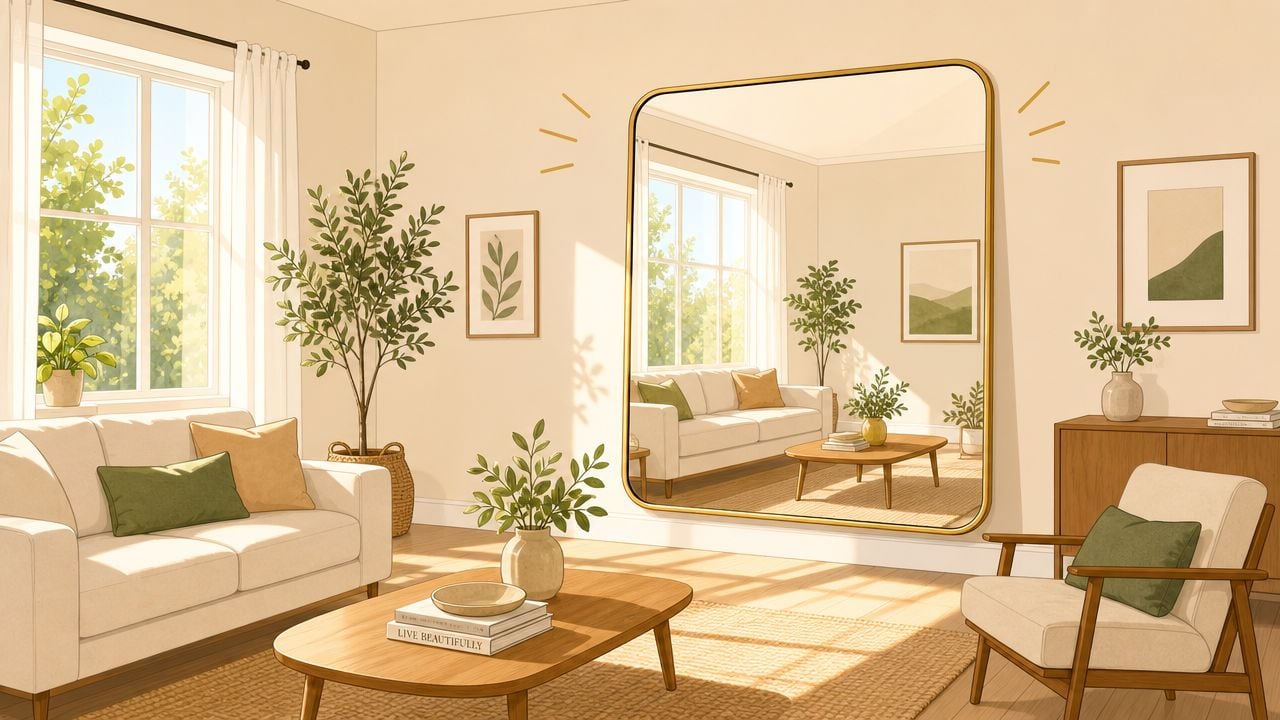
To increase light reflection and depth, place a large wall mirror directly opposite or adjacent to a natural light source like a window, and use painter's tape to outline the size on the wall before installation, as recommended in this living room mirror sizing guide.
That advice matters in the Rogue Valley, where not every living room gets all-day sun. A mirror placed near a window can help a room feel more open from morning through late afternoon without adding another lamp or brighter overhead light.
Match placement to the room problem
Different rooms call for different mirror locations.
- Dark corner seating area. Place the mirror where it can catch side light from a nearby window.
- Long wall behind a sofa. Use the mirror to break up a broad stretch that would otherwise need multiple smaller pieces.
- Low-ceiling room. Choose a taller mirror orientation so the eye travels upward more naturally.
- Narrow pass-through space near the living area. A mirror can keep that transition from feeling dead and closed off.
A mirror should reflect something worth seeing. If it only reflects a blank hallway or visual clutter, it won't help the room much.
Homes around Ashland often have charming architecture but tricky wall shapes. Newer Central Point layouts can have cleaner walls but need more warmth and dimension. In either case, the mirror should respond to what the room lacks, not just what wall happens to be empty.
The painter's tape trick is one of the most useful low-risk steps in the process. Tape the outline, back up, and look from the sofa, the main chair, and the doorway. If the shape feels awkward from two out of three viewpoints, it's usually the wrong spot.
Thoughtful mirror placement also works hand in hand with better lighting throughout the space. For anyone evaluating lamps, windows, and reflection together, this article on putting your living room in the best light is a helpful companion.
Styling Your Mirror Like a Professional
Hanging the mirror isn't the finish line. Styling around it is what makes the room feel settled.
A statement mirror can stand alone, but many living rooms benefit from a little supporting structure. That might mean a console underneath, a lamp nearby, a plant that softens the edge, or a grouping that turns several smaller mirrors into one composed wall.
Groupings that look collected, not messy
For mirror gallery arrangements, the cleanest rule is simple. Mix three or more shapes, vary the sizes, and keep a unified color palette or frame style such as teak or reclaimed wood. For larger pieces, hidden French cleats rated for 50+ lbs are advised for safety, according to this large wall mirror style guide.
That works because the variety creates movement, while the shared material keeps the arrangement from feeling random.
A few combinations tend to hold together well:
- Round, oval, and rectangle together if the frames share the same wood tone
- Mixed reclaimed finishes when the room already has natural textures
- Simple black frames when the rest of the room is modern and restrained
What doesn't usually work is mixing ornate traditional frames with very minimal furniture unless there's a strong reason elsewhere in the room. The mirror grouping should look deliberate, not like leftovers from different homes.
The case for a leaning floor mirror
A leaning mirror gives a room a more relaxed kind of drama. It can work beautifully beside a media console, near a corner chair, or layered behind a lower piece of furniture where the wall needs height.
That said, a leaning mirror isn't casual from a safety standpoint. If it's large, it still needs proper anchoring. Homes with children, frequent guests, or tight walkways shouldn't treat a floor mirror as decorative only.
Secure the piece first, then style around it. A beautiful mirror that isn't safely installed isn't finished.
This is also where White-Glove Delivery matters in real life. Professional placement and assembly make a difference with oversized decor, especially when the mirror is heavy, awkward to handle, or going into a room with delicate flooring nearby.
Bring Your Vision Home from Gates
The right statement mirror for living room design doesn't just fill a wall. It changes the room's balance, improves how light moves through it, and gives the space a stronger sense of identity. That's why this decision is usually less about decoration and more about how the whole room feels once the piece is in place.
For many Southern Oregon homeowners, it helps to see mirror scale, frame texture, and finish in person before deciding. In the 30,000 sq. ft. showroom in Grants Pass, customers can compare styles alongside living room pieces from La-Z-Boy, Flexsteel, Ashley, and Beautyrest, and see how a statement mirror relates to real furniture instead of a product photo.
Unique Finds are a big part of that search. Reclaimed wood, teak, and one-of-a-kind pieces give homeowners in Grants Pass, Medford, Central Point, Ashland, and across Southern Oregon options that feel personal, not mass-selected. For shoppers working within a budget, Gates Easy Pay includes $0 down, 6-month interest-free, and no-credit-needed options, which can make it easier to bring home the right piece without rushing into the wrong one.
Delivery matters too. White-Glove service means the team doesn't just leave a box at the door. They handle professional assembly and setup, and mattress purchases can include haul-away service as part of the broader customer care approach. Shoppers who want to start with available options can browse living room mirrors and home decor online.
Visit Gates Home Furnishings to explore statement mirrors, reclaimed wood and teak Unique Finds, and complete living room inspiration for homes across Grants Pass and the Rogue Valley. Stop by the Grants Pass Showroom to test comfort, compare styles in person, and get help from a local team that's been serving Southern Oregon since 1946 on the promise of Service and Value.