Financing No Credit Check: Get Furniture in Southern Oregon

A lot of people start furnishing a home with excitement, then hit the same wall. The sofa feels right. The mattress matters. The dining set finally makes the room feel finished. Then the question comes up: what happens if a credit check gets in the way?
That concern is more common than many neighbors in Grants Pass, Medford, Central Point, Ashland, and across the Rogue Valley think. A credit score doesn't always reflect real life. Someone may have steady income, good habits, and a clear need for quality furniture, yet still feel nervous about applying.
That's why the conversation around financing no credit check matters. It isn't just about getting approved. It's about understanding what's being offered, what it costs, and how to protect a household budget while still creating a comfortable home.
For local families trying to stretch a decorating budget, simple upgrades can help too. Small touches like lighting, mirrors, and textiles can make a room feel finished, and resources on affordable home decor projects can give practical ideas while larger purchases are being planned. For anyone starting from scratch, a helpful local planning guide on how to furnish a new home can also make the process feel less overwhelming.
Creating Your Home Without the Credit Stress
In Grants Pass, this often starts with a life change. A family moves into a new place near downtown. A retiree wants a better recliner with easier support getting in and out. A couple in the Rogue Valley finally replaces the mattress they've been “making do” with for too long. The need is real, even when the timing isn't perfect.
That's where stress can sneak in. People hear “financing” and assume it means a traditional credit process, a hard stop, or embarrassment at the register. In reality, financing no credit check is often meant for people whose financial picture doesn't fit neatly on a standard credit report.
Local trust matters in this kind of decision. Gates Home Furnishings was established by George Gates Jr. in Grants Pass in 1946, starting as a 5,000-square-foot store at 7th and H Street and growing into a 30,000-square-foot showroom at 700 SW 6th St. according to the Grants Pass & Josephine County Chamber listing. That history matters because furniture buying is personal. People want straight answers from a business that's been part of the community for generations.
Good financing should lower confusion, not add to it.
That older promise of Service and Value still sets the right standard for how this topic should be explained. A financing option should help a household understand what it's agreeing to, what ownership looks like, and whether the payments adequately fit the month-to-month budget.
A home also isn't built from generic pieces alone. Southern Oregon shoppers often want comfort they can test in person and style that feels personal, not copied from a warehouse page. That's where a large showroom in Grants Pass becomes useful. It gives people room to compare support, fabrics, sizes, and standout pieces before making a financial commitment.
What No Credit Check Financing Really Means
Financing no credit check doesn't mean free furniture, guaranteed approval, or no review at all. It usually means the lender or program looks at something other than a traditional credit score as the main gatekeeper.

A simple way to think about it
A standard credit application is a bit like a job interview focused mostly on past history. A no-credit-check option is closer to a manager asking, “Can this person do the job now?” Instead of emphasizing old borrowing history, the review often centers on current income, recent account activity, and ability to make the payments.
That matters because many adults don't have enough traditional credit history to fit the usual system. The World Bank notes that an estimated 53 million people in the United States have thin or no credit files, leaving them “credit invisible” and often outside standard lending products, as explained in this World Bank report on financial inclusion and alternative data.
What a lender may look at instead
The details vary, but these programs often focus on practical questions such as:
- Income coming in: Is there verifiable money arriving regularly enough to support the payment?
- Banking activity: Do recent deposits and account patterns show stability?
- Basic eligibility requirements: Some programs ask for an active bank account and identity verification.
- Current affordability: Can the customer handle the payment without stretching too far?
That's why “no credit check” can be a confusing phrase. It doesn't always mean “no standards.” It often means different standards.
Practical rule: If a financing offer can't explain how approval works in plain language, it's not clear enough yet.
People also run into this financing style outside furniture. For example, readers comparing purchase options for other major home needs may find it useful to see how Van Dyke Outdoors' no credit financing is framed in another category. Looking across categories can help shoppers ask better questions about terms, ownership, and final cost.
For furniture shoppers who want a clearer overview of common approval paths, a local explainer on furniture financing options can help sort out what's promotional, what's lease-based, and what deserves a closer look.
What people often misunderstand
A common misconception is that these programs are only for people in financial trouble. That isn't always true. Some customers haven't used much credit before. Others have income that doesn't fit a neat traditional pattern. Some prefer a private approval process that looks at today's budget instead of yesterday's file.
What matters most is understanding the structure before signing. If the monthly number looks manageable but the agreement is vague about fees, ownership, or missed payments, that's where problems start.
Comparing Common No Credit Financing Options
Not all no-credit-check offers work the same way. Some are built around temporary use with a path to ownership. Others are installment arrangements directly through a retailer. Some are outside loans that should rarely be used for furniture at all.
The main differences that matter
When comparing options, most shoppers want answers to a few practical questions:
- Who owns the furniture during payments
- Whether the total cost is clear up front
- What happens if a payment is missed
- Whether there's a fair path to ownership
- How much the financing adds to the purchase
Those are better questions than asking whether approval is easy.
No-Credit-Check Financing Options at a Glance
| Feature | Lease-to-Own (LTO) | In-House Financing | Third-Party Payday Loans |
|---|---|---|---|
| Ownership during payment period | The provider usually keeps ownership until the agreement is completed | Terms vary, but the structure is often tied directly to the furniture purchase | The borrower owns the purchase, but repays a separate cash loan |
| How approval is often evaluated | Often based on current income, bank activity, and basic eligibility | Often based on income, account status, and program terms | Often based on employment and income rather than credit score |
| Cost clarity | Must be reviewed carefully, especially total cost to own | Usually easier to evaluate when terms are written plainly | Can be very costly and should be approached with caution |
| Flexibility | May help shoppers who need a nontraditional approval path | Can be convenient when terms are transparent | Fast access to cash, but often risky for household goods |
| Best use case | A shopper who needs furniture now and wants a defined ownership path | A shopper who wants store-linked payment options | Generally not a strong fit for furniture purchases |
Lease-to-own and rent-to-own
Lease-to-own can be useful for shoppers who don't qualify under a traditional credit model and still need a couch, bed, or recliner now. The key point is ownership. During the lease period, the customer is usually paying toward the right to own the item later, rather than owning it immediately.
That structure isn't automatically bad, but it has to be understood clearly. The monthly amount can feel manageable while the final cost over time becomes much higher than expected if the agreement isn't read carefully.
A local guide on rent-to-own furniture can help shoppers sort out how these arrangements differ from standard installment financing.
In-house financing
In-house financing is often easier for shoppers to understand because it stays closer to the purchase itself. Instead of taking out a separate cash loan, the payment plan is attached to the furniture transaction.
This approach can feel more straightforward when the store explains the basics clearly. Is there a promotional period? Is there a no-interest option if paid in full on time? Is there a lease-to-own path for customers who need it? Those are the right questions.
Why payday loans are different
Some shoppers consider taking a cash loan elsewhere and then using that money to buy furniture. That's where caution is essential. According to Experian, payday loans can average APRs of 400% or more, which makes them an extremely expensive way to finance a household purchase, as noted in this Experian overview of no-credit-check personal loans.
Furniture should bring comfort to a home. The financing behind it shouldn't create a separate crisis.
For most households, a payday-style loan is the wrong tool for furnishing a living room or bedroom. A better path is a transparent furniture-specific program that explains ownership, total obligation, and payment timing from the start.
Red Flags to Watch For When Financing Furniture
Some financing offers sound easy because they leave out the details that matter most. That's why careful shoppers slow the process down before signing anything.
Warning signs in the paperwork
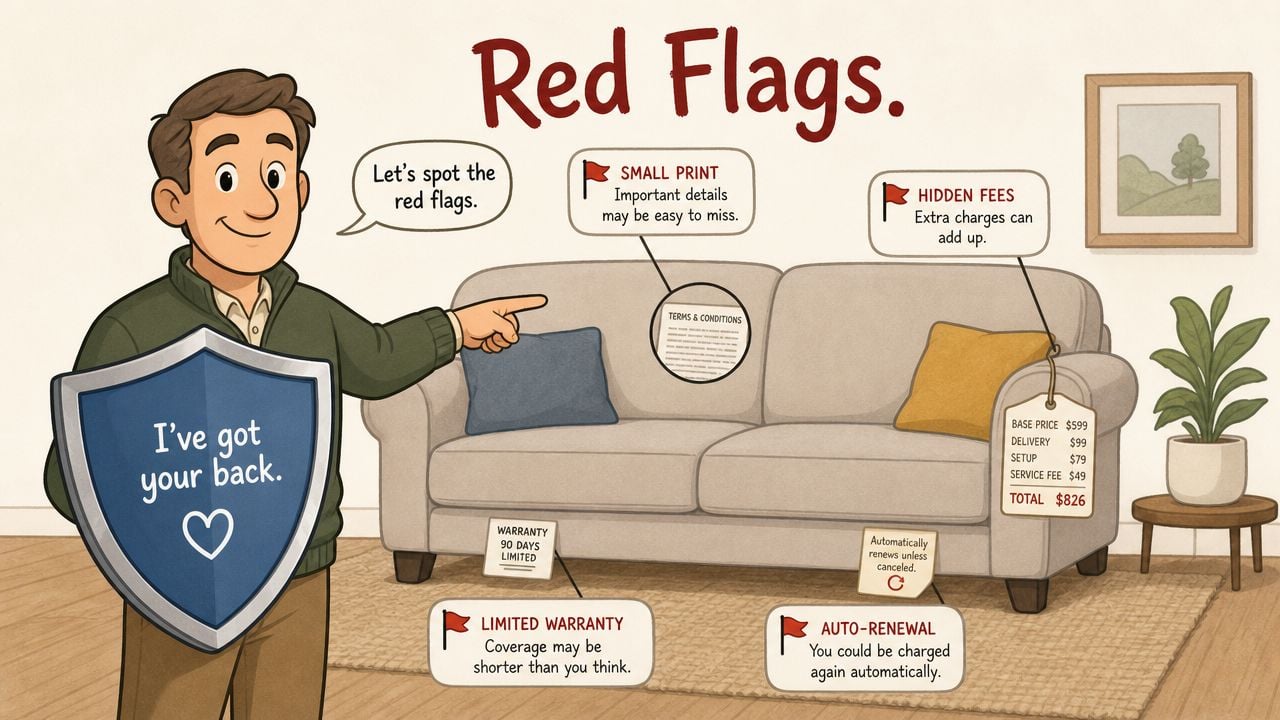
The first red flag is vague language around the full cost. If an agreement talks a lot about the weekly or monthly amount but makes the total obligation hard to find, that deserves a pause.
Another concern is pressure. If a seller rushes the signature before the customer understands ownership, fees, return terms, or missed-payment consequences, the financing isn't being presented responsibly.
Watch for these issues:
- Unclear total price: The payment looks small, but the agreement makes the final amount hard to calculate.
- No clear ownership path: The shopper can't tell when the item becomes theirs.
- Pressure to decide fast: There isn't enough time to read, ask questions, or compare.
- Confusing penalty language: Late fees, reinstatement rules, or default terms aren't explained plainly.
What “helping your credit” may not mean
Many shoppers assume that making every payment on time will automatically strengthen their credit file. That isn't always how these programs work. Snap Finance explains that “no credit needed” financing programs often report negative payment data like defaults to credit bureaus while omitting positive history, so on-time payments may not build credit in the way shoppers expect, as described in this overview of how no-credit-needed financing works.
That doesn't mean these programs never have a place. It means shoppers should avoid assuming they serve two goals at once. A program may help someone get furniture. It may not help build credit history.
Ask one direct question before signing: “If every payment is on time, what happens, and how is that reported?”
A safer decision process
A careful buyer usually does three things before agreeing:
- Reads the ownership language: This shows whether the arrangement is a lease, a loan, or a promotional plan.
- Checks the missed-payment rules: That reveals how forgiving or strict the agreement is.
- Looks past the monthly number: The key question is whether the overall commitment makes sense.
This kind of caution isn't pessimism. It's good household management. A sofa, mattress, or dining set should improve day-to-day life, not create confusion that lingers long after delivery.
The Gates Easy Pay Promise Our Approach
The best local financing programs don't just focus on approval. They focus on clarity, fit, and whether the purchase works for the home and the budget.
Financing built around real households
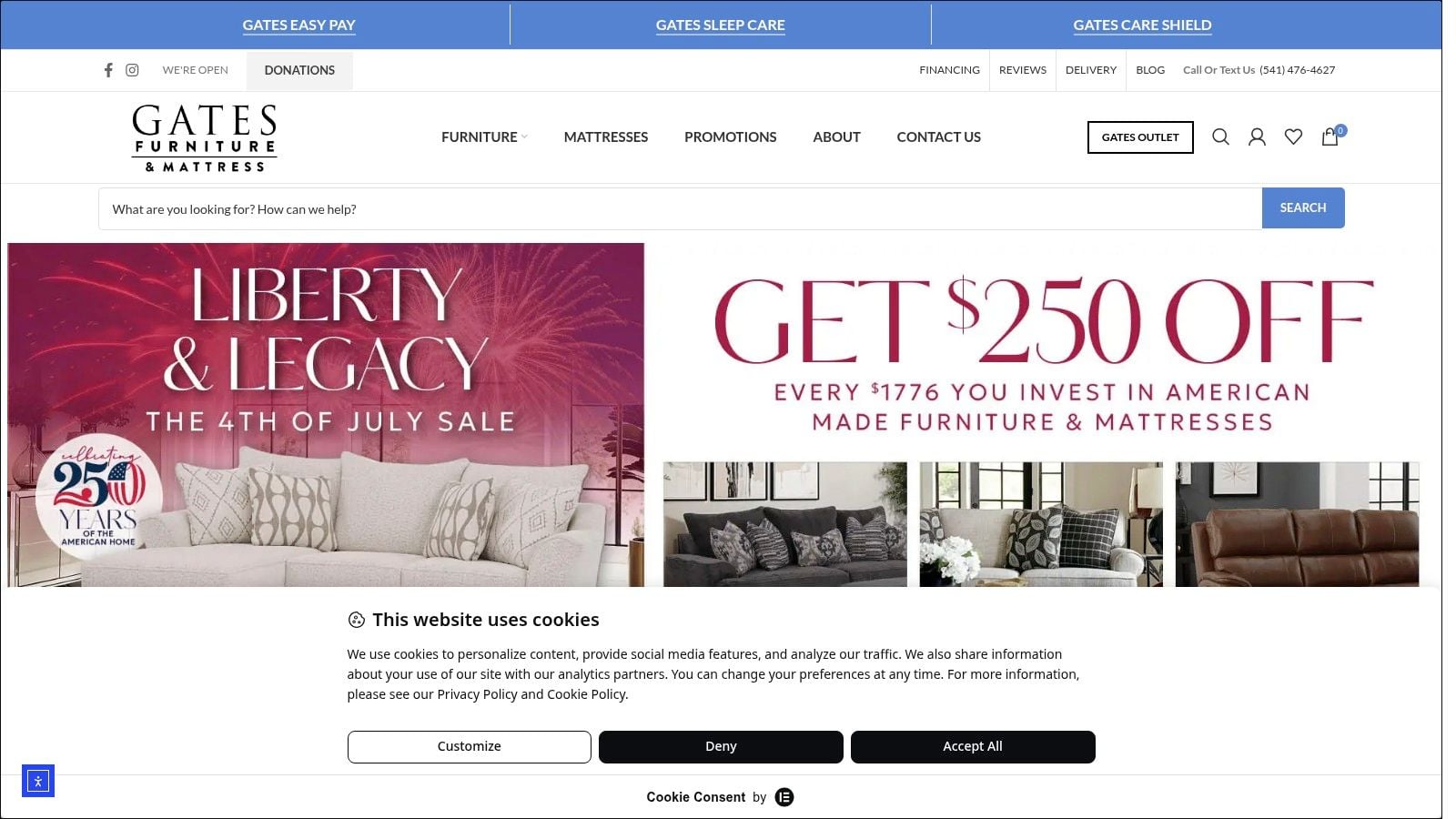
That's where Gates Easy Pay stands out as a practical local example. Gates Easy Pay includes no-credit-needed options, lease-to-own programs, $0 down, and six equal payments, along with no interest if paid in full within the promotional period. The focus is flexibility, so customers can look for a path that matches their situation instead of assuming one model fits everyone.
Details on the available programs can be reviewed directly through Gates Easy Pay financing options.
The strongest part of this approach is how it connects financing to actual home needs. A family replacing a worn-out mattress may need one kind of payment structure. A customer shopping for a recliner after a surgery or mobility change may need another. Someone furnishing a first apartment may want the simplest possible promotion with clear payment timing.
The showroom matters too
Furniture financing shouldn't happen in a vacuum. It helps when shoppers can test comfort, compare build quality, and see scale in person before agreeing to a plan. In Grants Pass, that means a 30,000 sq. ft. showroom where people can sit in the chair, lie on the mattress, and compare styles side by side.
That matters for major brands shoppers already know, including La-Z-Boy, Flexsteel, Ashley, and Beautyrest. It also matters for the more distinctive pieces that aren't easy to judge online. The showroom includes Unique Finds such as reclaimed wood, teak, and one-of-a-kind statement pieces that give a room more personality than standard catalog furniture.
The inventory depth also changes the experience. The showroom carries more than 400 recliners in stock, which gives Southern Oregon shoppers a real chance to compare support, seat height, arm feel, and motion before taking one home the same day.
A financing plan is only half the decision. The other half is whether the piece is right for daily life.
Service after the purchase
A lot of frustration in furniture buying happens after the paperwork is done. Boxes arrive. Assembly becomes the customer's problem. Old bedding or packaging gets left behind. That's where service still matters.
White-Glove Delivery means the furniture is professionally brought into the home, assembled, and set up rather than dropped at the curb. Mattress haul-away is part of that service, which can make a big difference for households replacing older sleep sets. Protection also matters, and Gates Care Shield adds coverage against accidental spills and tears for years.
That full-circle approach ties back to a much older promise. Since 1946, the family standard set by George Gates has been Service and Value. In practical terms, that means financing shouldn't be treated as a gimmick. It should be one part of helping a neighbor furnish a home responsibly in Grants Pass, Medford, Ashland, Central Point, and across Southern Oregon.
Your Simple Guide to Getting Started
For anyone weighing financing no credit check, the most useful next step is a calm review of the basics. A rushed decision usually becomes an expensive one.
Three checks before signing
Know the budget first
Start with the monthly number that fits after rent, mortgage, utilities, groceries, and fuel. If the payment only works in a “good month,” it probably doesn't fit.Read for ownership and total obligation
The shopper should know whether the agreement is a lease, a promotional financing plan, or another structure. The total commitment matters more than the smallest advertised payment.Ask direct questions out loud
Ask what happens if a payment is late, when ownership transfers, and whether the plan helps build credit or only reports problems. Clear answers usually signal a better experience.
A smart buying process also includes choosing the right furniture the first time. A practical guide on how to shop for furniture smartly can help shoppers compare comfort, size, material, and room fit before they ever get to the financing step.
For Southern Oregon households, it helps to keep the process local and personal. A real conversation can clear up confusion much faster than staring at fine print alone. That's especially true for shoppers coming from Medford, Ashland, Central Point, or nearby neighborhoods in Grants Pass who want to compare options in person before making a decision.
For neighbors looking for straightforward answers, comfortable brands like La-Z-Boy, Flexsteel, Ashley, and Beautyrest, distinctive reclaimed wood and teak Unique Finds, and flexible payment options rooted in a long local tradition of Service and Value since 1946, Gates Home Furnishings is worth a visit. Visit our Grants Pass Showroom near downtown on SW 6th Street to test comfort in person, or browse our collection online from anywhere in the Rogue Valley.