Best Recliners for Elderly to Sleep In


A lot of Southern Oregon families reach the same point the same way. A parent starts dozing off in the living room because getting in and out of bed has become hard. A spouse notices swollen legs by evening, or hears that familiar line: “The bed just doesn't feel right anymore.” Then the questions come fast. Is it safe to sleep in a recliner every night? What kind of recliner supports sleep, not just TV watching? How do you choose one without guessing wrong?
Those questions matter because the wrong chair can make a long night even longer. The right chair can make daily life easier, safer, and a lot more comfortable.
In Grants Pass, this isn't a new conversation. Since 1946, George Gates Jr. built the business on a simple promise of Service and Value. Gates Home Furnishings began as a 5,000-square-foot store at the corner of 7th and H Street and grew into a 30,000-square-foot showroom at 700 SW 6th St. in Grants Pass, Oregon, according to the Grants Pass & Josephine County Chamber listing. That long history matters because families rarely shop for sleep recliners on a whim. They need practical answers, not fluff.
A good starting point is improving the whole sleep setup, not just replacing furniture. The guide on how to improve sleep quality helps frame the bigger picture.
A Good Night's Sleep Is Closer Than You Think
A recliner can be the right answer for an older adult, but only if it matches how that person lives. Some need easier transfers. Some need leg elevation. Some need a flatter sleep position because a partly reclined lounge chair won't cut it through the night.
That's why broad advice from the internet usually falls apart in real homes across Grants Pass, Medford, Central Point, and Ashland. A chair that feels comfortable for ten minutes can feel completely different after an evening nap, a midnight wake-up, and a morning stand-up.
A recliner for overnight sleep should solve a problem, not just feel soft in the showroom.
The good news is that recliners for elderly to sleep in have come a long way. There are now specialized lift chairs and medical-grade recliners designed with adjustable backrests, articulated leg rests, and zero-gravity positioning to reduce pressure on joints and support circulation during sleep, as described in this category overview.
What families usually worry about
Most concerns fall into a few buckets:
- Safety getting up: If standing is the hardest part of the day, the chair has to help.
- Sleeping posture: A nap chair isn't automatically a sleep chair.
- Pain and swelling: Legs, hips, lower back, and shoulders all need support.
- Daily practicality: Remote controls, fabric, room placement, and cleanup matter.
Why local trial matters
Online photos don't show seat depth. Product listings don't show whether someone's heels hit the floor properly. Reviews don't tell a daughter in the Rogue Valley whether her dad can work the handset with stiff fingers.
That's where an in-person trial changes everything. A large showroom gives families room to compare fit, firmness, motion, and exit ease side by side instead of gambling on a doorstep delivery and hoping for the best.
Choosing the Right Recliner Mechanics for Sleep
Not every recliner is built for sleeping. That's the first filter.
A manual recliner may feel familiar, but it often asks too much from older knees, hips, shoulders, or hands. If someone has to shove hard with their legs or twist to work a lever, the chair is already failing the test. A basic power recliner is easier, but it still may not offer the positioning needed for overnight rest. A power lift recliner adds real transfer support, and for many seniors, that's the feature that changes daily life.
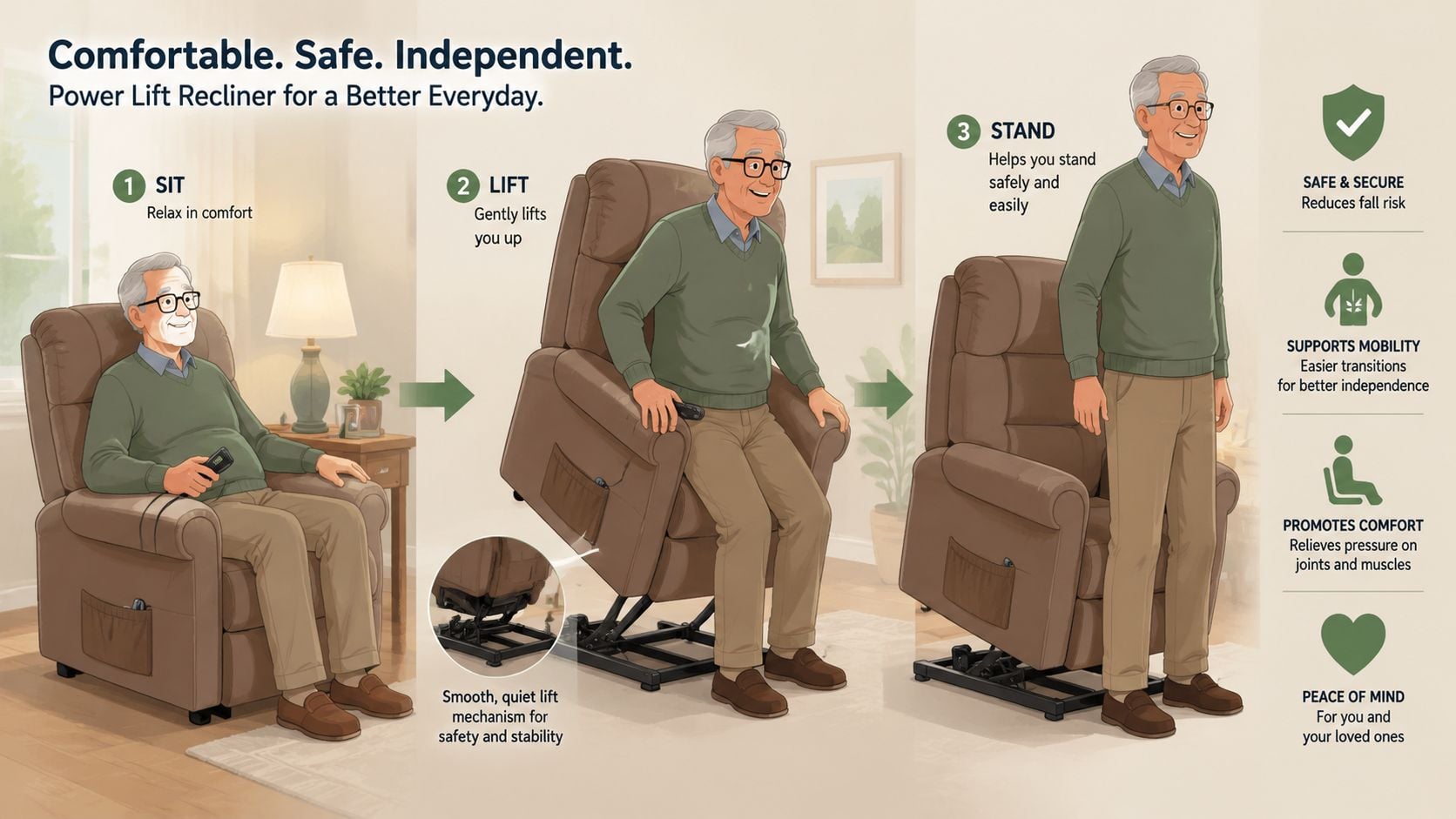
For a simple overview of mechanism styles, the guide to types of power reclining seating is useful.
Manual, power, and lift chairs are not the same
Here's the plain-English breakdown:
| Type | Best for | Main limitation |
|---|---|---|
| Manual recliner | Short sitting sessions and occasional naps | Harder to operate and stand from |
| Power recliner | Easier positioning for sitting and light resting | May still lack true sleep-friendly adjustability |
| Power lift recliner | Mobility support, safer transfers, and sleep use | Needs careful sizing and feature selection |
The big mistake is buying based on appearance alone. Plenty of chairs look plush. Far fewer work well through an entire night.
Dual motor is the feature that matters most
If a recliner is going to be used for serious sleep, dual-motor design is the line in the sand. According to Freedom Care's recliner guidance, a dual-motor system allows independent adjustment of the backrest and footrest to reach a near-flat position of about 150 degrees, which is the benchmark for comfortable napping and reduced spinal strain. The same source notes that single-motor models often only recline to 130 degrees.
That difference is not small. It changes how the lower back, hips, and legs sit for hours at a time.
Practical rule: If the back and footrest can't move separately, it's harder to fine-tune a sleep position that actually supports the body.
A single-motor chair ties movements together. That usually means the feet don't extend enough unless the back drops too far, or the back stays too upright when the legs need more elevation. It's a compromise mechanism. For overnight sleep, compromise gets old fast.
What else matters beyond the motor
The mechanics are the backbone, but comfort finishes the job.
Look closely at these details:
- Seat depth: Too deep, and the user slides forward. Too shallow, and thigh support disappears.
- Lumbar shape: The lower back should feel supported without forcing a rigid posture.
- Arm height: Arms should help with balance and easy transfers, not leave shoulders shrugged up.
- Fabric feel: Breathable fabric usually works better for overnight use than a slick or heat-trapping surface.
- Cushion response: Soft isn't always better. The chair should support pressure points without swallowing the user.
A buying opinion worth taking seriously
For nightly sleep, skip “occasional recliners.” Focus on sleep-capable lift chairs or medical-grade power recliners with independent movement, stable support, and easy controls. The chair should fit the person's body first and the room second.
That's not glamorous advice. It's the advice that prevents returns and regret.
Prioritizing Health Safety and Medical Benefits
Health is the reason most families start looking in the first place. Comfort matters, but safety usually drives the decision.
For many seniors, especially those dealing with mobility limits or pain, sleeping in a power lift recliner is more than a preference. According to this senior recliner guide, sleeping in a power lift recliner is often medically recommended for people with conditions like sleep apnea or back pain, and a quality model can raise a person up to 25 inches to reduce the strain and fall risk involved in getting in and out of bed.
That matters most in the dark, in the early morning, or after a rough night when legs feel weak and balance isn't steady.
Why a recliner can be safer than a bed
A standard bed asks for a lot. The user has to scoot, pivot, plant both feet well, and push up from a lower surface. A lift chair reduces those demands by helping bring the seated body forward and upward in a controlled way.
That's especially useful for older adults who deal with:
- Back pain
- Sleep apnea
- Circulation issues
- Post-surgery recovery
- Joint stiffness
The right recline can also raise the legs, ease pressure on joints, and support blood flow. Those are practical gains people notice at home, often within the first few days.
Elevated sleep is not the same as flat sleep
This point gets missed all the time.
Some people do well sleeping slightly inclined. Others need a much flatter position to avoid awkward pressure through the spine and hips. Those are two different needs, and families shouldn't treat them as interchangeable.
A general power recliner may be fine for upright rest, reading, or afternoon naps. It may not be the right answer for someone who plans to sleep in it every night. Specialized sleep chairs are important for this purpose. Flexsteel is one example of a brand known for dedicated sleep-chair designs, and stores that carry lines such as La-Z-Boy, Flexsteel, Ashley, and Beautyrest give families a better chance to compare true sleep options in person.
Some older adults need a chair that eases breathing when elevated. Others need a chair that gets much closer to bed-like alignment. Those are separate buying decisions.
Pressure relief deserves more attention
Anyone who sits or sleeps in one chair for long stretches should think about pressure management early, not after skin irritation starts. Caregivers who want a practical framework can review NDIS pressure injury assessments from Nursing Assessment Australia for a useful overview of what to monitor.
This is also where fit and cushioning matter more than showroom softness. Pressure tends to build at the lower back, tailbone, hips, calves, and heels if the chair doesn't distribute weight well.
For readers comparing models, the article on best lift chairs for elderly gives a helpful starting point.
Two safety checks families should never skip
A chair can have the right shape and still be wrong for the user. Two checks deserve attention every time:
- Weight capacity: The frame and mechanism have to match the person using it.
- Motor noise: Sleep and loud mechanisms don't belong together.
A quiet, smooth lift and recline movement is more than a luxury. It helps keep nighttime adjustments from turning into full wake-ups.
Your In-Person Measurement and Trial Checklist
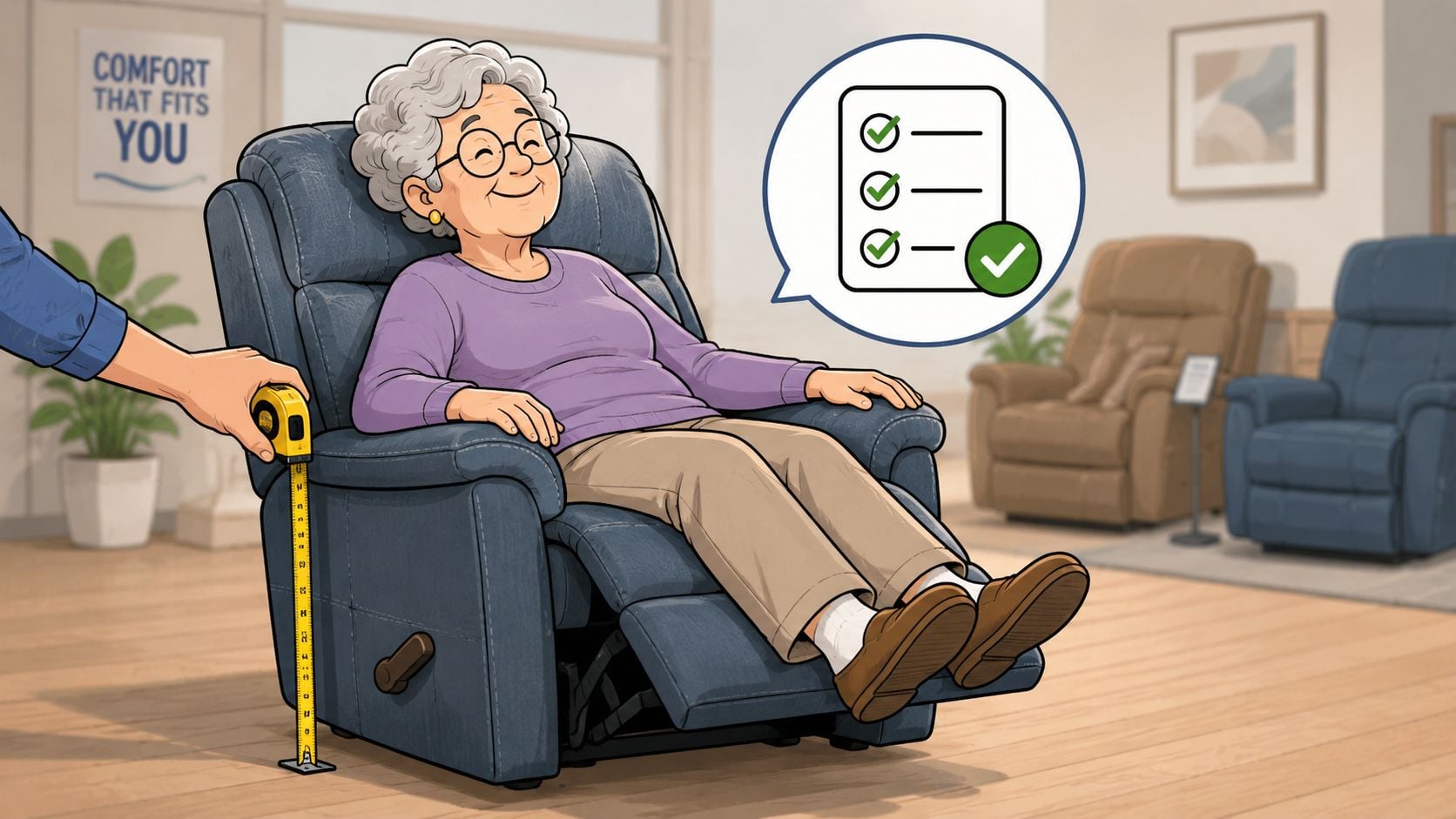
The fastest way to make a bad recliner purchase is to skip the sit test.
A screen can show color. It can't show whether the chair hits the back of the knees too hard, whether the shoulders slump, or whether the remote makes sense in tired hands. That's why the strongest advice for shoppers in Grants Pass, Medford, Central Point, Ashland, and around the Rogue Valley is simple. Test the chair in person.

Families who want to prepare before they shop can use this guide on how to measure furniture.
What to bring to the showroom
Bring the basics. It makes the trial more useful.
- Measurements from home: Note doorway widths, walking clearances, and the wall space where the chair will live.
- A list of health needs: Write down what the chair must solve. Swelling, back pain, standing difficulty, overnight sleep, or all of the above.
- Daily-use items: Glasses, a walker, or the kind of blanket normally used at night can all affect comfort and function.
A 30,000 sq. ft. showroom in Grants Pass gives families room to compare multiple fits instead of settling for the first chair that looks decent.
The sit test checklist
Use this checklist while seated and again while fully reclined:
- Feet on the floor: When seated upright, feet should rest comfortably without tiptoeing or dangling.
- Seat depth: The back should touch the chair while leaving enough space behind the knees to avoid pressure.
- Arm support: Arms should rest naturally, not float too high or drop too low.
- Head position: The neck shouldn't crane forward to watch TV or talk.
- Remote use: Buttons should be easy to see, hold, and press.
- Entry and exit: The user should feel steady sitting down and getting up.
- Full recline comfort: Legs, hips, shoulders, and lower back should all stay supported as the chair moves.
Test gentle motion if available
Not every sleeper wants movement, but a gentle rocking action can be worth trying. A study published through the National Library of Medicine found that sleeping in a recliner chair with rocking motions increased the duration of deep sleep and significantly decreased the time it took to fall into deep sleep in elderly users.
That's one of those features that can't be evaluated online. A person has to feel whether the motion calms the body or feels distracting.
The right recliner should feel better after fifteen minutes than it did after the first thirty seconds.
Try more than one upholstery and feel
In-store shopping, in this scenario, outperforms guessing.
Some fabrics breathe better through the night. Some cushioning feels good at first and then reveals pressure spots. Some recliners look compact but fit the body poorly. Some larger models turn out to be easier to enter and exit. Gates Home Furnishings offers lift chairs among other seating options, and testing brands such as La-Z-Boy, Flexsteel, and Ashley side by side gives shoppers a clearer sense of what their body actually prefers.
A final practical note. While shopping for function, don't ignore the room itself. A sleep recliner can still look at home beside reclaimed wood or teak Unique Finds, especially when the space needs to feel warm and lived-in rather than clinical.
Accessories and Long-Term Care for Your Investment
A recliner used for nightly sleep needs support around it, not just beneath it. The smartest purchases often aren't flashy. They're the small add-ons that keep the chair cleaner, easier to use, and more comfortable over time.
Accessories worth adding early
A few extras make daily life smoother:
- Washable cover: Helpful for hygiene, spills, and easier cleaning.
- Side caddy: Keeps the remote, glasses, phone, and reading material within reach.
- Supportive throw or pad: Can soften pressure points without changing the chair's structure too much.
- Nearby table: A stable surface for water, medications, or nighttime essentials matters more than people think.
A reclaimed wood or teak accent table can do that job without making the room feel medical. That's one reason Unique Finds work so well in comfort-focused spaces.
How to keep the chair working properly
Long-term care is simple, but it needs consistency.
Keep the mechanism area free of dust and blockage. Clean upholstery based on the fabric's care instructions. Don't yank the remote cord or wedge objects beneath the leg rest. If the chair starts moving unevenly or sounding rough, stop using force and have it checked.
For households dealing with worn seating in other rooms too, this couch cushion support guide offers a practical look at what happens when seat support starts to fail.
Protection matters if the chair will see daily use
A sleep recliner gets used harder than a typical living room chair. That's why protection plans deserve a real look, especially in homes with pets, regular snack use, or mobility aids. Accidental spills, fabric wear, and tears happen in normal life.
The page on upholstery protection spray is a good place to start when comparing basic prevention options. Gates Care Shield is also relevant for shoppers who want added protection against accidental spills and tears over the long haul.
A recliner used every day should be cared for like essential equipment, not occasional furniture.
Bringing Comfort Home The Gates Service Promise
The right chair doesn't help much if the buying process creates new problems. Older adults and caregivers need clear advice, practical delivery, and setup that works the first night the chair comes home.
That expectation goes back to 1946 and George Gates Jr.’s promise of Service and Value. In a category as personal as sleep seating, that old promise still fits. Families in Grants Pass, Medford, Central Point, Ashland, and across Southern Oregon usually don't need a pitch. They need someone to help them choose a chair that matches the user, the room, and the daily routine.
Why service matters after the purchase
Lift chairs aren't basic box furniture. The user needs the chair placed correctly, assembled properly, and explained clearly. The remote has to make sense. The room spacing has to work. The transfer path has to feel safe.

For shoppers comparing service levels, this page on white-glove delivery service explains what professional in-home setup includes. White-glove delivery is the right standard for sleep recliners because families shouldn't be left wrestling with assembly, placement, or haul-away details.
Financing should make the choice easier, not harder
A good recliner can be a meaningful investment, especially when it's replacing a bed for part or all of the night. Flexible payment options help families buy the right fit instead of settling for the wrong chair because of timing.
Gates Easy Pay includes $0 down, 6-month interest-free options, and no-credit-needed financing. That kind of flexibility matters when comfort and mobility can't wait.
The practical case for choosing a real lift chair
Specialized lift chairs for older adults can show a 94% reduction in fall risk during the sitting-to-standing transition compared to traditional furniture, according to this lift chair study chapter. That's the kind of result families should pay attention to, because standing up safely is often the hardest part of the day.
The final recommendation is straightforward. Buy the chair that fits the body, supports the health need, and works in the home. Test it in person if possible. Don't guess on mechanics. Don't ignore setup. Don't treat nightly sleep like an afterthought.
For neighbors looking for recliners for elderly to sleep in, Gates Home Furnishings offers the kind of in-person trial that online shopping can't match, with a 30,000 sq. ft. showroom in Grants Pass, brands like La-Z-Boy, Flexsteel, Ashley, and Beautyrest, White-Glove Delivery with professional assembly and mattress haul-away, plus Gates Easy Pay options including $0 down, 6-month interest-free, and no-credit-needed financing. Visit our Grants Pass Showroom or browse our collection online.