Recliner Chair Luxury: A Southern Oregon Buyer’s Guide


The search usually starts the same way. A homeowner in Grants Pass, Medford, or Ashland sits down at the end of a long day, shifts twice, reaches for a pillow behind the lower back, and realizes the chair in the room looks fine but doesn't feel fine for very long. That's the moment when recliner chair luxury stops being about appearance and starts being about relief, support, and whether the chair fits the body that uses it every day.
A luxury recliner can be a sanctuary, but only if the details under the upholstery are doing real work. Plenty of chairs look refined from across the room. Far fewer deliver the kind of ergonomic support, dependable mechanism design, and lasting cushion structure that make them worth bringing home. That gap matters, especially for Southern Oregon households furnishing a main living room, a reading corner, or a recovery-friendly seat for a family member who needs extra support.
Table of Contents
- Your Journey to Unmatched Comfort Begins Here
- What Truly Makes a Recliner Chair a Luxury
- Understanding Advanced Recliner Mechanisms
- Finding Your Perfect Fit for Comfort and Home Style
- Exploring Health Wellness and Lift Chair Options
- Budgeting for Luxury and Making It Affordable
- The Gates Difference Why You Should Shop Local
Your Journey to Unmatched Comfort Begins Here
The right recliner usually solves more than one problem at once. It needs to support tired backs, fit the room, work with the home's style, and still feel inviting after a long movie, a quiet afternoon with a book, or a recovery day when comfort matters more than anything else. That's why buying one by looks alone often leads people in the wrong direction.
A better approach starts with one simple question. Is the chair delivering real comfort, or only the appearance of luxury?
That question has shaped how Southern Oregon families have shopped for furniture for generations. Gates Home Furnishings was established in 1946 by George Gates Jr. in Grants Pass, Oregon, starting as a 5,000-square-foot store at the corner of 7th and H Street before expanding to its current 30,000-square-foot showroom at 700 SW 6th St, Grants Pass, OR 97526, carrying forward George Gates' promise of “Service and Value” (company history on Houzz).
That history matters because recliners aren't impulse purchases. They're everyday-use furniture. A chair that feels acceptable for two minutes can feel wrong after twenty. A chair that seems sleek online can turn out to have weak lower-back support, shallow cushioning, or a mechanism that doesn't suit the person using it most.
What shoppers should settle before they buy
- Primary use: Decide whether the chair is mainly for reading, TV watching, napping, recovery, or all-day sitting.
- Body support needs: Lower-back comfort, seat height, head support, and ease of getting in and out matter more than trend language.
- Room placement: A recliner in a family room near traffic flow needs different proportions than one in a bedroom corner or den.
- Delivery reality: Large motion furniture often needs professional setup, especially when doorways, hallways, or tight turns are involved.
Practical rule: If a recliner only feels good in one exact position, it probably isn't luxury. Good luxury seating stays comfortable through normal shifts in posture.
For anyone starting that search, it helps to review examples of recliners with delivery options before narrowing down features. The goal isn't to find the fanciest chair on the tag. It's to find the one that supports daily life in Southern Oregon homes without asking the body to compromise.
What Truly Makes a Recliner Chair a Luxury
Luxury in a recliner isn't one thing. It's a stack of decisions made well. Materials matter. Cushioning matters. The frame matters. The mechanism matters. Most of all, the chair has to support the body in a way that still feels good after regular use, not just during a quick sit in a showroom.
Luxury starts where comfort lasts
A premium recliner should have substance under the surface. Upholstery choice affects feel and maintenance, but the seat core is what determines whether a chair holds its shape. True luxury recliners integrate high-density “Superlastic” or “Super-Latic” foam cores, often exceeding 40-50 kg/m³ density, with multi-layer fiber overstuffing, which creates stronger lumbar support and better structural resilience than lower-density alternatives that sag sooner (recliner market material details).
That's one of the clearest differences between decorative luxury and functional luxury. A chair can wear handsome leather or a refined fabric and still disappoint if the cushion pack collapses too quickly or never supported the spine properly in the first place.
Material choices deserve a careful look too:
- Leather quality: Premium leather usually ages better and develops character. Lower-grade alternatives can look polished at first but wear unevenly.
- Performance fabric: This can be a smart choice for active households that want softness without constant worry.
- Frame integrity: A strong internal structure gives the mechanism a stable foundation and keeps the seat from feeling loose over time.
For shoppers comparing upholstery, it helps to review a premium USA leather selection and evaluate texture, hand-feel, and how the surface will live with pets, sunlight, and daily use.
The luxury illusion to watch for
Some of the most attractive recliners on the market are also the most misleading. They're designed to hide the mechanism so well that they resemble stylish accent chairs. That can be a good thing, until the design strips out the support the body needs.
The biggest miss is often lumbar support. Some luxury-styled recliners prioritize a slim silhouette and a “doesn't look like a recliner” profile, but they don't provide properly sized lower-back support. Without that support, even an expensive chair may offer no meaningful ergonomic advantage over a standard sofa or lounge chair.
A beautiful recliner that doesn't support the lower back is decorating, not solving.
A better test is simple. Sit back naturally. Let the body settle. If the lower back immediately searches for a pillow, the chair hasn't earned the word luxury.
Another good sign of quality is how the chair behaves over time, not just how it photographs. Better recliners maintain support across upright sitting, mild recline, and deeper relaxation. Inferior ones feel fine in one angle and awkward everywhere else. That's where real recliner chair luxury separates itself from showroom theater.
Understanding Advanced Recliner Mechanisms
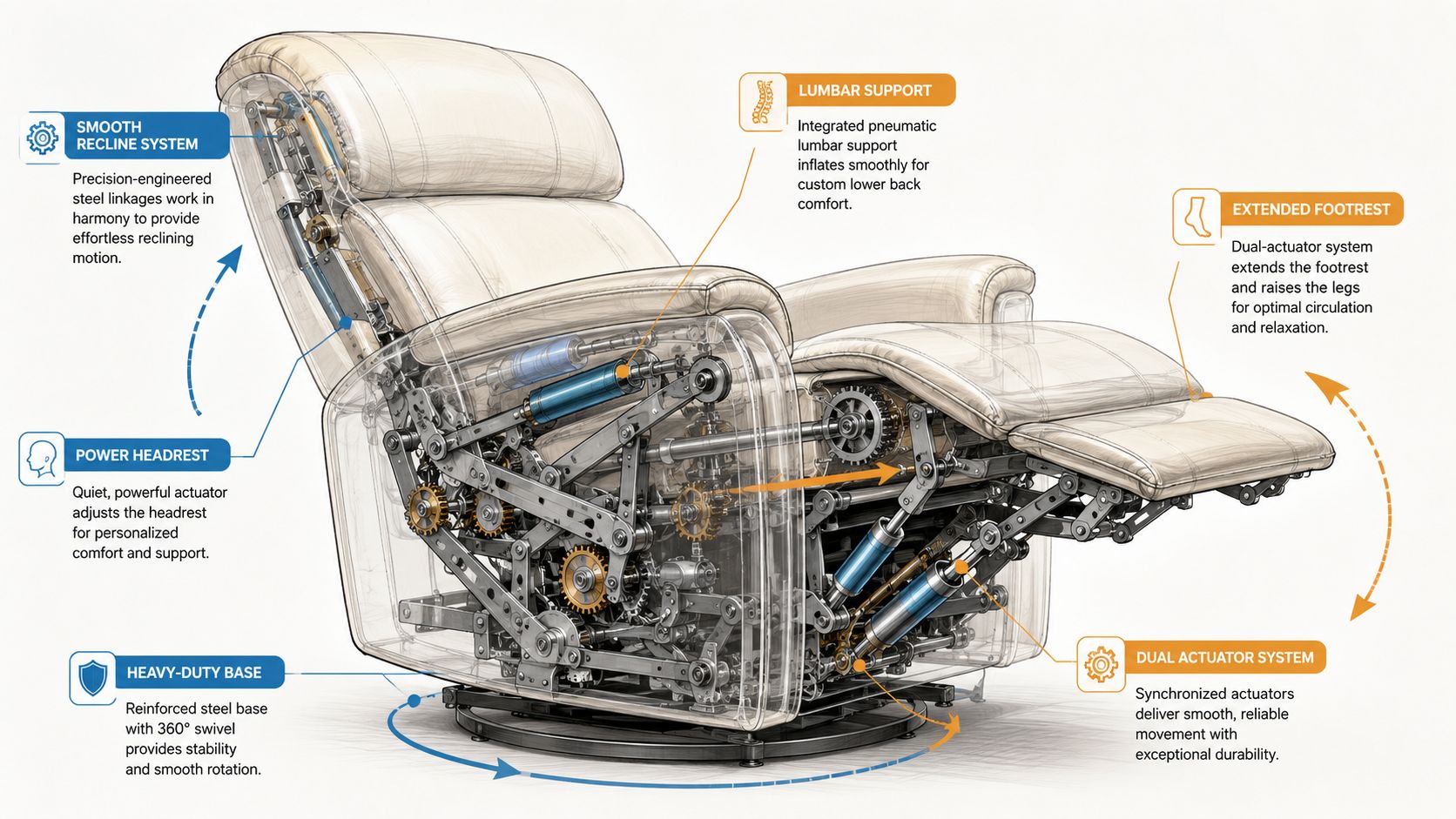
The mechanism is where comfort becomes engineering. Two chairs can look nearly identical from the front and behave completely differently once the footrest rises and the back moves. That's why mechanism design deserves as much attention as upholstery or color.
From simple motion to engineered support
Basic recliners usually fall into two groups. Manual models rely on a lever or body weight to move the chair. Power models let the user fine-tune position with buttons, which often creates a smoother and more precise experience.
Then there are specialized options that solve room or comfort problems more directly:
| Mechanism type | Best for | Main trade-off |
|---|---|---|
| Manual recline | Simplicity and fewer electronics | Less precise positioning |
| Power recline | Fine adjustment and easier operation | Higher complexity |
| Wall-hugger style | Tighter rooms and smaller layouts | Fewer oversized silhouettes |
| Lift functionality | Safer transitions in and out of the chair | More mechanical components |
For homeowners in smaller homes, townhomes, or carefully planned living rooms in Grants Pass or Ashland, mechanism clearance matters. A chair that needs too much room behind or in front of it can throw off the whole furniture plan.
Why high-end mechanisms cost more
The most important mechanism to understand in this category is Tilt-in-Space. True Tilt-in-Space mechanisms maintain a fixed 90° seat-to-backrest angle while tilting the entire seating unit, redistributing pressure more evenly to reduce shear friction. These systems are generally 20-40% more expensive than standard models because of their engineering and comfort benefits (Tilt-in-Space explanation).
That sounds technical, but the practical effect is easy to understand. In a standard recliner, the back opens up and the user may shift or slide as the chair moves. In a Tilt-in-Space design, the body stays in a steadier relationship to the seat and back, which can feel more secure and supportive over long sessions.
The mechanism shouldn't ask the user to brace, scoot, or correct posture every time the chair reclines.
That kind of engineering is especially useful for people who spend extended time seated or who want a chair that supports comfort without constant repositioning. For anyone sorting through motion features, types of power reclining seating can help organize the differences between everyday power recline and higher-end ergonomic systems.
Finding Your Perfect Fit for Comfort and Home Style
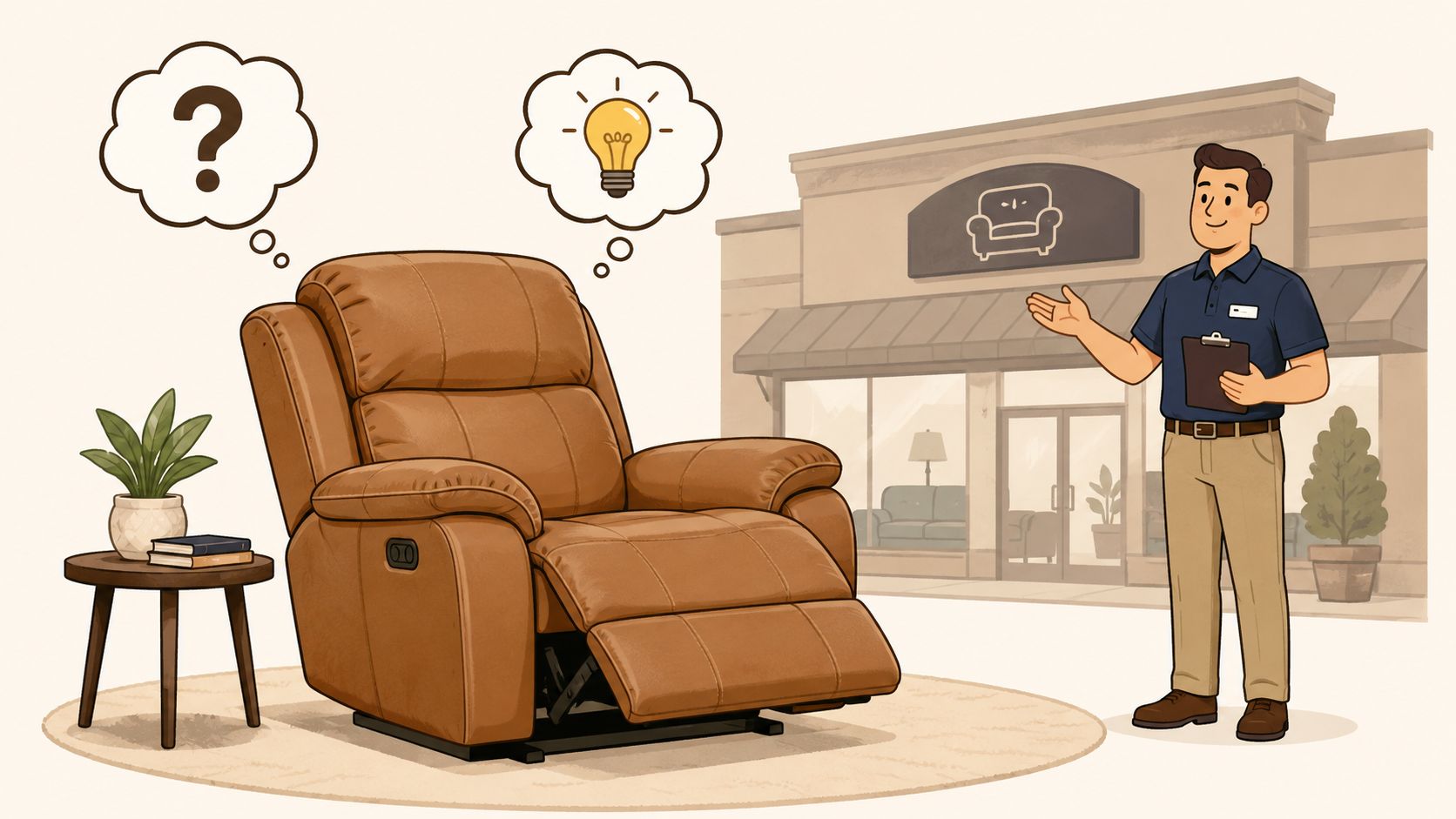
A customer sits down in a recliner that looks impressive on the sales floor. Ten minutes later, the lower back starts to lose contact, the headrest hits too low, and the footrest feels a little short. That is the difference between a chair that looks luxurious and one that delivers real comfort every day.
Luxury starts with fit. A perfectly fitted recliner supports the body in a way that feels natural before you ever notice the fabric, stitching, or silhouette. That matters because ergonomic luxury holds up after movie night, after an afternoon nap, and after months of daily use. Decorative luxury only has to look good from across the room.
Fit the body first
Seat depth is usually the first make-or-break detail. A seat that runs too deep leaves shorter users reaching for lumbar support that never quite lands in the right place. A seat that runs too shallow can leave taller users without enough thigh support, which often shows up as restlessness and constant repositioning.
A proper in-store fit test should cover a few simple points:
- Seat height: Feet should rest flat and comfortably on the floor in the upright position.
- Seat depth: The lower back should meet the back cushion while the knees stay relaxed.
- Arm position: Shoulders should stay loose, with elbows supported without shrugging or slumping.
- Head and neck support: The chair should support reading, conversation, television, and rest, not just one posture.
If two people plan to use the chair, both need to try it. Shared use reveals fit problems fast, especially with headrest height, arm placement, and seat depth.
A large showroom helps because shoppers can compare body fit across multiple styles and brands without relying on specs alone. In a 30,000 sq. ft. showroom in Grants Pass, those side-by-side sit tests make the differences obvious. A chair can measure well on paper and still miss the body in practice.
Then fit the room
Once the chair fits the person, it has to live well in the room. Good room fit is not just about footprint. It is about proportion, traffic flow, sightlines, and whether the chair feels settled into the space instead of dropped into a corner as an afterthought.
Compact luxury recliners can work very well in smaller living rooms and open-concept homes. The trade-off is that some smaller profiles trim padding, arm width, or head support to keep the chair visually lighter. That is a fair compromise for some homes, but it should be a conscious choice.
A few planning checks usually prevent expensive mistakes:
- Map the full reclined position so the footrest does not cut across a walkway or crowd a coffee table.
- Check table and lamp height so the chair still works with the pieces around it.
- Compare visual weight with the rest of the room so the recliner feels connected to the design.
Materials around the chair matter, too. Wood tones, metal finishes, and textiles can either soften the chair's presence or make it feel out of place. Reclaimed wood consoles, teak accents, and textured decor often help a recliner feel intentional in Southern Oregon homes, whether the room leans rustic or more refined. For households layering comfort into a full-room design, a thoughtful modern luxury textile collection can add warmth and texture around the chair without crowding it.
Price often enters the conversation at this stage because the right fit sometimes means stretching beyond the first number a shopper had in mind. That is common with recliners that combine better scale, better support, and better upholstery. For families weighing those trade-offs, furniture financing options can make it easier to choose the chair that fits both the body and the home the first time.
Exploring Health Wellness and Lift Chair Options
A chair can look luxurious on the showroom floor and still be the wrong choice if your back tightens after 20 minutes or standing up feels like work. That is the difference between visual luxury and ergonomic luxury. The better wellness recliners earn their place by reducing strain day after day, not just by adding polished trim or extra buttons.
For households dealing with stiffness, fatigue, circulation concerns, or long hours of sitting, comfort features need to do something specific. Heat can relax tight muscles on cold Southern Oregon mornings. Gentle massage or vibration can take the edge off after yard work, travel, or a long afternoon in one position. Adjustable headrest and lumbar support matter even more. Those settings let the chair fit the body instead of forcing the body to adapt to the chair.
Zero-gravity positioning is another feature worth testing in person. Some people love the lighter, pressure-relieving feel through the lower back and legs. Others prefer a more upright posture for reading, conversation, or easier entry and exit. I usually tell shoppers to treat wellness features like support tools, not luxury extras. If a function improves how your body feels after regular use, it has value. If it only sounds impressive on a tag, skip it.
Gates Home Furnishings carries recliners in this category with practical features such as power lumbar support and power headrest. Those details matter because they affect posture, neck support, and how long the chair stays comfortable during a real evening at home.
When a lift chair is the right answer
Lift chairs solve a different problem. They help a person move from seated to standing with more control and less strain on the knees, hips, and lower back.
That makes them useful for older adults, people recovering from surgery, and family members who want safer daily routines at home. Seating is only one part of the plan, so families often pair that decision with broader home adaptations for independent living.
The best lift chair is rarely the one with the longest feature list. It is the one that fits the user's height, supports the forearms during push-off, and rises at a pace that feels steady instead of abrupt. Seat depth matters. Arm height matters. Foot placement matters. A helpful starting point is reviewing lift chair options for elderly users and then testing where the chair matters most: at the point of transfer.
A lift chair should feel calm and predictable in motion. If the rise feels abrupt or the seat shape pushes the body forward awkwardly, keep looking.
Budgeting for Luxury and Making It Affordable
Luxury recliners cost more for reasons that are usually easy to trace. Better upholstery, denser cushioning, more advanced mechanisms, refined power functions, and stronger internal construction all add up. The key is making sure the extra cost is buying comfort and durability, not just a nicer silhouette.
What drives the cost
A shopper usually pays more when the chair includes:
- Advanced motion systems: More parts, smoother movement, and better control raise the build cost.
- Higher-grade materials: Better leather, better fabric, and better seat construction hold up longer.
- Support-focused engineering: Specialized ergonomic designs require more than a basic recline frame.
- Added comfort functions: Power headrests, lumbar adjustment, heat, and massage increase complexity.
Some premium recliners also fall into a known higher range because of those integrated features. The market overview on recliners notes that advanced models with comfort technology and high-end upholstery often sit in a premium tier that starts well above entry-level seating (recliner market report).
Ways to make a better chair more manageable
Financing can turn a long-postponed purchase into a practical one, especially when the chair is needed for comfort rather than decoration. Gates Easy Pay offers $0 down with 6 equal payments, no-interest terms if paid within the promotional period, and no-credit-needed or lease-to-own programs (Gates financing options).
That gives buyers several paths depending on their situation:
- Short planned payoff: Good for households that want promotional no-interest timing.
- Low upfront entry: Useful when $0 down matters more than anything else.
- Alternative qualification path: Helpful for buyers who prefer no-credit-needed or lease-to-own structures.
Anyone comparing payment paths can review the store's furniture financing options and match the chair purchase to a monthly plan that feels realistic. That approach keeps the focus where it belongs, on value over sticker shock.
The Gates Difference Why You Should Shop Local
A recliner isn't finished once it's paid for. It has to arrive, fit through the home, be assembled correctly, and land in the exact spot where it's going to support daily life. That's one reason local furniture shopping still matters so much, especially with larger motion pieces.

Service after the sale matters
Gates Home Furnishings provides White-Glove Delivery with professional in-home assembly, setup, and mattress haul-away services for customers in Grants Pass, Medford, Central Point, and Ashland (BBB business profile). That kind of service matters with recliners because they're not simple drop-at-the-door purchases.
It helps to think about white-glove service the way people think about in-home medical equipment setup. The product only becomes useful when it's placed, assembled, and ready to use correctly inside the home. Motion furniture benefits from that same standard of care.
A good delivery experience should cover more than transportation:
- Room placement: The chair belongs where it functions best, not where the box lands.
- Assembly and setup: Power features and moving parts should be checked before the crew leaves.
- Home protection: Careful handling matters in tight entries, hallways, and around finished floors.
- Haul-away support: Removing packaging or old sleep products reduces the work left to the customer.
Why local shopping changes the outcome
Buying locally gives shoppers a better chance to test fit, compare support, and get practical guidance from people who understand regional homes and everyday needs across the Rogue Valley. A compact recliner for a cottage near downtown Grants Pass is a different choice than a statement chair for a larger home outside Medford or near the hills above Ashland.
There's also a values piece to it. Since 1946, George Gates Jr.’s original promise of “Service and Value” has meant furniture shopping should be helpful, informed, and grounded in the community. That same approach still shows up in the physical showroom experience, the ability to compare comfort in person, the presence of Unique Finds like reclaimed wood and teak pieces, and the fact that delivery doesn't stop at the curb.
For anyone serious about recliner chair luxury, that combination matters. The chair should look right, feel right, fit the body, fit the room, and arrive with the kind of service that makes the whole purchase easier from start to finish.
Visit Gates Home Furnishings to explore recliners, lift chairs, and full-room furniture solutions for Grants Pass and the wider Rogue Valley. Shoppers can Visit our Grants Pass Showroom to test comfort in person, or Browse our collection online to start narrowing down styles, materials, and support features before the trip.