Recliners Made in USA: A Southern Oregon Buyer’s Guide


A lot of people start this search the same way. The old recliner has become the chair nobody wants to claim, the online listings all sound alike, and every product page seems to promise comfort, quality, and American craftsmanship without saying much that can be checked.
That's where a careful buying process matters. In Southern Oregon, families often want a recliner that feels good at the end of a long day, fits the room, and won't become a service headache later. They also want straight answers about what “Made in the USA” means, because vague labeling has made this category harder to shop than it should be.
That kind of practical guidance reflects the standards of businesses built to last. In Grants Pass, Oregon, Gates Home Furnishings was established by George Gates Jr. in 1946, beginning with a 5,000-square-foot store on the corner of 7th and H Street before growing into a 30,000-square-foot showroom at 700 SW 6th St, carrying forward his promise of “Service and Value” according to the Grants Pass & Josephine County Chamber listing. Shoppers who want a broader foundation before narrowing choices can also review a more general recliner buying guide.
Table of Contents
- Your Guide to Finding the Perfect American-Made Recliner
- The Advantages of Choosing USA-Made Recliners
- How to Verify a Recliner Is Truly Made in the USA
- A Breakdown of Recliner Types and Features
- What to Look for Inside Materials and Mechanisms
- Finding Your Perfect Fit Sizing and Testing
- Price Warranty and Long-Term Value
- Your Next Steps to Lasting Comfort
Your Guide to Finding the Perfect American-Made Recliner
The best recliner purchases usually don't start with fabric or color. They start with a real household problem. Someone needs better back support while watching TV. A taller family member can't get proper leg support from the current chair. A smaller living room needs a reclining seat that won't dominate the space.
That's why shoppers looking for recliners made in USA often need more than a brand list. They need a way to separate marketing language from construction quality, and they need practical criteria that hold up after the first few weeks of ownership.
A better way to shop this category
A strong buying process usually comes down to four questions:
- Origin: Is the chair made in the United States, or just marketed that way?
- Construction: Does the inside of the chair support years of use?
- Fit: Does it support the head, back, legs, and room layout correctly?
- Serviceability: Can it still be maintained if a motor, mechanism, or cushion component needs attention later?
Those four questions matter more than showroom sparkle or a dramatic sale sign.
Practical rule: A recliner should be judged twice. Once with the footrest down, and once fully reclined. Some chairs feel fine upright but lose support in the position people use most.
What a good guide should help buyers avoid
The biggest mistakes are predictable. Buyers get drawn to soft padding without checking support, trust origin claims without verification, or focus on the opening price without asking how repairs work later.
A thoughtful search also leaves room for style. In a well-curated local showroom, shoppers often want to compare everyday recliners with more distinctive pieces and design accents, including Unique Finds such as reclaimed wood, teak, and one-of-a-kind statement furniture that help a room feel personal instead of copied from a catalog. That contrast can be useful because it keeps the recliner purchase tied to the home as a whole, not just the chair in isolation.
The Advantages of Choosing USA-Made Recliners
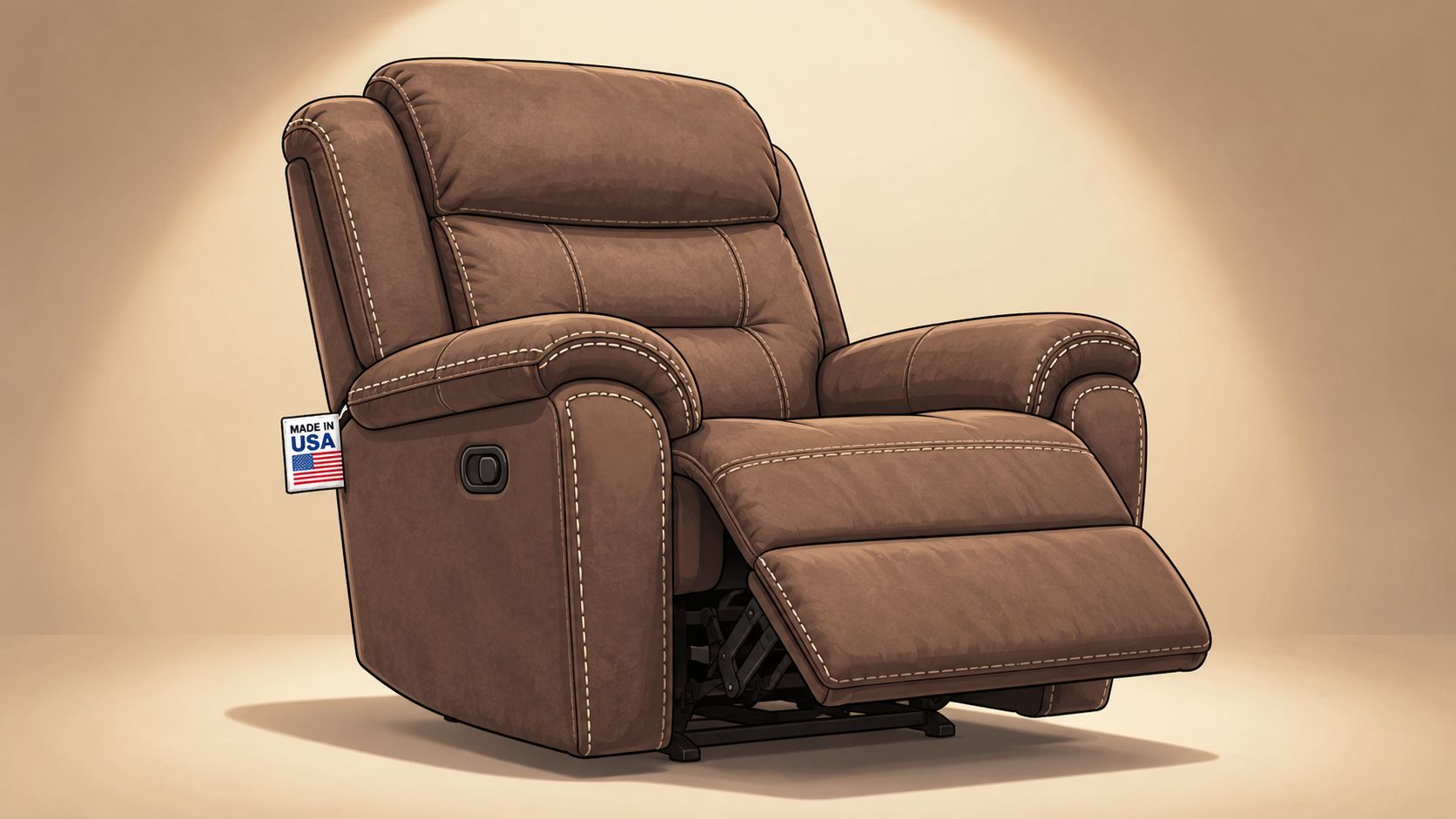
American-made reclining furniture earns attention for practical reasons, not just patriotic ones. Buyers often want a clearer manufacturing story, stronger accountability, and construction choices that feel deliberate rather than cost-cut for shipping efficiency.
One recent market signal makes that clear. In 2024, BarcaLounger introduced a new program of domestically produced leather recliners with retail prices ranging from $1,599 to $2,199 per unit, including seven distinct reclining chair models with special-order options, as reported by Furniture Today's coverage of the launch. That kind of release shows how the premium end of the market is actively using U.S.-made positioning as part of the value story.
For shoppers comparing leather seating, a curated look at premium USA leather seating can help narrow expectations before visiting a store.
Why domestic production still matters
A domestically built recliner often gives buyers a cleaner line of sight into how the chair was produced. That doesn't automatically make every model better, but it usually makes the conversation easier. Questions about frame material, upholstery options, or where assembly happened are more likely to get specific answers instead of vague marketing language.
There's also a trust factor. When a company highlights U.S. manufacturing directly, it's usually because origin is part of the purchase decision, and buyers care enough to ask.
What buyers usually notice first
Showroom visitors don't often discuss joinery or motion control. They notice simpler things first:
- The sit feels more stable: Better-built recliners tend to feel planted when someone shifts weight or leans to one side.
- The motion feels calmer: The footrest and back should move in a controlled way, not with a sudden drop or a strained sound.
- The upholstery story is clearer: Higher-end domestic programs often give buyers better visibility into leather options, customization, and ordering choices.
That doesn't mean every imported chair is poor or every domestic chair is excellent. It means U.S.-made recliners often give the buyer a stronger starting point for evaluating long-term value.
A good recliner shouldn't just feel comfortable for five minutes. It should still feel correct after an hour.
The best way to think about this category is simple. Buyers aren't paying only for a flag label. They're paying for a more verifiable product, a more accountable manufacturing claim, and a better chance that the chair was built with longevity in mind.
How to Verify a Recliner Is Truly Made in the USA
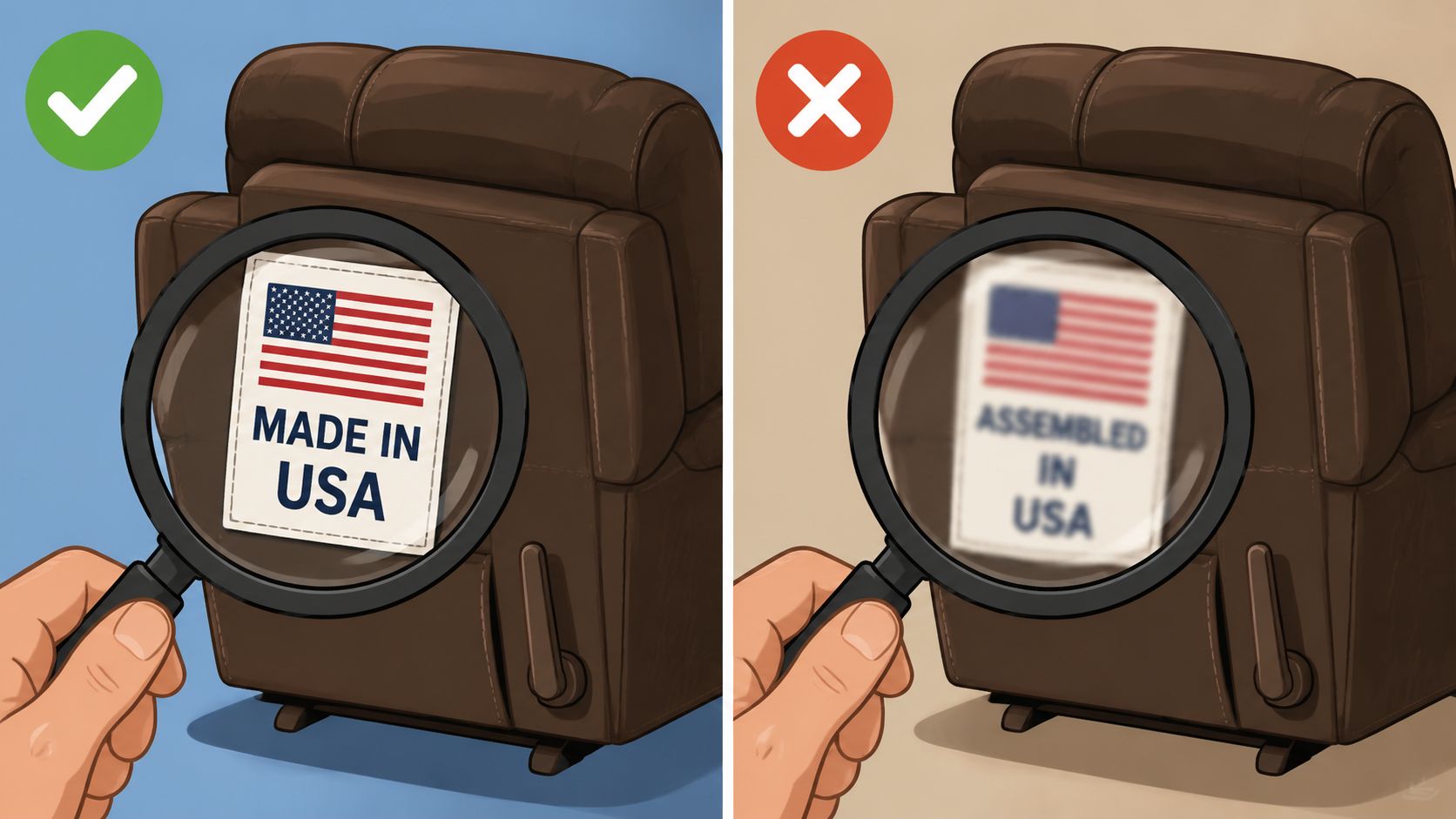
Many shoppers often get tripped up. Product pages use phrases like “American-made,” “crafted domestically,” or “assembled here,” and those terms don't all mean the same thing.
A buyer who wants an authentic product needs to shop like an investigator, not just a browser. That means reading tags, asking direct questions, and pressing past soft language.
For a useful companion on decoding model details and spec language, this guide on how to read furniture product descriptions and buy with confidence helps shoppers sort marketing from meaningful information.
What the label must actually mean
According to the Federal Trade Commission standard summarized by AllAmerican.org's recliner guide, an item advertised as “Made in the USA” must be “all or virtually all” assembled in the United States from domestically sourced components, and that claim must be visibly stated on product labels.
That phrase matters. “All or virtually all” is much stricter than “assembled in the USA.” A recliner can be assembled domestically and still rely heavily on imported components.
A practical verification checklist
Use a checklist like this before buying:
Read the exact wording on the tag
“Made in the USA” has a different meaning than “assembled in the USA” or broad language like “American craftsmanship.”Ask where the major components come from
The frame, mechanism, motor, and upholstery materials tell a more honest story than advertising headlines.Request documentation if the origin claim is central to the sale
If a seller leans heavily on domestic manufacturing, it's reasonable to ask what supports that claim.Look for consistency across materials
If the showroom tag, website description, and salesperson explanation all describe origin differently, that's a warning sign.Pay attention to evasive answers
A clear claim should get a clear explanation.
If a buyer has to guess what “American-made” means, the claim hasn't been explained well enough.
Red flags worth taking seriously
Some warning signs show up again and again:
- A headline claim with no tag support: If the selling story says U.S.-made but the product label stays vague, pause.
- Substitute phrases doing too much work: “Built with global materials” may be perfectly legitimate, but it isn't the same claim.
- No one can answer where the mechanism came from: That usually means the origin story is weaker than the marketing suggests.
- The seller shifts the conversation back to comfort only: Comfort matters, but it shouldn't replace origin transparency.
A careful buyer doesn't need to be suspicious of everything. The goal is simpler than that. The goal is to make sure the product claim matches the product reality.
A Breakdown of Recliner Types and Features
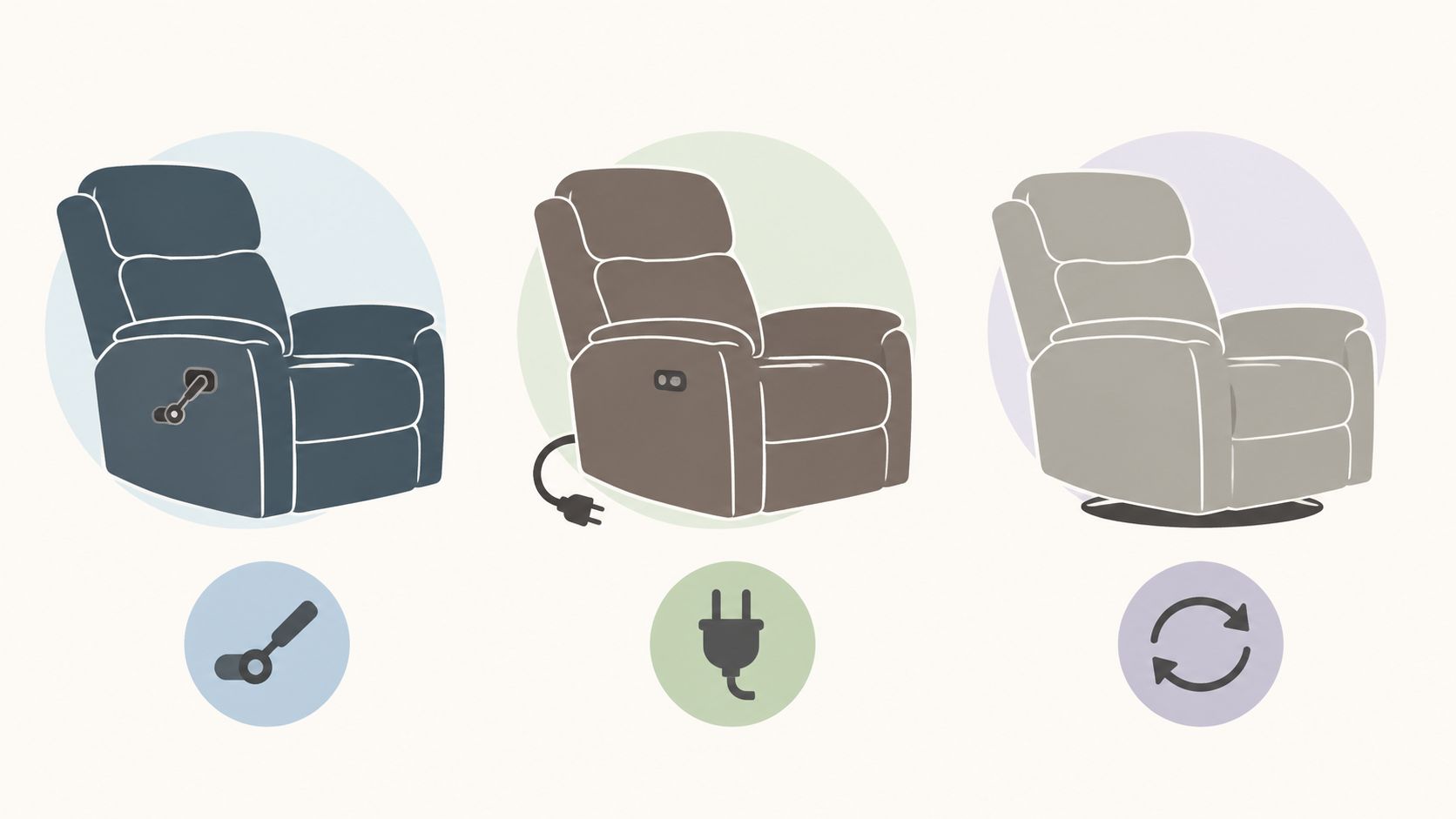
Not every recliner solves the same problem. The right chair for a movie room isn't always the right one for a reading corner, a recovery setup, or a compact living room in Grants Pass, Medford, Central Point, or Ashland.
Buyers often make better decisions when they stop asking which recliner is best and start asking which recliner fits daily use. For motion seating that goes deeper into powered options, this overview of types of power reclining seating is a helpful reference point.
Common recliner styles and who they suit
Manual recliners
These work well for buyers who want straightforward function and fewer powered parts. They're often a good fit for households that prefer simple operation and don't need added positioning controls.Power recliners
These suit people who want smoother adjustment and easier control of the reclining position. They're especially useful when a user wants to fine-tune comfort instead of moving between only a few fixed positions.Lift chairs
These are designed for buyers who need assistance getting from seated to standing. For seniors or anyone managing mobility challenges, that extra help can change whether a chair feels supportive or frustrating.
Features worth matching to daily life
Some features matter less in the showroom than they do at home. Others are the opposite.
| Type | Best for | Main thing to watch |
|---|---|---|
| Manual | Simplicity | Ease of operating the handle or push-back motion |
| Power | Precision comfort | Smooth motor response and button placement |
| Lift | Mobility support | Seat height, lift action, and entry-exit ease |
| Swivel recliner | Flexible conversation areas | Whether the base stays stable during motion |
| Wall-hugger | Smaller rooms | Clearance needed behind and in front of the chair |
Room layout matters more than buyers expect
A recliner doesn't live alone. It has to open without blocking walkways, bumping tables, or crowding other seating.
That's why wall-hugger styles deserve a close look in tighter rooms. They can be especially practical in homes where every foot of floor space counts. Swivel recliners can also work nicely in open-concept rooms, where the chair needs to face the television at one moment and a conversation area the next.
The best recliner type is the one that fits the user, the room, and the routine at the same time.
One more point often gets overlooked. A chair that offers more features isn't automatically a better purchase. Extra motion functions only help when they solve a real comfort problem.
What to Look for Inside Materials and Mechanisms
The outside of a recliner can be attractive while the inside tells a different story. Buyers who want real durability need to care about what sits under the cushions and upholstery, because the frame and mechanism determine whether the chair stays quiet, stable, and comfortable over time.
According to a technical breakdown from a recliner construction video guide, high-quality U.S.-made recliners often use engineered hardwood frames, mortise-and-tenon joinery for rigidity, and internal mechanisms with bushings to reduce noise plus springs that control recline speed.
Frame details that signal durability
A strong frame matters because every movement of the chair stresses the same connection points again and again. Better construction spreads that stress more effectively.
Look for signs like these:
- Engineered hardwood structure: This often gives a stable, dependable base when it's used well.
- Mortise-and-tenon joinery: That joinery method is a strong signal that the frame was built for structural integrity, not just speed.
- Clean internal assembly: Glue and coated staples can be part of sound construction when the overall frame design is solid and consistent.
Amish-made seating often gets attention for using solid hardwoods and traditional joinery. That doesn't mean every buyer needs that exact build style, but it does provide a useful benchmark for what premium craftsmanship looks like.
Why motion quality tells a story
Many shoppers can detect mechanism quality without knowing the technical terms. They hear it and feel it.
A recliner with good internal motion control usually:
- Opens and closes with less racket
- Avoids sudden, jerky changes in speed
- Feels more settled when fully extended
Bushings and spring control help create that smoother motion. If a chair snaps back, creaks loudly, or feels rough in transition, the mechanism may be the weak point.
For buyers also thinking about indoor air quality and material standards in the broader bedroom and home environment, understanding GREENGUARD Gold can add useful context when comparing household furnishings.
Construction details don't need to sound glamorous to matter. Quiet motion, rigid joinery, and a stable frame are comfort features too.
Finding Your Perfect Fit Sizing and Testing
Even a well-built recliner can be the wrong chair if the fit is off. A seat that's too deep can force a shorter person forward. A back that's too low can leave the head unsupported. A footrest that ends too soon can make a taller user feel like the chair almost works, but not quite.
That's why in-person testing still matters. According to the Houzz business profile, the Grants Pass location includes a 30,000-square-foot showroom where shoppers can personally test recliners and other furniture, which is one of the biggest advantages a physical store has over remote buying and boxed delivery models in Southern Oregon, as described on the Gates Home Furnishings Houzz profile. Before heading out, a quick review of how to measure furniture can prevent sizing mistakes.
What to check when sitting in a recliner
A proper fit test should be deliberate. Buyers should sit all the way back, let the body settle, and then check support points one by one.
Use this short test:
- Head support: The top of the back should support the head in a natural position.
- Lower back contact: There shouldn't be a hollow spot that leaves the lumbar area unsupported.
- Seat depth: Knees should bend comfortably without the front edge pressing awkwardly behind them.
- Footrest reach: In the reclined position, legs should feel supported rather than left hanging at the calf or heel.
- Arm height: Arms should rest naturally, not lifted or dropped.
Why in-person testing still wins
Photos can show style. They can't show fit.
That matters for shoppers across the Rogue Valley, from Grants Pass to Medford, Central Point, and Ashland. A recliner is one of the most body-specific pieces of furniture in the house, and comfort testing is much easier when someone can compare sizes, seat heights, and motion styles side by side.
A good showroom visit also helps with room planning. Buyers can judge whether a recliner feels oversized, visually heavy, or exactly right for the scale of the home. While they're there, many people also like to explore surrounding pieces that complete the room, including reclaimed wood and teak Unique Finds that bring in texture and character.
A recliner should fit the person first, but it also has to fit the path through the room, the nearby table placement, and the way the household actually lives.
Price Warranty and Long-Term Value
Price matters, but sticker price doesn't tell the whole story. A recliner can look affordable on day one and become expensive later if support is poor, replacement parts are hard to get, or delivery leaves the buyer handling setup problems alone.
That's why long-term value should be judged as a package. Buyers should think about purchase price, expected durability, repair path, warranty clarity, and whether the manufacturer still supports the chair after years of ownership.
How to think about cost without getting fooled
A better frame, quieter mechanism, and clearer origin claim usually cost more upfront. That isn't the problem. The problem is paying premium pricing without getting premium accountability.
Buyers should compare value in practical terms:
- Build quality: Does the chair feel like it was built for regular use?
- Warranty clarity: Are the covered parts and service terms easy to understand?
- Repairability: Can the chair be fixed, or is it treated like a disposable product?
- Delivery experience: Will the chair arrive assembled and ready, or is the buyer taking on that burden?
Professional setup matters more than people expect. Many households prefer White-Glove Delivery because it includes in-home assembly, and for mattress purchases it can also include haul-away service. That approach is very different from a drop-box experience where packaging, placement, and setup all become the customer's problem.
Questions that protect the purchase later
A key issue often gets missed until something breaks. Buyers should verify whether the manufacturer supplies original replacement parts like motors and mechanisms directly to consumers after several years, as emphasized in this electric recliner buying guide on parts availability.
That leads to a better set of questions at the point of sale:
- If the motor fails later, can the original replacement be ordered?
- If a mechanism part wears out, who provides it?
- Can the seller explain the repair path in plain language?
- Does the chair still make sense if service is needed years from now?
Financing also shapes value when buyers are trying to balance quality with budget. Gates Easy Pay offers $0 down, 6 equal interest-free payments if paid within the promotional period, and no-credit-needed options including lease-to-own programs, which can make a better chair attainable without forcing a buyer into the cheapest short-term option.
Good value isn't always the lowest number on the tag. Often, it's the chair with the clearest support story before money changes hands.
Your Next Steps to Lasting Comfort
A smart recliner purchase comes down to a handful of decisions that are easy to remember. Verify the origin claim. Check the internal construction. Match the chair type to the way the room and household function. Test the fit with care. Ask what happens years later if a part needs replacement.
That approach helps buyers cut through a crowded category where many chairs look similar at first glance. It also protects against one of the biggest mistakes in furniture shopping, choosing with the eyes first and the questions second.
For Southern Oregon households, local context still matters. Buyers in Grants Pass, Medford, Central Point, Ashland, and across the Rogue Valley often benefit most from seeing motion seating in person, comparing support levels side by side, and working with a team that understands that comfort isn't one-size-fits-all. The same trip can also help shoppers discover complementary pieces, including reclaimed wood, teak, and other Unique Finds that give a room a more individual feel.
The best local furniture businesses tend to keep the same values for generations. In Grants Pass, that standard has long been tied to the promise George Gates Jr. made in 1946. Service and Value still sums up what people want when they're making a major furniture purchase. Clear information, practical help, flexible options, and support that doesn't disappear after delivery.
For buyers who want to move from research to real-world testing, the logical next step is simple. Sit in the chairs. Operate the mechanisms. Ask the hard questions. Measure the room. Then choose the recliner that feels right not only today, but years from now.
For personalized help finding the right recliner, room-fitting advice, flexible payment options, and professional setup, visit Gates Home Furnishings. Shoppers can Visit our Grants Pass Showroom or Browse our collection online to explore quality seating, major brands such as La-Z-Boy, Flexsteel, Ashley, and Beautyrest, plus distinctive Southern Oregon favorites throughout the showroom near downtown Grants Pass.