The Antique Drum Table With Leather Top Guide

You might start out looking for a side table and end up stopping cold in front of something round, weighty, and unusually dignified. A leather inset top. A ring of drawers. A base that looks more like architecture than furniture. That’s often how people first respond to an antique drum table with leather top. It doesn’t feel like a filler piece. It feels like it has a past.
We’ve seen that reaction for generations. Since 1946, when George Gates Jr. founded our family business on a promise of Service and Value, Southern Oregon families have come to us for pieces that do more than fill a corner. Some want comfort they can test in person in our 30,000 sq. ft. showroom in Grants Pass. Others are drawn to our Unique Finds, those one-of-a-kind pieces with character you do not get from a flat-packed box.
A Timeless Piece of History for Your Home
One customer recently wandered through our showroom while comparing living room styles and stopped at a round table with a worn leather writing surface. She wasn’t shopping for antiques that day. She was looking for something practical. But the moment she saw the table, the question changed from “Where would this go?” to “What’s the story behind this?”
That’s the appeal of a drum table. It draws people in because it feels both formal and useful. It has presence, yet it’s compact enough to live comfortably in a library, living room, bedroom, or entry.
If you’re exploring classic interiors, our guide to traditional design style gives helpful context for how pieces like this fit into a home without making it feel stiff or overly formal.
Why this table catches people off guard
A lot of antique furniture can feel either too delicate or too decorative for everyday life. A drum table usually doesn’t. It tends to feel grounded.
That comes from a few things working together:
- The shape keeps it approachable. A round table is easier to place and move around than many rectangular case pieces.
- The leather top signals use, not just display. People immediately understand it was meant for writing, reading, and conversation.
- The drawers add that satisfying sense of purpose. Even when you don’t need a place for stationery or chargers, you like knowing it’s there.
A good antique should still make sense in a modern room. A drum table often does.
Why it matters today
An antique drum table with leather top isn’t just an object from another century. It’s one of those rare forms that still works in daily life. It can hold a lamp, collect mail, anchor a reading chair, or become the piece everyone asks about when they visit.
That’s why it’s worth learning how to recognize quality, understand value, and care for one properly. When you know what you’re looking at, the piece stops being mysterious and starts becoming personal.
The Rich History of the Drum Table
The drum table has deep English roots. The antique drum table with leather top originated in Britain during the late Georgian period, emerging around the 1780s to early 1800s, and it gained prominence through the Regency and Victorian eras, as noted in this English mahogany drum table history.

These tables became especially popular in the libraries and sitting rooms of affluent English homes. They weren’t named for music. They were named for their round, drum-like form, with a deep apron encircling the top.
For readers who enjoy unusual historic seating and statement pieces, our article on antique sectional couches shows how period furniture often balanced beauty with surprisingly practical design.
What made the design so successful
A drum table solved several problems at once. It offered a generous writing surface, useful storage, and a shape that looked polished from every angle. That mattered in formal rooms where furniture was often placed away from the wall.
Many antique examples included multiple drawers, often four to eight pull-out compartments, which made them ideal for letters, papers, ledgers, and writing tools. The leather top wasn’t just decorative either. It created a durable writing surface that handled regular use better than many polished wood tops.
Why leather tops became part of the tradition
The leather inset gave the table a more refined identity. It also made practical sense. A writing table needed a surface that felt a bit softer under the hand and that stood up to ink, paper, and routine contact.
You’ll often see leather in tones like brown or green, sometimes with embossed or gold-tooled decoration around the border. Over time, that leather develops patina. That’s one reason these tables feel so compelling in person. The top records use in a way polished wood often doesn’t.
Historical clue: When a piece looks elegant but clearly built for work, you’re often looking at furniture from a period when utility and status lived side by side.
How the form evolved
As the style moved through the 19th century, details shifted with taste. Some examples stayed restrained and neoclassical. Later ones could become more decorative, with richer inlays, brass hardware, and more expressive legs.
By the turn of the century, English versions often showed refined updates such as a turned central column, reeded saber legs, brass caps, and casters. Even with those variations, the core identity stayed the same. Round top. Deep frieze. Drawer rhythm. Center support. Leather writing surface.
That consistency is part of why drum tables remain so recognizable today. Once you know the silhouette, you’ll spot it quickly.
How to Identify Authentic Styles and Materials
A convincing drum table can fool a casual shopper. That’s why it helps to slow down and look at the piece in layers: top, body, drawers, base, and hardware. You’re not hunting for one magic detail. You’re checking whether the whole table makes sense together.
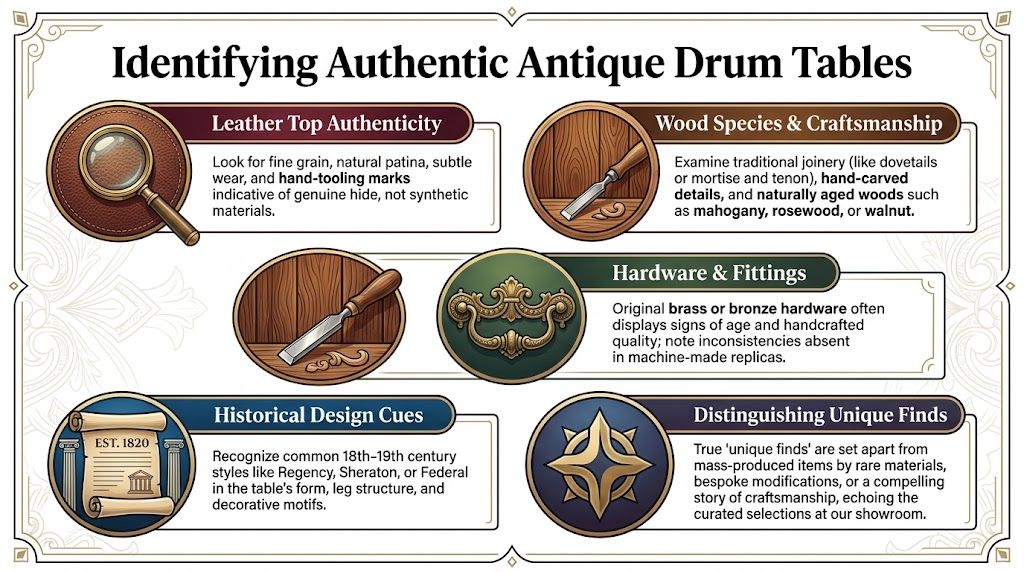
A traditional drum table has a heavy circular design supported by a central pillar or platform base on four tapering claw feet, and comparable Regency-era mahogany examples often had stable load-bearing capacity exceeding 150-200 lbs, according to Britannica’s drum table entry. That broad, centered support is one of the form’s defining traits.
If you’d like a primer on wood construction before inspecting antiques, our guide on real wood furniture helps explain what to look for in grain, veneer, and build quality.
Start with the leather top
The leather is usually the first thing people notice, but not always the first thing they evaluate well. They focus on color and miss the signs of age.
Look for:
- Natural patina rather than a flat, uniform finish.
- Tooling or embossing that feels intentional and slightly irregular.
- Wear that matches use, especially near the edge or writing area.
- Attachment details that don’t look recently glued in with modern shortcuts.
A perfectly even, plastic-looking top can signal a later replacement or reproduction. That doesn’t always make the table worthless, but it does change what you’re buying.
Then study the wood and joinery
Mahogany is common in this category, and many of the strongest examples use it beautifully. The wood should support the style of the piece, not fight it.
Check the drawer interiors, undersides, and less-polished areas. Those spots often tell the truth faster than the finished top.
If you're learning how to uncover hidden antique treasures, this kind of close inspection is where confidence starts. The best finds usually reveal themselves in the overlooked details.
Drum Table Style Comparison
| Style (Era) | Key Characteristics | Common Woods | Leg/Base Style |
|---|---|---|---|
| Georgian | Cleaner lines, restrained decoration, balanced proportions | Mahogany | Central support with simpler feet and less ornament |
| Regency | Elegant silhouette, refined hardware, stronger neoclassical influence | Mahogany, sometimes with decorative inlay | Central column or platform base with tapering claw feet |
| Victorian | More ornament, richer detailing, a heavier visual presence | Mahogany and other dark woods | More elaborate carved supports and decorative foot treatment |
Small details that separate old from newer
Hardware matters. So do inconsistencies. Older pieces often show signs of handwork that machine-perfect reproductions smooth away.
Pay attention to these clues:
- Drawer fit: Slight variation can be normal in older furniture. Perfectly identical fit can point to newer production.
- Brass pulls: Original hardware often shows age that matches surrounding wood.
- Carving: Hand-carved details tend to have life to them. Sharp but slightly varied edges are a good sign.
- Wear patterns: Real age usually appears where hands, knees, and chairs made contact over time.
The strongest authenticators aren’t dramatic. They’re quiet signs that use, craftsmanship, and age all agree with each other.
Understanding the Value of an Antique Drum Table
People get confused about value because online listings often look similar while prices don’t. One table seems close to another in photos, yet the asking price can be far apart. That doesn’t always mean one seller is unreasonable. It often means the listing isn’t explaining enough.
A documented marketplace gap shows this clearly. Similar pieces can appear at $3,885 versus $2,400 to $3,000 without clear explanation of regional differences, wood quality, or authentication methods, which creates a knowledge gap for buyers, as discussed in this analysis of antique drum table pricing and buyer questions.
Why two similar tables can feel worlds apart
Condition is one reason, but it’s not the only one. Buyers also pay for confidence.
A table with believable age, quality timber, well-matched hardware, and a leather top that still feels right in the hand will usually inspire more trust than one with mixed signals. Provenance can matter too, but even without paperwork, a table can communicate quality through consistency.
What affects value most
Here are the questions seasoned buyers ask first:
- Is it period or later? A true 19th-century piece and a later reproduction can look similar from across the room.
- Has the leather been replaced? Replacement isn’t automatically bad, but it changes originality.
- Do the drawers, hardware, and base belong together? Married pieces happen.
- Does the wear make sense? Honest use looks different from artificial distressing.
Authenticity matters more than listing language
A grand description online doesn’t prove much. Terms like “Regency style” and “antique look” can describe reproductions just as easily as originals.
That’s why in-person evaluation matters so much with an antique drum table with leather top. You want to see whether the wood tone, drawer action, hardware wear, underside construction, and leather condition all tell the same story.
Buyer’s rule: If a seller can’t explain why a piece is priced the way it is, slow down.
Why local expertise still matters
When shoppers buy sight unseen, they often end up relying on assumptions. They assume the leather is old, the mahogany is solid, the hardware is original, and the photos show everything that matters. Sometimes that works out. Sometimes it doesn’t.
A trusted local source adds something online marketplaces often miss. Context. You can ask questions. You can compare pieces side by side. You can get plain answers about whether you’re looking at an original, a later revival piece, or a decorative reproduction with antique character.
That kind of transparency doesn’t just protect your budget. It helps you buy a piece you’ll still respect years from now.
Proper Care and Restoration for Your Investment
Owning an antique table shouldn’t feel intimidating. Most pieces do best with steady, gentle care rather than constant treatment. The goal is preservation, not making the table look brand new.
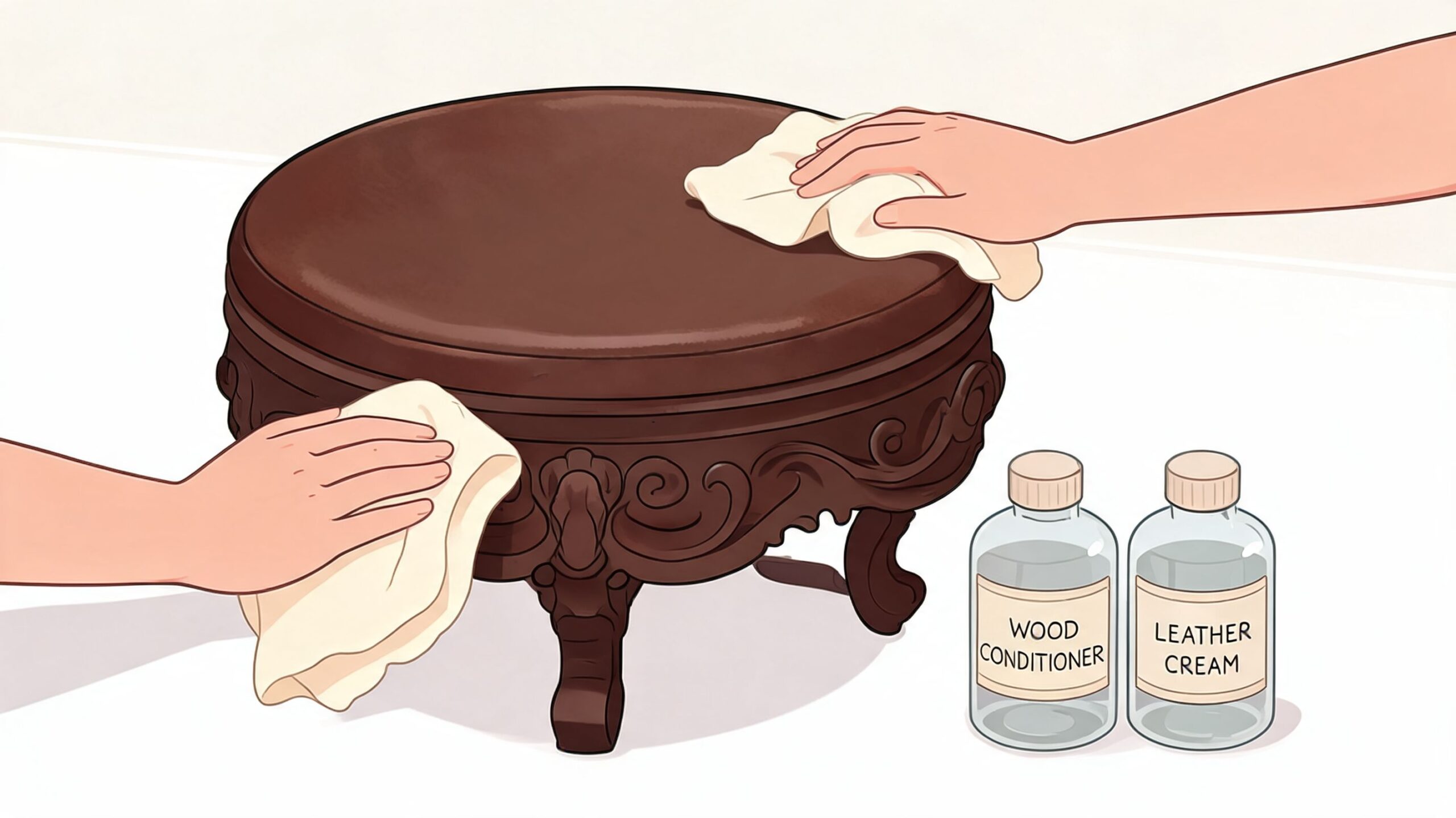
One of the biggest trouble spots is the leather top. For longevity, humidity control at 40-55% RH helps prevent leather shrinkage, and leather can contract by up to 15% above 65% RH. The same source recommends pH-neutral conditioners to protect gold-tooled embossing and notes they may extend the surface’s life by 20-50 years, according to this care guidance for leather-top drum tables.
If you already own leather furniture and want a broader care foundation, our article on caring for leather sofas and furniture covers habits that apply beyond antique tables too.
Day-to-day care that actually helps
The safest routine is simple:
- Dust with a soft dry cloth. Don’t grind dust into the leather or wood with a rough rag.
- Keep drinks on coasters. Old finishes and old leather don’t recover well from moisture rings.
- Avoid direct sun. Sunlight can dry leather and fade wood unevenly.
- Use conditioners sparingly. More product isn’t better. Use the right product only when needed.
Placement matters in Southern Oregon homes
Rogue Valley homes see real seasonal shifts. A table placed near a sunny window, wood stove, or HVAC vent may age much faster than one in a stable interior spot.
That’s why placement deserves as much attention as cleaning. If the leather starts to feel dry, tight, or slightly lifted at the edge, the room may be the problem more than the table.
Keep antique leather in a stable room, not in the path of heat, glare, or big humidity swings.
What you can do yourself and what to leave to a pro
Basic upkeep is usually fine for a careful owner. Light dusting, cautious conditioning, and protecting the top from sharp objects are all reasonable.
Professional help makes more sense when you see:
- Lifting leather or separation at the edges
- Cracking or flaking in the writing surface
- Loose legs or wobble in the base
- Damaged drawer runners or sticking drawers
- Missing brass hardware that needs period-appropriate replacement
Trying to “improve” an antique with aggressive polish, heavy oils, or a fast refinishing kit often lowers the piece’s character. In some cases, it lowers value too.
A good restoration respects the table’s age. It doesn’t erase it.
Styling a Drum Table in Your Southern Oregon Home
A drum table works best when you treat it like a living piece of furniture, not a museum exhibit. It can anchor a room or serve as the one object that gives the room its point of view.
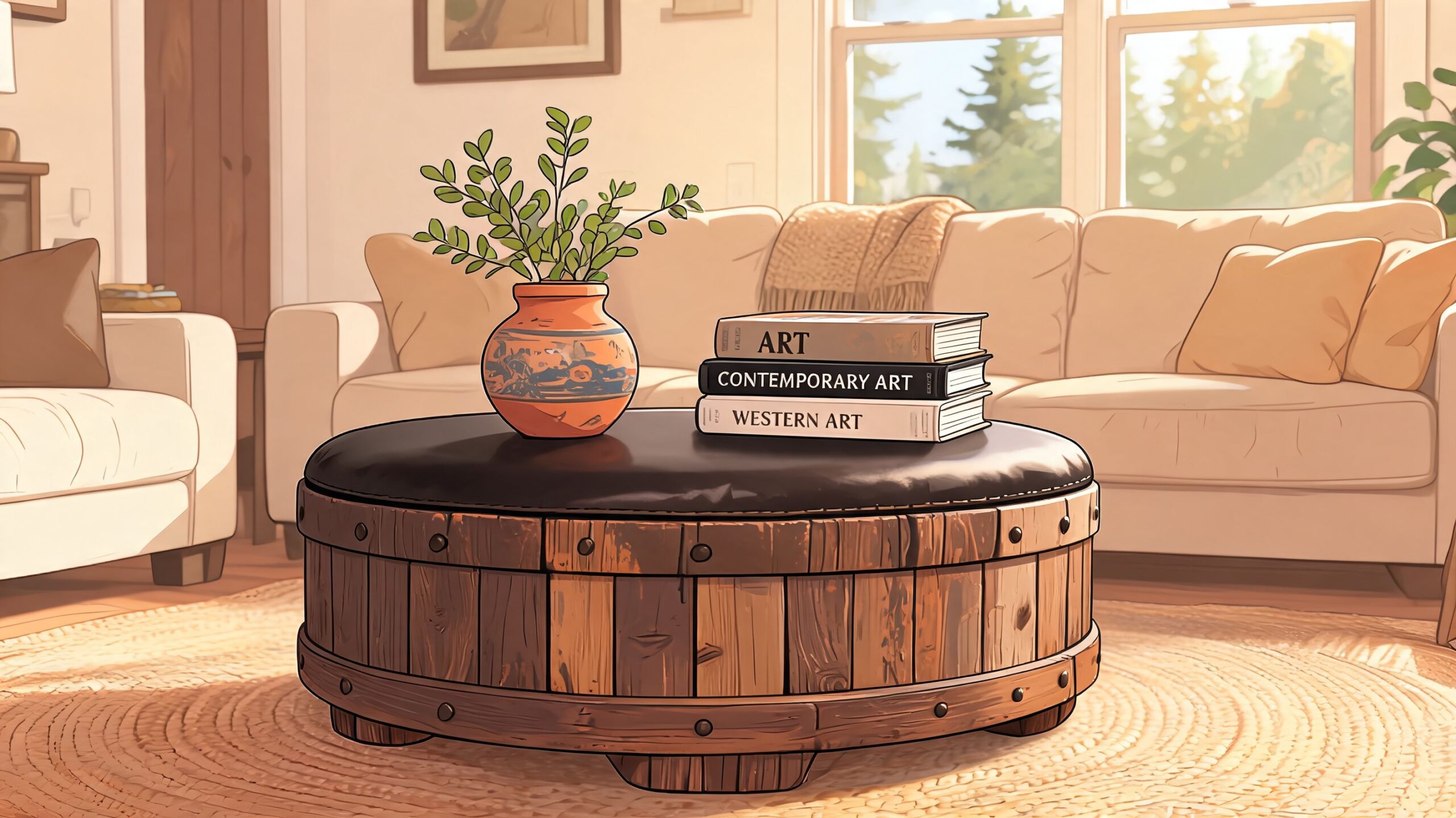
In Grants Pass, Medford, Central Point, and Ashland, we see homes that mix traditional pieces with newer comfort-focused furniture all the time. That’s why a drum table often looks better in real homes than people expect.
For more placement ideas, our guide on how to style a living room is a helpful starting point.
Three placements that work especially well
Entryway statement piece
A round drum table in an entry can soften a space full of straight walls and hard corners. Add a lamp, a small tray, and one framed photo. Suddenly the room feels intentional.
This works especially well in larger foyers where a narrow console would feel undersized.
Living room side table
A leather-top drum table can sit beside a structured sofa or even next to a comfortable recliner from brands like La-Z-Boy or Flexsteel. That contrast is often what makes the room feel lived-in rather than staged.
Use the drawers for remotes, reading glasses, or notecards. The table earns its keep.
Bedroom or reading nook piece
In a spacious bedroom, a drum table can replace a conventional nightstand on one side of the bed. In a reading corner, it gives a chair and lamp a sense of permanence.
A lot of people assume antiques only belong with other antiques. Not true. A drum table can pair beautifully with newer pieces from Ashley or near a bedroom set anchored by a Beautyrest sleep space because the round form and leather top add texture, not clutter.
How to keep the look balanced
A few styling rules help:
- Let the table breathe. Don’t cover the entire leather top with décor.
- Mix old and new. One antique often has more impact than a room full of period pieces.
- Repeat tones, not eras. Match wood warmth, brass accents, or deep leather tones instead of chasing historical purity.
The easiest way to make an antique feel current is to use it naturally.
Find Your Heirloom Piece at Gates Home Furnishings
An antique drum table with leather top offers something many furniture pieces don’t. It combines history, craftsmanship, utility, and personality in one compact form. It can serve your home today and still feel worth handing down later.
That’s why people across Grants Pass, Medford, Ashland, Central Point, and the wider Rogue Valley still prefer seeing pieces like this in person. Photos can suggest character. They can’t replace touch, scale, or the confidence that comes from asking questions face to face.
Since 1946, our family has served Southern Oregon with George Gates’ original promise of Service and Value. In our 30,000 sq. ft. showroom in Grants Pass, you can explore not only trusted brands like La-Z-Boy, Flexsteel, Ashley, and Beautyrest, but also the one-of-a-kind statement pieces that make our Unique Finds collection special.
When you’re ready to buy, we make that easier too. Gates Easy Pay includes $0 down, 6-month interest-free options, and no-credit-needed financing for qualified shoppers. Our White-Glove Delivery team doesn’t just drop boxes at the curb. We provide professional in-home setup and assembly, and we also offer mattress haul-away when needed.
If you're looking for a piece with history and everyday usefulness, Gates Home Furnishings is ready to help. Visit our Grants Pass showroom to see our latest Unique Finds in person, or browse our collection online and let our team help you find the right heirloom for your Southern Oregon home.