Storage Cabinet Decor: A Pro Styling Guide for Your Home

You bought a cabinet because you needed storage. Then it arrived, or you inherited one, and now it’s sitting there looking either full of possibility or mildly accusing.
That’s normal.
An empty cabinet can feel harder to style than an empty room because every shelf asks for a decision. What belongs here. What stays hidden. What deserves to be seen. Good storage cabinet decor solves all three at once. It keeps your home useful, but it also gives the room a point of view.
From Empty Space to Statement Piece
The struggle isn't rooted in a lack of taste. It arises because shelves magnify every choice.
A single bowl looks random. Ten bowls look cluttered. Family photos can feel warm or messy depending on what sits beside them. That’s why cabinet styling works best when you stop thinking about “filling shelves” and start thinking about building a display with purpose.
Storage cabinets have always carried more meaning than storage alone. Their history reaches back to the Middle Ages, when simple wooden cupboards held dishes and household goods before evolving into decorative status pieces. Doors were added in the 16th century, a turning point that improved both function and appearance, as noted by Showplace Cabinetry’s history of cabinets.
That long history still shows up in modern homes. A cabinet isn’t just a box with shelves. It’s one of the few pieces that can hide clutter, frame treasured objects, and shape the mood of a room at the same time.
Start with what the cabinet should say
Before you place one item, decide the cabinet’s job. Pick one main identity.
- Display piece for collected objects, books, pottery, or glassware
- Working storage for dining linens, office supplies, or media
- Mixed-use cabinet that hides the practical stuff and shows the pretty stuff
If you skip this step, the cabinet ends up confused. Half trophy case, half junk drawer. That never looks intentional.
Practical rule: Every cabinet needs one clear role and one clear mood. Choose both before you style.
Use one strong object to break the fear
If you’re frozen, begin with one piece that has presence. A large vase, a stack of art books, a ceramic lamp, or a sculptural natural object gives the eye a starting point. For homes that lean earthy or collected, something like an Amethyst Cathedral Geode Brazilian Crystal Home Decor piece can work as an anchor because it brings height, texture, and a natural focal point without needing a lot around it.
Then build outward.
If you want more shelf-by-shelf inspiration before arranging your own piece, this guide on https://gatesfurniture.com/how-to-decorate-shelves-in-any-room/ is worth a look. It’s practical, not fussy.
The Foundation Prepping Your Cabinet for Decor
Pretty styling won’t save a cabinet that wobbles, sags, or has shelves coated in dust. Prep first. Always.
A cabinet should feel solid before it looks beautiful. That matters even more if you’re mixing heavier pieces like books, pottery, servingware, or framed art.
Check the structure before the styling
Here’s the order we recommend:
Empty it fully.
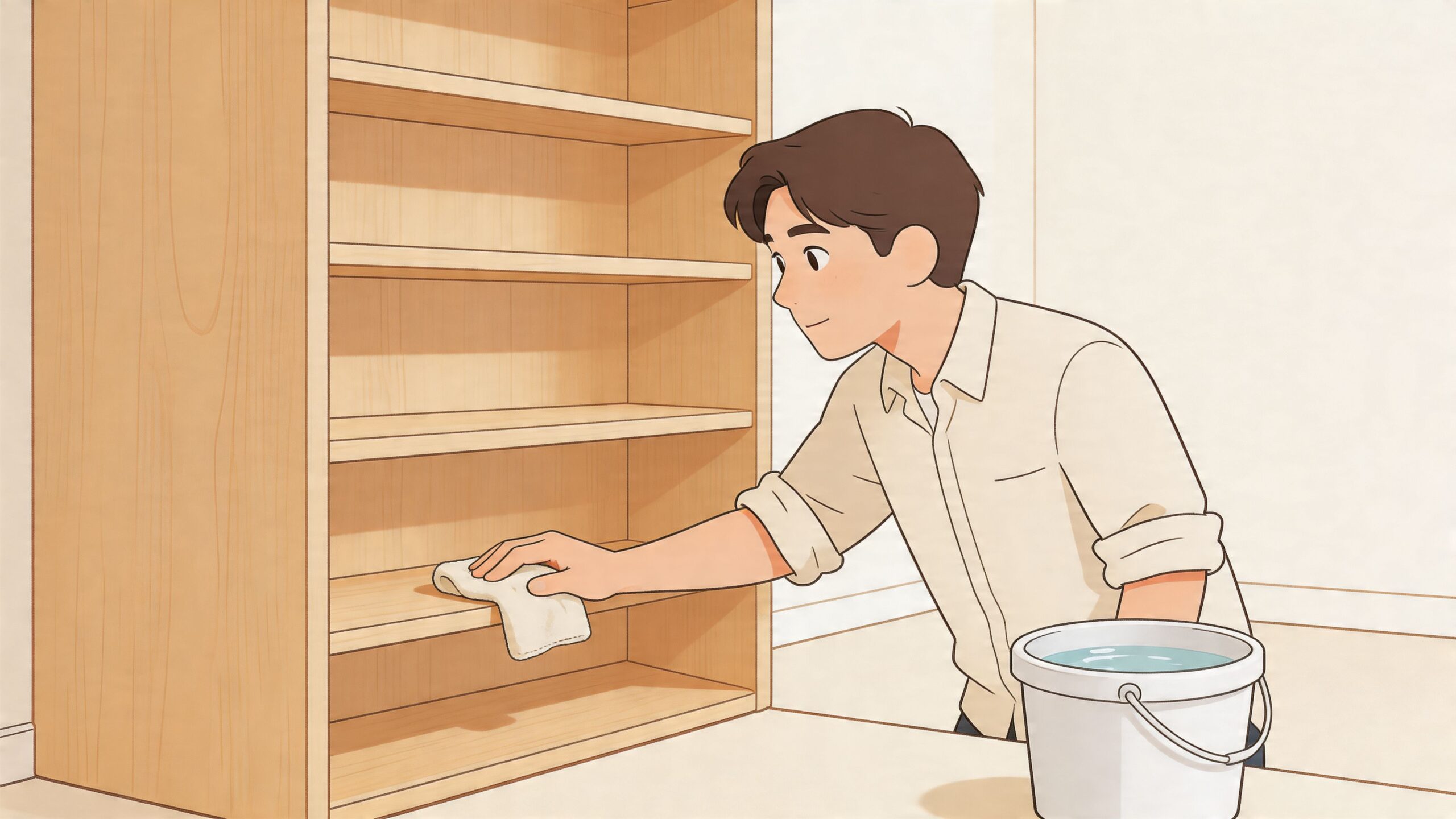
Don’t style around old clutter. Pull everything out so you can see the cabinet clearly.Clean every surface.
Use a soft cloth and a gentle cleaner that suits the material. Dust in corners and grime on glass will dull every object you place inside.Test for wobble.
Put a hand on each side and gently check for movement. If it rocks, fix that before adding anything breakable.Inspect the shelves.
Look for bowing, loose pegs, cracked supports, or hardware that doesn’t sit flush.Study the back panel and finish.
A faded interior, peeling veneer, or stained backing can make even good decor look tired.
Material matters more than most people think
Cabinet quality changes what you can safely display. According to this accent cabinet construction guide, solid wood can often support 200 to 400 lbs per shelf, while MDF is more affordable but can sag under 100 lbs over time. That same guide notes that high-end accent cabinets can retain up to 80% of their resale value after 10 years when they’re well made.
That’s why we’re opinionated about this. If you want a cabinet to hold books, ceramics, and real daily-use pieces, don’t treat material choice like a small detail. It’s the foundation of the whole look.
A cabinet that sags under its own display never feels elegant. It feels temporary.
Decide what needs a refresh
Not every cabinet needs paint. Some need restraint.
Use this quick decision table:
| Cabinet condition | Best move |
|---|---|
| Solid wood with minor wear | Clean, condition, and keep the original finish |
| Dated color but good shape | Paint or refinish only if it improves the room |
| Scratched laminate or tired fronts | Consider a surface update |
| Good structure, boring interior | Add wallpaper, fabric backing, or a painted interior panel |
If you’re refreshing a cabinet front instead of replacing the piece, how to cover kitchen cabinets offers useful ideas that also translate well to storage cabinets outside the kitchen.
Prep details that improve the final result
- Level the shelves: Crooked shelves make objects look sloppy even when they’re carefully arranged.
- Replace weak hardware: New pulls can sharpen the whole piece.
- Pick the right paint color first: If you’re changing the finish, use a room-wide palette, not an isolated cabinet color. This paint guide helps: https://gatesfurniture.com/guide-to-picking-the-perfect-paint-color-for-your-home/
- Line hidden storage thoughtfully: Felt, cork, or washable liners make drawers and lower cabinets feel finished.
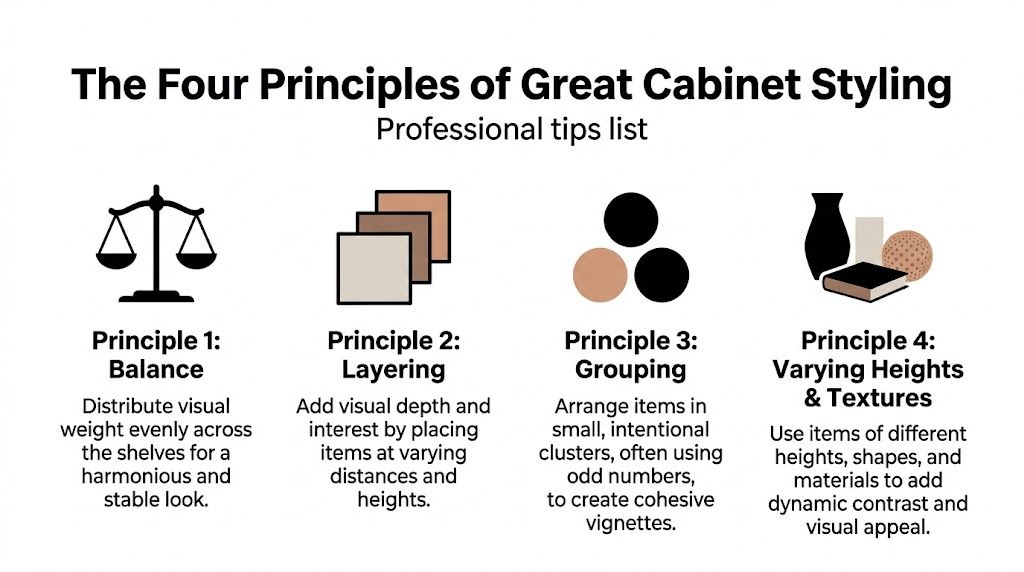
The Four Principles of Great Cabinet Styling
Good styling isn’t magic. It’s a small set of design habits used on purpose.
Once you understand them, storage cabinet decor gets much easier. You stop second-guessing every shelf.
Balance
Balance doesn’t mean matching both sides perfectly. It means the cabinet feels steady to the eye.
If you place a tall vase on the left, you don’t need another tall vase on the right. You need something that carries similar visual weight. That could be a stack of books, a framed photo, or two smaller objects grouped together.
A cabinet looks awkward when all the heavy pieces sit on one side or all the dark colors bunch up in one corner.
Layering
Flat displays look unfinished. Layering fixes that fast.
Set one object slightly in front of another. Lean art behind a bowl. Place a small box on top of books. Put a low tray beneath a candle and a bud vase so the grouping reads as one moment, not three unrelated items.
Designer habit: Put the tallest item toward the back, the medium item near it, and the smallest object slightly forward. That gives the shelf depth without chaos.
Grouping
One lonely object often feels accidental. Small groups feel considered.
The easiest method is to create mini scenes.
- A ceramic bowl, two books, and a brass object
- A framed photo, a candle, and a small lidded box
- A plant, a low dish, and a vertical stack of books
Odd-numbered groupings usually feel more relaxed than even ones, but don’t force the rule if the shelf needs simplicity.
Varying heights and textures
If every object is smooth, square, and the same height, the display gets dull fast.
Mix:
- Tall with low
- Round with angular
- Matte with reflective
- Natural with refined
A cabinet gets richer when wood, glass, ceramic, metal, linen, and paper all show up in measured ways.
A quick shelf formula that works
Use this if you tend to overthink:
| Shelf zone | What to place |
|---|---|
| Back | One tall anchor such as art, vase, or branch arrangement |
| Middle | A medium object or horizontal stack |
| Front | One small accent with shape or texture |
| Empty area | Leave breathing room |
That last row matters most. Negative space is what keeps a cabinet from looking like a garage sale.
If your room palette feels disjointed, this color resource can help you edit more sharply: https://gatesfurniture.com/an-experts-guide-to-the-perfect-color-palette/
An Item-by-Item Guide to Arranging Your Decor
A well-styled cabinet should feel like a series of small stories. Not a pile of nice things.
That’s especially true for curio cabinets and glass-front pieces. Curio cabinets trace back to the 16th century, when elites created entire “cabinets of curiosities” to display specimens, art, and collected objects before the idea evolved into furniture for heirlooms and china, according to Laurel Crown’s history of curio cabinets.
That origin is useful. It reminds us that display furniture has always been about editing and meaning.
The book lover’s nook
This look works beautifully in living rooms, home offices, and dens.
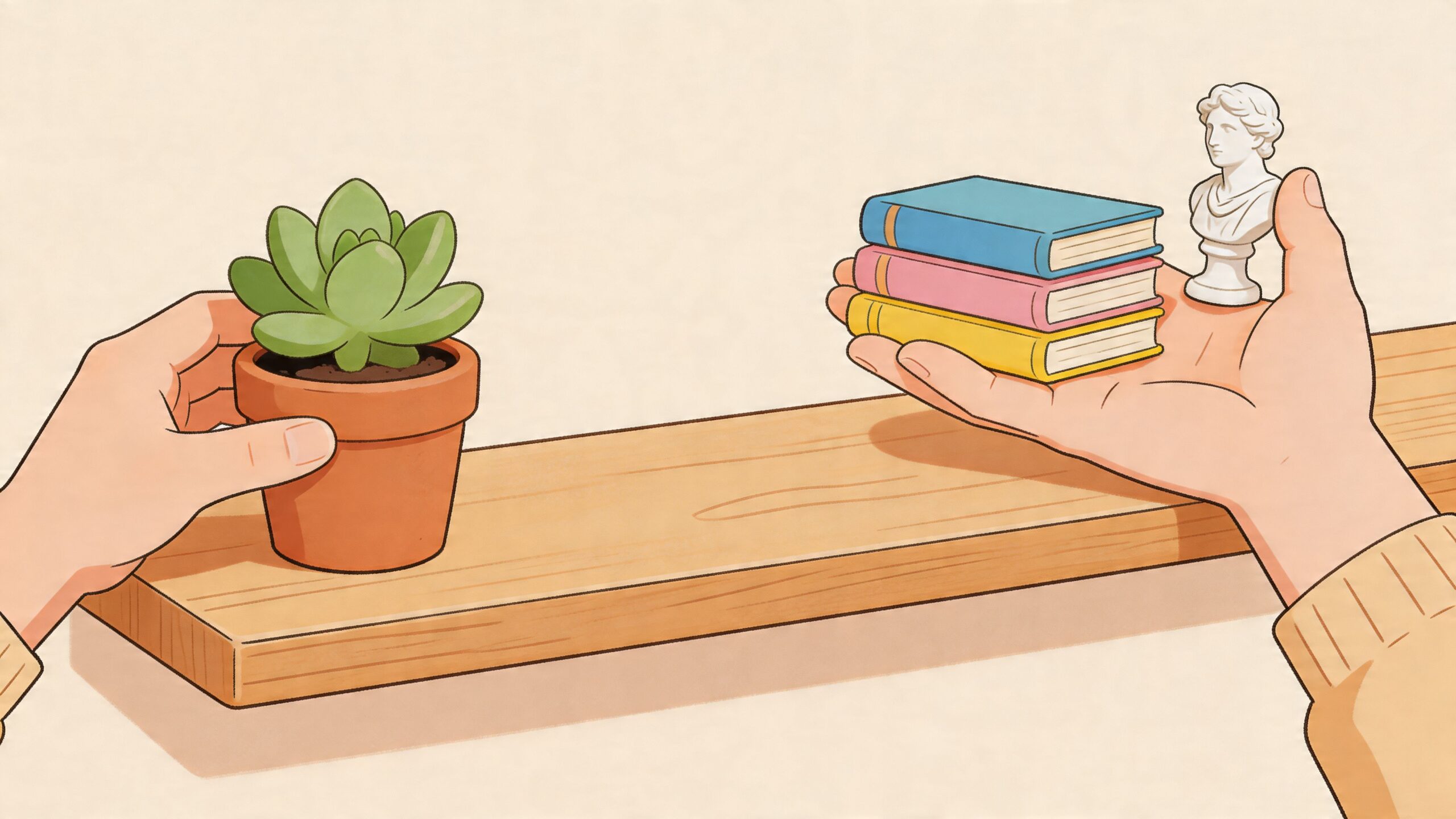
Start with books, but don’t turn the cabinet into a library unless that’s the point. Mix vertical rows with short horizontal stacks. A stack of two or three hardcovers can lift a candle, small bust, or pottery piece so it sits at a better height.
Add one personal object that breaks the seriousness. A framed family snapshot, a magnifying glass, a carved box, or a small plant keeps the arrangement from feeling stiff.
What to place:
- Books with varied jacket tones for warmth and rhythm
- A sculptural object on one stack
- One organic element such as a trailing plant or branch clipping
- A small lidded box to hide bookmarks, chargers, or odds and ends
Keep the lower shelves heavier. Books naturally belong low because they ground the cabinet visually.
The collected traveler display
This one suits open shelving, glass doors, or a dining room hutch.
Use pieces that hold special meaning. Pottery from a road trip. A bowl brought home from a favorite market. A stone object. A handwoven basket. The point isn’t luxury. The point is memory.
Here, restraint matters. Spread objects out so each one reads clearly.
The cabinet should feel collected over time, not purchased in one afternoon.
A strong arrangement might include a wide bowl on one shelf, two framed postcards leaning behind a carved object on another, and a stack of linen-bound books with a small tray beside them below.
The minimalist edit
Minimal doesn’t mean empty. It means intentional.
Choose fewer objects, but make each one count. If you love cleaner interiors, use a limited palette and repeat one material. Black and wood. White ceramic and glass. Sand tones with matte metal.
The easiest formula:
- One tall item
- One horizontal stack
- One low object
- Empty space around them
This style falls apart when people add “just one more thing” on every shelf. Stop sooner than feels natural. That’s usually the right moment.
The practical-pretty dining cabinet
Some cabinets need to work hard. They hold serving pieces, table linens, or everyday dishes. Good storage cabinet decor can still make that look polished.
Try this arrangement:
| Shelf type | Best use |
|---|---|
| Eye-level shelf | Best-looking bowls, platters, or glassware |
| Middle shelf | Folded napkins, stacked plates, or serving pieces |
| Lower shelf | Baskets, bins, or less decorative essentials |
| Behind doors | Backup sets, seasonal pieces, and practical overflow |
Use repetition to calm the display. Matching bowls, folded linens, or clear glasses lined in simple rows can look every bit as attractive as purely decorative objects.
Glass doors versus open shelves
Glass doors ask for cleaner spacing because everything is framed and visible all the time. Open shelves let you be a little looser.
For glass-door cabinets:
- Keep color palettes tighter
- Leave more negative space
- Avoid tiny cluttery objects
- Wipe shelves and glass often
For open cabinets:
- Lean art casually
- Let books and baskets soften the edges
- Use a few concealed containers to keep utility nearby
The anchor-first method
If you don’t know where to start, use this order every time:
- Place the largest object first
- Add medium pieces next
- Stack books or boxes to create height changes
- Tuck in one small accent
- Remove one thing
That last step is the difference between styled and stuffed.
Smart Swaps and Seasonal Refreshes on a Budget
You do not need a full room makeover to keep a cabinet looking current. You need a few smart swaps and the discipline to stop overbuying little filler decor.
That’s my strongest opinion on budget styling. When decorating on a budget, individuals frequently waste money on too many small objects and never save for the one anchor piece that would improve the cabinet.
Buy fewer accents and better anchors
A cabinet changes fastest when you swap one of these:
- Art or framed prints
- A larger vase or bowl
- Textiles in nearby view, such as table runners or folded linens
- Seasonal natural elements, including branches, greenery, seed pods, or fruit bowls
Those changes shift the whole mood without forcing you to replace everything.
Renter-safe upgrades are worth taking seriously
A lot of decorating advice still assumes you own the place and can drill, paint, or install permanent hardware whenever you want. That’s out of touch.
According to this piece on corner cabinet ideas and renter-friendly upgrades, the U.S. has 44 million renter households, and interest in non-permanent updates like peel-and-stick fronts or modular magnetic facades has grown, including a 35% surge in sales last year for that type of solution. That matters because storage cabinet decor shouldn’t be reserved for homeowners doing full remodels.
If you rent, focus on reversible moves:
- Peel-and-stick lining inside the back panel
- Temporary knobs if your cabinet allows easy hardware swaps
- Decorative baskets and boxes to hide practical items
- Freestanding risers or shelf inserts for more usable layers
- Magnetic or removable facade treatments when the surface allows it
Budget truth: Temporary doesn’t have to look temporary.
Seasonal refreshes that actually work
Don’t redecorate every shelf four times a year. That gets expensive and annoying.
Instead, rotate a small kit:
- Spring and summer. Lighter ceramics, greens, woven textures
- Fall. Wood tones, amber glass, richer books, small branches
- Winter. Candlelight, darker accents, metallics, tighter groupings
Keep your core pieces constant. Swap the accents around them.
Stretch the budget with one plan
A smart cabinet budget usually looks like this:
| Spend a bit more on | Save on |
|---|---|
| The cabinet itself | Small seasonal accents |
| One anchor object | Vases from thrift or resale finds |
| Better hardware | Books, branches, and collected objects |
| Storage baskets that will last | Temporary liners and removable styling layers |
For a room-wide strategy that keeps costs under control, this guide to https://gatesfurniture.com/how-to-decorate-living-room-on-a-budget/ has solid ideas you can apply to cabinet styling too.
Caring for Your Cabinet and Bringing It Home
Styling matters. Care determines whether the cabinet still looks good years from now.
A neglected cabinet gets cloudy glass, dry wood, sticky hardware, and shelf scuffs. None of that is hard to prevent if you stay consistent.
Daily care that keeps the finish looking right
For most cabinets, the routine is simple:
- Dust with a soft dry cloth
- Wipe spills quickly
- Use a cleaner that matches the material
- Keep heavy items within the shelf’s safe limits
- Avoid direct sun when possible, especially for wood finishes and fabrics nearby
Glass-front cabinets need more frequent wiping because fingerprints and dust show fast. Wood cabinets need gentler products and less moisture.
If your piece is wood, this care guide is a good reference point: https://gatesfurniture.com/how-to-care-for-wood-furniture/
Southern Oregon homes need a little extra thought
Southern Oregon homes deal with changing moisture levels through the year. That can affect cabinet longevity, especially with lower-quality materials.
For that reason, construction matters. In variable humidity, HDF reinforcements can increase warping resistance by 3x compared to wood alone and support longevity to 15+ years, according to Global Industrial’s cabinet guide. If you’re choosing a cabinet for long-term use, especially in a home office, dining area, or room with fluctuating conditions, that’s a practical detail worth caring about.
Choose a cabinet for the real house you live in, not the showroom fantasy version of it.
Delivery and setup affect the final result
People underestimate this part. A cabinet can be beautifully made and still end up scuffed, crooked, or poorly placed if delivery is sloppy.
Professional setup matters because:
- The piece can be leveled correctly
- Doors and drawers can be checked after placement
- Glass and shelves can be installed safely
- You avoid dragging a heavy cabinet across flooring
- The cabinet lands where it works in the room
That last point matters more than people expect. A cabinet styled well but placed badly still feels wrong.
A beautiful storage cabinet decor plan starts with the right piece, continues with thoughtful prep, and lasts through good care. That’s the full cycle.
If you’re ready to find a cabinet that works as hard as it looks, visit Gates Home Furnishings. Since 1946, our family has served Grants Pass and the Rogue Valley on George Gates Jr.’s promise of Service and Value. You can test pieces in our 30,000 sq. ft. showroom in Grants Pass, explore one-of-a-kind Unique Finds in reclaimed wood and teak, and shop trusted names like La-Z-Boy, Flexsteel, Ashley, and Beautyrest. We also offer Gates Easy Pay with $0 down, 6-month interest-free, and no-credit-needed options, plus White-Glove Delivery across Grants Pass, Medford, Central Point, Ashland, and Southern Oregon with professional assembly and haul-away. Visit our Grants Pass Showroom or browse our collection online.