Best Mattress for Pressure Relief: A Gates Guide

You go to bed tired, sleep a full night, and still wake up with a sore hip, a stiff shoulder, or that familiar ache across your lower back. A lot of people in Grants Pass, Medford, Ashland, and across the Rogue Valley tell us the same thing. They assume it’s age, stress, or just part of sleeping on “an okay mattress.”
Usually, it isn’t.
For many sleepers, pressure is the issue. The mattress isn’t spreading body weight well, so a few spots take too much force all night long. That’s why one person wakes up with a numb arm, another with tender hips, and another feeling like they tossed and turned for hours.
We’ve helped Southern Oregon families sort this out since 1946, when George Gates built this business around a simple promise of Service and Value. That promise still shapes how we talk about sleep. Plain English, honest guidance, and enough real-world testing to help people stop guessing.
If your soreness is tied to pregnancy, muscle strain, or changing body mechanics, it can also help to read this physical therapy guide on bad backache in early pregnancy. Mattress comfort matters, but it’s smart to look at the whole picture.
Waking Up Sore Is a Choice Not a Requirement
One of the most common conversations we have starts like this: “I can fall asleep fine. I just don’t stay comfortable.” That sentence tells us a lot.
Maybe you’re a side sleeper whose shoulder gets jammed into the bed. Maybe you’re an active hiker from the Rogue Valley whose hips already feel tight before bedtime. Maybe your mattress used to feel supportive, but now it feels flat, saggy, or strangely hard in the wrong places.
What soreness often points to
Pressure pain usually shows up in a few predictable ways:
- Hip tenderness: Common with side sleepers on mattresses that are too firm or too thin in the comfort layers.
- Shoulder pressure: A big sign that the surface isn’t contouring enough.
- Low back fatigue: Often linked to a mattress that lets the midsection sink too far or doesn’t support the lumbar area evenly.
- Restless sleep: If you keep shifting positions, your body may be trying to escape pressure points.
A good mattress shouldn’t ask your body to “tough it out” for eight hours.
People often get confused because they think firmness and pressure relief are the same thing. They aren’t. A mattress can feel soft but still lack support. It can also feel firm and still do a good job relieving pressure if it’s built with the right materials.
Why this matters before you shop
The best mattress for pressure relief isn’t the same for every person. Your body type, sleep position, pain areas, and even local climate all matter. That’s one reason online shopping can get frustrating fast. Product pages throw around terms like plush, adaptive, ergonomic, and pressure-balanced without explaining what those words should feel like under your body.
If you want a simple starting point, our guide to keys to waking up refreshed in the morning helps connect sleep comfort, support, and everyday habits.
What Exactly Is Mattress Pressure Relief
Pressure relief sounds technical, but the idea is simple. When you lie down, your body weight shouldn’t pile up on a few sharp contact points. It should spread across the surface in a more even way.
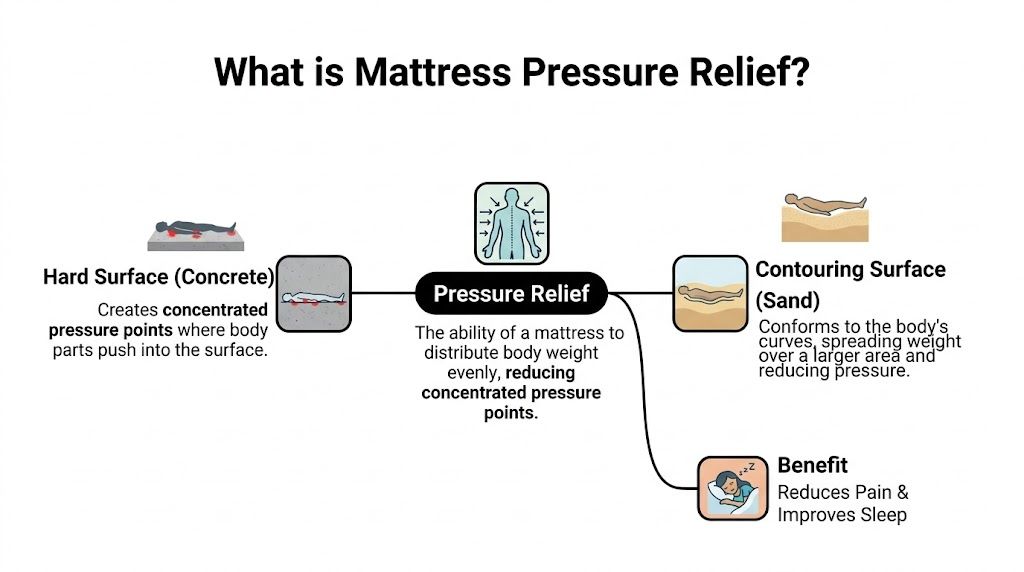
A concrete sidewalk doesn’t do that. Sand does.
Concrete versus sand
Think about lying on hard concrete. The heaviest and pointiest parts of your body push down the most. Specifically, this means the shoulders, hips, and sometimes heels. Those spots take the brunt of the force.
Now think about lying on packed sand at the beach. The sand gives way under your curves and supports a larger area of your body. The weight spreads out. That spreading out is the heart of pressure relief.
A mattress with good pressure relief works more like sand than concrete. It contours where you need cushioning, while still holding up the rest of you so your spine doesn’t drift out of line.
Why your body notices pressure at night
When a mattress creates too much concentrated force in one area, your body reacts. You shift. You curl up differently. You wake up briefly to move, even if you don’t remember doing it. Over time, that can mean lighter sleep and more soreness in the morning.
This idea comes from medical science, not marketing language. A 2021 Cochrane systematic review of 59 trials found that high-specification foam mattresses significantly reduce the incidence of pressure ulcers compared to standard mattresses, showing that advanced materials play an important role in distributing body weight and protecting vulnerable areas, according to the Cochrane review summary at NCBI.
Practical rule: If a mattress feels fine for two minutes but painful after ten, pressure relief is probably the missing piece.
Pressure relief is not the same as sinking
Many shoppers encounter a common pitfall. They lie on a very soft mattress, feel an instant “ahh,” and assume that means excellent pressure relief. Sometimes it does. Sometimes it just means the top feels plush.
True pressure relief has to work together with support. If your shoulders and hips sink nicely but your lower back twists or your pelvis drops too far, you may trade one problem for another. That’s why we always look at both comfort and alignment together.
Here’s a quick way to separate the terms:
| Surface feel | What it means |
|---|---|
| Softness | The first impression when you lie down |
| Pressure relief | How well the mattress spreads weight away from hips, shoulders, and other hot spots |
| Support | How well the mattress keeps your spine and core from sagging out of position |
If you want a deeper look at one material that often comes up in this conversation, our article on what is a memory foam mattress breaks down how contouring foams behave.
The sleep benefit people actually feel
The practical payoff is straightforward. Better pressure relief often means less tossing, fewer sore spots, and a more settled feeling through the night. Not because the mattress is magic, but because your body isn’t spending hours trying to escape bad contact points.
That’s why pressure relief matters so much for side sleepers, people with joint pain, seniors, and anyone whose daily life already puts wear on the shoulders, hips, or back.
Exploring the Best Materials for Soothing Pressure Points
Materials matter because they change how the mattress responds under your body. Some compress slowly and mold around you. Some push back more quickly. Some combine cushion with deeper structural support.
Memory foam for close contouring
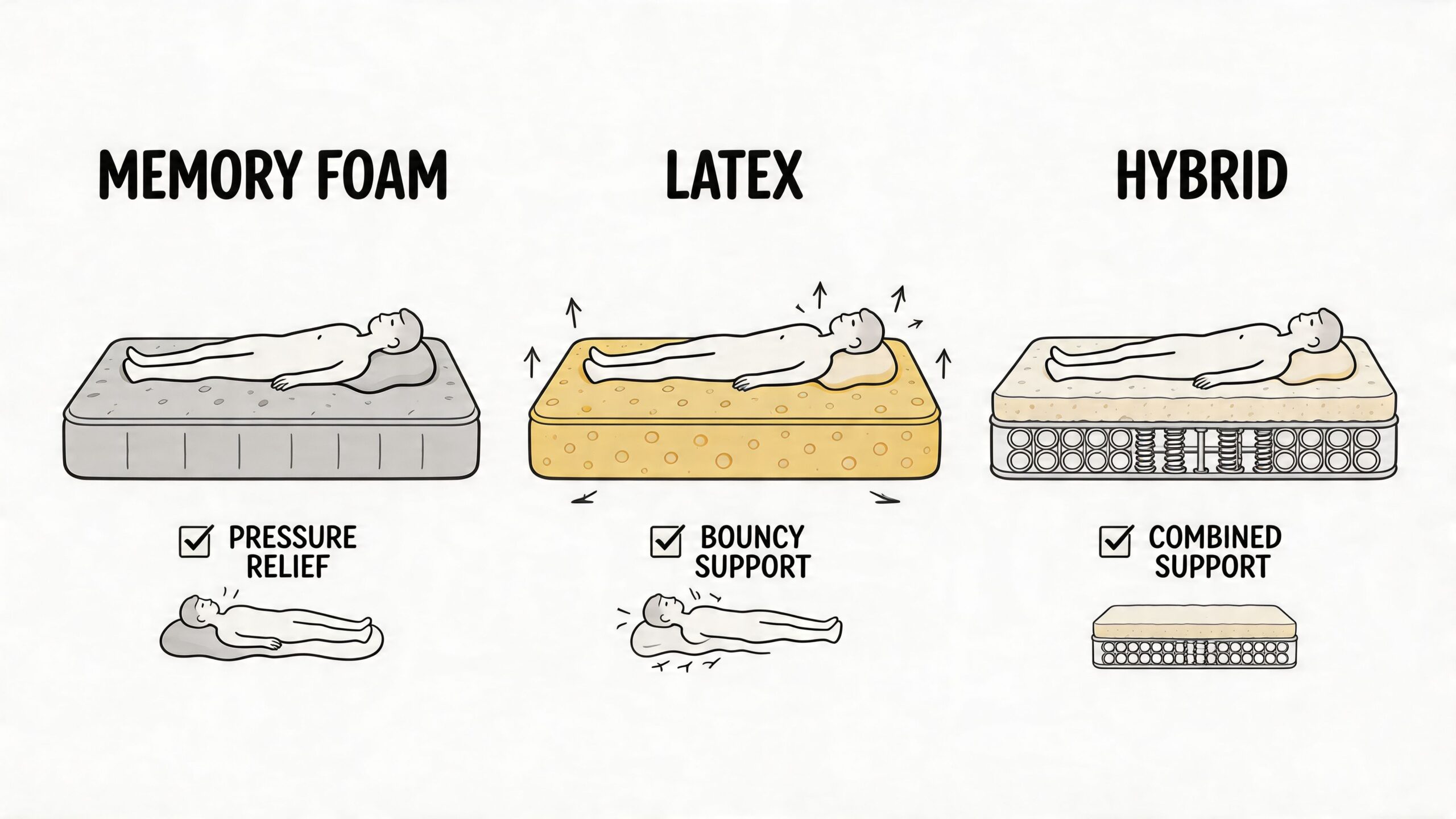
Memory foam remains one of the clearest pressure-relief materials because it conforms closely around heavier joints and curves. It doesn’t just cushion on top. It spreads force across a broader area when it’s built well.
That’s especially true with denser foams. High-density memory foams of at least 5 lb/ft³ can reduce peak pressures on hips and shoulders by 25 to 35 percent compared to standard foams, based on pressure mapping tests summarized by Shop Silica’s pressure relief guide.
What that means in plain language is simple. Better foam lets your shoulder and hip settle in without hitting a hard stop underneath.
A few practical notes:
- Best fit: Side sleepers, lighter to mid-range body types, and people who want a close “hug” feel.
- Watch for: Heat retention and excessive sink if the comfort system is too soft for your build.
- Good example brands: Tempur-Pedic and many modern foam hybrids.
Latex for buoyant pressure relief
Latex feels different from memory foam. Instead of slowly molding around you, it responds faster and feels springier. Some sleepers love that because it relieves pressure without making them feel stuck in the bed.
Latex often works well for people who want contouring with easier movement. It can also be a smart option for heavier sleepers who want durability and less deep sink.
Some people describe memory foam as “melting around you.” Latex feels more like “floating with support.”
Latex isn’t always the first choice for every side sleeper with sharp shoulder pain, but it can be a very balanced choice for combination sleepers and people who dislike the slower response of traditional foam.
Hybrids for the middle ground
Hybrid mattresses combine foam or other comfort materials on top with a coil support unit underneath. For many shoppers, these mattresses allow pressure relief and support to meet in a more forgiving way.
The upper layers cushion pressure points. The pocketed coils below add airflow, support, and often zoned reinforcement under the lower back or midsection. That’s one reason hybrids are so popular with couples, back sleepers, and people who don’t want the deep cradle of an all-foam bed.
If you’re comparing different mattress types like hybrid and innerspring, it helps to focus on how each one handles contouring. A true hybrid usually offers far more targeted cushioning than a basic traditional innerspring.
Why old-school innersprings often miss the mark
A basic innerspring usually has thinner comfort layers and a more connected coil system. That means the mattress pushes back, but not in a very body-specific way. You may feel support, but not much relief at the hips and shoulders.
That’s why many people say an old mattress feels “firm in the wrong places.” It isn’t always that the bed is too hard overall. It’s that it doesn’t adapt enough where your body needs give.
For a closer comparison of how these constructions feel in real life, our guide on innerspring vs memory foam can help narrow your options.
A simple material cheat sheet
| Material | Pressure relief feel | Common strengths | Common cautions |
|---|---|---|---|
| Memory foam | Deep contouring | Cushions shoulders and hips well | Can sleep warmer, can feel slow-moving |
| Latex | Buoyant contouring | Easier movement, durable feel | Less “hug” than memory foam |
| Hybrid | Balanced contouring | Support, airflow, broader appeal | Quality varies based on top layers |
If you visit a curated mattress gallery, you’ll usually see this range in brands like Tempur-Pedic, Beautyrest, and other better-built models rather than one-note bargain beds. The point isn’t to chase buzzwords. It’s to match the material to how your body sleeps.
How Your Sleep Position Determines Your Perfect Mattress
The same mattress can feel wonderful to one sleeper and terrible to another. Sleep position is one of the biggest reasons why.
Side sleepers need room for shoulders and hips
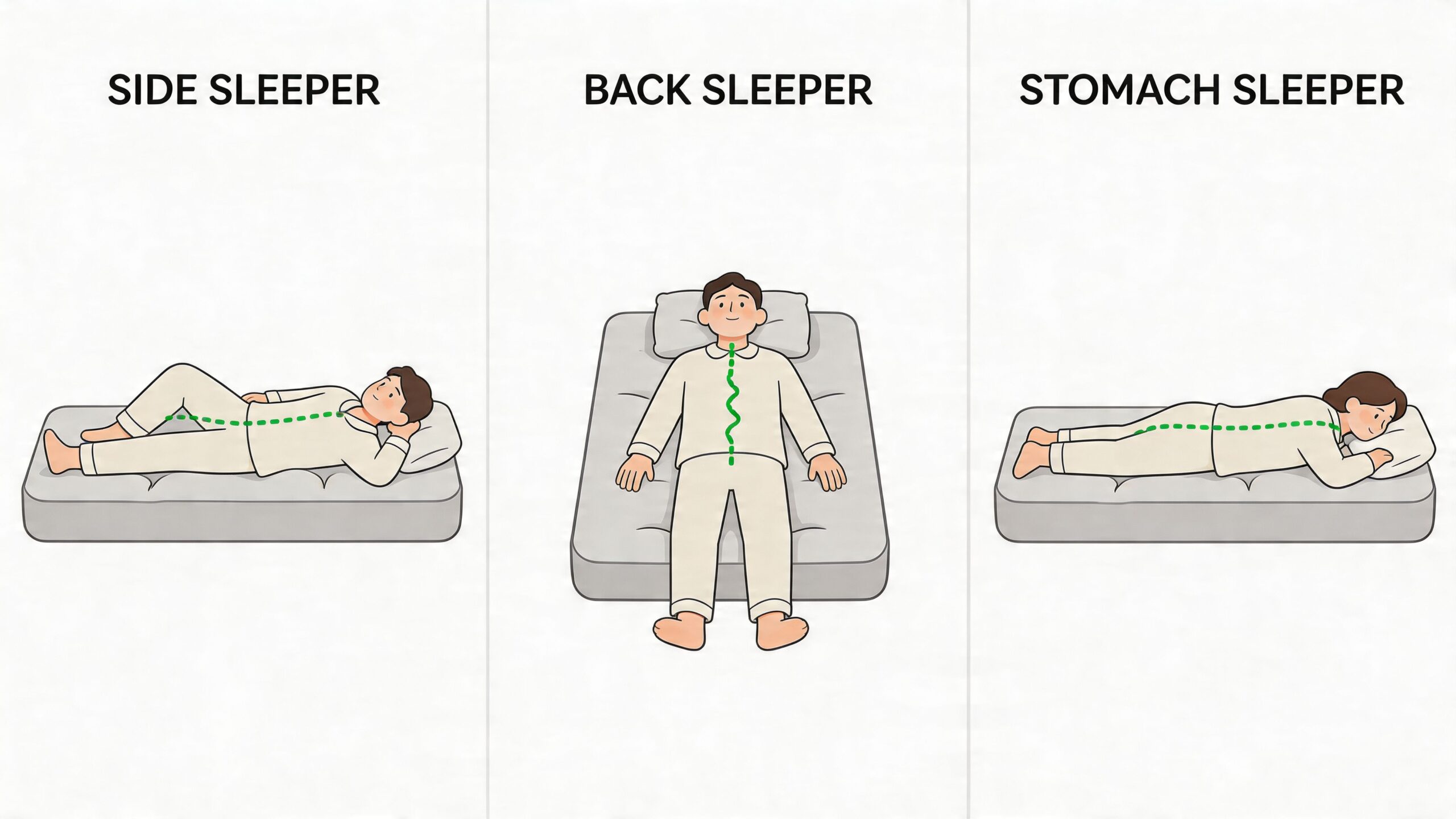
Side sleeping creates the most obvious pressure points because two bony areas take the load first. If the mattress is too firm or too flat, the shoulder gets compressed and the hip starts to ache. If it’s too soft without enough support, the midsection can sag.
That’s why side sleepers usually do best with a mattress that has noticeable contouring in the comfort layers. Zoned support can help too. Expert evaluations in 2026 note that the Helix Midnight Luxe uses zoned coils that can reduce pressure on the shoulders and hips by up to 40 percent in pressure mapping tests, while innersprings often score near zero for pressure relief because they lack targeted contouring, according to Dweva’s mattress pressure point guide.
If that’s your sleep style, our guide to the best mattress for side sleepers goes deeper.
Back sleepers need a balanced surface
Back sleepers usually need a middle-ground feel. There should be enough give for the shoulders and seat, but not so much that the pelvis sinks lower than the ribcage. When that happens, the lower back often complains in the morning.
A good back-sleeper mattress tends to feel even rather than dramatic. You shouldn’t feel your hips dropping. You also shouldn’t feel a gap under the lumbar area.
A few signs you’re on the right surface:
- Your lower back feels supported: Not jammed upward, not left hanging.
- Your hips stay level: They settle a little, but don’t sink excessively.
- You can relax your shoulders: You’re not bracing against the bed.
Stomach sleepers need firmer support than they expect
Stomach sleeping is often the trickiest position for pressure relief because the goal isn’t only cushioning. It’s preventing the midsection from bowing into the mattress.
When the hips drop too far, the lower back extends into a strained position. That’s why most stomach sleepers need a firmer, flatter-feeling surface than side sleepers do. Some padding is still useful, but not a thick, overly plush cradle.
If you sleep on your stomach and wake with an arched, tight lower back, your mattress may be too soft through the middle.
Combination sleepers need response
A lot of people don’t stay in one position all night. If you move from your side to your back, or from your back to your stomach, the mattress has to do two jobs. It has to relieve pressure and let you reposition without a struggle.
That’s where responsive hybrids and buoyant latex can stand out. The mattress should cushion enough when you land on your side, but it shouldn’t trap you there.
A quick position guide
| Sleep position | What usually helps most | What often causes problems |
|---|---|---|
| Side | Softer to medium feel with contouring | Flat, firm surfaces with thin comfort layers |
| Back | Medium to medium-firm balance | Hammocking through the hips |
| Stomach | Firmer support with controlled cushioning | Plush tops that let the pelvis sink |
| Combination | Responsive comfort with easy movement | Slow, deep sink that resists repositioning |
The best mattress for pressure relief always depends on who’s lying on it. Position is the first filter. Your build, pain points, and preferences refine the answer.
Special Considerations for Southern Oregon Sleepers
Southern Oregon sleepers have a few pressure-relief challenges that broad national mattress lists often miss. The climate matters. So does lifestyle. So do the needs of seniors and heavier individuals whose bodies interact with a mattress differently than a generic online reviewer’s.
In the Rogue Valley, plenty of people spend the day hiking, lifting, biking, gardening, or working on their feet. They don’t come in asking for “advanced contour response.” They come in saying their shoulders are cooked, their hips are tight, or their lower back won’t settle down at night.
Heat changes the conversation
A mattress can have excellent pressure relief and still not be the right fit if it traps too much heat. That matters in warmer stretches around Grants Pass and throughout the valley, especially for older sleepers.
According to a discussion summarized at Mattress Underground’s guidance on pressure point and low back pain relief, 60 percent of seniors report overheating, and in those conditions zoned hybrids that promote airflow can outperform pure foam for durability and comfort under heavier weight, with lab tests showing up to 30 percent less sinkage in models like the Bear Elite.
That lines up with what we hear in the showroom. People want pressure relief, but they don’t want to sleep hot to get it.
Seniors often need more than softness
Older sleepers are sometimes steered toward very plush mattresses because “soft equals comfort.” That can backfire. If the surface is too soft, getting in and out of bed gets harder. Movement takes more effort. And if support fades under the hips, the back can feel worse instead of better.
For many seniors, a better setup includes:
- Gentle contouring: Enough to cushion shoulders and hips.
- Stable support underneath: So the body doesn’t sag through the night.
- Good edge support: Helpful when sitting down or standing up.
- Temperature control: Especially important for sleepers who run warm.
Adjustable bases can also be useful when someone wants to slightly raise the head or legs for comfort, circulation, or easier rest.
Heavier sleepers need deeper support
People with larger body frames often need stronger support systems and more resilient comfort layers. A mattress that feels plush and pressure-relieving in a quick store test can bottom out over time if the materials aren’t up to the job.
That’s why zoned coils, denser foams, durable hybrids, and reinforced edges matter more in this group. Pressure relief still matters, but it has to happen without collapse.
For heavier sleepers, “soft enough” and “supportive enough” have to happen at the same time. One without the other usually leads to pain.
Local shopping helps because local bodies aren’t generic
A big-box mattress quiz won’t know if you spend weekends on the river, work construction, or wake up hot during summer nights in Grants Pass. It won’t know if you’re recovering from years on a too-soft bed or trying to find something easier to move on after age sixty.
That’s where in-person testing becomes useful. You can compare cooler hybrids, denser foams, adjustable-base compatibility, and sturdier builds side by side instead of trying to decode sales language from a phone screen.
How to Properly Test a Mattress in Our Showroom
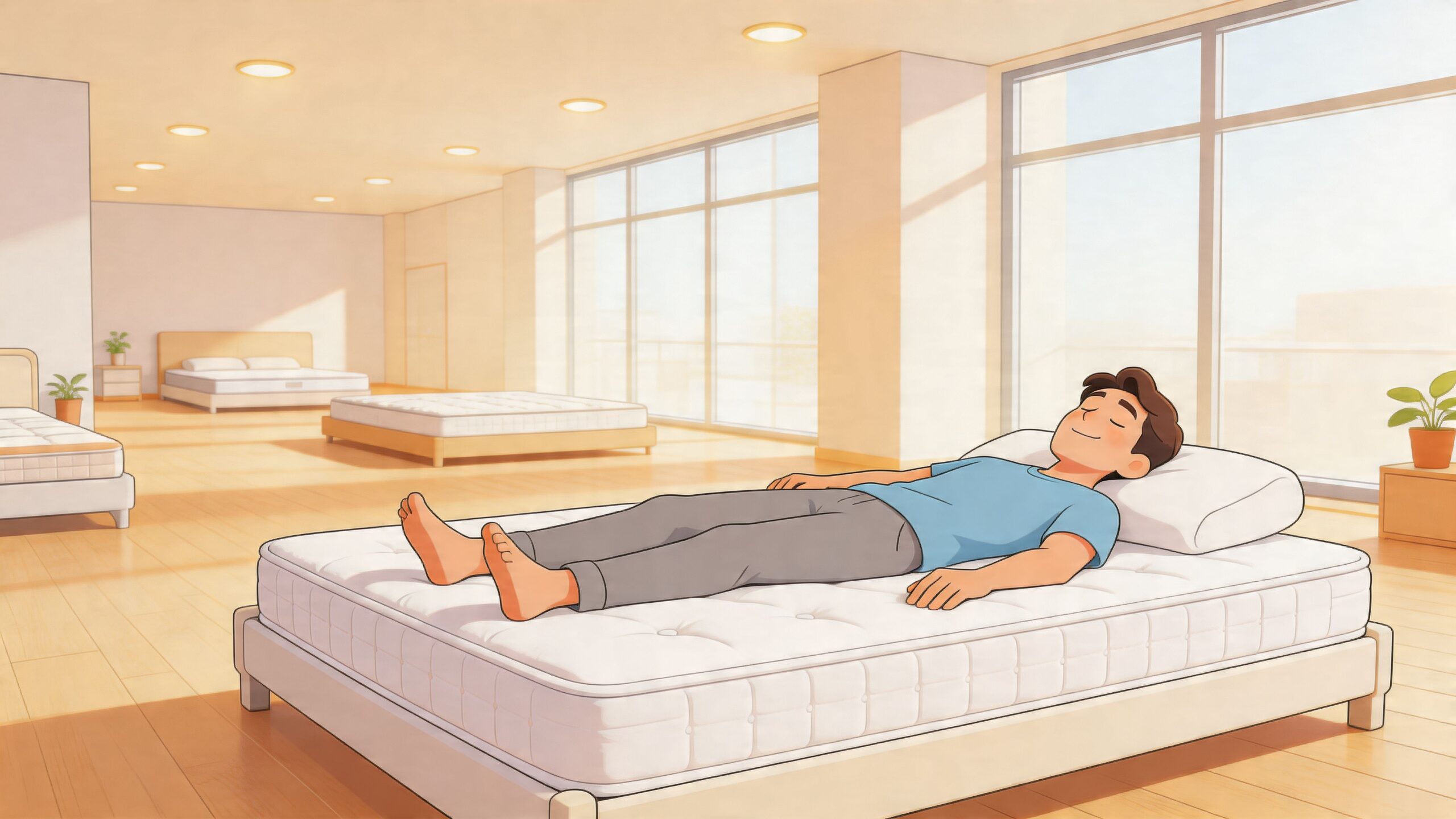
Mattress shoppers often test a mattress for about thirty seconds. They sit on the edge, bounce once, lie down flat on their back, and make a snap judgment.
That doesn’t tell you much about pressure relief.
Start with your real sleep position
If you sleep on your side at home, test on your side in the showroom. If you rotate between your back and side, do both. Pressure relief only shows up when your body is in the position that usually creates the problem.
Give each mattress enough time. A surface can feel fine at first and reveal pressure after several minutes.
Here’s a better testing routine:
- Wear comfortable clothes so you can relax.
- Lie down for at least 15 minutes on any mattress you’re seriously considering.
- Settle into your normal position instead of the position that feels most “presentable.”
- Notice your hot spots. Shoulder, hip, lower back, ribs.
- Roll and reposition once or twice to see whether movement feels easy or awkward.
Pay attention to what your body says
A good showroom test isn’t about brand names first. It’s about body feedback.
Ask yourself:
- Does my shoulder feel crammed?
- Are my hips sinking too far?
- Is there tension in my lower back?
- Can I turn over without fighting the mattress?
- Do I feel supported near the edge?
If you’re shopping with a partner, both of you should test the bed for real. Not just one person. Shared mattresses are compromise products by nature, and pressure relief can feel completely different from one body to another.
Use the showroom the way it’s meant to be used
A large floor lets you compare construction types quickly. In a 30,000 sq. ft. Grants Pass showroom, that means you can move from a memory foam model to a hybrid, then to a firmer supportive design without trying to remember how one felt days earlier.
One practical option is the mattress selection at Gates Home Furnishings, where shoppers can compare brands such as Tempur-Pedic and Beautyrest in person rather than relying on online descriptions alone. That kind of side-by-side testing often makes pressure relief differences obvious within minutes.
Don’t judge a mattress by the first ten seconds. Judge it by how your pressure points feel after you’ve been still for a while.
A few mistakes to avoid
| Common mistake | Better move |
|---|---|
| Testing only on your back | Test in the position you actually use most |
| Choosing by softness alone | Check pressure relief and spinal support together |
| Rushing through several beds | Narrow to a few and stay on each longer |
| Ignoring edge feel | Sit and lie near the edge if that matters to you |
| Assuming your old firmness still fits | Let your current body and pain points guide the choice |
The right test is calm, not rushed. That’s how you notice whether a mattress is soothing pressure or feeling superficially plush for a minute.
Protecting Your Investment and Making It Affordable
Once you find the right mattress, the next step is making sure it stays comfortable and workable for your budget. A mattress is a long-term sleep tool, not a casual impulse buy.
That’s where wraparound service matters. Delivery, setup, haul-away, financing, and practical after-purchase guidance all shape the experience.
What helps a new mattress last
Pressure relief can change if the mattress isn’t cared for well. A supportive foundation, a good protector, and regular attention to the manufacturer’s care instructions all matter. If the mattress is compatible with rotation, that can help wear stay more even over time.
Some sleepers also benefit from fine-tuning with pillows or, in select cases, a topper. A topper can slightly change feel, but it won’t fix a mattress that lacks the right support underneath. If the base mattress is wrong, accessories usually won’t rescue it.
Delivery service matters more than people think
A mattress isn’t convenient when it arrives as one more problem to solve. For many households, especially seniors or busy families, professional setup is part of the value.
White-glove delivery means the mattress is brought in, assembled properly, and the old mattress can be hauled away. That’s a very different experience from a box left at the porch. It’s especially useful for customers from Central Point, Medford, Ashland, and throughout Southern Oregon who don’t want to wrestle a heavy mattress through hallways or stairs.
Financing can make the right choice possible
A lot of shoppers settle for the wrong mattress because they’re trying to hit a short-term budget target. Then they live with the discomfort for years.
Flexible financing can make the better long-term fit realistic. With Gates Easy Pay, that includes $0 down, 6-month interest-free options, and no-credit-needed programs. If you want to see how those choices work, the details are outlined on our furniture financing options page.
The same store experience often includes more than mattresses. If you’re furnishing a full room, it can help to coordinate sleep products with bedroom pieces, recliners, or even the kind of one-of-a-kind reclaimed wood and teak Unique Finds that give a home more personality than a standard chain setup.
Your Invitation to a Better Night's Sleep
Pressure relief isn’t just a comfort buzzword. It’s the difference between a mattress that spreads your weight well and one that leaves your hips, shoulders, or back doing the work all night.
If you’re still unsure what you need, ask yourself a few simple questions. Where do you hurt when you wake up? What position do you sleep in? Do you sleep warm? Do you need easier movement, stronger support, or both?
For some sleepers with severe medical needs, home-use powered systems may also be worth discussing with a care team. According to Rehabmart’s guide to choosing a pressure relief mattress, powered air mattresses can reduce pressure ulcer incidence by up to 70 percent by dynamically adjusting pressure below the 32 mmHg capillary closure threshold. That’s more clinical than what most shoppers need, but it shows how important pressure management can be.
We’ve believed in practical help since George Gates opened the business in 1946 on a promise of Service and Value. That’s still how we approach sleep in Southern Oregon. Real testing. Clear advice. No mystery.
Visit Gates Home Furnishings to test mattresses in our Grants Pass showroom or browse our collection online. We serve shoppers across Grants Pass, Medford, Central Point, Ashland, and the Rogue Valley with a full 30,000 sq. ft. showroom, White-Glove Delivery with assembly and mattress haul-away, trusted brands like Beautyrest, La-Z-Boy, Flexsteel, and Ashley, plus Gates Easy Pay with $0 down, 6-month interest-free, and no-credit-needed options.