Most Comfortable Recliner for Seniors: A 2026 Guide


The search usually starts the same way. A parent’s favorite chair isn’t comfortable anymore. It sits too low, the arms don’t give enough push, the back support is weak, and getting up has become the hardest part of the day.
That’s when “comfortable” stops meaning soft and starts meaning safe, supportive, and easy to live with.
We’ve helped families across Grants Pass, Medford, Ashland, Central Point, and the wider Rogue Valley sort through this exact decision for generations. Since 1946, when George Gates Jr. opened our doors with a promise of Service and Value, we’ve believed furniture should make daily life easier, not harder.
Your Search for the Perfect Senior-Friendly Recliner
If you’re looking for the most comfortable recliner for seniors, you’re probably not shopping for style alone. You’re trying to solve a daily problem. Maybe it’s swollen legs by evening, a sore lower back after sitting too long, or the worry that standing up from a low seat could turn into a fall.
That changes how you should shop.
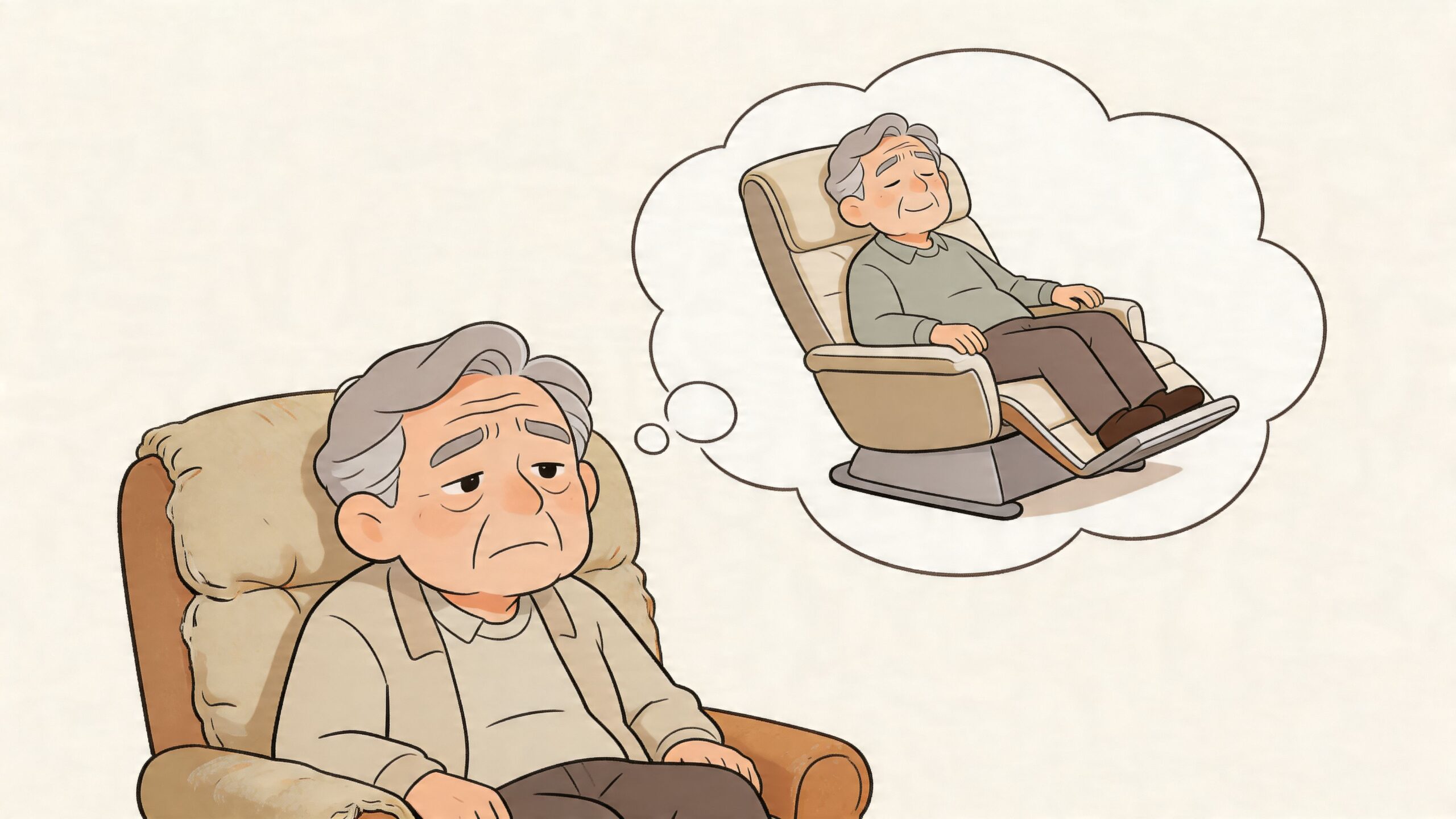
Most online lists stop at generic advice. They’ll tell you to look for padding, cup holders, or a nice fabric. That’s not enough. The right recliner for a senior should match the body, the room, and the health concern. Arthritis needs one kind of support. Post-surgery recovery needs another. Limited mobility changes the decision again.
We take a direct view on this. If a recliner feels plush for five minutes but makes it harder to stand, it’s the wrong chair. If it reclines nicely but doesn’t support the head, lower back, and legs for long sitting, it’s the wrong chair. Comfort without function isn’t comfort for long.
Here’s a quick comparison to narrow the field before you shop:
| Need | Best recliner type | Why it works |
|---|---|---|
| Trouble standing up | Power lift recliner | Helps reduce strain during sit-to-stand transitions |
| Arthritis stiffness | Recliner with adjustable lumbar and easy controls | Supports joints and reduces awkward repositioning |
| Post-surgery recovery | Dual-motor power recliner or lift chair | Lets you raise legs and back more precisely |
| Long hours seated | High-back recliner with strong seat support | Better head, neck, and lower-back support |
| Simple comfort with easier reclining | Traditional power recliner | Good fit if mobility is still strong |
A good place to start is a collection that includes setup help, not just the chair itself, like these recliners with delivery options.
The best senior recliner isn’t the softest one on the floor. It’s the one that lets someone sit down easily, rest comfortably, and stand up with confidence.
What Truly Defines Comfort in a Senior Recliner
A senior recliner earns the word “comfortable” in three places. The back. The seat. The way it changes position.
If one of those is off, the chair won’t stay comfortable for long.
Start with support, not softness
A lot of shoppers make the same mistake. They sit down, feel a plush top layer, and decide the chair is comfortable. Then after twenty minutes, their lower back starts working harder than the chair does.
The most useful comfort feature is proper lumbar support. It keeps the lower spine from collapsing into the cushion. That matters even more for seniors who spend long stretches seated during the day.
Head and neck support matter just as much. A high back can be excellent, but only if it supports the head without forcing it forward. Adjustable headrests are especially helpful for reading, watching television, or napping upright.
Cushion construction changes everything
Not every soft seat is supportive, and not every firm seat is uncomfortable.
Here’s how we explain it in plain terms:
- High-density foam tends to feel more supportive and steady over time. It’s often the better choice for seniors who need easier repositioning and less sink.
- Plusher pillow-top cushioning can feel inviting at first, but if it lets the hips sink too deep, standing up gets harder.
- A firmer seat with a softer back is often the sweet spot for seniors who want both support and comfort.
If back pain is part of the issue, it helps to browse options designed around that need, like these recliners for back pain.
Practical rule: If the seat swallows you, it won’t help you. Seniors usually do better in a recliner that supports the hips and thighs instead of letting the body sink low.
Positioning matters more than most people realize
A recliner isn’t just a chair. It’s a positioning tool.
That’s why zero-gravity positioning deserves attention. Power lift recliners with zero-gravity positioning can significantly ease joint pressure and improve circulation, which matters because arthritis affects 50% of US seniors over 65 and falls cause 3 million ER visits yearly for those 65 and older, according to this 2026 power lift recliner review roundup.
For many seniors, the right angle does four practical things:
- It takes pressure off sore joints.
- It raises the legs more comfortably.
- It makes longer sitting sessions easier.
- It reduces the need for constant shifting.
The best comfort is condition-specific
Many articles often simplify the issue. They describe one perfect recliner for everyone. That doesn’t exist.
A better way to see it is:
| Condition or need | Comfort feature that matters most |
|---|---|
| Arthritis | Easy controls, gentle positioning, pressure relief |
| Lower back pain | Lumbar support and a stable seat |
| Swelling in legs | Strong leg elevation and smoother recline positions |
| Frequent napping | Full recline or near-flat comfort with good head support |
| Weak grip or hand pain | Large, simple power controls |
Some seniors also spend extended periods seated. In those cases, a recliner that offers multiple angles and a full recline position can help with rest and reduce the hassle of transferring to bed for every nap. That’s practical comfort. Less strain, less repositioning, and more independence.
Power Lift vs Traditional Power Recliner A Critical Choice
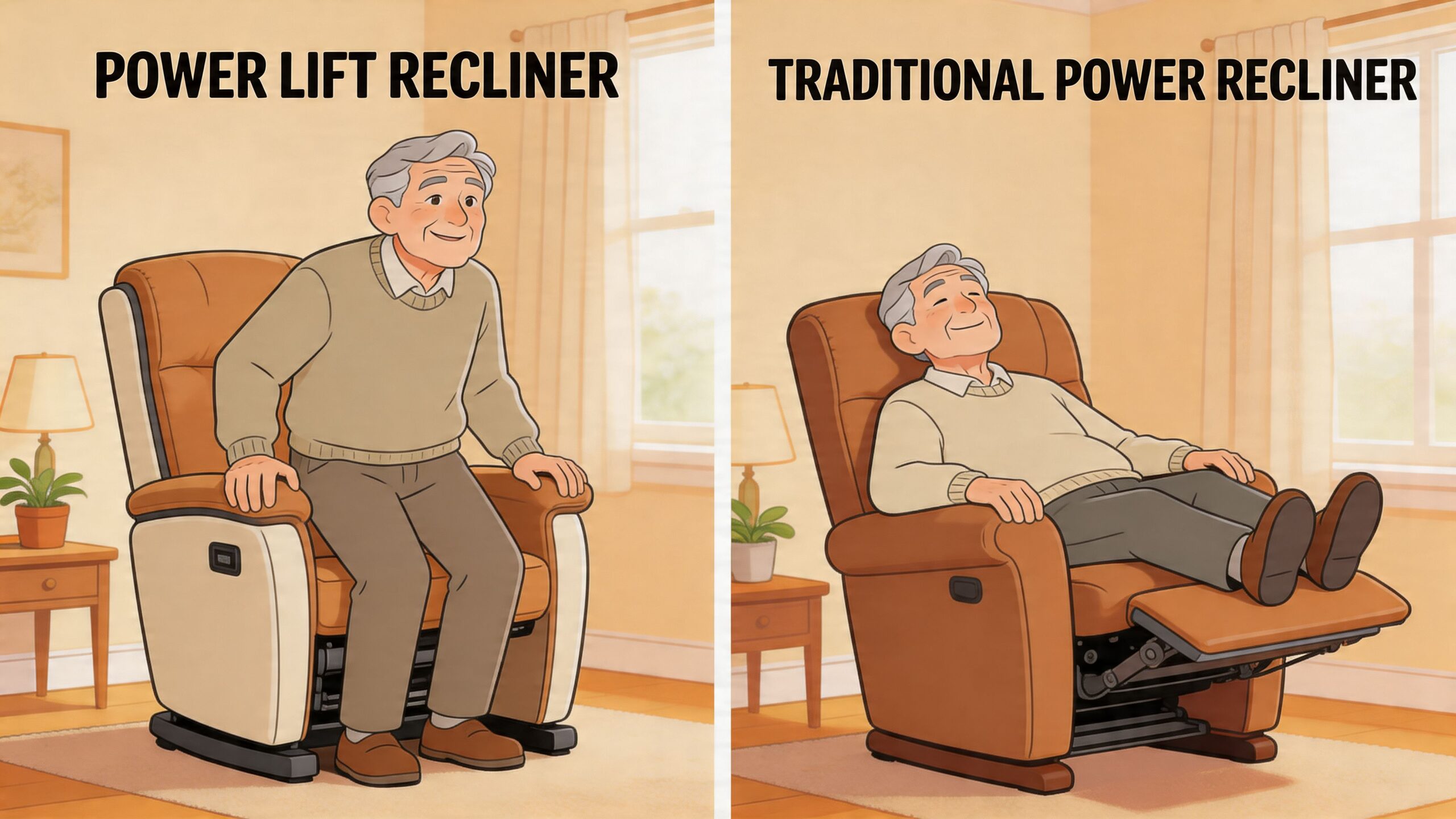
This is the decision that matters most. Should you buy a power lift recliner or a traditional power recliner?
Our opinion is simple. If standing up has become difficult, stop looking at standard recliners first. Start with lift chairs.
When a power lift chair is the right call
A power lift recliner doesn’t just recline. It tilts forward to help the user rise with less strain on the knees, hips, and lower back.
That feature matters because 28% of adults over 65 experience mobility limitations, and falls affect 1 in 4 seniors annually, as noted in this guide to senior recliners and lift mechanisms. If a person struggles to get out of a chair even once or twice a day, a lift mechanism stops being a luxury and starts being basic safety equipment.
A lift chair is usually the better choice for:
- Mobility challenges that make standing slow or painful
- Recovery after surgery when pushing off the arms is difficult
- Knee or hip issues that make low seats frustrating
- Caregivers who want safer transfers with less physical strain
- Fall concerns during sit-to-stand movement
For examples built around that use case, look at lift chairs for elderly users.
When a traditional power recliner is enough
A standard power recliner still has a place. If someone can stand up safely without help and mainly wants easier reclining, a traditional power model can be the cleaner, simpler option.
It works well for seniors who:
- want automatic footrest and back adjustment
- still have decent lower-body strength
- don’t need the chair to help them stand
- prefer a less medical look in the living room
Side-by-side decision guide
| Question | Power lift recliner | Traditional power recliner |
|---|---|---|
| Helps with standing | Yes | No |
| Better for weak knees or hips | Yes | Sometimes |
| Good after surgery | Often | Sometimes |
| Sleeker appearance | Sometimes | Usually |
| Best for independent mobility support | Yes | No |
| Best for simple lounging comfort | Yes, if needed | Yes |
Buy for the hardest part of the day, not the easiest one. If getting up is the hard part, choose the chair that solves that first.
Some shoppers resist a lift chair because they think it means “giving in.” We don’t see it that way. We see it as protecting independence. A chair that helps someone stand without waiting for assistance preserves dignity in a very practical way.
How to Measure and Test for the Perfect Recliner Fit
You can eliminate half the bad options before you ever sit down. Measure first. Test second. Buy last.
The fit of a recliner affects comfort more than color, fabric, or brand name.
Measure the body and the current chair
Start with the chair the person uses now, even if they don’t like it. That gives you a baseline for what feels too low, too deep, or too narrow.
Check these basics:
- Seat height: The person should be able to place both feet flat on the floor with knees at a natural bend.
- Seat depth: The back should touch the backrest without the seat edge pressing hard behind the knees.
- Seat width: There should be enough room to sit comfortably, but not so much that the body leans or shifts.
- Arm height: Arms should assist in standing or shifting, not sit too low to be useful.
If you want a simple reference before visiting a showroom, this guide on how to measure furniture is a helpful starting point.
What to test in person
This is one purchase we never recommend choosing from a photo alone. A recliner can look perfect online and feel wrong in less than five minutes.
In the showroom, test it in this order:
- Sit all the way back.
- Check whether the feet rest flat on the floor.
- Rest the head naturally against the back.
- Use the arms to push lightly as if standing.
- Recline and return to upright.
- Try the controls without help.
Red flags that mean keep shopping
A recliner isn’t the right fit if any of these happen:
- Head pushed forward: The back pillow or headrest angle is wrong.
- Feet dangling: The seat is too tall.
- Knees raised too high: The seat is too low or too deep.
- Hard pressure behind knees: Seat depth is off.
- Arms too wide apart: The chair may be too large for safe use.
- Buttons too small or confusing: Daily use will become frustrating fast.
A senior should never have to “climb out” of a recliner. If that’s how it feels in the store, it’ll feel worse at home.
Why showroom testing still matters
A large showroom offers distinct advantages. In a 30,000 sq. ft. showroom in Grants Pass, it’s much easier to compare seat heights, arm styles, back heights, and different motion systems side by side. You can feel the difference between a La-Z-Boy seat, a Flexsteel seat, and an Ashley power recliner in real time instead of guessing from dimensions on a page.
That hands-on comparison is especially important for seniors with arthritis, back pain, or recent surgery. The right fit is personal. There’s no shortcut around testing it.
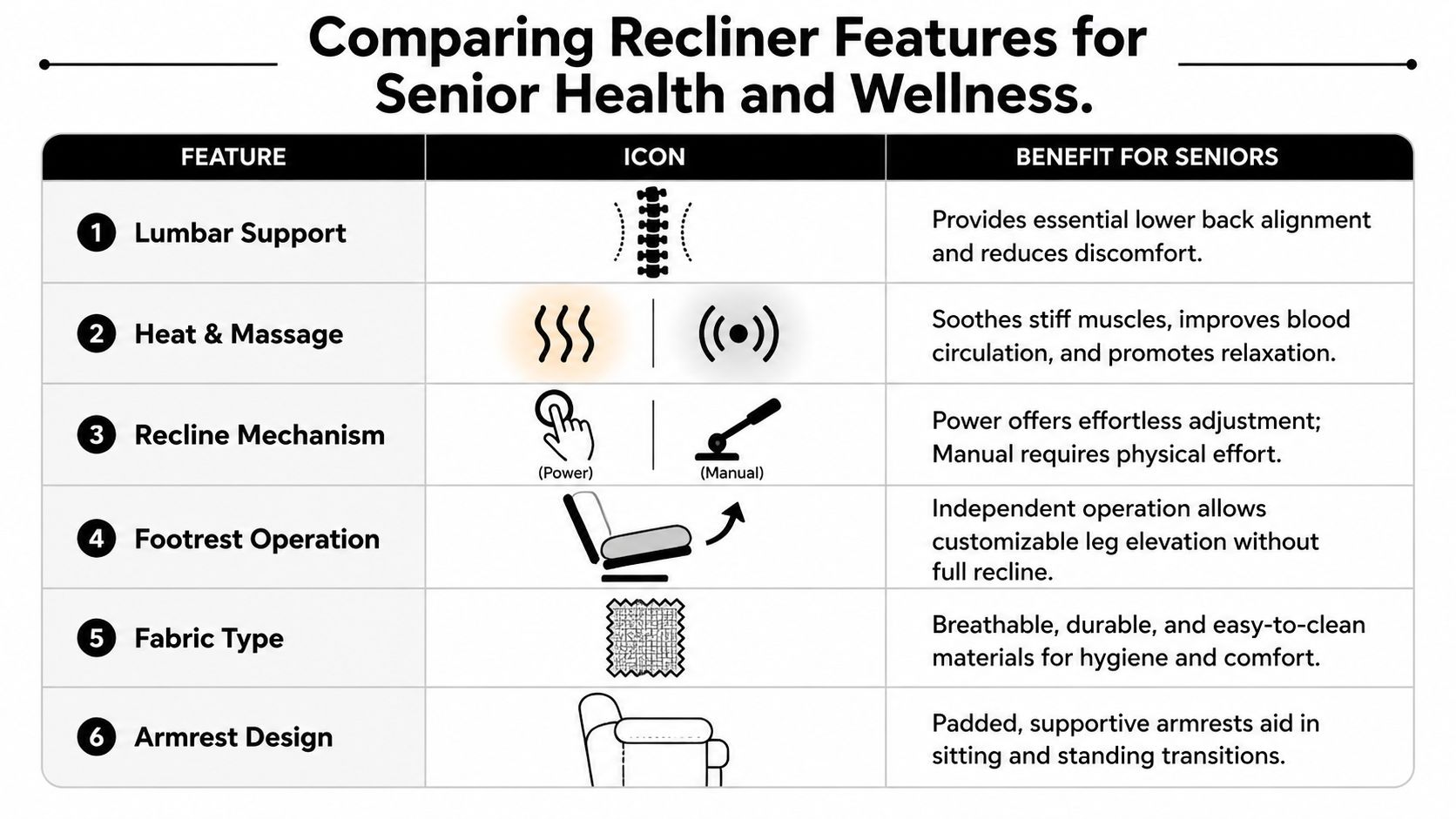
Comparing Recliner Features for Senior Health and Wellness
Features can help, but they can also distract. Cup holders and USB ports are nice. They aren’t what determine whether a chair supports a senior’s body well.
The features that matter most are the ones that affect posture, pressure relief, leg elevation, and ease of movement.
The feature list that actually matters
Here’s what we tell shoppers to focus on first:
| Feature | Why it matters | Best for |
|---|---|---|
| Adjustable lumbar support | Supports the lower back in seated and reclined positions | Back pain, long sitting sessions |
| Power headrest | Keeps the neck supported at different angles | Reading, TV, upright napping |
| Dual-motor control | Lets the back and footrest move independently | Swelling, recovery, precise positioning |
| Stable arm design | Gives push support when sitting down or standing up | Limited mobility |
| Easy-clean fabric | Simplifies daily maintenance | Caregiver households |
| Zero-gravity position | Helps reduce pressure and supports circulation | Arthritis, fatigue, leg discomfort |
Single motor versus dual motor
This is one of the biggest quality-of-life differences.
A single-motor recliner usually moves the back and footrest together. That can be fine for general relaxation. It’s simpler and often easier for shoppers who want fewer controls.
A dual-motor recliner gives separate control of the backrest and footrest. That’s the better setup for seniors with specific physical needs. Someone recovering from surgery may want legs raised without leaning too far back. Someone with back discomfort may want the opposite.
We’re opinionated here. If a senior has a medical or mobility issue, dual motor is usually worth it.
Fabric and surface feel
Upholstery affects more than appearance. It changes heat retention, ease of cleaning, and how easy it is to reposition in the seat.
A few practical patterns:
- Breathable fabric usually feels softer and less sticky for long sitting.
- Performance fabrics are easier for everyday cleanup and work well in busy households.
- Very slick surfaces can make some users feel less secure when shifting position.
The right choice depends on who’s using it. A senior living independently may prioritize feel. A caregiver may prioritize maintenance.
A useful model comparison
Some model comparisons are worth paying attention to because they explain how features affect real use.
The La-Z-Boy Pinnacle is known for its enclosed lift mechanism and supports 375 lbs, while the Pride Mobility VivaLift Escape offers a faster lift in under 8 seconds and high-density foam that can reduce pressure points by 25% in zero-gravity. Both also use quiet DC motors at under 45 dB and include adjustable lumbar support, according to this comparison of La-Z-Boy Pinnacle and Pride Mobility VivaLift Escape.
That tells us two things. First, not every premium chair excels in the same area. Second, the best recliner depends on whether the buyer values long-term durability, faster lift support, pressure relief, or a specific feel.
Matching features to medical needs
Shopping gets personal.
For arthritis, we like chairs with easy controls, smooth movement, and supportive lumbar. For post-surgery recovery, dual-motor positioning and stable armrests matter more. For general mobility challenges, a reliable lift mechanism usually outranks extra features.
Most buying guides don’t help enough here. If you want a broader framework for comparing motion, support, and upholstery, this ultimate recliner buying guide covers the decision points well.
Don’t pay for features you won’t use. Pay for the feature that solves the physical problem you deal with every day.
A few model-level opinions
We’d separate common senior recliner choices this way:
- La-Z-Boy lift models are often a smart fit for shoppers who want familiar styling and a durable lift system.
- Pride Mobility lift chairs make sense when mobility support is the top priority.
- Ashley power recliners, including models like the Yandel mentioned in senior recliner coverage, are appealing when buyers want power features and more living-room styling.
- MCombo and similar zero-gravity focused chairs can be worth considering for shoppers who prioritize leg elevation and position flexibility.
The right answer isn’t always the fanciest chair. It’s the one that fits the body, the condition, and the room.
Safety Accessibility and In-Home Placement
A recliner can be comfortable in the showroom and unsafe at home if the setup is wrong.
This part gets overlooked all the time. Then the chair arrives, the power cord runs across a walkway, the back hits the wall, and the user has to twist to get in and out. That’s avoidable.
Placement rules that matter
Start with the path to the chair, not just the space around it. A senior should be able to approach it without stepping around baskets, lamps, or side tables with sharp corners.
Keep these basics in mind:
- Leave room to recline fully: The chair needs clear space behind and in front.
- Protect the walking path: Don’t let the footrest extend into a common route through the room.
- Manage the cord carefully: Power cords should be routed out of the way, never across open floor traffic.
- Give the chair a stable landing zone: It should sit level on the floor without rocking.
Accessibility isn’t just about the chair
The best setup looks at the whole room. If someone is dealing with mobility changes, the recliner is only one piece of a safer home.
For families thinking beyond seating, this guide to walk in shower for seniors is a useful resource because it shows how comfort and fall prevention often work best when several everyday spaces are improved together.
Why professional setup is worth it
This is one of those purchases where delivery service matters more than people expect.
A boxed recliner left at the front door doesn’t solve anything. Professional in-home setup does. The right team places the chair where it works best, assembles it correctly, checks the motion, and removes the packaging so the room is safe from day one.
That matters most for lift recliners and larger power models. The chair needs to be positioned so the user can enter, recline, and stand without bumping walls or furniture.
A senior recliner should reduce obstacles, not introduce new ones. If placement makes the room harder to move through, the setup needs to change.
White-glove delivery is valuable because it removes guesswork. The chair ends up where it belongs, fully assembled, tested, and ready to use.
Experience the Gates Difference in Southern Oregon
Families still want local guidance for this purchase, and they should. A senior recliner is too personal to treat like a commodity.
We’ve served Southern Oregon since 1946, when George Gates Jr. built this business around Service and Value. That promise still shapes how we help customers in Grants Pass, Medford, Ashland, Central Point, and throughout the Rogue Valley.

Why local guidance beats generic shopping lists
Most online guides miss how to select recliners for specific medical conditions. They focus on generic features and leave seniors without enough guidance on how dual-motor recliners can help with post-surgery circulation needs or how firmer lumbar support can help with arthritis, which is the gap noted in this discussion of lift chair buying guidance and condition-specific selection.
That’s why in-person help matters. A senior with hand pain needs different controls than someone recovering from a hip procedure. A caregiver may need a fabric that cleans easily. A tall user may need a longer footrest and a higher back. Those details don’t show up well on a thumbnail image.
What people find when they visit
Our 30,000 sq. ft. showroom in Grants Pass gives shoppers room to compare recliners from names people already know, including La-Z-Boy, Flexsteel, Ashley, and Beautyrest across the store. People also find our Unique Finds, including reclaimed wood and teak pieces, if they’re furnishing more than one room at the same time.
We also make the buying process easier with Gates Easy Pay, including $0 down, 6-month interest-free, and no-credit-needed options. And our white-glove delivery team handles professional assembly and setup instead of dropping boxes at the curb. For longer-term peace of mind, there’s also the Gates Care Shield protection plan.
For families planning broader accessibility improvements, this guide to aging in place home modifications is worth reviewing alongside recliner shopping because the best results often come from combining better seating with safer layout and home access.
One practical option for local shoppers is Gates Home Furnishings, which offers recliners and lift chairs in Southern Oregon along with in-store testing, delivery, assembly, and financing.
Frequently Asked Questions About Senior Recliners
Is it okay for a senior to sleep in a recliner?
For many seniors, yes. A modern recliner can be a practical resting place for naps or even longer overnight use if it supports the head, back, and legs properly. This is especially helpful for people who feel more comfortable sleeping slightly upright or who want to avoid frequent bed transfers.
The key is support. If the recliner doesn’t keep the neck aligned or puts pressure on the lower back, it won’t stay comfortable through the night.
What happens during white-glove delivery?
A good white-glove team does more than bring the chair to the house. They place it in the room, assemble it, test the power functions, and remove the packing materials so the space is usable right away.
That matters a lot with senior recliners. Large power chairs can be awkward to move, and lift chairs need to be positioned carefully for safe entry, exit, and full motion.
How does financing usually work?
Flexible financing can make a higher-quality recliner easier to buy without settling for the wrong chair. At our store, Gates Easy Pay includes $0 down, 6 equal payments, 6-month interest-free options, and no-credit-needed financing choices.
That gives families room to choose the chair that fits the person instead of only the chair that fits the moment’s budget.
Should I buy online or test in person?
For senior recliners, test in person if you can. Fit, seat height, arm support, and control simplicity are all easier to judge in real life than on a product page.
That’s especially true for seniors with arthritis, mobility limitations, or recovery needs. This is one furniture purchase where five minutes in the chair can tell you more than fifty photos.
If you’re looking for the most comfortable recliner for seniors, we’d love to help you narrow it down in person. Visit our Gates Home Furnishings showroom in Grants Pass to test lift chairs and recliners side by side, or browse our collection online from anywhere in Southern Oregon.