Latex Mattress vs Memory Foam: A Local Buyer Guide

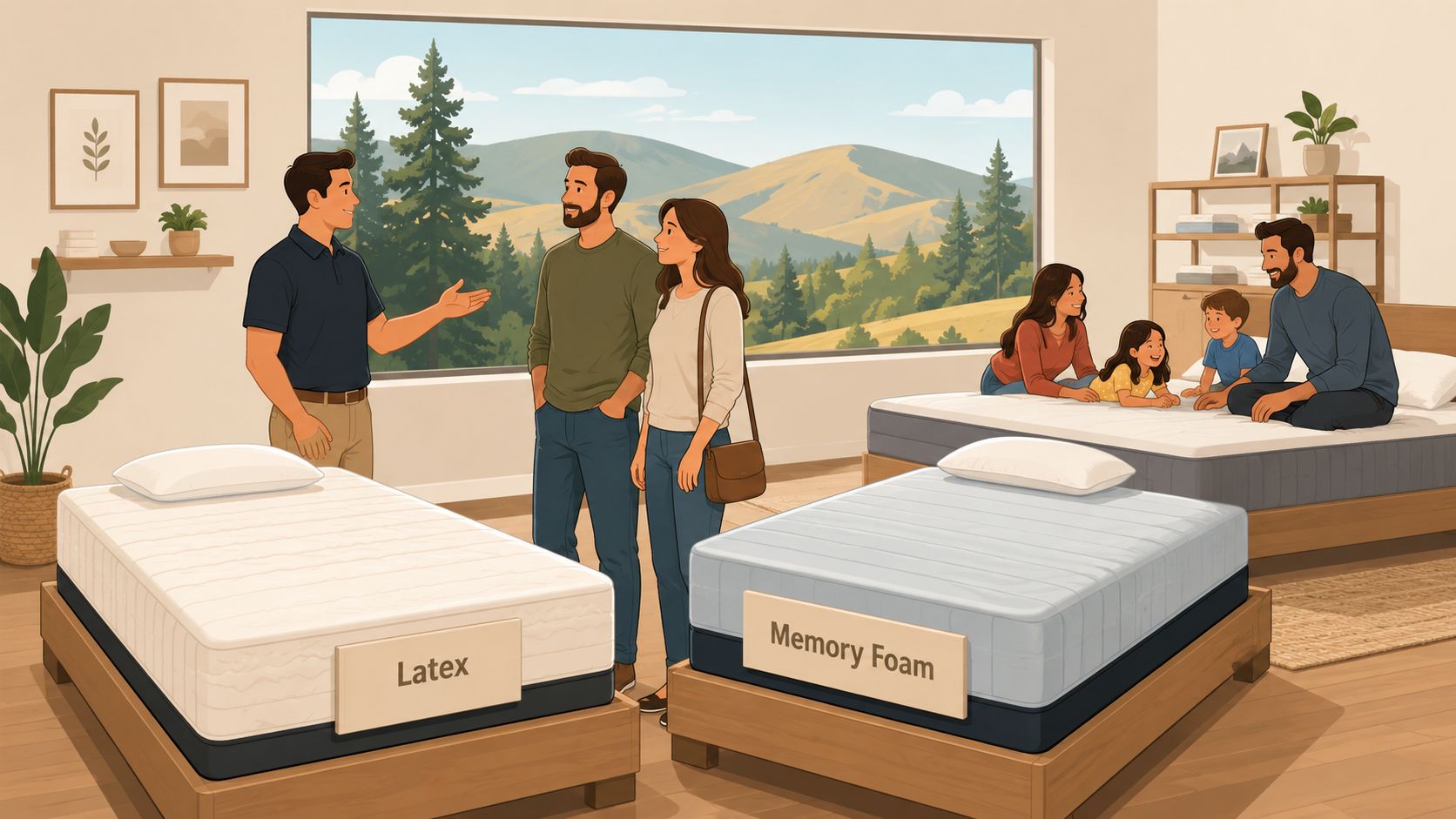
You're standing on the showroom floor in Grants Pass, one hand on a mattress that feels cloud-soft, the other on one that feels firmer and cooler. One bed hugs you right away, the other pushes back with a little lift, and both seem to solve part of the problem. That's the latex mattress vs memory foam decision for most Rogue Valley shoppers, not a theory exercise, but a question about which bed will work on school nights, hot August nights, and the mornings after a long drive down Highway 199.
At Gates Home Furnishings, we hear the same back-and-forth from families from Medford, Central Point, Ashland, and right here in Grants Pass. Since Est. 1946, we've kept George Gates' promise of Service and Value, and that still matters when someone is trying to replace a worn-out bed without making the wrong call. The right choice usually comes down to feel, heat, motion, and how long the mattress keeps doing its job, not just what sounds good online.
| Decision Point | Latex Mattress | Memory Foam |
|---|---|---|
| Cooling | Better for hot sleepers | Better for sleepers who like a warmer, cocooned feel |
| Responsiveness | Faster, easier to move on | Slower, more enveloping |
| Motion Isolation | Good, but less still | Stronger for couples |
| Durability | Usually the longer-lasting option | Usually the lower upfront-cost option |
If a mattress shopping trip is overdue, start by checking our guide to supporting local businesses and then come in ready to test both feels with clear expectations.
Why Southern Oregon Shoppers Are Asking This Question Right Now
A couple walks into the Grants Pass showroom and one of them says, “I sleep hot, but my shoulder hurts on the side I favor.” The other says, “I just don't want to feel every toss and turn.” That's the exact kind of split opinion that keeps latex mattress vs memory foam at the top of the conversation on our floor.
Southern Oregon shoppers tend to ask sharper questions because the use cases are real. A mattress here might need to handle warm summer nights in Ashland, a guest room in Central Point, or a couple in Medford with different temperature preferences. The bed also has to hold up to years of actual family life, not just a few minutes of showroom comfort.
What makes this comparison different from the usual mattress talk is that the old labels don't help much anymore. Buyers aren't just choosing between “soft” and “firm.” They're deciding whether they want a cooler, quicker-recovery surface or a deeper, stiller cradle that quiets movement for a partner.
Practical rule: if the mattress has to serve two sleepers with different needs, the conversation should start with heat and movement, not just plushness.
That's why our floor at 30,000 sq. ft. in Grants Pass works so well for this topic. People can test a latex feel, then lie down on memory foam and notice the difference right away, instead of guessing from a product page. The same visit usually sparks a broader home conversation too, because shoppers often notice our Unique Finds, including reclaimed wood, teak, and one-of-a-kind statement pieces that you just don't see in a big-box aisle.
How Latex and Memory Foam Are Built and Why It Matters
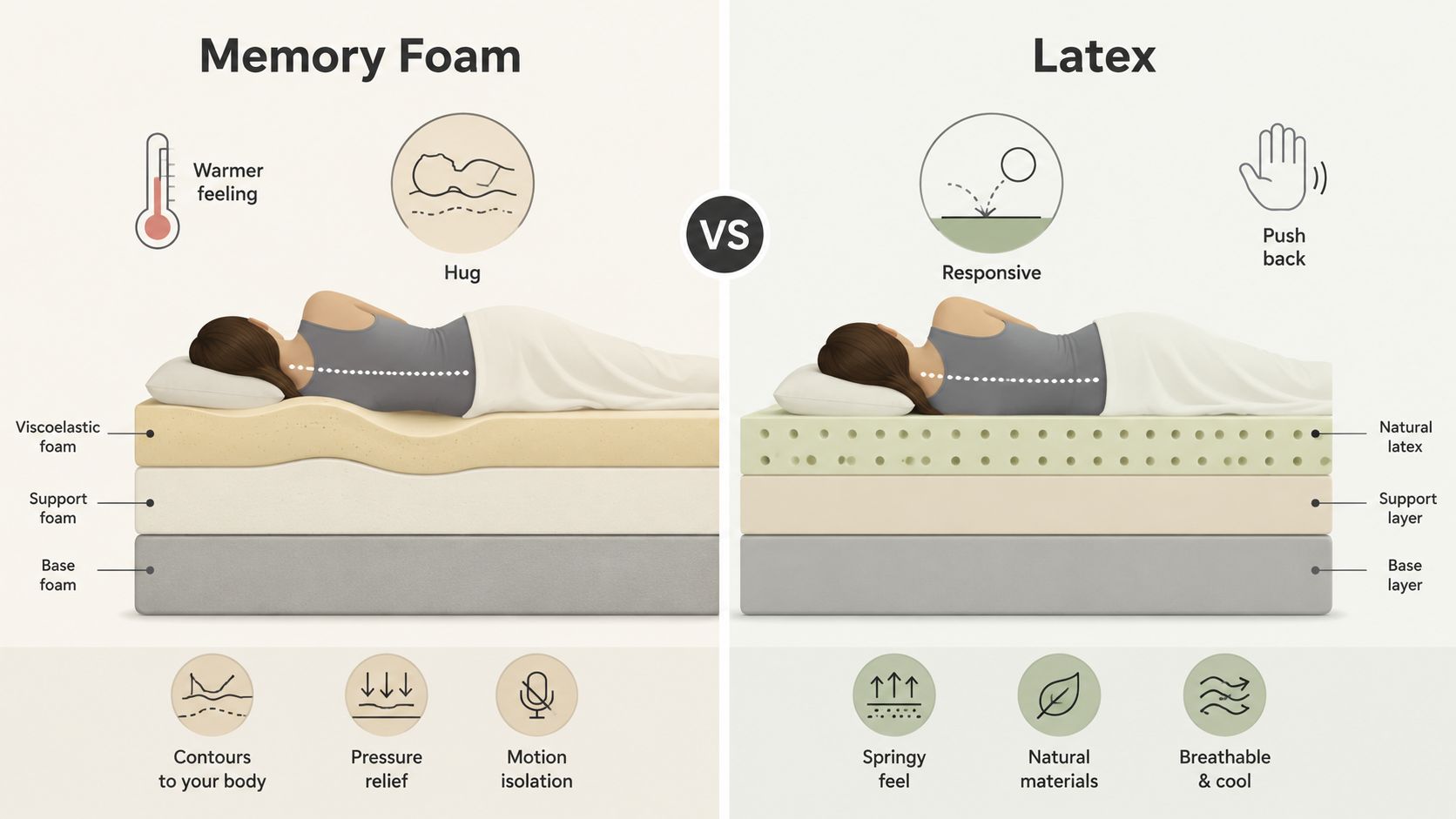
The material story explains the feel story. Memory foam is a polyurethane-based viscoelastic foam, which means it softens with body heat and slowly conforms around pressure points. Latex can come from natural rubber tree sap, synthetic materials, or a blend, and it tends to push back more quickly when weight comes off it.
That difference shows up the moment someone lies down. Memory foam feels like a slow, warm handshake, while latex feels more like a supportive porch seat that lifts back instead of swallowing you in. One is designed to absorb shape and motion, the other is designed to spring back and keep you moving.
Why the source material changes the sleep experience
Latex made from natural rubber tends to feel more breathable and resilient, while memory foam's viscoelastic structure creates that close, body-hugging sensation many side sleepers love. In practical showroom terms, latex usually feels a bit livelier under a hand press, and memory foam feels slower to recover after you change position.
If a bed feels instantly movable and airy, latex is usually behind that feel. If it feels like your body sinks in and stays there for a second, memory foam is doing its job.
That matters in Southern Oregon because sleepers here aren't buying a chemistry lesson, they're buying comfort in a climate that can run warm and dry. For shoppers who want more detail on the construction side, our memory foam mattress guide gives a plain-language breakdown of the material itself.
Construction also affects smell, weight, and how the mattress ages. Natural latex often has a more organic reputation, while memory foam is built from synthetic ingredients and additional chemicals. That's why two mattresses can both be called “foam” and still feel wildly different after five minutes on the bed.
Feel, Cooling, Bounce, and Motion Transfer Compared
In showroom tests, latex usually comes out ahead on cooling and responsiveness, while memory foam does better on motion isolation. Latex also shows a much bigger rebound, which is why it feels springier under a live body and easier to move on. Memory foam recovers more slowly, so it gives that quieter, more settled surface couples often prefer.
| Performance Area | Latex Score | Memory Foam Score | What It Feels Like |
|---|---|---|---|
| Cooling | 9.2 | 8.2 | Latex feels airier and less heat-trapping |
| Responsiveness | 10.0 | 8.1 | Latex rebounds faster when you move |
| Motion Transfer | 7.5 | 9.2 | Memory foam keeps the surface steadier for partners |
What those numbers mean at 2 a.m.
Cooling is the first thing hot sleepers notice. Latex usually feels less stifling because it lets more air move through the comfort layers and does not hang onto body heat as much. Memory foam can still feel comfortable, but it is more likely to create that tucked-in, enclosed feel some people like and others reject fast.
Responsiveness is the other big split. That higher bounce figure for latex matches what you feel in person, a quicker return when you roll, sit up, or shift from back to side. Memory foam moves more slowly, which gives it the deep, settled feel many buyers want, especially if they do not change positions much during the night.
Motion transfer is where memory foam has the edge. If one partner gets up often or tosses through the night, the bed keeps movement more contained. Couples who are easily disturbed usually notice that difference right away, and it can matter more than feel on the first sit. For shoppers sorting out a hotter sleep setup, our hot sleeper mattress guide fits this comparison well.
Hot Side Sleepers and Pressure Relief at the Same Time
This is the hardest version of the mattress question, and it's the one we hear most often. A side sleeper wants the shoulder and hip to sink just enough, but a hot sleeper doesn't want to roast while getting that pressure relief. That combination doesn't always land cleanly on one material.
Latex usually wins on temperature control and responsiveness. It gives more lift, more airflow, and less of the stuck-in-place feeling that can bother people who shift during the night. Memory foam usually wins on deeper contouring and that cradled, pressure-point feel that can calm sore shoulders and hips, especially for a strict side sleeper.
How to test the trade-off in person
A few minutes in the showroom can tell a lot if the sleeper tests with purpose.
- Lie on the side first: Pay attention to whether the shoulder feels cushioned or jammed upward.
- Stay still for a minute: Memory foam reveals its contouring more slowly, while latex shows its response right away.
- Roll once or twice: If movement feels too effortful, the mattress may be too sinky for that sleeper.
- Check the top layer firmness: A softer comfort layer over latex can change the whole result.
A mattress doesn't need to be all one thing. A well-built latex bed with a softer top can feel far less rigid than people expect, and that can narrow the gap for a hot side sleeper.
For shoppers dealing with pain patterns, that same pressure discussion matters off the mattress too. A useful outside reference on pelvic pain treatment after sleeping can help frame why pressure points wake people up in the first place. For mattress selection, our pressure relief guide is the better fit if the main issue is shoulder or hip comfort.
Durability, Lifespan, and Real Cost Over Time
Latex usually makes the stronger buy if you care about how long the mattress stays usable. Industry guides commonly place natural latex mattresses in the 15 to 20 years or more range, while memory foam is usually closer to 7 to 10 years. Some comparisons stretch memory foam to 8 to 12 years and premium latex to 25 years, but the direction stays the same, latex holds up longer. Saatva's latex vs memory foam comparison lays out that lifespan gap plainly.
Sleep Foundation's mattress guidance points the same way and also shows why foam quality matters so much. It places latex ahead on useful life, with latex around 7.5 to 8.5 years versus 6 to 7 years for memory foam on average, and it notes that density changes durability a lot. Low-density memory foam under 2.5 lb/ft³ is often tied to 4 to 6 years, medium-density foam to 7 to 10 years, and high-density foam to 10 to 15 years. Sleep Foundation's latex and memory foam breakdown is a good reminder that the foam inside the bed matters more than the label on the tag.
What that means for value
The sticker price can fool people. One comparison in the source set puts a latex mattress at $2,500 lasting 15 years, which works out cheaper per year than a $1,200 memory foam mattress lasting 8 years. Another comparison puts long-run cost at about $66 per year for latex versus $143 per year for memory foam once service life is included.
That is the part many Rogue Valley shoppers miss in the showroom. A lower upfront price helps only if the bed keeps its shape, support, and comfort long enough to justify the savings. Under heavier bodies, couple use, and a lot of edge sitting, latex usually resists impressions and sagging better. Memory foam can feel excellent at first, then show body impressions sooner if the build quality is modest or one area takes repeated stress.
If a mattress starts to dip in the center, lose edge support, or feel uneven through the shoulder and hip zones, it is usually telling you it is wearing out. For care that can stretch useful life, our mattress maintenance guide is worth a look before replacement becomes urgent.
Matching the Mattress to the Sleeper
The right answer changes fast once you stop talking about mattresses in general and start talking about real people. A couple with different temperature needs usually has a better shot with the cooler sleeper's comfort taken seriously first, because heat complaints tend to ruin more nights than firmness complaints. That is why latex usually gets the nod in these mixed-temperature beds, since it sleeps cooler and responds more quickly under the body.
Hot sleepers are the clearest latex fit. Combination sleepers who change position often fit there too, and many heavier sleepers prefer a bed that stays supportive instead of sinking too far. Memory foam makes more sense for sleepers who want a slower, deeper hug and stronger motion isolation, especially when one partner keeps moving after lights out.
Who should try what first
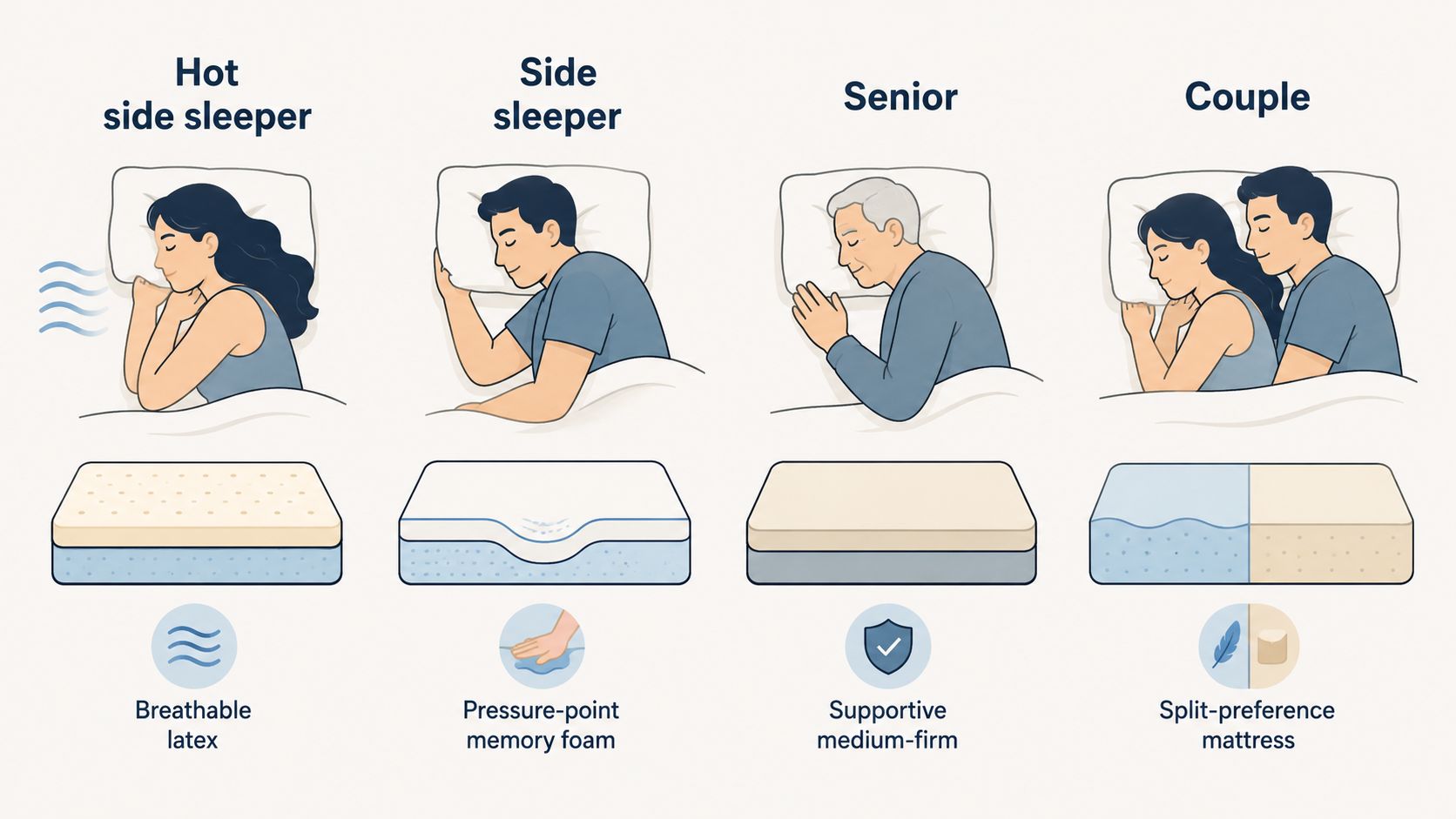
- Hot side sleepers: Start with latex, then compare a softer memory foam if pressure relief still feels short.
- Couples with different sleep styles: Start with memory foam if motion is the top complaint, then test latex to see whether cooling matters more.
- Seniors who want easier movement: Try latex first, because the quicker recovery makes turning and getting out of bed feel less effortful.
- Guest rooms: Memory foam often makes sense when a still, familiar feel matters more than long-term durability.
- Allergy-sensitive shoppers: Natural latex is often the better starting point because it resists dust mites and mold better than many foam builds.
For mattresses used by kids, the decision usually comes down to a simple choice between lower entry cost and longer service life. For guest rooms, a comfortable memory foam bed can be perfectly reasonable if the room won't see daily use. For any sleeper who wants to understand body support in a broader sleep context, the air bed spine health guide is a useful contrast, even though the bed type is different.
One practical note from our sleep gallery floor, we match sleep profiles to actual models instead of abstract categories. Well-known mattress brands help with that process, but the core job is matching how a bed feels to how a person sleeps, not chasing a label on the tag.
Your Local Buying Checklist for Grants Pass and the Rogue Valley
A mattress should be tested like you mean it. Wear something comfortable, lie down in your usual sleep position, and give each bed enough time to show what it does after the first 30 seconds. A lot of shoppers in Grants Pass, Medford, Central Point, and Ashland rush the decision because the bed feels good right away, then discover the issue later at home.
What to ask before buying
- Trial terms: Ask how long the comfort exchange window lasts and what condition the mattress must be in.
- Warranty language: Read what counts as a body impression versus normal settling.
- Setup details: Confirm whether the mattress includes assembly and old-bed removal.
- Base compatibility: Make sure the mattress works with the frame or adjustable base already in the home.
- Firmness swap options: If one sleeper is unsure, ask what happens if the feel is wrong after a few nights.
Budget should never block a better night's sleep. Gates Easy Pay offers $0 down, 6-month interest-free options, and no-credit-needed financing, so the question becomes fit, not just price. That matters when a worn-out mattress has to be replaced now, not six months from now.
Ask about haul-away before delivery day. A mattress that has to be carried down stairs or out of a tight upstairs room is a different job than a simple drop-off.
That's where white-glove service earns its keep. Professional assembly, in-home setup, and mattress haul-away save a lot of hassle, especially when replacing an older bed in a narrow hallway or upstairs room. Our team built that kind of support around the same Service and Value promise that started in 1946, because the sale shouldn't be the hard part.
Our Recommendation and How to Take the Next Step
Here's the blunt version. If the sleeper runs hot, changes positions often, or wants a longer-lasting mattress, latex is usually the smarter call. If the sleeper needs the strongest motion isolation, likes a deeper sink, or wants a lower entry price, memory foam is often the better fit.
There's still room for a hybrid in the middle, especially when a shopper wants a split of support and contouring. But for most couples and families walking into our showroom, the answer comes from body type, heat, and how the bed feels after a few honest minutes, not from a label on the tag.
We've spent decades helping Southern Oregon families sort out exactly that kind of decision, and the floor test still beats guesswork every time. Visit our 30,000-square-foot showroom in Grants Pass to try both feels side by side, or start from home if browsing first makes more sense.
Visit Gates Home Furnishings for mattresses, white-glove delivery, and flexible financing that fit real Southern Oregon budgets. We'll help you compare latex and memory foam the way it should be done, with straight answers, careful testing, and the kind of service George Gates promised back in 1946.