Financing Through Dealership: A Plain 2026 Guide


A Grants Pass household has found a sectional that fits the living room and a mattress that finally feels supportive. The remaining question isn't about fabric or firmness. It's whether taking the furniture home means arranging a bank loan first, accepting the payment on the screen, or asking more questions before signing.
Financing through a dealership is a way to arrange payment, not a reason to skip comparison shopping. A quick approval isn't complete until the shopper knows who holds the account, how interest works, and whether the scheduled payments will clear the balance.
What Financing Through a Dealership Means
Consider a household standing beside a La-Z-Boy sectional and a Beautyrest mattress in Gates' 30,000-square-foot Grants Pass showroom. Both pieces feel right, but paying for everything at once would leave too little for moving expenses. The household asks whether a bank must approve a loan before the purchase can proceed.
Dealership-arranged financing means the seller collects an application and submits it to one or more finance partners. The shopper doesn't have to arrange the credit independently, but the lender named in the agreement, rather than the salesperson, controls the credit account. That distinction matters when a payment question or billing error comes up.
The dealer counter and the lender aren't the same
The familiar car-lot model helps explain the arrangement. In the first half of 2023, approximately 80% of new-vehicle sales and 38% of used-vehicle sales in the United States were financed through a loan or lease, according to the Federal Reserve's consumer financing discussion.
Those are automobile figures, not furniture figures. The useful comparison is the process: a seller helps connect a large purchase with a lender and a repayment schedule.
That's different from buy-here, pay-here, where the dealer originates and services the loan itself. A furniture financing agreement might instead involve a finance company, card issuer, or lessor. The business collecting the monthly payment should be unmistakable before the shopper signs.

What a useful explanation includes
For sofas, bedroom sets, dining tables, and mattresses, the practical questions stay much the same:
- Payment amount: What must leave the household budget each billing period?
- Promotional deadline: On what date must the promotional balance reach zero?
- Total repayment: What will the furniture cost after finance charges and fees?
- Late-payment consequences: What changes if a payment arrives late or is returned?
George Gates founded the business in 1946 with a promise of “Service and Value.” Applied to financing, that philosophy means explaining the obligation as carefully as the furniture. A comfortable sectional shouldn't come with an uncomfortable surprise in the paperwork.
Counter rule: An approval message isn't a substitute for a readable repayment agreement.
How Dealership Financing Compares With Other Ways to Pay
| Path | Who holds the account | Cost signal to compare | Ownership | Fits when |
|---|---|---|---|---|
| Dealership-arranged installment | Finance partner receiving the application | APR, promotional conditions, and total repayment | Usually at delivery, subject to any security interest | The application is convenient and the payoff schedule fits |
| Bank or credit union loan | The bank or credit union | Quoted APR, fees, and total repayment | Furniture is purchased with loan proceeds | The shopper can compare a direct loan before visiting |
| Credit card | Card issuer | Purchase APR and promotional expiration terms | At purchase | The balance can be cleared without carrying expensive debt |
| Lease-to-own or rent-to-own | Lessor | Total scheduled lease cost and purchase-option terms | After contractual ownership conditions are met | The household accepts the full cost and timing of ownership |
| No-credit-needed program | Named finance partner or lessor | Fees, total cost, and reporting practices | At purchase for a purchase contract; after required payments for a lease | Credit access is limited but the obligation remains affordable |
Compare the account, not just the payment
Dealership-arranged installments can simplify the application process. Convenience has value, particularly when the furniture is needed for a move, but it doesn't establish that the offer is the least expensive choice. The shopper should compare the approved agreement with the cash price and any direct-loan quote.
A bank or credit union loan is worth pricing before visiting. For context, the auto-financing comparison summarized in CFPB guidance on buy-here, pay-here lending describes borrowers with scores of 620 or below receiving roughly 15% to 20% rates from auto finance companies and buy-here, pay-here dealers, compared with approximately 10% at banks and credit unions. These aren't furniture quotes or promised rates, but they illustrate why broader access can come at a higher price.
A credit card means dealing with the card issuer. Existing available credit can make checkout easy, yet the purchase still needs a payoff plan. Adding furniture to a card that already carries a balance also makes it harder to see what the household owes for the new purchase alone.
Access and ownership deserve separate questions
With lease-to-own, receiving the furniture doesn't necessarily mean owning it. The agreement should identify the total scheduled payments, any purchase option, and what happens if the customer ends the lease early. Gates' rent-to-own furniture guide helps shoppers frame those questions before accepting a lease.
No-credit-needed describes an application pathway, not a standard price or ownership arrangement. Some programs are leases; others use a different contract structure. The agreement, not the label, determines the obligation.
Credit reporting also deserves a direct question. Some sellers may report negative payments without consistently reporting positive ones, so shoppers shouldn't assume that paying on time will build their credit history.
The practical verdict: use a promotion only when its payoff deadline fits the budget. Otherwise, price a personal loan or consider paying cash for a Gates Outlet piece.
Tips to Improve Approval Odds
Approval depends on what the lender can verify, not on a score alone. Preparation helps the lender assess the application, but it doesn't guarantee acceptance.
- Review credit reports. Check each bureau's report and dispute documented errors, such as an account incorrectly shown as open.
- Gather income records. Recent pay stubs, benefit letters, or bank statements should support the income entered.
- Match identifying details. Use a consistent name, address, and phone number, supported by photo identification and a recent utility bill.
- Keep the purchase realistic. A modest sofa purchase creates a smaller repayment request than furnishing an entire bedroom at once.
- Reduce card balances when possible. High revolving balances can weigh on a credit application.
- Ask about submission. Before applying, establish which partners will receive the application and whether a credit inquiry is involved.
- Request a written explanation. Ask what conditions remain and, after a denial, what information supports the decision.
Preparation after a credit setback
For households with a repossession history, Superior Credit Repair's resource on how to prepare for auto financing after repossession offers related preparation context. Furniture programs have their own criteria, so no outside checklist should be treated as an approval promise.
How to Apply and What Approval Actually Covers
A financing application should describe the purchase the household intends to make, not an incomplete version that becomes more expensive at signing. Selecting the furniture and building an itemized quote first makes the approval easier to evaluate.
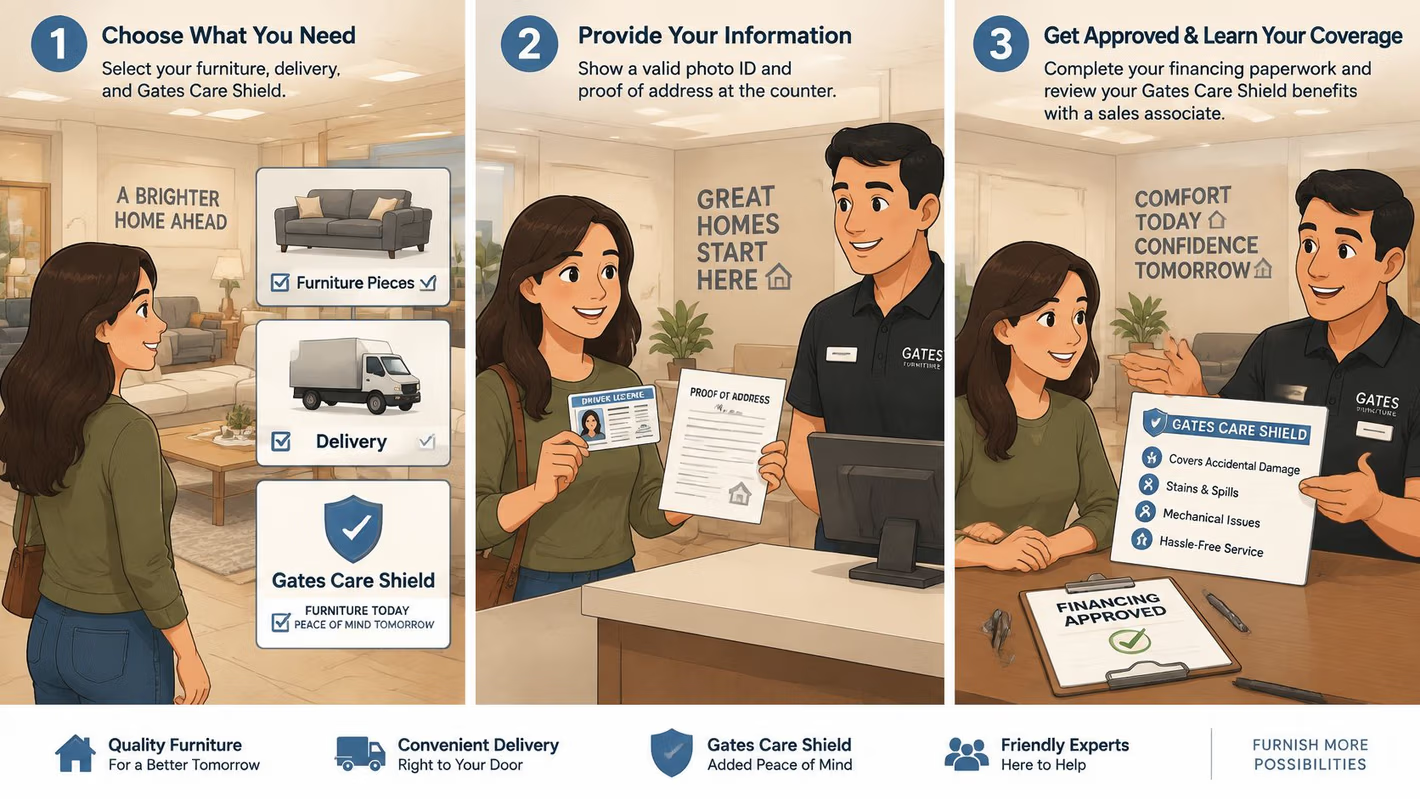
Follow the application in order
- Choose the pieces and build the quote. Include requested delivery and any optional Gates Care Shield coverage. A special-order Flexsteel sofa or Ashley bedroom group requires an accurate purchase total, just like an in-stock piece.
- Bring verifiable information. Photo identification, the current address, and explainable income figures help the partner assess the request. Applicants from Grants Pass, Medford, Central Point, Ashland, and elsewhere in the Rogue Valley should use their actual current residence.
- Name the application path. Ask whether the request is for an installment account, promotional financing, or a no-credit-needed lease. Similar-looking monthly payments can represent different contracts.
- Submit through the intended channel. Applications can begin in the showroom or through online-only financing for a private answer before the drive. Avoid submitting another application because the first result needs explanation.
- Read the approval itself. Locate the creditor or lessor, amount financed, APR or deferred-interest wording, payment schedule, and payoff date. The mattress financing options guide can help frame questions for a mattress purchase.
- Match approval to quote. A same-day acceptance isn't enough if the approved purchase amount, selected pieces, or repayment terms differ from the written estimate.
- Confirm service before signing. Requested white-glove delivery, professional assembly, and mattress haul-away should appear in the order documentation, along with applicable charges and service conditions.
Understand a conditional approval
A conditional approval means something still needs confirmation. The partner might need income verification, identity documents, or an updated purchase amount. Adding delivery, optional coverage, or applicable charges can change the amount requested and may require another review.
A customer shouldn't interpret a provisional amount as permission to enlarge the order without checking the payment again. The written agreement must match the final purchase.
The useful approval is the one tied to the actual furniture, actual services, and actual repayment obligation.
Before accepting the monthly figure on a screen, the household should calculate the payment needed to meet the promotional deadline. The contractual minimum and the amount needed for timely payoff aren't necessarily the same.
Sample Payments for Six-Month Furniture Offers
True 0% APR and no interest if paid in full aren't interchangeable. A genuine zero-interest promotional period doesn't impose interest attributable to that period, while a deferred-interest offer can accrue interest from the purchase date and waive it only after timely full repayment; the CFPB's promotional financing explanation notes that non-promotional rates on these offers are generally around 25%.
Sample six-payment furniture tickets
The examples below are hypothetical purchase balances, not advertised furniture prices. Each equal payment is the amount financed divided by six, assuming no additional financed charges.
| Example ticket | Amount financed | Six equal payments | Safer target | If a balance remains on a deferred offer |
|---|---|---|---|---|
| Sofa or sectional | $1,200 | $200 | $200 plus a small timing buffer | Accrued interest can be added |
| Bedroom set | $2,400 | $400 | Above $400 if charges increase the financed balance | The agreement's non-promotional rate applies |
| Mattress set | $3,000 | $500 | $500 plus any added financed charges divided across the schedule | The minimum payment may not retire the balance in time |
| Recliner, such as a Flexsteel model | $900 | $150 | $150 before any separate fee | The same deferred-interest rule applies if specified |
The calculation is simple; applying it to the right balance takes care. A bedroom set's price tag isn't necessarily the amount financed if the customer adds delivery or optional coverage. The calculation should start with the final financed balance, not the display price.
The minimum isn't the payoff plan
Under the CFPB's repayment-disclosure rules, deferred-interest repayment disclosures must account for whether minimum payments will eliminate the balance before the promotion expires. When they won't, the estimate must reflect the possibility of accrued interest.
That makes the smallest number on a statement a poor planning shortcut. A shopper can satisfy a monthly minimum yet still miss the deadline for eliminating the promotional balance.
A workable payoff worksheet records:
- Final financed balance: Include every charge placed on the account.
- Equal-payment target: Divide that balance by the promotional months.
- Exact expiration date: Record the date from the agreement, not an estimated anniversary.
- Payment timing: Allow time for processing and verify the payment posted.
- Remaining balance: Check statements and confirm the final payoff rather than assuming automatic payments finished it.
Payment safeguard: Schedule the final payoff early enough to resolve a returned or misapplied payment before the promotion expires.
Gates' no-interest furniture financing guide gives shoppers a place to begin asking about promotional terms. The signed agreement still determines which offer applies.
A household that can't sustain the calculated payment should reduce the purchase before signing. Hoping that a future refund or extra work shift will cover the remaining balance isn't the same as having room in the current budget.
When Approval Is Denied or the Payment Does Not Fit
A fast yes isn't necessarily the safest outcome. A clear denial, an understandable condition, or a decision to buy less can protect a household better than an approval with unclear costs.
A denial or conditional approval
Before placing a deposit, ask whether it is refundable if financing fails and obtain the answer in writing. After a denial, request the reason and establish whether a different proposal would involve a new application or a different contract.
The CFPB's annual complaint report recorded approximately 28,500 vehicle-loan or lease complaints in 2025, with 74% sent to companies for review, and described complaints involving missing disclosures and deposits after credit denials. Those are vehicle-financing complaints, not furniture statistics, but they underline the importance of documented terms.
Delivery shouldn't proceed on an agreement the customer hasn't reread and accepted.
Terms that change after the visit
A replacement document deserves a fresh comparison, even when the explanation sounds minor. Check the creditor, payment amount, promotional expiration, and late-fee provision against the original quote before scheduling the truck.
The pre-signing check should include:
- Creditor or lessor: The legal business responsible for the account.
- Total cost: Total repayment or scheduled lease cost, not just the furniture price.
- Promotion expiration: The contractual payoff deadline.
- Late-payment result: Fees, interest consequences, and any default provisions.
- Cancellation terms: What can be canceled, when, and at what cost.
- Error contact: The party and procedure for disputing an incorrect charge.
A payment that doesn't fit
The affordability test belongs beside rent, utilities, groceries, and transportation. If the required payment leaves no room for an unexpected bill, a smaller Ashley piece, an outlet purchase, or waiting may be the sounder decision.
The Federal Reserve's household borrowing report placed household consumer credit at approximately $4.998 trillion in 2025 Q2. That national total doesn't determine a Rogue Valley household's budget; the useful response is to borrow only what the household can comfortably repay.
Gates' guide to buying furniture with bad credit can support a more deliberate choice. Paying cash for one room or choosing a Gates Outlet piece is a clear fallback, not a failed shopping trip.
Gates Easy Pay for Southern Oregon Shoppers
Gates Easy Pay provides choices within the same decision process as a direct loan, card purchase, or cash purchase. Its options include $0 down and six equal payments, promotional no-interest arrangements when the balance is paid within the stated period, and no-credit-needed or lease-to-own programs. Eligibility and the written agreement determine which terms apply.
A six-month interest-free description should always be read alongside the contract's precise wording. The shopper needs to establish whether the offer is a true promotional APR or a paid-in-full deferred-interest arrangement before accepting it.
Start with the complete purchase amount
Zero down changes the timing of the initial cash payment; it doesn't erase delivery charges or optional products. The CFPB's closed-end credit disclosure framework addresses the amount financed and repayment disclosures, helping customers evaluate the actual obligation.
For a hypothetical $1,200 balance, six equal installments would be $200 each before separately disclosed fees or finance charges. That illustration applies only when the balance and schedule match those assumptions.
Optional Gates Care Shield coverage for accidental spills and tears should be separately identified if selected. The customer should understand its terms and see its cost in the financed amount rather than discovering it inside an unexplained total.
Test comfort before committing to payments
The Grants Pass showroom offers a practical stop for shoppers traveling from Medford, Central Point, Ashland, and across Southern Oregon. A recliner or lift chair should be tested for seat depth, support, and ease of use before the household commits to financing it.
The floor includes La-Z-Boy, Flexsteel, Ashley, and Beautyrest, alongside Unique Finds in reclaimed wood and teak. These one-of-a-kind statement pieces deserve the same affordability check as a mattress or sofa. Financing shouldn't turn a distinctive find into a purchase the household can't sustain.
Delivery also belongs in the decision:
- Professional assembly: Confirm the setup requested for the selected pieces.
- Mattress haul-away: Include the requested service in the order.
- Written charges: Make the service cost visible before accepting the financed total.
White-glove delivery means more than dropping boxes at the curb. The order should describe the work the delivery team will perform.
The Gates Easy Pay options also include an online-only application pathway for shoppers who prefer to start privately from home. The purpose is preparation, not pressure to sign before testing comfort.
Decide What to Sign Before You Visit
Accept the dealership plan when the payoff schedule fits the household budget and the contract describes an obligation the shopper understands. Wait, reduce the purchase, or compare a credit union loan when the only approval carries an uncomfortable total cost or the proposed payment won't clear a promotional balance on time.
A useful shopping folder contains the itemized quote, approval terms, and a household payment target. Bringing those together makes it easier to distinguish a piece that merely qualifies for financing from a purchase that fits.
Can the application start before the drive?
Yes. Shoppers traveling from Medford or Ashland can begin through online-only financing, then confirm the approved figures against the final showroom order. An early answer is useful for setting limits, but it shouldn't replace checking the selected furniture and services.
Does a late promotional payment only add a fee?
Not necessarily. The contract may attach other consequences to a late payment, and an unpaid balance at a deferred-interest deadline can trigger previously accrued interest. A customer with a payment problem should contact the named creditor promptly rather than assuming the store can alter the account.
Will every on-time payment be reported?
The creditor or lessor named in the agreement should answer that question. Reporting practices aren't established by the salesperson's approval screen, and a shopper shouldn't accept a costly program solely on an assumption about credit building.
A sensible decision leaves room for both the furniture and everyday life. A supportive mattress, comfortable chair, or well-made dining table should serve the household without making every billing date a strain.
George Gates' 1946 promise of “Service and Value” remains a useful standard for the conversation: explain the cost, name the deadline, and give the household room to decide. The right signature follows understanding, not urgency.
Gates Home Furnishings offers furniture, mattresses, Unique Finds, and Gates Easy Pay options that can be reviewed alongside the full purchase cost. Visit the Grants Pass showroom to test comfort and review the payoff date with the team, or browse the collection online and begin the financing process from home.