Coffee Table with Storage on Wheels: A Buyer’s Guide


A living room in Southern Oregon rarely does just one job. It’s where people watch the game, fold laundry, help with homework, answer emails, set out snacks for guests, and try to keep remotes, blankets, and chargers from taking over the room.
That’s why a coffee table with storage on wheels makes so much sense. It isn’t just a table. It’s a movable work surface, a hidden storage spot, and a flexible piece that can shift with the way real homes work.
Families often get stuck between two choices. They buy a beautiful coffee table that looks right but doesn’t solve clutter, or they choose a practical piece that feels bulky and awkward. The right rolling storage table can do both, but only if you know what to look for.
Your Guide to Flexible Living Room Furniture
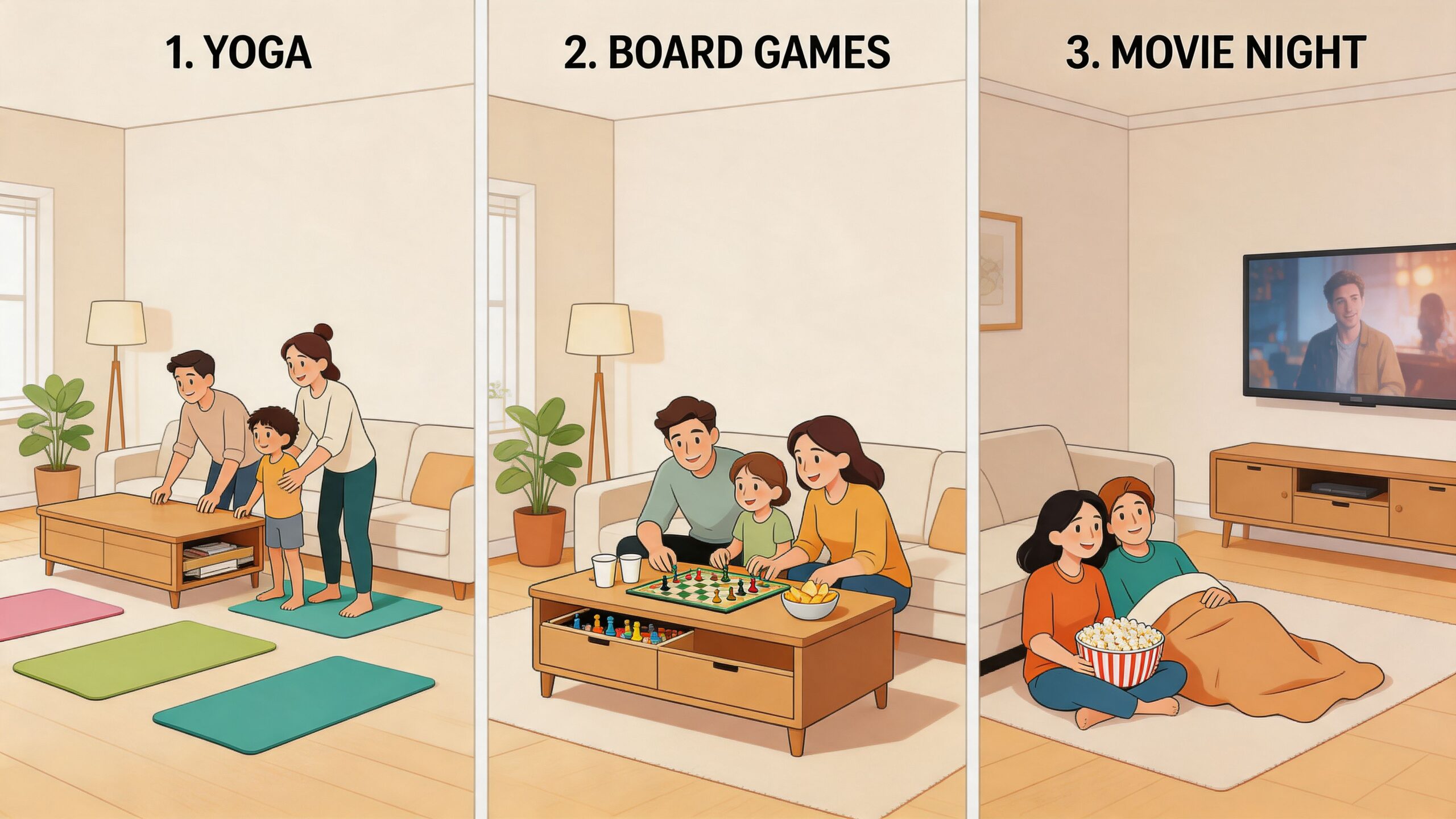
A common scene goes like this. In the morning, the coffee table holds coffee mugs and mail. By afternoon, it’s a laptop perch. By evening, someone needs room for a board game, and later the same room becomes a movie space with blankets and snacks.
A fixed table can make that room feel locked in place. A coffee table with storage on wheels gives you options. You can pull it closer to the sofa, roll it aside for floor space, or shift it toward a chair when someone needs a temporary workspace.
That kind of flexibility matters in homes from Grants Pass to Medford, especially when one room has to support several routines. If you’re trying to make your space work harder without feeling crowded, our guide to multi-functional furniture for modern homes is a useful next read.
The idea isn’t new. Good furniture has always been about usefulness first. Since 1946, when George Gates built his business on a promise of Service and Value, that same principle has guided how local furniture experts help families choose pieces that hold up in daily life.
A smart coffee table should solve at least two problems at once. Clutter, layout, comfort, or all three.
Some readers worry that wheels make a table feel temporary or flimsy. They don’t have to. A well-built rolling table can feel every bit as grounded as a stationary one, provided the frame, top, and casters are chosen with long-term use in mind.
Why Mobile Storage Tables Are So Popular
People aren’t choosing rolling coffee tables just because they look interesting. They’re choosing them because homes have changed. One room now has to stretch further than it used to.
Open floor plans are part of it. When the living room connects to the kitchen or dining area, furniture needs to feel adaptable instead of fixed. A table that rolls can help the room shift from everyday lounging to entertaining without much effort.
Smaller living spaces also play a role. In apartments, townhomes, and compact houses around the Rogue Valley, every piece needs to earn its spot. A coffee table that stores throw blankets, card games, coasters, and charging cords can reduce the need for an extra cabinet or basket.
Why this format fits real life
A mobile storage table works because it supports the little changes people make all day.
- For hosting you can roll the table closer to the seating area, set out drinks and snacks, and then move it back when people need more walking space.
- For kids’ activities it can hold crayons, puzzles, or game controllers in one contained place instead of scattering them across the room.
- For quiet evenings it keeps blankets and reading materials nearby without leaving everything visible.
- For cleaning day it’s easier to move than a heavy table with no mobility.
If you’re trying to cut visual clutter without making the room feel over-furnished, these kinds of living room storage solutions can make a noticeable difference.
More than a trend
Some furniture trends come and go because they’re driven mostly by looks. This one has staying power because it answers practical problems.
People also like that a rolling table can serve different ages and stages. A young renter may use it for work-from-home supplies. A family may use it for toys and movie nights. An older homeowner may appreciate being able to reposition the table without lifting.
Here’s where readers sometimes get confused. They assume “on wheels” means “industrial style only.” That’s not true. You’ll find this feature in farmhouse, transitional, modern, and rustic designs. The wheels change the function more than the style.
The best mobile tables don’t call attention to the wheels first. They simply make the room easier to use.
Your Essential Buying Checklist for a Rolling Coffee Table
A rolling coffee table can look great on the sales floor and still become a nuisance six months later. We see that happen when shoppers focus on the finish and storage, but skip the parts that take the daily wear. In Southern Oregon homes, that usually means the wheels, the base, and how the table behaves on wood, tile, or area rugs through every season.
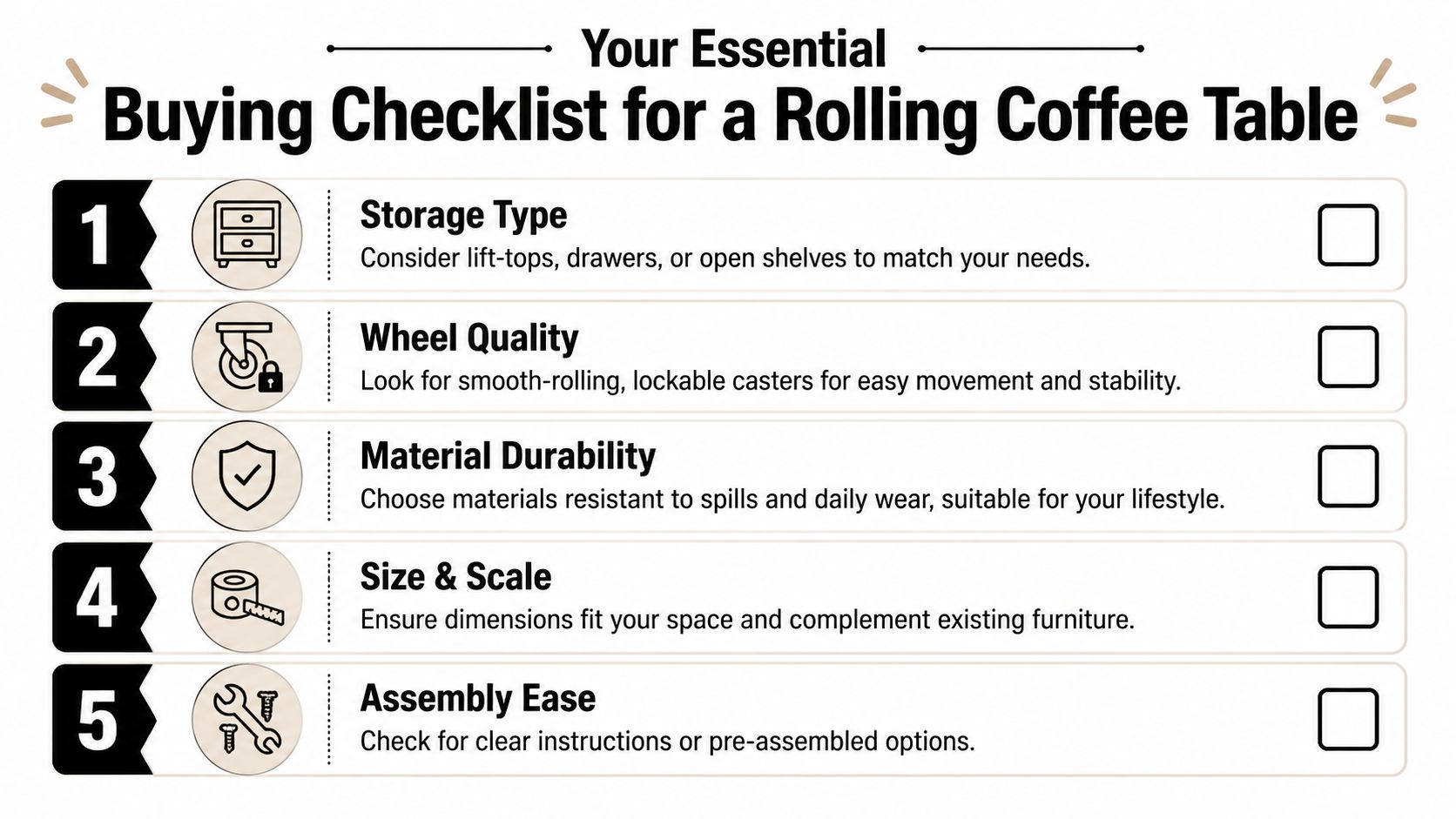
A good checklist keeps you from buying with your eyes only. If you want a broader shopping framework, this guide to shopping for furniture smartly is worth bookmarking.
Start with the storage style
Storage should match what lands in your living room.
| Storage type | Best for | Watch for |
|---|---|---|
| Lift-top | Laptops, casual meals, writing | Mechanism should feel smooth and stable |
| Drawers | Remotes, chargers, coasters, small items | Check drawer glide quality |
| Open shelf | Baskets, books, folded throws | Can look cluttered if overfilled |
| Trunk-style interior | Larger items like blankets or games | Lid weight and finger safety matter |
Each style has a trade-off. A lift-top works like a small work surface brought closer to you, which helps if you answer emails from the sofa or need a spot for lunch during a game. The trade-off is mechanical complexity. Hinges and lift hardware need to feel controlled, not springy or loose.
Drawers keep small items sorted and out of sight. Open shelves are easier to reach, but they ask you to be a little disciplined or use baskets. Trunk-style tables hold bulky items well, though the lid needs to open safely and close without slamming on fingers.
Check the wheels like someone who plans to keep the table
Wheels are not a decorative extra. They are the part that decides whether the table glides easily, rattles every time you touch it, or leaves you worrying about your floors.
Start with the caster itself. Look for locking wheels, metal mounting hardware, and a wheel that rolls smoothly instead of chattering across the floor. If the caster feels flimsy in the showroom, it usually feels worse at home once the table is loaded with books, trays, or storage underneath.
Floor type matters here, especially in the Rogue Valley. Harder wheels can roll fine on low-pile rugs but may be rougher on hardwood or older flooring. Softer wheels are often kinder to finished surfaces, though they may not move as freely on thick carpet. The best choice depends on where the table will live most of the time.
Use this quick wheel check:
- Lock each caster and make sure the table stays put
- Push from more than one side to see if the base tracks straight
- Listen for noise on the showroom floor
- Look underneath for secure mounting plates and tight hardware
- Check for floor-friendly wheel material if you have wood, laminate, or luxury vinyl planks
One small detail matters more than many shoppers expect. A large, heavy table on poor casters behaves like a grocery cart with a bad wheel. You can still move it, but it never feels quite under control.
Judge the frame and top together
A rolling table needs the top and base to work as one piece. If the top is heavy and the frame is light, the table can feel top-heavy when you push it. If the base is sturdy but the top scratches easily, the table may roll well and still disappoint in daily use.
Check the corners, supports, and how the table reacts when you press on one edge. It should stay level and feel settled. A little firmness here saves a lot of irritation later.
Pay attention to these signs:
- Solid joinery at corners and supports
- A base that does not twist when pushed from the side
- A top material that fits your household
- Consistent finish quality around edges, handles, and lower shelves
That last point is practical, not cosmetic. In busy homes, edges and corners take the hits first, especially from vacuum cleaners, toys, pet traffic, and moved seating.
Test it the way you live
Showroom styling can hide problems. Folded books and a staged tray do not tell you how the table feels during real use.
Try this short routine before you decide:
- Roll it forward and back on a hard surface.
- Turn it slightly to see whether the casters swivel smoothly.
- Lock the wheels and lean lightly on the top.
- Open every drawer, lid, or lift-top fully.
- Stand up and sit down nearby to check whether the shape and placement feel natural.
This part helps prevent a common mistake. A table can pass the style test and still fail the ownership test. The best rolling coffee tables are the ones that stay easy to move, easy on your floors, and easy to live with long after the new-furniture excitement wears off.
Finding the Perfect Size and Material
A rolling coffee table often looks right in the showroom, then feels awkward the first week at home. In Medford, Ashland, and across the Rogue Valley, we see that happen when a table is sized for looks instead of daily movement. The fix starts with the room, not the finish.
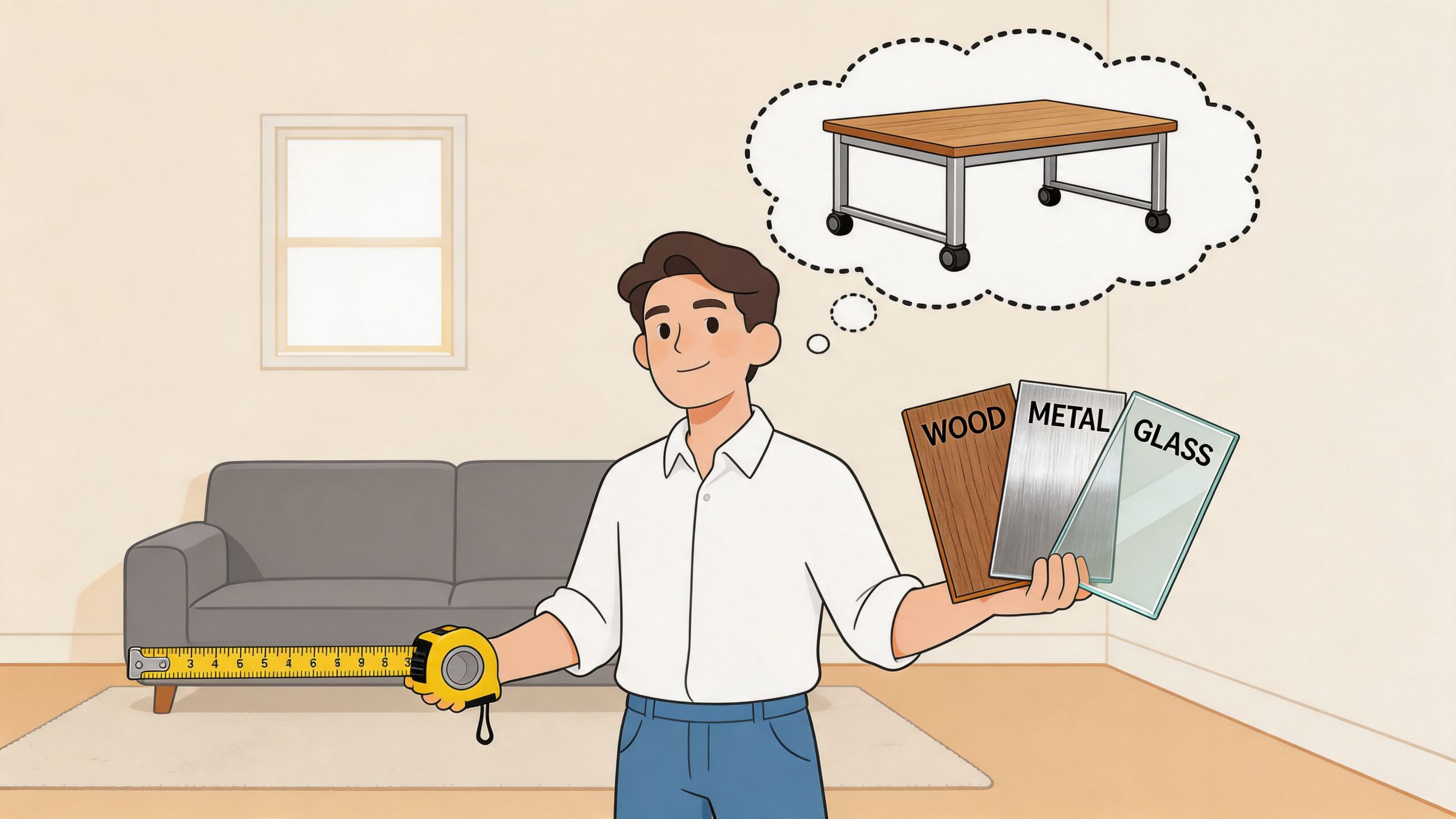
Before you shop, measure three things. Measure your sofa width, the open floor area in front of it, and the space people walk through. If you want a refresher, this guide on how to measure furniture before you buy helps prevent the kind of sizing mistake that turns an easy room into a tight one.
How to think about size
A coffee table should work like a good helper. Close enough to be useful, small enough to stay out of the way.
Start with proportion. A long sofa usually needs more surface area than a compact loveseat. A sectional often does better with a wider table or a shape that gives more than one seat easy reach. In a narrower living room, a heavy square table can create the same problem as a parked suitcase in a hallway. Everyone notices it because everyone has to work around it.
Movement matters even more with wheels. The table needs room to roll without clipping chair legs, scraping baseboards, or catching the edge of an area rug. That is especially true in older Southern Oregon homes, where rooms can have tighter layouts, brick hearths, or slight floor transitions between wood, tile, and carpet.
A few sizing checks help:
- Leave comfortable passing space so people are not turning sideways to get around the table.
- Match the table shape to your seating pattern so the people using it can reach the top and storage.
- Plan for its parked position and its moved position if you expect to roll it aside for guests, games, or cleaning.
- Check height against the sofa seat so drinks, remotes, and books are easy to grab without leaning too far.
Choosing the right material
Material affects more than appearance. It changes the table’s weight, how the casters perform, how safely it rolls over your floors, and how much upkeep it asks from you over the years.
Here’s a practical comparison:
| Material | Strengths | Trade-offs |
|---|---|---|
| Reclaimed wood | Warm character, natural texture, one-of-a-kind look | Can vary in hardness, finish, and edge smoothness |
| Teak | Rich tone and distinctive grain | Weight and surface condition can vary, especially in reclaimed pieces |
| Metal frame with wood top | Strong structure, often stable for rolling designs | Can feel heavier in motion and may mark floors if wheel quality is poor |
| Veneer or laminate | Easier to wipe clean, often lighter to move | Surface wear may show sooner at corners and edges |
Reclaimed wood appeals to homeowners who want character, and it can be a good fit in Rogue Valley homes with farmhouse, lodge, or mixed rustic-modern style. It also asks you to look closer. Some reclaimed tops are softer than they appear, and some have more texture than a glass or mug likes. If you have kids doing homework on the table, or you tend to set down plates and board games, a smoother and harder-finished top may serve you better over time.
Teak and other reclaimed species can be beautiful, but they need a base that supports them properly. If the wood is softer or the grain is inconsistent, standard fasteners may not hold as well as shoppers expect. For people interested in custom or one-of-a-kind designs, that is part of the appeal and part of the trade-off. A 2025 Houzz report on home design trends found that many homeowners with smaller living rooms are drawn to modular and customizable furniture, which helps explain the growing interest in personalized rolling tables.
Metal-and-wood combinations tend to hold up well if the frame is square and the casters are matched to the table’s weight. That pairing also suits many Southern Oregon homes because it bridges styles well. It can look at home near a leather sofa, a painted built-in, or a cleaner contemporary fireplace wall.
Lighter veneer or laminate tables are often easier to move and easier to live with in busy households. They are practical for TV rooms, rentals, and homes where the table gets used hard every day. The trade-off is long-term wear. If the edge gets chipped from repeated bumps, repair is usually less forgiving than with solid wood.
Matching material to Southern Oregon homes
Our local conditions shape ownership more than catalog photos do. Dry summers, tracked-in grit, pet nails, and a mix of hard flooring and rugs all put stress on a rolling table.
That is why floor contact matters as much as tabletop material.
If your home has hardwood, luxury vinyl, or older plank floors, pay attention to table weight and caster quality before you fall in love with a thick top. A heavier wood slab on small, hard wheels can leave marks over time, especially if grit gets caught in the caster. A slightly lighter table with better wheels often gives a better long-term experience than a heavier table with a more dramatic look.
Finish choice matters too. Distressed wood can hide small dings better than a dark glossy top. Matte finishes usually show fewer fingerprints. Rounded edges tend to wear more gracefully than sharp corners in homes with children, dogs, or frequent rearranging.
For styling around natural materials, plants can soften metal frames and bring balance to wood tones. This guide offers expert plant styling advice for gardeners if you want greenery nearby without crowding the surface.
A good rolling coffee table should still look good after real life gets to it. The right size keeps the room comfortable. The right material keeps the table useful, protects your floors, and makes ownership easier year after year.
Styling Ideas for Your Mobile Coffee Table
A rolling coffee table works best when it looks intentional, not overloaded. Because it already has a job to do, styling should support function rather than fight it.
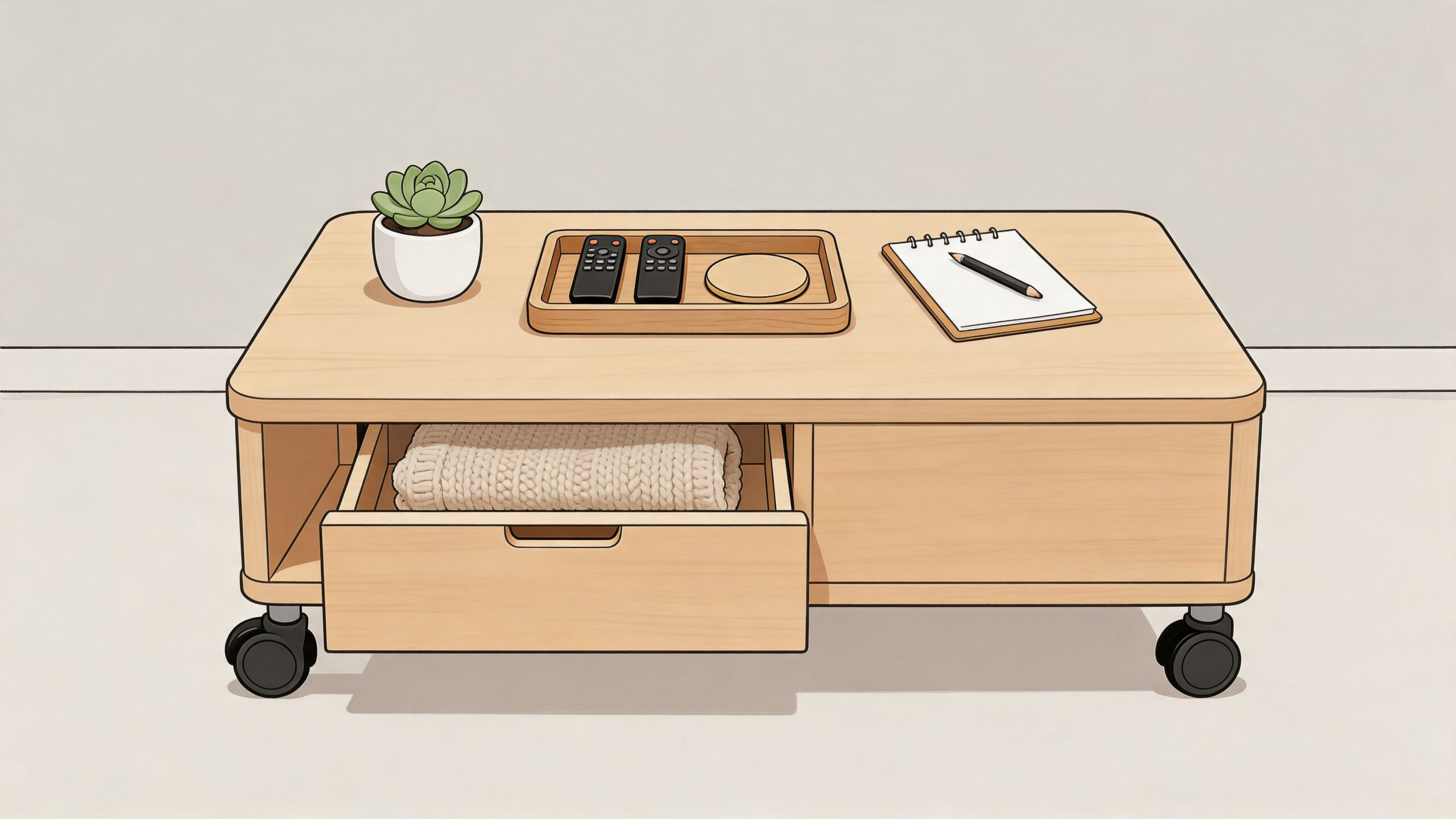
The easiest way to style one is to divide it into zones. Keep the top partly clear, give the storage a purpose, and let one or two accessories add personality.
For more ideas on arrangement and balance, this guide to a perfectly styled coffee table can help you avoid the usual “too much stuff on top” problem.
Three real-life setups
The same table can feel completely different depending on how you use it.
For entertaining
On a Friday night, the table can become a casual serving station. Keep a tray on top for glasses, napkins, and a candle. Store bottle openers, coasters, and snack bowls below so they’re close by but not cluttering the surface.
For work-from-home days
If your living room doubles as an office, keep the top spare. Store your charger, notebook, pens, and headphones inside. When work is done, close the lid or drawer, roll the table back into place, and the room starts feeling like home again.
For family use
A mobile coffee table can act as a contained activity hub. One drawer for coloring supplies, one shelf for card games, one basket for throws. That setup helps the room reset faster after busy evenings.
Decor that moves well
Some decor pieces don’t belong on a rolling table. Tall fragile objects, anything top-heavy, and loose clusters of tiny accessories can become a nuisance if the table gets moved often.
Better choices include:
- A low tray to corral remotes and coasters
- A sturdy candle or lidded jar that won’t tip easily
- A small stack of books for texture without too much height
- A compact plant with a stable pot
If you like adding greenery, expert plant styling advice for gardeners offers helpful ideas for choosing and placing plants so they look integrated instead of random.
Keep the center of gravity low. A rolling coffee table should feel calm and balanced, even when you move it.
One styling mistake to avoid
Don’t decorate the table as if it were stationary if you plan to roll it around often. That usually leads to too many breakables, too much height, and not enough usable surface.
The best-styled coffee table with storage on wheels still leaves room for a coffee mug, a book, or a snack plate. If decor crowds out daily use, the table stops doing its job.
Safety and Long-Term Maintenance Tips
Saturday morning is when many homeowners notice whether a rolling coffee table was built well. You slide it aside to vacuum, one wheel hangs up at the edge of the rug, and suddenly you can feel every weak point underneath the frame. That long-term ownership side matters more than many shoppers expect.
A table on casters asks a little more of you than a fixed coffee table. The trade-off is flexibility. The wheels, locks, and mounting plates need occasional attention if you want the table to keep moving smoothly and avoid marking up floors.
Caster quality deserves a close look. Reviews in this caster coffee table category show a common pattern. Lower-grade plastic wheels tend to wear out sooner, while heavier metal hardware and rubberized treads are usually better suited to regular use. In Rogue Valley homes with a mix of hardwood, laminate, tile, and area rugs, locking rubber wheels are often the safer everyday choice because they roll with less chatter and are less likely to scuff a finished surface.
Protect your floors first
Your floor usually takes the first hit, not the tabletop.
That is why wheel care matters so much in older homes around Medford, Ashland, and Grants Pass, where transitions between rooms are not always perfectly level. A tiny bit of grit stuck in the tread can work like sandpaper. A locked wheel dragged sideways can leave a mark faster than many people realize.
A few habits help:
- Check the wheel tread regularly for gravel, pet hair, and grit
- Wipe the casters before rolling from a rug onto hardwood or laminate
- Use the locks after you position the table
- Roll the table straight instead of pulling a locked caster sideways
If your living room has thick rug edges or uneven boards, do a simple test run with the table empty first. It works like pushing a cart over a cracked sidewalk. If it catches now, it will keep catching later, especially once you add books, blankets, or serving trays.
Simple upkeep that prevents bigger problems
Maintenance is not complicated, but timing matters. Small issues are cheap and easy to fix. Wobble, scraping, and loose hardware usually get worse if ignored.
- Turn the table over carefully from time to time and inspect each caster mount.
- Remove wrapped hair and dust from the wheel axle so the caster can turn freely.
- Tighten loose screws or bolts before the frame starts to rack or sway.
- Clean spills quickly around lift-top hinges, drawer slides, and storage openings.
Homes with kids or pets need one extra layer of caution. A rolling table can look like a toy, a step stool, or something to climb. Good locks help, but stable construction matters too. If the table shifts too easily during normal use, that is a sign to check the wheel locks, the load inside the table, and whether the weight is balanced from side to side.
A well-made coffee table with storage on wheels should feel dependable after the first month, the first year, and the tenth time you rearrange the room for guests. That is the difference between a table that only looks good in a photo and one that holds up to real life in Southern Oregon.
Experience the Gates Difference in Southern Oregon
Buying a coffee table with storage on wheels online can look easy. The challenge comes later. You can’t feel wheel quality through a screen. You can’t test a lift-top mechanism from a product photo. And you can’t tell whether a reclaimed wood top feels solid and balanced until you stand next to it.
That’s where a local showroom matters. At Gates Home Furnishings, families from Grants Pass, Medford, Central Point, Ashland, and across the Rogue Valley can compare styles in person inside a 30,000 sq. ft. showroom. You can test how a table rolls, how the storage opens, and how the materials look under real light instead of studio photography.
Why in-person shopping helps with this category
This kind of furniture has more variables than a standard end table.
You’ll want to check:
- Wheel feel on hard surfaces
- Locking function and stability
- Storage access from a seated position
- Material character, especially on reclaimed wood and teak
- Scale next to the kinds of sofas and sectionals you already own
That hands-on comparison is especially useful if you’re choosing among brands known for living room furniture, such as Flexsteel and Ashley, or if you’re exploring the kind of one-of-a-kind reclaimed wood pieces that stand apart from a typical big-box assortment.
More than a product display
Gates has served Southern Oregon since 1946, when George Gates founded the business on his promise of Service and Value. That promise still matters because practical furniture buying is rarely about one isolated item. It’s about how that item works in your home, with your floors, your traffic paths, and your storage needs.
The store’s Unique Finds selection is especially relevant for shoppers who want more character from a rolling coffee table. Reclaimed wood, teak, and statement pieces can bring warmth and individuality to the living room, particularly in homes that lean rustic, industrial, or collected rather than cookie-cutter.
Help that continues after the purchase
Cost and logistics stop a lot of people from buying the piece they want. That’s why Gates Easy Pay is worth knowing about. Flexible options include $0 down, 6-month interest-free, and no-credit-needed paths, which can make it easier to choose a better-built table instead of settling for a short-term fix.
Then there’s delivery. Gates offers White-Glove Delivery, which means the team doesn’t just drop boxes at the curb. They handle professional assembly and setup, and that level of service matters when you’re buying furniture with moving parts.
For shoppers furnishing more than one room, that same expertise extends beyond coffee tables. The store is also known for brands such as La-Z-Boy and Beautyrest, making it a practical stop whether you’re updating a living room, bedroom, or mattress setup.
If you’re in Grants Pass, it’s an easy showroom visit. If you’re coming from Medford or elsewhere in the Rogue Valley, it’s still worth making the trip to test a piece in person before bringing it home.
Find Your Perfect Mobile Coffee Table Today
The right coffee table with storage on wheels gives you three things at once. Better storage, easier movement, and a living room that adapts to real life.
It can hide clutter without feeling bulky. It can move when the room needs to change. It can also add warmth and style if you choose the right size, material, and wheel construction.
Most shoppers do best when they slow down and look beyond the surface. Check the casters. Think about your floors. Match the storage style to your habits. Choose materials that fit both your home and how you live in it.
If you want to compare designs in person, test wheel quality, or explore reclaimed wood options with more character, there’s a lot to gain from seeing these tables up close before you decide.
If you’re ready to explore a coffee table that fits your home and your routine, visit Gates Home Furnishings online or stop by the Grants Pass showroom. Since 1946, our team has helped Southern Oregon families find the right mix of style, function, and long-term value.