Why Does My Mattress Hurt My Back? A Local Expert Guide

Waking up sore changes your whole day. You stand up slowly, reach for the nightstand, and wonder whether you slept wrong, worked too hard, or are just getting older. In plenty of cases, the problem is simpler than that. Your mattress isn’t supporting your body the way it should.
We’ve helped Southern Oregon families sort through this problem for generations. Since 1946, our work has been guided by George Gates Jr.’s promise of “Service and Value.” That still matters when someone walks in from Grants Pass, Medford, Central Point, or Ashland asking the same frustrated question: why does my mattress hurt my back? The answer usually comes down to support, alignment, and choosing the right sleep surface for the person using it.
That Morning Ache A Familiar Problem in the Rogue Valley
We hear the same story all the time. Someone goes to bed tired, sleeps through the night, then wakes up feeling worse than when they laid down. The low back feels tight. The hips feel jammed up. It takes a hot shower and a little pacing around the kitchen before the body loosens up.
That pattern matters. Morning pain that eases as you move is often a sign that your mattress is working against your spine instead of supporting it.
The pattern we see most often
A lot of people assume pain in bed means their mattress is too soft. Others assume they need the hardest bed they can find. Both guesses can be wrong. What matters is whether the mattress keeps your body in a neutral, supported position through the night.
If you’ve been searching for answers, this Carlsbad sleep expert's back pain guide does a good job explaining why morning pain often points back to the sleep surface itself. We also share practical habits that help people sleep more comfortably in our article on keys to waking up refreshed in the morning.
Some of the most frustrating back pain is the kind that disappears once your day starts. That usually means your nighttime support needs attention.
A local problem with a local solution
In the Rogue Valley, we meet people who’ve put up with this ache for months because they think it’s normal. It isn’t. You should not expect your bed to leave you stiff and guarded every morning.
We’ve been helping neighbors solve comfort problems since 1946, and our advice hasn’t changed much at the core. Listen carefully. Test thoroughly. Match the bed to the body. That’s George Gates’ old promise of Service and Value, and it still holds up.
How a Mattress Causes Back Pain
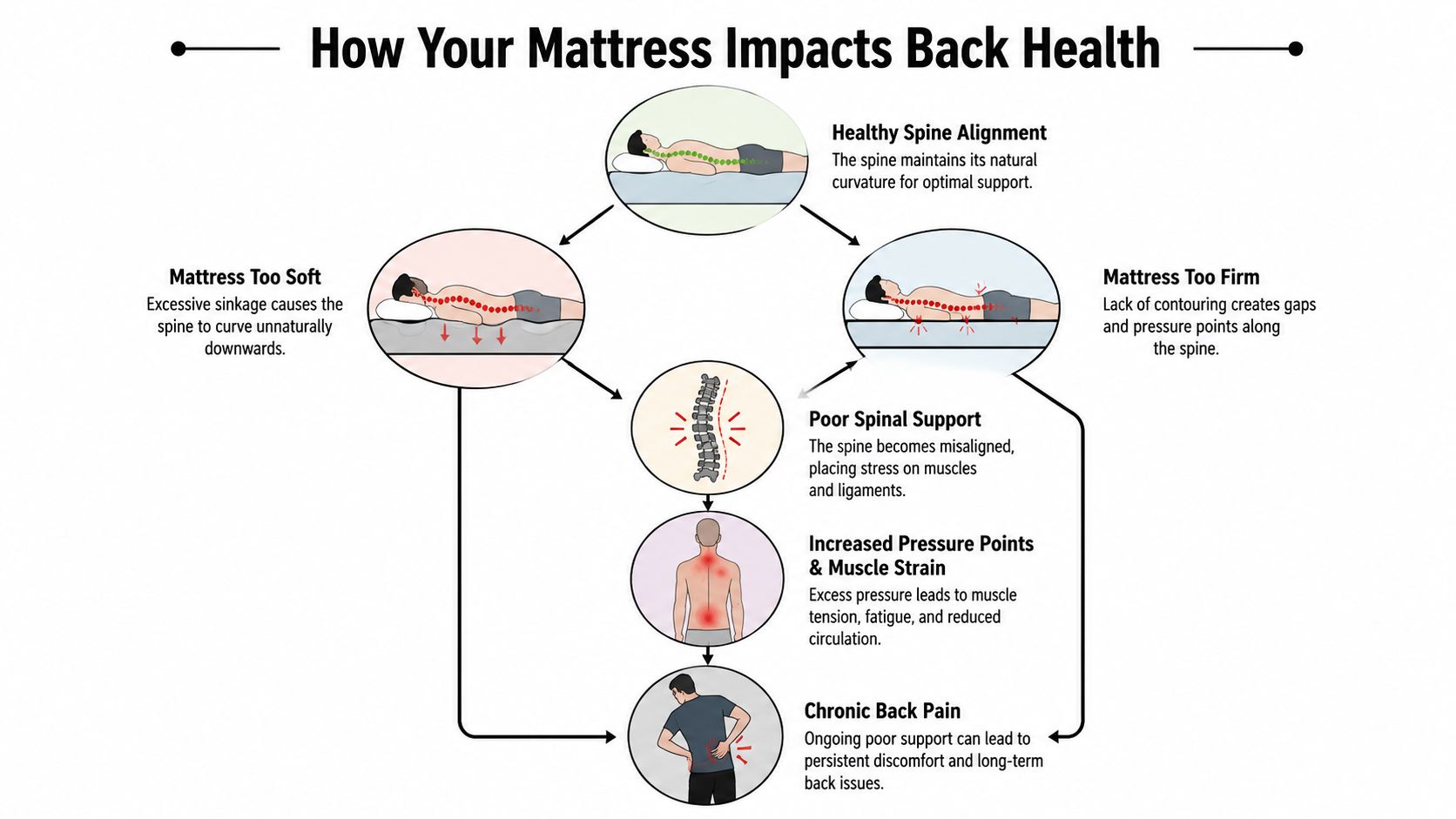
A mattress can hurt your back in two opposite ways. It can be too soft, or it can be too firm. Both create poor spinal support. They just do it differently.
What proper support actually means
Your spine has natural curves. A mattress should support those curves without forcing your hips too low or leaving your shoulders under pressure. Consider a bridge: if the middle sags, the structure strains. If the surface is rigid in the wrong places, the load shifts where it shouldn’t.
Research summarized by Sleepworld’s explanation of mattress-related back pain notes that over 7-8 hours of sleep, sustained spinal misalignment creates cumulative stress on muscles, ligaments, and joints, resulting in stiffness worst upon waking. That same guidance says sleep experts recommend medium-firm orthopedic mattresses because they balance pressure relief with support.
Too soft versus too firm
Here’s the plain-English version:
| Mattress problem | What happens to your body | Common result |
|---|---|---|
| Too soft | Hips sink too far | Lower back loses its natural position |
| Too firm | Shoulders and hips press against a rigid surface | Pressure points force the spine to compensate |
| Properly matched | Curves stay supported and weight is distributed more evenly | Less strain overnight |
A soft mattress often creates the “hammock effect.” Your heavier areas drop more than the rest of your body, and the lower back pays for it.
A firm mattress creates a different problem. If your shoulders and hips can’t settle in, your spine gets pushed into a position it can’t comfortably hold all night.
Practical rule: If a mattress feels supportive for five minutes but punishing after twenty, it’s too firm for your body.
Body weight and sleep position matter here. Heavier sleepers often need more support to avoid too much sink. Lighter sleepers can feel pressure faster on very firm beds. Side sleepers usually need more cushioning than back sleepers.
If you want another useful perspective, this guide from New Zealand Bed Company can help you find your best mattress for back pain. And if you’re trying to compare construction styles, our look at innerspring vs memory foam is a practical place to start.
Is Your Mattress the Culprit A Quick Self-Assessment
You don’t need fancy equipment to spot a mattress problem. You need a few honest checks and a little attention to your own body.
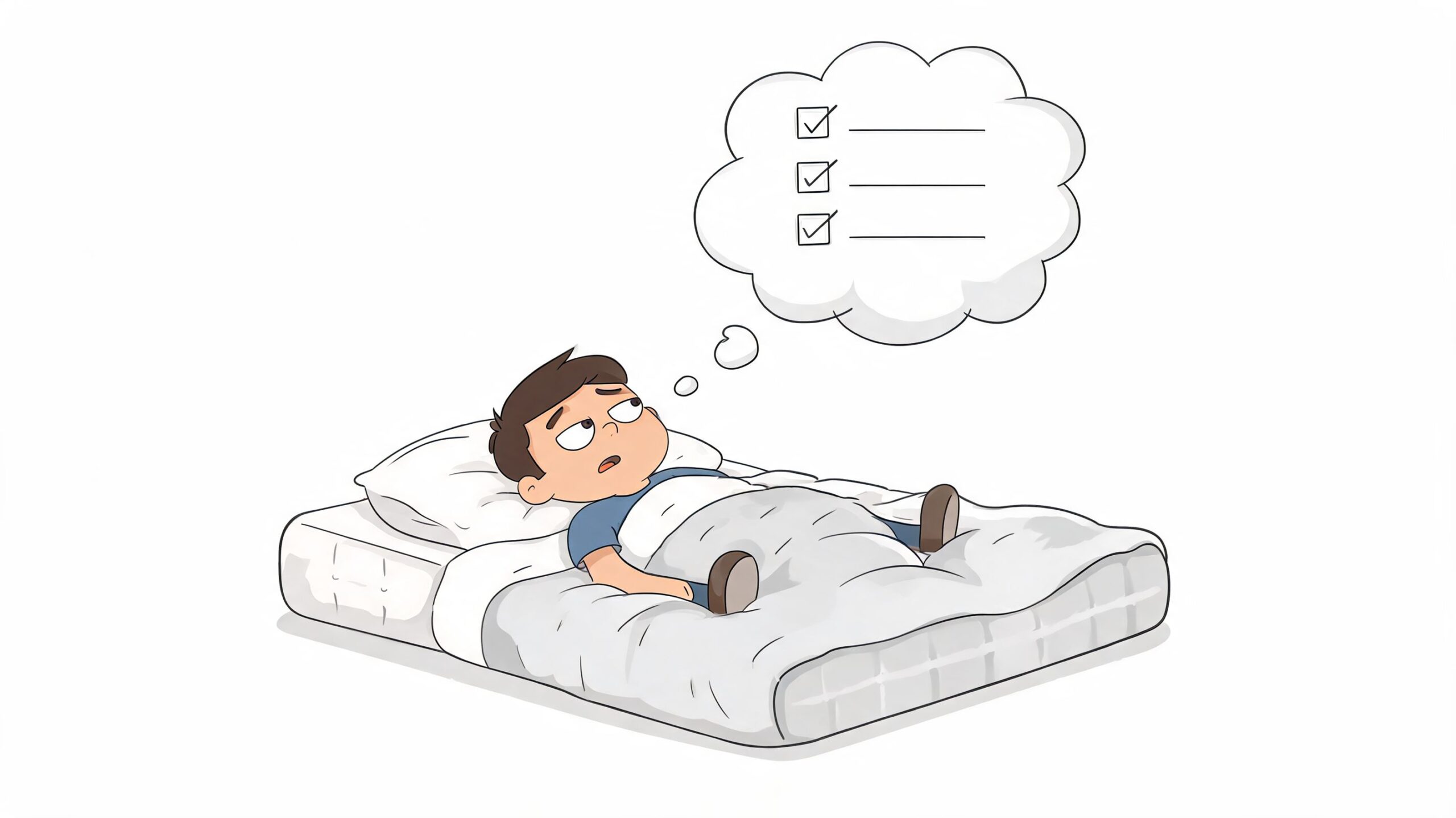
Start with the mattress itself
A failing mattress usually leaves clues.
- Visible sagging: Look across the surface from the side. If you can see a dip where your hips usually rest, that matters.
- Body impressions that stay put: Some contouring is normal. Deep, lingering impressions are not.
- Noisy support: Older innerspring systems can start creaking or shifting when internal components wear down.
- Edge collapse: If the side caves when you sit or lie near it, the support system may be breaking down.
According to Garden State Pain’s discussion of mattress support failure, the structural integrity of mattress support systems directly correlates with spinal misalignment symptoms, with sagging being a primary technical failure mode. That source also explains that a drooping mattress provides inadequate support precisely where spinal stability is most critical.
Then pay attention to your symptoms
Your body often tells the truth before the mattress does.
Ask yourself:
- Is the pain worst in the morning? If it eases after you get moving, your sleep surface deserves suspicion.
- Do you feel better on another bed? Many people notice relief in a hotel, guest room, or even on a newer couch.
- Do you keep shifting at night? Constant repositioning can mean your body is trying to escape pressure or poor support.
- Do certain spots always ache? Hips, shoulders, and the low back are the usual pressure and alignment trouble zones.
If you wake up stiff at home and sleep better elsewhere, stop blaming your body first. Check the bed.
A short yes or no test
If you answer “yes” to several of these, the mattress is a strong suspect.
| Question | Yes points toward mattress trouble |
|---|---|
| Morning stiffness improves after moving around | Yes |
| You sleep better on other surfaces | Yes |
| You can see sagging or deep impressions | Yes |
| The bed feels uneven or unsupportive in the center | Yes |
If you want a more structured way to think through your sleep habits and comfort problems, our sleep quality assessment is a useful next step.
Finding the Right Firmness For Your Sleep Position
The right mattress isn’t the firmest one in the store. That old advice has caused a lot of sore backs.
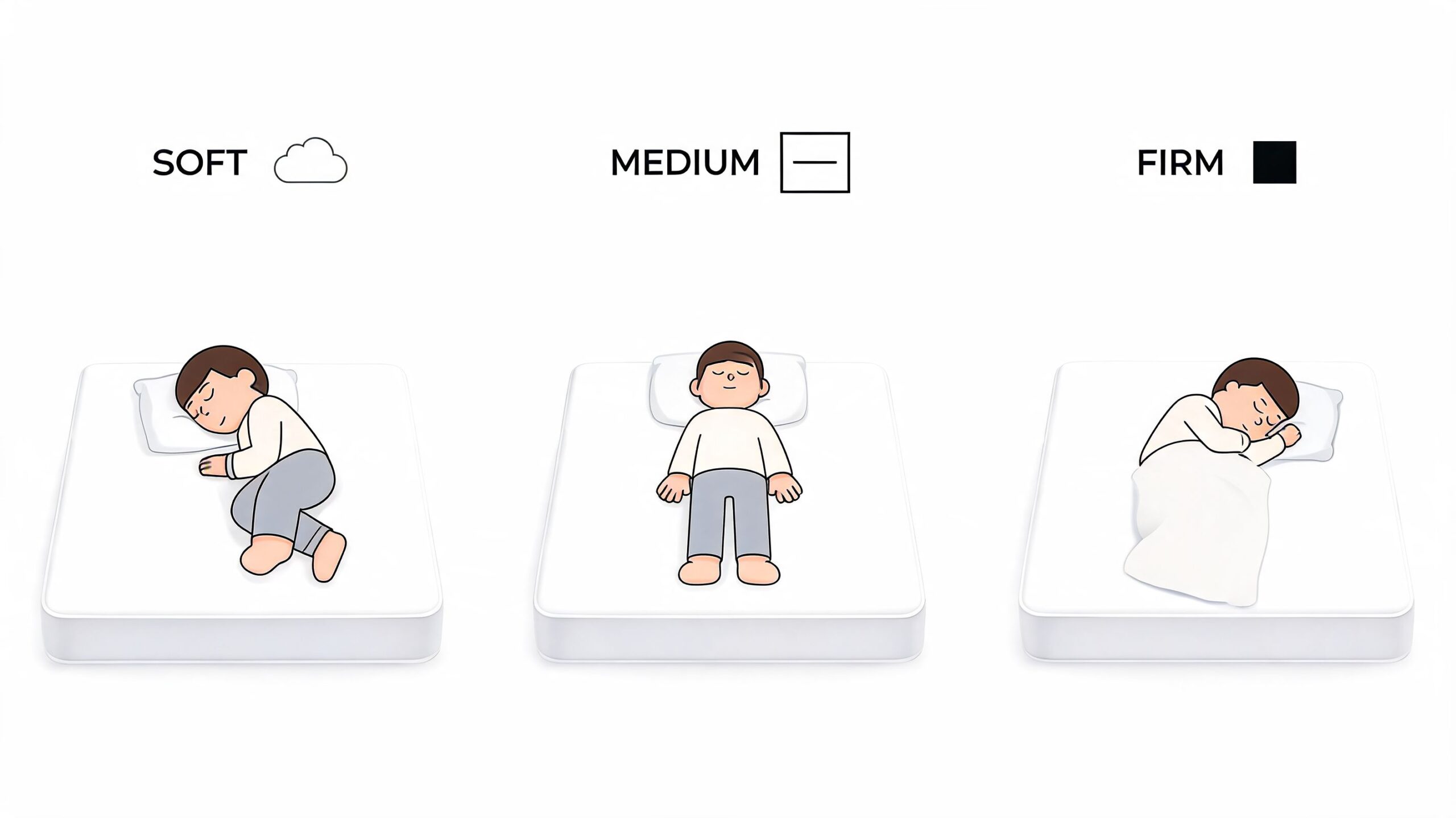
Research summarized in this review on mattress firmness and back pain found that medium firmness was associated with significantly lower pain severity compared to both soft and firm mattresses, and the study reported a statistically significant link between mattress firmness and low back pain severity with p < 0.001. The same review notes that multiple studies have consistently demonstrated that medium-firm bedding systems reduced clinically diagnosed back pain, shoulder pain, and spine stiffness while positively affecting sleep quality.
Side sleepers need pressure relief
If you sleep on your side, your shoulders and hips carry more of your body weight against the mattress. A bed that’s too firm can jam those areas upward and knock your spine out of line.
For most side sleepers, start in the medium-soft to medium range. You want enough cushioning for the shoulders and hips, but not so much softness that your midsection sinks too far.
Back sleepers need balanced support
Back sleeping usually works best on a medium to medium-firm mattress. That feel supports the lower back while still allowing the hips and shoulders to settle naturally.
Many people with low back pain find comfort in a supportive bed. The bed shouldn’t feel hard. It should feel stable.
Stomach sleepers need firmer support
Stomach sleeping is usually the toughest position on the low back. If the mattress is too plush, the hips dip and the spine arches in a way that can leave you sore fast.
A firmer surface usually works better here. Not board-stiff, but supportive enough to keep the pelvis from dropping.
A mattress should match the way you sleep most of the night, not the way you fall asleep for ten minutes.
A simple comparison
| Sleep position | Usually works best | Main goal |
|---|---|---|
| Side | Medium-soft to medium | Cushion shoulders and hips |
| Back | Medium to medium-firm | Support the lumbar curve |
| Stomach | Firm | Keep hips from sinking |
Material matters too. Memory foam can help with contouring. Hybrids can give you support plus pressure relief. Traditional innerspring models can still work well when the construction is sound. Our mattress firmness guide can help you narrow it down before you test anything in person.
The Gates Sleep Care Experience Our Promise to You
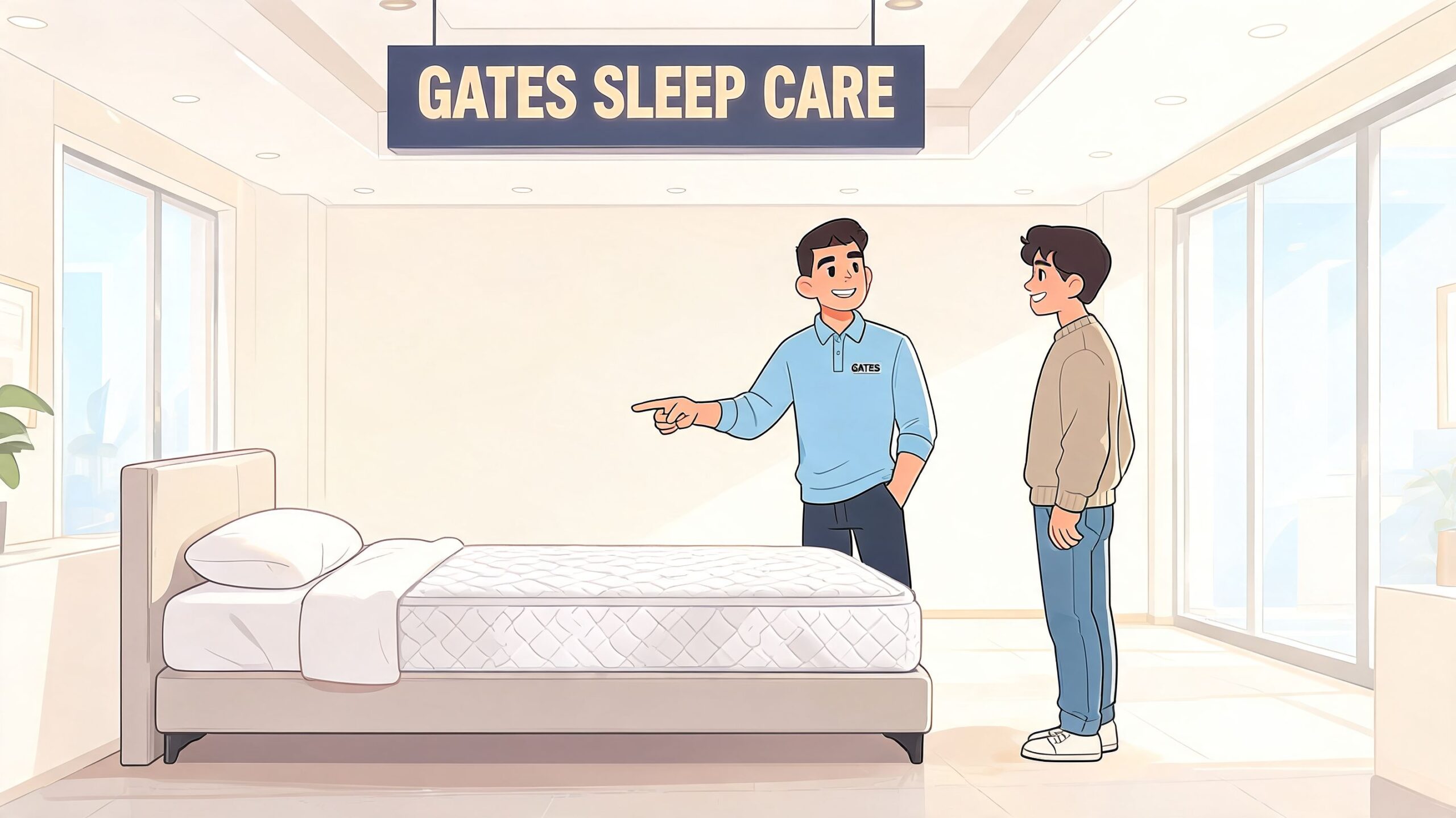
A mattress problem rarely gets solved by reading tags and pressing a hand into the corner of a bed. You need to lie down, settle in, and pay attention to what your spine does. That’s why the in-store testing process matters so much.
Testing beats guessing
At our 30,000 sq. ft. showroom in Grants Pass, people can compare comfort levels side by side instead of making a blind decision from a box and a marketing slogan. We carry recognized brands like Beautyrest, Ashley, La-Z-Boy, and Flexsteel, and we help shoppers pay attention to support, pressure relief, and sleeping position, not just buzzwords.
This is the one place in the article where we’ll say it plainly. Gates Home Furnishings uses the Gates Sleep Care process to help match sleepers with mattress types and firmness levels based on how they rest. That’s useful when someone is deciding between memory foam, hybrid, or innerspring and doesn’t want to guess wrong.
What to expect with a new mattress
A lot of people panic when a new mattress feels different right away. That’s a mistake. Adjustment is normal.
Guidance outlined by Bryte’s explanation of mattress adjustment suggests that a 2–3 week adjustment period is common as the body adapts to a new mattress. It also notes that discomfort that peaks in the first 3–7 days and steadily improves is likely adaptation, while pain that worsens after 2–3 weeks may point to a poor match.
Our promise still comes back to service
That’s where old-fashioned help matters. We’ve served this region since 1946, and George Gates Jr.’s promise of Service and Value still applies after the sale, not just during it.
If your body is adjusting and getting better, stay patient. If the pain is getting sharper or more consistent, stop pretending it will fix itself.
People from Grants Pass, Medford, Ashland, and across the Rogue Valley often need a real conversation, not a script. That’s what a proper showroom and experienced guidance are for.
Your Perfect Mattress is Within Reach
Once you know why your mattress hurts your back, the next concern is usually cost. We understand that. A mattress is important, but it still has to fit the family budget.
You have options in construction and feel
Some people prefer the familiar support of an innerspring. Others want the contouring feel of memory foam. Many land in the middle with a hybrid, which combines support coils with comfort layers that soften pressure at the shoulders and hips.
The right answer depends on your body and your sleeping position. It also depends on what you’ll enjoy sleeping on every night. The “correct” mattress that feels awful to you is not the correct mattress.
A better bed doesn’t have to wait
We’ve made affordability part of our long-standing service model. Gates Easy Pay includes $0 down, 6-month interest-free options, and no-credit-needed programs for qualifying shoppers. That gives people in Grants Pass, Medford, Central Point, Ashland, and throughout Southern Oregon a realistic path to replacing a mattress that’s causing pain instead of putting it off.
A few practical reasons people move forward sooner:
- Pain rarely fixes itself when the bed is the cause: If the support surface is failing, more time usually means more frustration.
- Better sleep affects the whole house: When one person sleeps badly, mornings get harder for everyone.
- You can solve the whole room at once: Many shoppers pair a new mattress with bedroom furniture that makes the space calmer and more functional.
Comfort can extend beyond the mattress
A restful room helps people stick to better sleep habits. We often see customers pair a mattress with quieter, more grounded bedroom pieces, including our Unique Finds made from reclaimed wood and teak. Those one-of-a-kind pieces give a room character that big-box stores usually can’t match.
And when the new mattress is chosen, we don’t just drop boxes at the curb. Our White-Glove Delivery team brings it in, sets it up properly, and can haul away the old mattress. That matters when you’re replacing a bed because your back already hurts.
Take the First Step Toward Waking Up Pain-Free
If you’ve been asking, why does my mattress hurt my back, don’t ignore what your body is telling you. Morning stiffness, pressure points, sagging, and poor support are not things you should just live with. In many cases, the fix is choosing a mattress that fits your sleep position, body type, and comfort needs.
We’ve been serving Southern Oregon since 1946, and that family-owned commitment still guides how we help people from Grants Pass to Central Point, Medford, and Ashland. George Gates Jr. built this business on Service and Value, and that promise still means listening first, guiding with integrity, and making the process easier from start to finish.
A mattress is often the main problem, but it isn’t the only piece of the puzzle. If your back is cranky in the morning, a few gentle lower back pain exercises can help you loosen up while you work on the bigger issue. Then deal with the bed that’s setting you back every night.
And when you’re ready, remember this. We don’t stop at the sale. Our White-Glove Delivery service includes professional setup and mattress haul-away, so the transition is simple.
Visit Gates Home Furnishings to explore mattress options online, or stop by our 30,000 sq. ft. Grants Pass showroom and test the right support for yourself. If you’re ready to sleep better and wake up with less pain, we’re ready to help.