Rustic Lift Top Coffee Table: A Buyer’s Guide

Your living room probably does more jobs than it used to. It’s where you put your feet up after work, where kids spread out art supplies, where guests set down drinks, and where somebody often opens a laptop. That’s exactly why a rustic lift top coffee table keeps earning its place in Southern Oregon homes.
We’ve helped families furnish homes in Grants Pass and across the Rogue Valley since 1946, and one thing hasn’t changed. The right table isn’t just about looks. It has to fit your room, your habits, and your tolerance for maintenance. A table that photographs well but rattles, sticks, or overwhelms the room is a bad buy.
Rustic lift-top designs solve real problems. They give you storage, a usable work or dining surface, and the warmth of wood that softens a room. But not every model is built the same, and rustic styles bring a few extra ownership questions that many stores skip over. Wood movement, lift hardware, surface finish, and room fit all matter.
If you want one piece of advice up front, here it is. Buy the mechanism first, the wood second, and the style third. If the lift feels flimsy in the store, it won’t improve at home.
Welcome to Functional Rustic Charm
A coffee table sits in the center of the room, so it has to do more than fill space. In a Grants Pass family room, that usually means holding up to daily traffic, snacks, remotes, blankets, and the occasional casual dinner. In a smaller Ashland bungalow or Medford apartment, it may also need to work as a temporary desk.
That’s where the rustic lift top coffee table makes sense. You get the grounded look of wood, often with plank textures, weathered finishes, or reclaimed character. Then you add a top that rises to a more useful height, plus storage underneath for the clutter nobody wants sitting out all day.
Why rustic still works
Rustic style has staying power because it doesn’t feel precious. Scratches tend to blend in better than they do on glossy modern finishes. Knots, grain variation, and distressed marks look natural in real homes, especially if you’ve got pets, kids, or heavy daily use.
We’re opinionated on this point. A living room should feel lived in, not staged.
Practical rule: If you’re shopping for a table that will be used every day, choose a finish that hides wear instead of one that demands constant touch-ups.
Why lift tops have become so useful
The appeal is simple. You don’t have to lean forward awkwardly to eat, type, or sort mail. You raise the top, bring the surface closer, and use the room more comfortably. When you’re done, the top lowers and the room looks tidy again.
That mix of comfort and practicality fits George Gates Jr.’s original promise of Service and Value. We’ve believed since 1946 that furniture should make daily life easier, not fussier. A good lift-top table does exactly that.
The Practical Magic of a Lift Top Coffee Table
The best way to think about a lift-top coffee table is this. It’s the Swiss Army knife of the living room. Closed, it’s your standard centerpiece. Open, it becomes a better surface for dinner, paperwork, puzzles, or a quick work session.

The idea isn’t random. The coffee table itself was a practical response to changing habits. The shift from earlier tea tables to modern coffee tables brought the height down from over 27 inches to 18 to 19 inches, reflecting more casual living and seating arrangements, as noted in the history of the coffee table’s evolution. Today’s lift-top versions push that same idea further by making the surface work harder for modern homes.
What it changes day to day
A fixed coffee table gives you one height. A lift top gives you options.
Here’s where that matters most:
- Movie-night meals: You can eat from the table without hunching over.
- Work-from-home overflow: A laptop and notebook sit closer to you, which is easier on your shoulders than reaching down to a low tabletop.
- Kid-friendly projects: Coloring books, homework sheets, and games stay contained.
- Hidden mess control: Chargers, remotes, coasters, and throws can disappear under the top.
Some shoppers also want mobility with function. If that sounds like your room, take a look at coffee tables with wheels and lift tops, which can make rearranging easier in multipurpose spaces.
Who benefits most
Not every home needs a lift top. But some households should stop pretending a standard table is enough.
A lift-top model is a smart pick if:
- You eat in the living room often
- You use your sofa as a casual workspace
- You need concealed storage
- You’re furnishing a smaller room that needs one piece to do several jobs
A rustic lift top coffee table earns its keep when the room has to handle real life, not just look finished.
If your table only needs to hold a candle and two books, save the money and buy a fixed top. If you want one piece to serve dinner, storage, and daily utility, a lift top is worth serious attention.
Choosing Your Finish Reclaimed Wood and Teak
The wood you choose changes the entire personality of the table. It also changes how forgiving that table feels after months of use. Rustic style works best when the material has honest character, not fake distressing slapped onto a forgettable frame.
Reclaimed wood has more personality
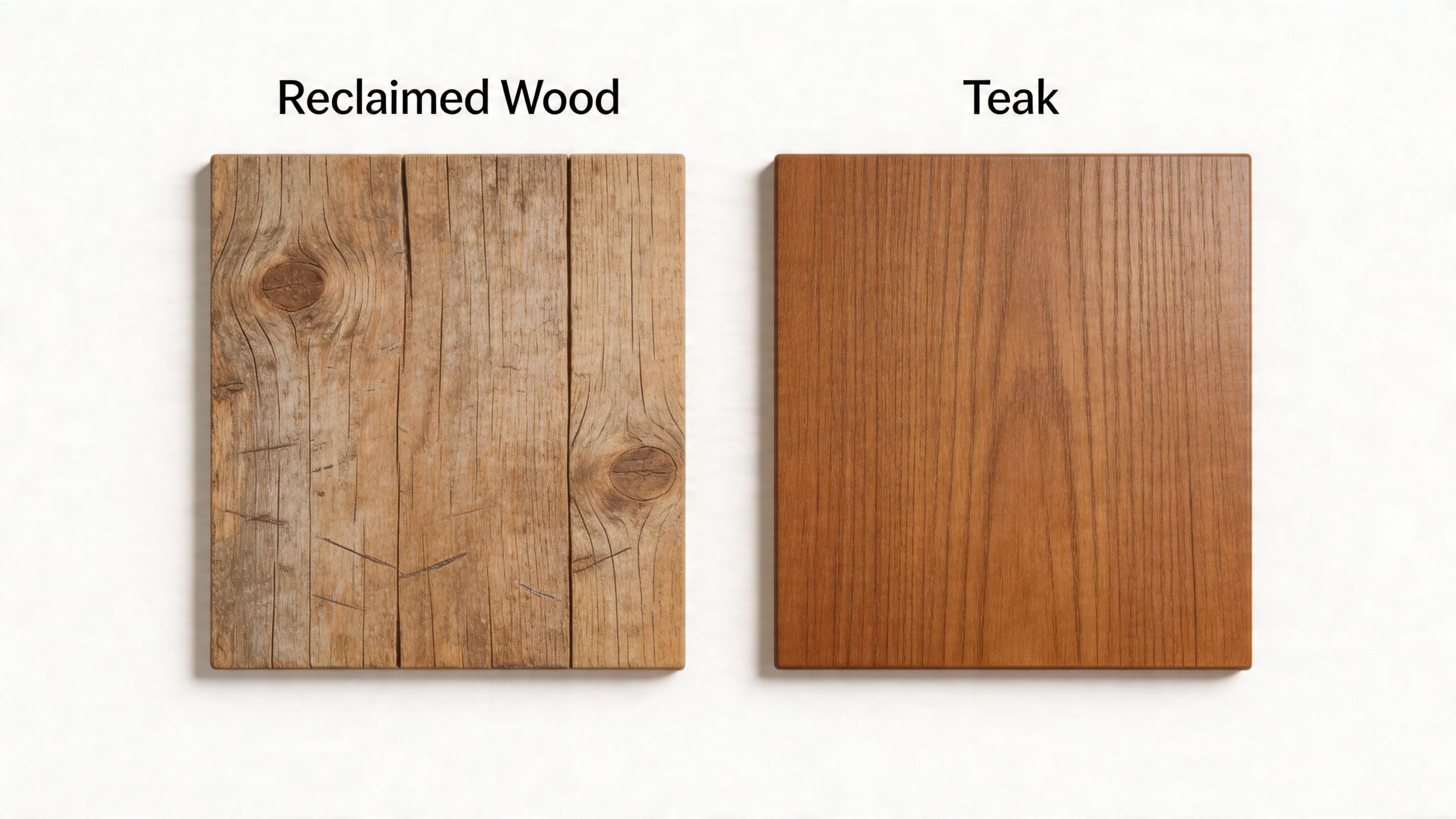
Reclaimed wood carries variation that factory-perfect pieces can’t fake well. You’ll often see old nail marks, grain shifts, color changes, and edge irregularities. In the right room, that’s a strength. It adds depth and keeps a coffee table from looking flat or generic.
This is why shoppers who want something with presence usually gravitate toward our reclaimed wood furniture options. It’s also where our Unique Finds stand apart. Reclaimed wood, teak, and one-of-a-kind statement pieces have more soul than catalog furniture built to offend nobody.
Reclaimed wood makes the most sense if your home leans farmhouse, lodge-inspired, eclectic, or relaxed craftsman. It also pairs nicely with metal brackets, black hardware, and warmer textiles.
Teak gives you a cleaner rustic look
Teak is a different animal. It still brings warmth, but it reads more refined. The grain is often smoother visually, and the overall effect lands somewhere between rustic and polished. If your home has cleaner lines, lighter walls, or a more edited look, teak usually integrates better than heavily weathered wood.
We often steer customers toward teak when they want rustic warmth without the rougher, barnwood feel. It plays especially well in newer homes around Medford and Central Point where the architecture is cleaner but the homeowner still wants natural materials.
Finish matters as much as species
Don’t choose by color chip alone. Look at sheen, texture, and how the finish will age. Matte and low-sheen finishes tend to hide fingerprints and small scratches better than shiny surfaces.
If you’re comparing finish types broadly, it’s worth reading about eco-friendly wood finishes to understand how different protective approaches affect appearance and upkeep. That’s useful context when you’re deciding how much maintenance you’re willing to take on.
Reclaimed wood gives you story. Teak gives you polish. Neither is automatically better. The better choice is the one that fits your room and your patience level.
Our blunt recommendation
Choose reclaimed wood if you want visible character and don’t mind variation.
Choose teak if you want warmth with a cleaner silhouette.
Skip any rustic finish that looks overly uniform. If every board looks identical, the piece usually feels generic in person.
Understanding Lift Mechanisms and Durability
Most shoppers spend too much time looking at the wood and not enough time testing the hardware. That’s backwards. The lift mechanism is the part you’ll notice every single day.
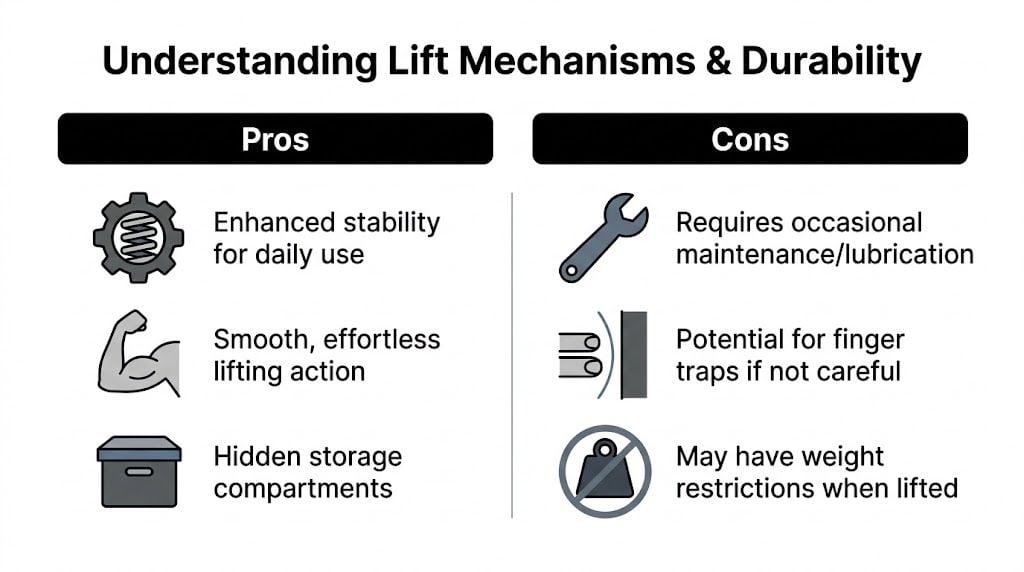
A rustic lift top coffee table lives or dies by three things. Smooth motion, solid alignment, and long-term stability. If the top twists, drops, squeaks, or feels uneven, walk away.
What the numbers actually mean
Lift-top ratings confuse people because the top and the storage area usually have different capacities. According to the product details summarized in this lift-top capacity reference, the lift-top surface typically supports 11 to 49 lbs, while the hidden storage compartment can handle 44 to 150 lbs. That gap exists because the lifting top takes dynamic stress while moving, while the lower compartment carries a more stable load.
That matters in real life. A table may hold heavier items inside, but the raised top may only be suitable for lighter daily-use objects like a laptop, plate, or notebook.
Lift Mechanism Comparison
| Feature | Spring-Loaded Mechanism | Hydraulic/Gas-Piston Mechanism |
|---|---|---|
| Opening feel | More basic, can feel quicker or stiffer | Smoother, more controlled |
| Daily use comfort | Fine for occasional use | Better for frequent lifting |
| Maintenance sensitivity | Can develop noise or tension issues | Depends on piston quality and seal condition |
| User effort | Usually requires more manual guidance | Usually easier to raise and lower |
| Best fit | Budget-conscious shoppers | Shoppers prioritizing smoother operation |
Rustic tables add extra stress
Heavier, wood-forward designs can look fantastic, but weight distribution gets tricky. A 2025 consumer report noted that 28% of lift-top table mechanisms fail within 18 months, and that climbs to 35% for wood-heavy rustic models, due in part to uneven weight distribution on irregular reclaimed surfaces, according to this report discussion on lift-top failures.
That doesn’t mean rustic lift tops are a bad idea. It means you need to shop with your eyes open.
Check these points in person
- Lift with one hand: The top should rise smoothly without jerking.
- Watch for racking: If one side lifts faster, the hardware may be underbuilt or poorly aligned.
- Lower it slowly: A good mechanism shouldn’t slam.
- Press lightly on the raised top: You’re checking for wobble, not trying to stress it.
- Inspect hinge mounting points: Weak attachment areas often tell on themselves early.
If the table makes noise on a showroom floor, it will be louder in a quiet living room six months later.
Southern Oregon ownership advice
Our climate isn’t extreme, but homes in Southern Oregon can still see seasonal shifts in indoor humidity and temperature. Wood expands and contracts. Hardware loosens. That’s why maintenance matters more on rustic styles, especially reclaimed designs with natural variation.
Do these simple things:
- Lift straight up, not sideways. Lateral pressure is hard on hinge points.
- Don’t overload the raised surface. Storage capacity and lift-top capacity are not the same thing.
- Tighten hardware periodically. A small wobble usually gets worse, not better.
- Keep the finish protected. Spilled drinks around seams and edges are rough on wood over time.
This is also where long-term support matters. We offer Gates Care Shield because accidental wear and ownership issues are part of real life. That’s consistent with George Gates’ promise of Service and Value. The sale isn’t the finish line.
How to Measure Your Space for the Perfect Fit
Most coffee table mistakes come down to scale. The table is too big, too deep, or too tall for the seating around it. A rustic lift top coffee table already has visual weight, so sizing has to be handled carefully.
Start with traffic flow
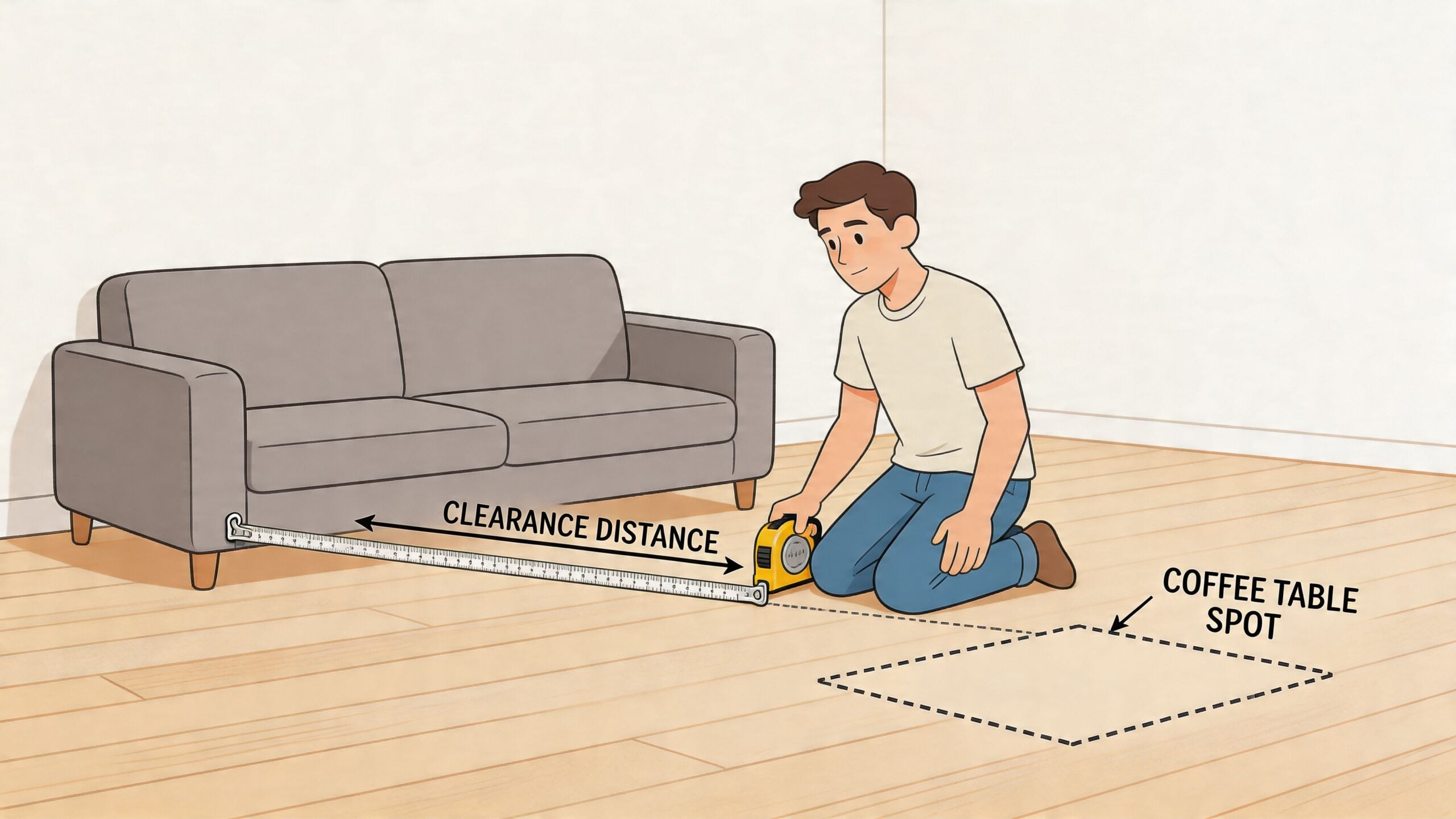
Before you shop, mark the footprint on your floor with painter’s tape. Then walk around it. Sit down, stand up, and test the path people use.
That simple step catches bad buys fast.
A lot of rustic lift-top tables still cluster around standard 40-inch widths, but there’s growing demand for options under 36 inches for smaller rooms, alongside a 22% rise in demand for multi-functional furniture for hybrid work-from-home setups, according to this rustic lift coffee table market page. If you’re furnishing a compact space, don’t assume standard sizing is your friend.
Measure the room like you mean it
Use this checklist before you buy:
- Measure sofa-to-TV clearance: The coffee table should support movement, not choke the walkway.
- Check lift path: Make sure the top can rise without bumping knees or crowding nearby seating.
- Note armchair swing space: Accent chairs often get ignored in the measuring process.
- Account for storage access: If baskets, poufs, or pet beds live nearby, leave room for them too.
For a more detailed prep list, our guide on how to measure furniture for your room is worth reviewing before you head into the showroom.
Don’t ignore visual bulk
Two tables can have similar dimensions and feel completely different. Thick tops, chunky legs, sliding barn-door fronts, and dark finishes all make a table feel larger. In a tighter room, a visually lighter base can save the space.
Space-saving rule: In small living rooms, prioritize narrower depth and cleaner leg design before you sacrifice lift-top function.
If you’re in an apartment, townhouse, or compact cottage in Ashland, under-36-inch options deserve a hard look. A slightly smaller table that fits correctly will serve you better than a feature-heavy piece that dominates the room.
Styling Your Table in a Southern Oregon Home
Rustic furniture works best when it looks like it belongs to the house and the people in it. In Southern Oregon, that can mean a lot of different things. A craftsman home in Grants Pass doesn’t want the exact same table treatment as a newer farmhouse outside Medford.
In a Grants Pass craftsman
A teak lift-top table can be the bridge between classic architecture and practical modern use. Pair it with warm lamps, a woven basket, and a couple of books instead of piling on heavy decor. If the room already has built-ins or wood trim, let the table echo that warmth without trying to match every tone exactly.
In a Medford farmhouse
This is where reclaimed wood and metal details shine. A weathered top, dark brackets, and hidden storage fit the style naturally. Add a tray, one low arrangement, and something soft nearby like a folded throw. Don’t clutter the surface so much that you defeat the whole point of the lift top.
In an Ashland bungalow
Smaller homes need more restraint. A rustic lift top coffee table can still anchor the room, but keep the styling lean. One decorative object, one practical item, and open space is usually enough. The table should still look inviting when it’s closed and still work when somebody needs to raise it.
A lot of homeowners over-style coffee tables and then wonder why daily use feels annoying. If you want a cleaner formula, our article on how to decorate a coffee table like a pro lays out a sensible approach.
A good coffee table display should clear in seconds. If it takes two hands and a side chair to move your decor every time you lift the top, you’ve styled it wrong.
Our Promise of Service Value and Easy Ownership
George Gates Jr. founded our business in 1946 on a promise of Service and Value, and that standard still shapes how we help customers buy furniture. Practical pieces deserve practical support.
The coffee table itself has always been rooted in usefulness. The modern version was invented in 1920 by Stuart Foote of the Imperial Furniture Company in Michigan, reportedly after he lowered a dining table at his wife’s request, as described in this coffee table history article. That same spirit carries into lift-top designs today. Better furniture should solve a problem.
Easy ownership matters
We don’t think service ends when the receipt prints.
That’s why we make ownership easier with:
- Gates Easy Pay: $0 down, 6-month interest-free, and no-credit-needed options.
- White-Glove Delivery: Our team handles professional in-home delivery and assembly. We don’t just drop boxes at the curb.
- Real showroom testing: Our 30,000 sq. ft. Grants Pass showroom gives you room to open, close, inspect, and compare pieces before you commit.
- Care guidance: If you bring home a wood table, knowing the upkeep matters. Our guide on how to care for wood furniture helps you protect the finish and keep it looking right.
We also carry trusted names like La-Z-Boy, Flexsteel, Ashley, and Beautyrest, which matters because established brands tend to offer more consistent construction standards across the rest of your home.
Your Checklist for Finding the Ideal Coffee Table
Keep this simple. If a table misses on one of these points, keep shopping.
- The size fits the room: It doesn’t block traffic or overpower the seating area.
- The mechanism feels solid: No twisting, sticking, slamming, or rattling.
- The wood fits your lifestyle: Reclaimed for character, teak for a cleaner look.
- The top height works for how you live: Eating, working, or just everyday lounging.
- The storage is useful: Big enough for the things you want to hide.
- The finish is forgiving: Especially if your home is busy.
- The piece looks right closed: A lift-top table still spends most of its time shut.
Buy for daily use, not for the staged photo. That’s the difference between a table you tolerate and one you’re still happy with years later.
If you’d like help narrowing down the right rustic lift top coffee table for your space in Grants Pass, Medford, Central Point, Ashland, or anywhere in the Rogue Valley, visit Gates Home Furnishings in our Grants Pass showroom or browse our collection online. We’ll help you test the lift, check the scale, and choose a piece that delivers the kind of Service and Value we’ve stood for since 1946.