Reclaimed Wood Trestle Table: Southern Oregon Guide

A lot of households start in the same place. The old dining table looks tired, the new-build options feel flat, and the room needs one piece with some soul. Not a delicate showpiece. A table that can handle weeknight dinners, homework, coffee cups, holiday meals, and the occasional hard elbow.
That's where a reclaimed wood trestle table earns its keep. It has presence, history, and usually better seating flexibility than many people expect. But looks alone shouldn't drive the decision. The smart buy comes down to structure, knee room, surface texture, and whether the table fits the way a Southern Oregon family lives.
Table of Contents
- Why a Reclaimed Wood Trestle Table
- The Story Behind Reclaimed Wood
- Built to Last What to Look For
- Finding Your Perfect Fit For Style and Use
- Living With Your Table Care and Maintenance
- Making It Yours With Gates Home Furnishings
- Your Reclaimed Wood Table Questions Answered
- Is a trestle table good for everyday family use
- Will the surface feel too rough
- Are extension versions worth considering
- Can a reclaimed wood trestle table work with mixed chair styles
- What should buyers bring when shopping in person
- Is delivery available beyond Grants Pass
- Do protection plans make sense on reclaimed wood
Why a Reclaimed Wood Trestle Table
A reclaimed wood trestle table makes sense for people who want more than a flat slab on four legs. It brings age, texture, and a strong visual anchor to the dining room. It also tends to feel less fussy than formal pedestal or heavily carved traditional tables, which is exactly why so many busy households gravitate toward it.

The trestle form also has serious roots. A trestle table is one of the oldest table types in furniture history, with evidence traced to ancient Egypt and broad use through the Middle Ages. One documented 15th-century European example measured 860 × 2,920 × 895 mm, which shows this wasn't a tiny occasional table but a substantial dining-scale form centuries ago, as noted by this history of the trestle table.
That history matters, but daily usefulness matters more.
Practical rule: If a table has character but doesn't seat people comfortably, it's décor pretending to be furniture.
For households in Grants Pass, Medford, Ashland, Central Point, and across the Rogue Valley, reclaimed pieces often stand out because they don't look machine-perfect. That's the appeal. A good one feels grounded, warm, and lived-in from day one.
The Story Behind Reclaimed Wood
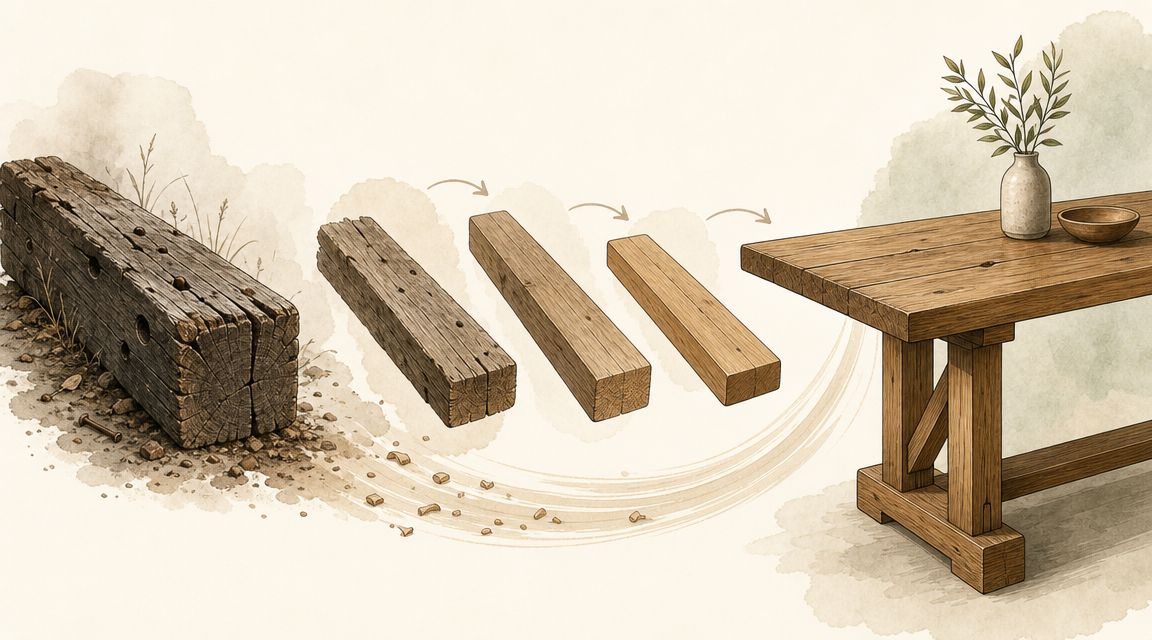
A reclaimed wood trestle table starts with material that already had a life before it ever entered a dining room. That's the part many product blurbs skip, and it's also the part that gives the piece its depth.
Old wood brings real history home
For reclaimed-wood tables, one of the strongest selling points is simple. The wood often comes from barns and buildings dating back to the 1800s, giving the material a documented past in historic structures rather than freshly milled lumber, according to this overview of reclaimed dining table materials.
That changes how the table feels in a room. Saw marks, color shifts, old nail traces, and uneven grain aren't flaws in the usual sense. They're evidence that the wood didn't begin life in a factory pipeline.
A buyer looking through reclaimed wood furniture options near Grants Pass should expect variation. Boards may not match like showroom-perfect veneers. That's the point. A reclaimed top usually tells the truth about the material.
Why that history matters in daily life
Old wood brings more than nostalgia. It also changes the personality of the furniture. New lumber can look clean but generic. Reclaimed boards usually bring more visual movement, deeper tone shifts, and a sense that the piece belongs in a home rather than a catalog.
There's also a practical side to that story. Households that want something distinctive often get more satisfaction from material with visible age than from distressed finishes trying to imitate it. Fake age is easy to spot. Real age isn't.
A reclaimed wood trestle table also works especially well for families who want one strong dining-room focal point instead of lots of decorative extras. The table carries the room. Rugs, lighting, and chairs can stay simpler because the table already has enough visual weight.
Old wood doesn't need a backstory invented for it. The marks, variation, and color already do that work.
Built to Last What to Look For
Most buyers spend too much time staring at the top and not enough time studying the base. That's backward. With a reclaimed wood trestle table, the base is the chassis. The top is the paint.

The base matters more than the finish
A reclaimed wood trestle table should be engineered around the base geometry as much as the top because the trestle form concentrates load into a central structural spine. Strong examples use hardwood members, broad cross-rails, and joinery that resists lateral sway, and buyers should check base width and top thickness when judging long-term stability, as explained in this product construction reference.
That's the plain-English version. If the base is too narrow, too light, or poorly joined, the table can look solid and still feel loose in use. Plates rattle. End seats feel bouncy. Someone leans on one side and the whole thing announces it.
For anyone comparing wood species and construction methods, this hardwood furniture guide helps frame what affects longevity.
What to inspect before buying
Skip the marketing adjectives for a minute and inspect the table like a mechanic would inspect a truck.
- Check the spine: Look underneath. The center structure should look substantial, not thin or decorative.
- Study the cross support: Broad cross-rails help control side-to-side sway. Skinny feet often lead to wobble.
- Look at the top thickness: A wide span needs enough substance above it. Thin tops on big tables can feel underbuilt.
- Push from the side: Gentle pressure should not create a noticeable shimmy.
- Sit at the end: End seating is one of the strengths of trestle design, but only if the base placement allows it.
Here's a useful benchmark from commercial examples. Reclaimed trestle tables are commonly sold in 84 by 40 by 30 inches, and some 60-inch versions extend to 84 inches. That tells buyers the form is expected to handle both everyday use and guest seating, but only if the joints and any extension hardware maintain alignment, as described in this reclaimed trestle table construction example.
A second example makes the same point with dimensions. Some products use a base around 72.3 inches by 29.2 inches under a 96-inch by 42-inch top with a 1.5-inch-thick surface. Those proportions show why the base can't be an afterthought. Wide tops need real support, not just visual bulk.
A heavy-looking table isn't always a stable table. Weight and structure are not the same thing.
If a table is available to test in person, that matters. Walking around it, nudging it, and sitting at the ends tells a buyer more in two minutes than a dozen polished photos ever will.
Finding Your Perfect Fit For Style and Use
The right reclaimed wood trestle table isn't the one that photographs best. It's the one that lets people sit comfortably, move around the room, and use the surface every day without annoyance.
Seat the people who actually use it
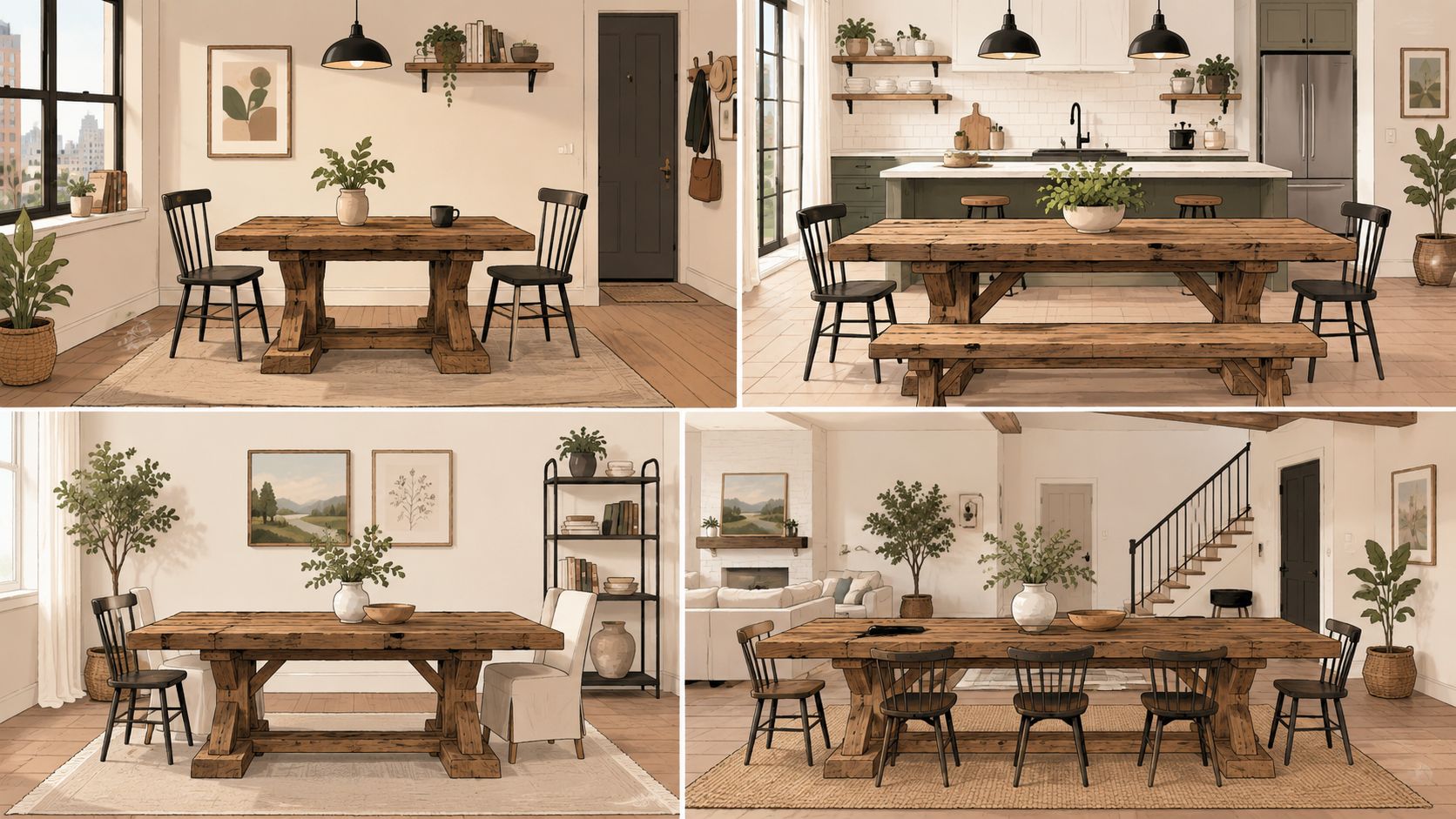
A key issue often missed in style-driven buying guides is how the trestle base affects modern dining use. Buyers should ask whether the base makes seating easier at the ends and how much knee room the center support leaves, because those details shape daily comfort far more than rustic charm alone, as noted in this discussion of salvaged wood trestle table usability.
That's where trestle tables can either shine or disappoint.
A well-designed trestle base often gives more flexibility than four corner legs. Chairs can slide around more freely along the sides. End seating can be easier too. But if the center support is bulky or badly placed, somebody's knees will find it every single meal.
Use this simple test before buying:
| What to test | Why it matters |
|---|---|
| Sit at both ends | End seats should feel usable, not decorative |
| Slide side chairs in and out | The base shouldn't trap chair legs |
| Check center knee room | The support should not crowd the natural sitting position |
| Mimic everyday use | Rest elbows, scoot in, stand up, repeat |
Households working with tighter footprints may also benefit from thinking beyond the table itself. The same logic used in a pro's guide to narrow console tables applies here. Furniture should fit circulation patterns, not just wall-to-wall dimensions.
Measure for movement, not just placement
A table can technically fit a room and still make the room miserable to use. That happens all the time.
For a smart fit, think in layers:
- Table footprint: What the table itself occupies.
- Chair movement: What chairs need when people sit down and get up.
- Walk paths: What everyone else needs to pass by without turning sideways.
- Visual scale: What the room can handle without feeling crowded.
For buyers comparing styles and sizes, this dining table selection guide is a useful next step.
The strongest choices usually come from honest self-assessment. Is the table for formal holiday use, or does it need to survive breakfast, projects, and school papers? Is the family hosting often, or is this mostly a daily four-chair setup with occasional extras? A reclaimed wood trestle table is ideal for homes that want one hardworking anchor piece, but the base design has to match the practical seating pattern.
Living With Your Table Care and Maintenance
A reclaimed wood trestle table isn't fragile, but it isn't maintenance-free either. Buyers who expect a perfectly slick, uniform, factory-flat surface often choose the wrong category and then blame the table.
Rustic does not mean carefree
The appeal of reclaimed wood comes with a tradeoff. Buyers often worry about tabletop roughness, pits, and how sealed surfaces handle spills. That concern is valid, because the same variation that creates charm can surprise anyone expecting a perfectly smooth, low-maintenance finish, as discussed in this homeowner conversation about salvaged wood table texture.
That doesn't mean reclaimed wood is impractical. It means expectations need to be accurate.
A textured surface may be fine for family meals and serving dishes, but less ideal for someone who wants to write directly on paper without a placemat or pad. Tiny crevices can also collect crumbs faster than a smoother tabletop. That's not a defect. It's part of the ownership experience.
What daily care should look like
The right question isn't “Will it need care?” Of course it will. The right question is “What kind of care fits this household?”
A practical routine usually looks like this:
- Wipe spills promptly: Even on sealed wood, standing moisture is asking for trouble.
- Use mats where needed: Especially under messy craft projects, hot dishes, or anything with condensation.
- Clean gently: Harsh chemicals can do more harm than the spilled drink they're supposed to fix.
- Expect variation: Character marks and uneven grain are part of the surface story.
For anyone wanting a more complete routine, this wood furniture care guide covers the basics well.
Buy reclaimed wood for warmth and character. Don't buy it if the goal is a sterile, glass-smooth work surface.
Protection plans can also make sense for busy homes with kids, frequent guests, or daily entertaining. A textured table still benefits from practical backup when life gets sloppy.
Making It Yours With Gates Home Furnishings
Buying a reclaimed wood trestle table gets easier when the decision is treated as part style choice, part usability check, and part logistics problem. That last part matters more than people think.
A large table needs proper delivery, careful placement, and competent assembly. Nobody wants a heavy dining table left in boxes at the door. Professional in-home setup removes a lot of the friction, especially for households furnishing a main dining space rather than a spare room.
Financing can matter too. A better-built table usually costs more than a disposable one, and stretching for quality makes more sense when the payment structure is manageable. That's where options like $0 down, 6-month interest-free, and no-credit-needed financing can open the door for buyers who want the right piece now instead of settling for a short-term placeholder.
For shoppers who want to see an example product first, the Stormy Ridge trestle table listing gives a starting point.
The practical advantage is simple. A showroom visit lets buyers sit at the table, judge the texture, test knee room, and decide whether the finish suits real life. That's more useful than guessing from staged room photos. In a 30,000 sq. ft. showroom in Grants Pass, families can compare dining options in person, alongside brands such as La-Z-Boy, Flexsteel, Ashley, and Beautyrest, and then arrange white-glove delivery rather than handling assembly alone.
Your Reclaimed Wood Table Questions Answered
Is a trestle table good for everyday family use
Yes, if the base is designed well and the surface expectations are realistic. Trestle tables are often better for everyday use than people assume because they can offer flexible side seating and usable end spots. The weak point isn't the concept. It's poor construction or a base that crowds knees.
Will the surface feel too rough
Sometimes, yes. That depends on the finish and how heavily the reclaimed character was preserved. Some buyers love visible saw marks, pits, and grain variation. Others want the look of reclaimed wood with a more refined feel. The smart move is to run a hand across the top and decide whether it matches the household's habits.
Are extension versions worth considering
They can be, especially for people who host guests but don't want an oversized table every day. The key is alignment and stability when opened. If the extension mechanism feels loose, fussy, or uneven, walk away.
Can a reclaimed wood trestle table work with mixed chair styles
Usually, yes. In fact, that's one of its strengths. Because the table itself carries so much visual character, it often works well with simpler upholstered chairs, ladder-back chairs, or a bench on one side. Matching everything too closely can make the room feel forced.
What should buyers bring when shopping in person
Bring room measurements, chair count goals, and a quick list of how the table will be used. Daily meals, entertaining, homework, crafts, and laptop use all push the decision in slightly different directions. A beautiful table chosen without that context is often the wrong table.
Is delivery available beyond Grants Pass
Yes. Buyers across Medford, Central Point, Ashland, and the broader Southern Oregon region should pay attention to delivery details, especially with heavy dining furniture. White-glove service matters because it includes placement and assembly rather than a box-drop experience.
Do protection plans make sense on reclaimed wood
For many homes, yes. Reclaimed surfaces hide some wear better than sleek finishes, but spills and accidents still happen. A protection plan is less about babying the table and more about taking the stress out of living with it.
A reclaimed wood trestle table is a smart choice for households that want warmth, history, and honest utility. The right one should feel sturdy, seat people comfortably, and suit the way the room works every day, not just during holidays.
For anyone ready to test a reclaimed wood trestle table in person, Gates Home Furnishings offers a practical next stop. Since 1946, the business has served Southern Oregon with George Gates' promise of Service and Value, and the 30,000 sq. ft. Grants Pass showroom makes it easy to compare dining options, explore Unique Finds, ask about Gates Easy Pay with $0 down, 6-month interest-free, and no-credit-needed options, and arrange white-glove delivery with professional assembly. Visit the Grants Pass showroom or browse the collection online.