Best Mattress for Couples with Different Preferences

Most couples don’t start mattress shopping because it sounds fun. They start because bedtime has turned into a small argument that repeats every night.
One partner says the bed feels too hard. The other says it’s too soft. One falls asleep instantly, while the other feels every turn, every knee adjustment, every trip out of bed. Add in temperature differences, sore shoulders, back pain, or an adjustable-base question, and suddenly a “simple” mattress purchase feels a lot bigger than it should.
We’ve helped Southern Oregon families sort through this problem for generations. Since 1946, our store has followed George Gates’ promise of Service and Value, and that matters with sleep. A mattress isn’t décor. It affects how you feel in the morning, how patient you are at dinner, and whether your bedroom feels restful or frustrating.
The Nightly Battle for Better Sleep
If you’re reading this, there’s a good chance your bedroom has become a nightly negotiation.
Maybe one of you is a side sleeper who wants cushioning at the shoulder and hip. The other might be a back sleeper who says that same mattress feels like a hammock. Maybe one of you sleeps warm and kicks the covers off while the other bundles up and still feels chilly. It’s common, and it’s exhausting.

Why compromise often fails
A lot of couples get told to “split the difference” and buy something medium-firm. Sometimes that works. Often, it just means neither person is fully comfortable.
Data shows that couples compromising on a single-firmness mattress report 30-40% higher dissatisfaction rates, and mismatches between side and back sleepers can lead to 25% more sleep disruptions over a two-year period, according to Sleepopolis’ guide to mattresses for couples. That’s the part many shoppers miss. A mattress that feels “good enough” for five minutes in a quick test can become a long-term problem.
A short compromise can feel reasonable in the store. A long compromise feels different at 2 a.m.
What couples usually need instead
The best mattress for couples with different preferences usually isn’t about winning an argument. It’s about finding a setup that lets both people sleep like themselves.
That can mean better motion control. It can mean separate firmness choices. It can mean a split configuration, a dual-feel design, or an adjustable base that gives each partner more control over position. It can also mean slowing down and testing the options properly, not guessing from online descriptions alone.
If you’ve been trying to improve your sleep in general, our guide on how to improve sleep quality for your best rest tonight is a helpful companion. But if the issue is that two people need two different things from one bed, the mattress itself usually becomes the biggest decision in the room.
The Five Pillars of a Couple-Friendly Mattress
A mattress for two people needs to do more than feel comfortable on first touch. It has to perform night after night, even when one sleeper moves, the other sleeps lightly, and both have different comfort preferences.
This simple framework helps couples shop with clearer eyes.
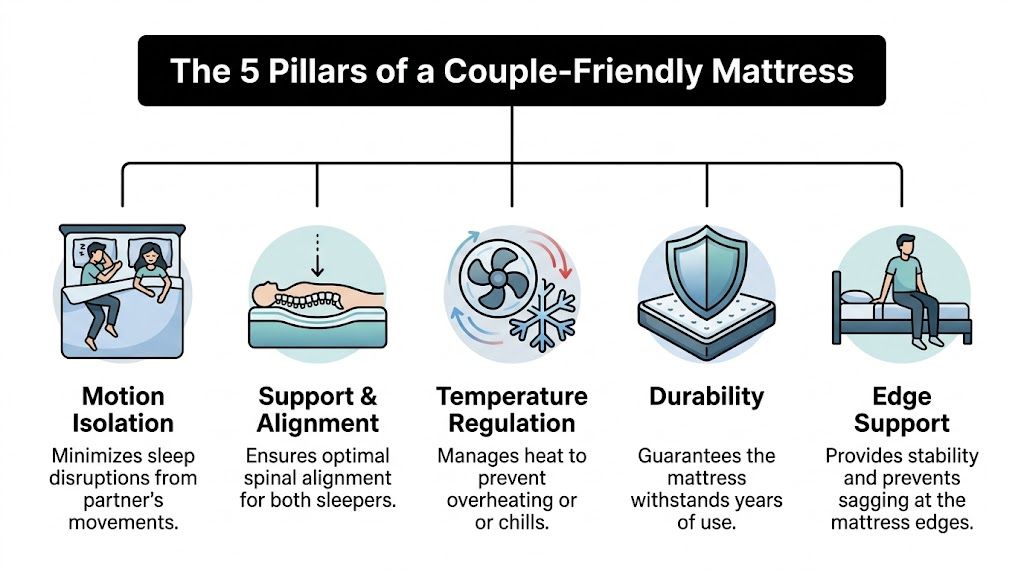
Motion isolation
Think of motion isolation like setting a glass of water on one side of the bed. If your partner rolls over on the other side, does the water stay calm or start rippling?
For couples, this is often the first issue to solve. According to Sleep Foundation’s mattress guide for couples, motion isolation is the most critical factor for couples, 68% of couples say a partner’s tossing and turning is their main sleep interrupter, and top-performing mattresses absorb 95-100% of movement. The same source notes that elite mattresses can keep vibration to under 2 inches of surface ripple in a 200-pound drop test, compared with over 8 inches on traditional spring beds.
If one of you is a light sleeper, this pillar matters more than almost anything else.
Support and alignment
Support doesn’t mean “hard.” That’s one of the biggest points of confusion we hear in the showroom.
A supportive mattress keeps your spine in a healthier position, like a good pair of shoes helps your body stay balanced when you walk. A side sleeper often needs more give at the shoulders and hips. A back sleeper usually wants a steadier, flatter feel through the middle of the body. Couples run into trouble when one person hears “support” and thinks “firm,” while the other hears “comfort” and thinks “soft.”
Practical rule: If your hips sink too far or your shoulders feel jammed, the mattress may feel cozy at first but won’t feel right through the whole night.
Temperature regulation
Temperature issues can make a decent mattress feel terrible.
Some materials hold more warmth close to the body. Others let more air move through the bed. If one person sleeps hot and the other doesn’t, the goal usually isn’t an ice-cold mattress. It’s a surface that avoids heat buildup and stays more neutral.
Edge support
Edge support sounds technical, but the idea is simple. Sit on the side of the bed. Does it feel stable, or does it collapse under you?
For couples, edge support matters because shared sleep shrinks your personal space. If the perimeter is weak, both people tend to drift inward and the mattress can feel smaller than it is. Stronger edges also make getting in and out of bed easier.
Size and personal space
Even the right feel can disappoint if the bed itself is too tight.
A larger sleep surface gives each person more room to turn, stretch, or sleep without feeling crowded. For some couples, going from queen to king changes the whole experience. For others, the breakthrough is not size alone but choosing a split or dual-comfort setup within that larger footprint.
If you want a plain-language breakdown of comfort levels before you shop, our mattress firmness guide can help you translate terms like plush, medium, and firm into what they feel like.
Solutions for Couples with Different Preferences
Once you know what to look for, the next question is practical. What kind of mattress setup works when two people want different things?
Most couples end up in one of three paths. None is automatically right for everyone. The best choice depends on how far apart your needs are, how important adjustability is, and whether you want one shared surface or two independently tuned sides.
The unified compromise
This is the most familiar option. You choose one mattress with a feel that both people can live with.
It tends to work best for couples whose preferences are different, but not opposite. A pair like this might include one person who likes medium and another who likes medium-firm. They may also do well with a balanced hybrid that mixes cushioning at the top with steadier support underneath.
The upside is simplicity. One mattress, one surface, standard bedding, and usually fewer setup questions. The downside is built into the name. Someone may still be compromising more than they want to.
The split king
A Split King uses two Twin XL mattresses side by side to create a king-size footprint. This became a major solution in the early 2010s for couples who struggled with firmness mismatch, and by 2025 it accounted for over 15% of premium mattress purchases, especially among couples ages 35-55, according to Suburban Furniture’s overview of mattresses for couples with different preferences.
This setup shines when one partner wants firm and the other wants plush, or when adjustable-base independence matters. One side can sit up to read while the other stays flat. One sleeper can choose a totally different feel without forcing the other person to adapt.
The trade-off is that some couples notice the center split more than they expected, especially if they aren’t prepared for the bedding and base details that come with it.
The dual-firmness mattress
A dual-firmness mattress keeps one mattress body but changes the feel from side to side.
For couples who dislike the idea of two separate mattresses but still want individualized comfort, this can be an appealing middle path. It often preserves a more unified look and may reduce concerns about the center seam compared with a split setup. It can also be a smart fit for pairs who want different support levels but don’t necessarily need two independently moving bases.
The downside is that not every dual-feel design solves every issue equally well. Some handle firmness differences better than motion or temperature. That’s why testing matters.
Comparing mattress solutions for couples
| Solution | Best For | Pros | Cons |
|---|---|---|---|
| Unified compromise | Couples with moderately similar preferences | Simple setup, one mattress surface, easier bedding | One or both sleepers may still be settling |
| Split king | Couples with very different firmness or position needs | Independent comfort, strong personalization, excellent fit for adjustable bases | Center gap can bother some sleepers, setup details matter more |
| Dual-firmness mattress | Couples who want one mattress with different feels side to side | More customized than a compromise mattress, more unified feel than a split | Not every model solves motion, temperature, and support equally well |
Some couples need a middle ground. Others need independence. The mistake is assuming those are the same thing.
How to choose between them
Ask yourselves three honest questions:
- How far apart are our preferences? If one person likes soft and the other likes firm, a split or dual-firmness design usually deserves serious attention.
- Do we want independent adjustability? If yes, a split setup often makes more sense, especially with an adjustable base. Our article on the benefits of an adjustable base and enhancing comfort and well-being can help you think that through.
- How sensitive are we to seams and setup details? Some couples care most about personalized comfort. Others care most about maintaining one continuous sleep surface.
One practical option couples in Southern Oregon can explore is the sleep-matching support available through Gates Home Furnishings, where split and dual-comfort configurations can be tested in person rather than guessed from online descriptions. That matters because the “right answer” often becomes obvious only when both people lie down and compare.
How Mattress Materials Impact Your Shared Sleep
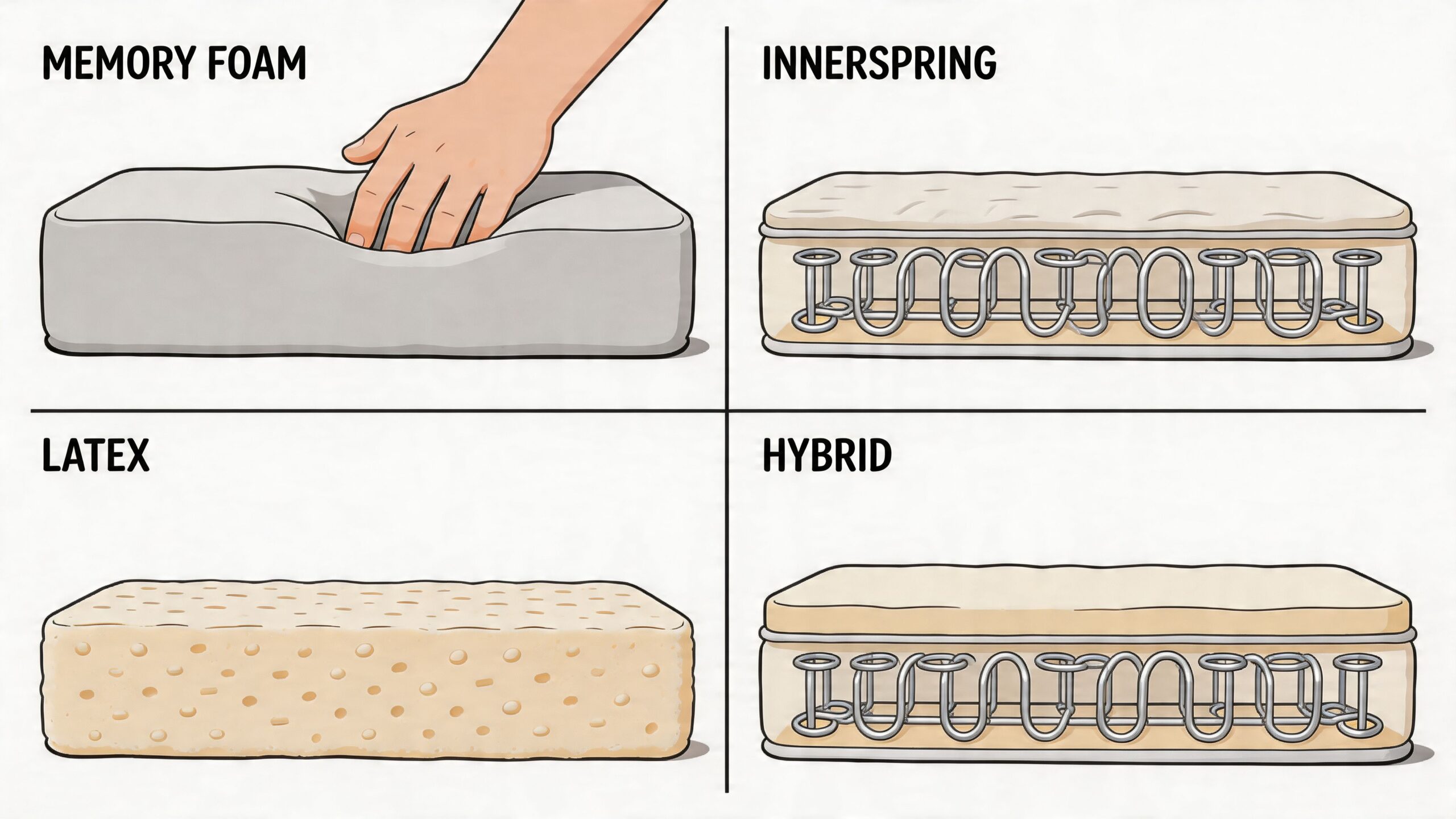
Once a couple chooses a general direction, compromise mattress, split king, or dual-comfort, the next decision is material, a point where many online guides get fuzzy.
Material changes how a bed feels when you first lie down, but it also changes what happens later in the night. That includes movement, heat, support, and the way the mattress responds when two bodies share the same surface.
Memory foam
Memory foam is the material many couples notice first for one reason. It tends to absorb movement well.
If your partner tosses and turns, foam often reduces that “whole bed wiggle” feeling. The trade-off is that some foam designs can feel warmer or more hugging, which one sleeper may love and the other may not. For couples with pressure-point pain, that contouring feel can be a major plus.
Innerspring
Traditional innerspring beds feel more lifted and bouncier. Some sleepers enjoy that easier-on, easier-off surface, especially if they don’t like sinking into a mattress.
The downside for couples is that classic spring designs often pass more movement across the bed. If one person is restless, the other may feel more of it. We often explain innerspring this way. It’s like standing on a wooden dock instead of packed sand. Movement travels more easily.
Latex
Latex usually lands in the middle in an interesting way. It can feel supportive, responsive, and more buoyant than memory foam, while still offering pressure relief.
Many couples like latex because it doesn’t have that deep “stuck” feeling. Others find it a little springier than expected. It’s often a good material to test in person because written descriptions don’t always match what your body feels.
Hybrid
Hybrids try to combine the strengths of multiple materials, usually foam layers above a coil support system. For many couples, practical considerations often begin with hybrids.
A good hybrid can soften the surface enough for pressure relief while keeping enough structure underneath for support and edge stability. That’s one reason couples often gravitate toward hybrid models from brands such as Beautyrest, especially when one person wants cushioning and the other wants a more held-up feel.
If you want an outside primer on the trade-offs, this comparison of Spring Mattress vs Foam Mattress does a nice job of framing how the two categories differ in everyday use.
Smart dual-zone systems
At the premium end of the market, some smart mattresses go beyond static materials and adjust in real time. According to Bryte’s article on mattresses for couples with different sleep preferences, advanced dual-zone systems can use real-time sensors and up to 16 air bladder zones per side to change firmness dynamically. The same source says this technology can achieve up to 90% pressure equalization, reduce partner disturbance by 83% compared with traditional innersprings, and potentially improve sleep efficiency by 25-30%.
That doesn’t mean everyone needs a smart bed. It does show how much material and construction can shape shared sleep when a couple’s needs are far apart.
Materials don’t just change comfort. They change behavior. They affect how the mattress moves, breathes, rebounds, and supports two different bodies at once.
For a closer look at the feel differences many shoppers compare first, our guide on innerspring vs memory foam is a useful next read.
Our Gates Sleep Care System A Guided Journey
Online research helps, but it also creates a strange problem. Couples often arrive with a dozen tabs open, three conflicting opinions, and no real confidence.
That’s why we use the Gates Sleep Care system. It’s not a script. It’s a guided process that helps us narrow the field based on how each person sleeps.
We start with the people, not the product
We ask about sleep position, pressure points, pain concerns, motion sensitivity, and whether either person sleeps warm. We also ask what’s happening on your current bed.
That last part matters more than most shoppers think. “My shoulder goes numb.” “I feel my partner every time they move.” “The edge collapses when I sit down.” Those comments tell us far more than a label that says plush or firm.
Why in-store testing changes the decision
A mattress is one of the few purchases where your body knows the answer faster than your brain does.
Our 30,000 sq. ft. showroom in Grants Pass gives couples the space to compare mattress types, support styles, and comfort levels side by side. You can feel the difference between a responsive hybrid and a slower-moving foam. You can test edge stability. You can see whether one partner’s movement transfers.
Since 1946, George Gates’ promise of Service and Value has meant helping people buy with clarity, not pressure.
That promise still shapes how we guide mattress shoppers today. We’re not trying to rush you into a trend. We’re trying to help two people make one good decision.
Why local guidance matters
National mattress lists can point you toward categories. They can’t watch how your shoulder sits on the bed or notice that your partner’s lower back loses support after a few minutes.
That’s where local, hands-on help earns its place. Couples from Grants Pass, Medford, Central Point, Ashland, and across the Rogue Valley often tell us the same thing after testing in person. The option they expected to love online wasn’t the one that felt right in real life.
Your In-Store Mattress Testing Checklist
If you’re going to test mattresses together, treat it like a real evaluation, not a quick sit-down on the edge of the bed and a guess. A few simple habits make the visit far more useful.

Before you come in
Have a short conversation at home first. Not a long debate. Just enough to get honest.
Use this framework:
- Identify your top priorities. One person may say, “I need pressure relief for my side.” The other may say, “I need firmer back support.”
- Talk about movement. If one person wakes easily, say so early.
- Decide how you feel about split options. Some couples are open to them right away. Others want one-piece solutions first.
- Set a comfortable budget range. That keeps the conversation practical and reduces stress.
What to do on each mattress
Many people lie down for thirty seconds and call it testing. That’s not enough.
Try this instead:
- Lie down in your real sleep position. Side sleepers should spend time on their side. Back sleepers should stay on their back long enough to notice alignment.
- Stay there for a while. Your body often needs several minutes to reveal pressure points.
- Roll over naturally. Don’t move carefully. Move the way you would at home.
- Have your partner pay attention. Did they feel the movement sharply, faintly, or hardly at all?
- Sit on the edge. Notice whether it feels secure or overly compressed.
Questions worth asking during the test
A good showroom visit gets easier when you ask direct questions.
- Does this model come in split or dual-comfort versions?
- How does it behave on an adjustable base?
- Will this feel more cushioning or more lifted over time?
- What type of sleeper usually likes this feel?
If both partners don’t lie down at the same time, you’re only testing half the problem.
What to notice besides comfort
Watch for the less obvious clues. Does one person smile the moment they settle in? Does the other keep adjusting? Does the center of the bed feel supportive when both people are on it?
Those reactions matter. Comfort is physical, but confidence often shows up in body language first.
If you’re visiting from Grants Pass or elsewhere in Southern Oregon, it also helps to wear comfortable clothes and plan enough time to compare several options without rushing. The goal isn’t to test everything. It’s to notice which category keeps pulling both of you back.
Completing Your Sleep Sanctuary with Gates
The mattress is the centerpiece, but it isn’t the whole bedroom experience. A restful room usually comes together when comfort, convenience, and setup all work together.
That’s where practical services matter.
Make the purchase easier on the budget
A better mattress shouldn’t force a stressful financial decision. Gates Easy Pay gives shoppers flexible options, including $0 down, 6-month interest-free, and no-credit-needed options. That means couples can look at the right solution for their sleep needs without feeling boxed into the cheapest short-term choice.
Make delivery easy on your back
We also believe delivery should solve problems, not create them. Our White-Glove Delivery includes professional assembly and mattress haul-away. We don’t just leave a box at the door and wish you luck.
That matters even more with larger sleep systems, adjustable bases, or split setups where proper placement and setup make a real difference.
Think beyond the mattress
A calmer bedroom helps the mattress do its job. Lighting, sound, airflow, and furniture layout all shape how restful the room feels. If you’re also thinking about creating the perfect bedroom environment for silent, blissful sleep, that guide offers useful ideas for reducing noise and improving comfort.
And if you’re furnishing the whole room, our Unique Finds often come into play. Reclaimed wood, teak, and one-of-a-kind statement pieces can turn a bedroom from functional to personal without making it feel generic or mass-produced.
From the mattress to the bed frame to the finishing details, we still believe in what George Gates promised back in 1946. Service and Value.
Frequently Asked Questions From Couples
What about the gap in a split king
This is one of the most overlooked questions in mattress shopping. According to discussion summarized by Mattress Underground’s forum thread on mattress options for couples with different preferences, only about 20% of online reviews address base compatibility and accessories like gap fillers, even though the split-king gap is a common concern.
In practice, the best fix depends on how you use the bed. Some couples are comfortable with the split once they add the right connector or bedding setup. Others prefer a dual-firmness mattress because they want a more continuous surface.
Can a mattress topper solve the problem
Sometimes, but usually only as a short-term patch.
A topper can change surface feel. It usually can’t fully fix deeper support problems, major motion issues, or a large difference in firmness needs between two partners. If one sleeper wants plush and the other wants firm, a topper often helps one person more than both.
Do adjustable bases work for couples with different preferences
Yes, but compatibility matters. If you want both partners to move independently, split setups usually make the most sense. If you mainly want one shared position change, some one-piece mattresses may still work well.
Is it better to shop online or in person
Online research is useful for narrowing options. In-person testing is what turns research into confidence.
That’s especially true for couples, because one mattress has to satisfy two bodies, two sleep styles, and often two very different comfort definitions.
If you’re ready to stop guessing and start testing, visit Gates Home Furnishings in Grants Pass. Since 1946, we’ve helped families across Grants Pass, Medford, Ashland, Central Point, and the Rogue Valley find better sleep with honest guidance, a 30,000 sq. ft. showroom, Gates Easy Pay financing, White-Glove Delivery, and bedroom pieces that include both trusted brands and distinctive Unique Finds. You can also browse our collection online and start narrowing your options before you come in.