Mattress Temperature Regulation Guide for Hot Sleepers

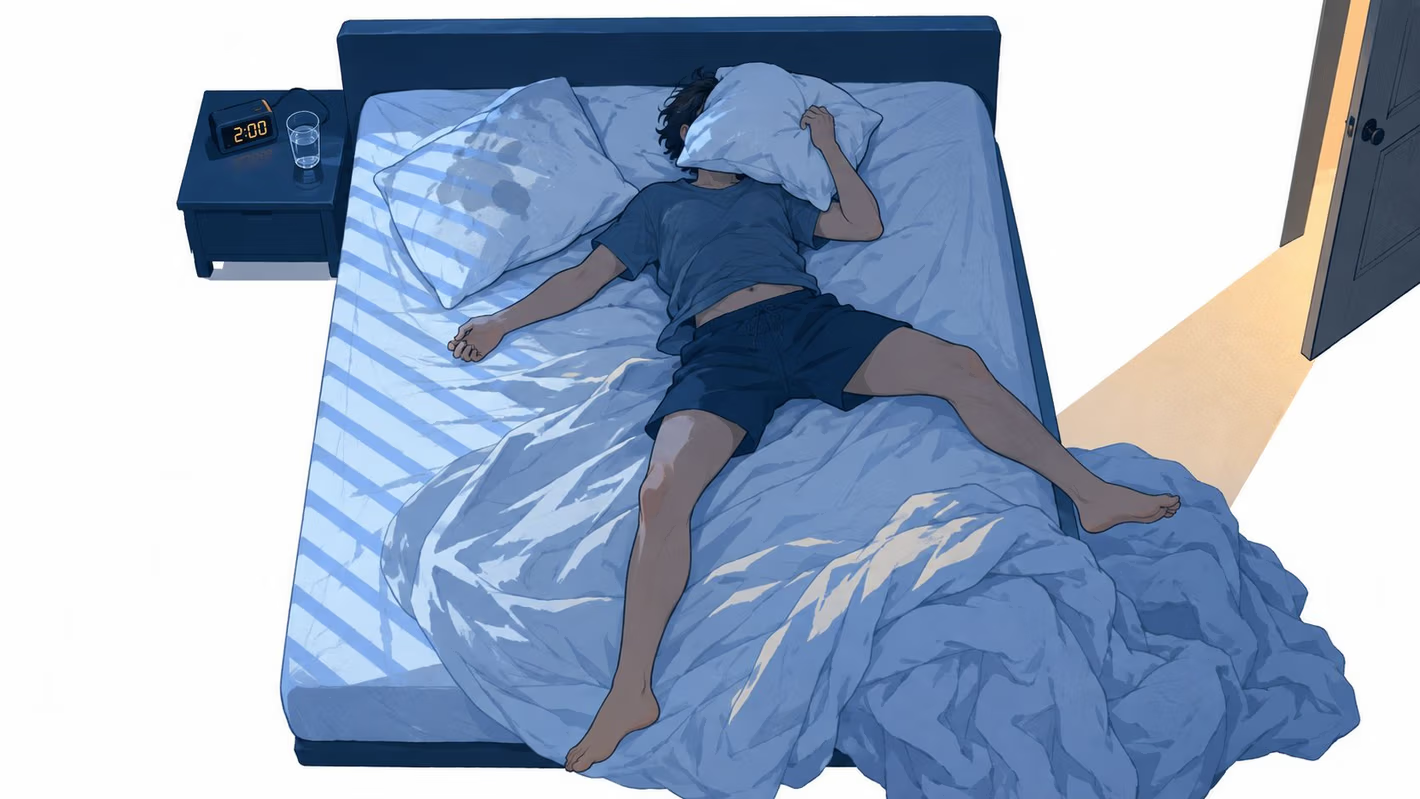
At 2 a.m., the duvet is on the floor, the pillow has been flipped twice, and the sheet feels damp against the skin. A mattress can support the body perfectly and still make sleep harder if it holds warmth and moisture close to the sleeper.
Mattress temperature regulation begins with the body, not a marketing label. Once shoppers understand how the body releases heat, how mattress materials move air and moisture, and how active systems change temperature, they can test cooling claims with more confidence. The most useful comparison rarely comes from a spec sheet alone. It comes from feeling two surfaces side by side, asking precise questions, and noticing how each mattress responds to the body.
Why Hot Sleepers Lose Sleep and What This Guide Covers
Overheating can interrupt sleep onset and contribute to repeated awakenings. It can also influence the balance of sleep stages, which matters because a cooler surface isn't only about feeling comfortable. In a one-week study of a temperature-controlled mattress cover, cooler temperatures during the first half of the night increased deep sleep in men and REM sleep in women. Warmer temperatures during the second half increased light sleep in men and wake time in women, supporting a cause-and-effect relationship between the timing of thermal input and sleep-stage outcomes (controlled mattress temperature study).
That doesn't mean every hot sleeper needs an electronic mattress system. A breathable cover, a more open construction, and a cooler bedroom may solve the problem. The important point is that constant coolness and well-timed cooling aren't necessarily the same experience.
A simple path from science to shopping
The subject becomes easier when approached in three stages:
- Understand the body: The body lowers its core temperature as sleep approaches, then relies on the sleep surface and room environment to release additional heat.
- Compare construction: Foam density, coil spacing, latex structure, cover fabric, quilting, and airflow paths all affect the microclimate around the body.
- Test the result: A side-by-side lie-down can reveal pressure, sink, airflow, and heat buildup more clearly than a product description.
Readers can stop after the science and make useful changes tonight, or continue into material comparisons, active technologies, and showroom testing. For shoppers in Grants Pass, Medford, Central Point, Ashland, and the broader Rogue Valley, a visit to a physical mattress gallery offers a practical way to check whether a surface feels cool after several minutes rather than only at first contact.
A guide to improving sleep quality naturally can help with habits beyond the mattress. The mattress remains important, but it works as part of a complete sleep environment.
How Your Body Regulates Temperature at Night
The body doesn't wait until sleep begins to start cooling. Core temperature must fall about 1 to 2°F, roughly 1°C, to initiate sleep, and the decline typically begins about two hours before habitual bedtime, as described in this overview of sleep thermoregulation. The process works like a household thermostat receiving a bedtime signal. Blood vessels near the hands and feet widen, allowing more heat to move from the core toward the skin and escape into the surrounding environment.
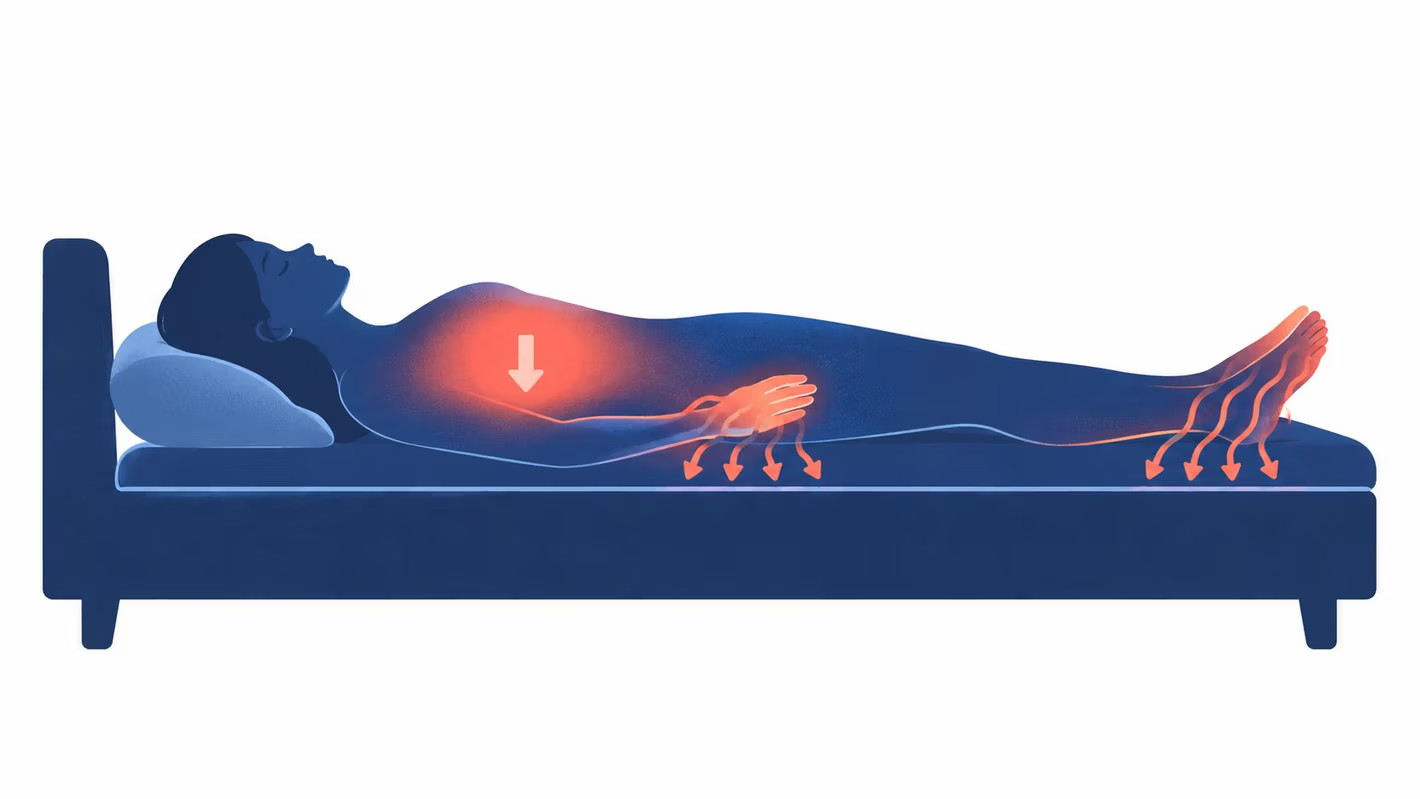
At the mattress surface, heat leaves through several pathways. Conduction moves heat directly into the foam, latex, fabric, or coils touching the body. Convection carries warmth through moving air, while radiation transfers heat into nearby bedding and surfaces. Evaporation uses perspiration to remove heat, but that process slows when humidity is high or when a mattress cover holds moisture against the skin.
The sponge and fan comparison
Dense foam can behave somewhat like a warm sponge. It absorbs body heat and may keep that warmth in the contact area, especially when the sleeper sinks into the material. A more breathable construction adds the equivalent of a fan and open channels, giving heat and water vapor a route away from the body.
Material-interface research illustrates why structure matters. In a controlled evaluation, spacer fabric dissipated heat with a heat flux of 33.6 W/m², compared with 10.4 W/m² for viscoelastic foam. With active airflow, the spacer fabric also reduced relative humidity from 99% RH to 40% RH over 24 hours, showing how airflow and breathable structure can move both sensible heat and moisture away from the support interface (spacer fabric and mattress heat dissipation research).
Practical rule: A mattress feels cooler when it gives heat and moisture somewhere to go, not simply when its cover feels cool for the first few moments.
Two people can sleep on the same mattress and report very different temperatures. Body size, sleep position, clothing, perspiration, contact area, and personal sensitivity all change heat transfer. A side sleeper may experience a different pressure and contact pattern than a back sleeper, while a partner can add warmth and reduce airflow across the shared surface.
Cooling Materials and How They Move Heat
Cooling materials work through different physical mechanisms, and none deserves a blanket promise. Dense memory foam contours closely, which can reduce motion transfer and create a cushioned feel, but that close contact can also reduce airflow around the body. Gel beads, copper, graphite, and phase-change coatings attempt to absorb, spread, or delay heat release. They may improve the initial feel, yet the surrounding foam density, cover, and base still determine whether warmth eventually builds.
Latex generally feels more buoyant and responsive than conventional memory foam. Its open-cell structure can support greater breathability, with Talalay and Dunlop constructions offering different feels and firmness profiles. A latex surface may suit sleepers who want less sink and easier movement, although the overall mattress can still run warmer or cooler depending on its cover and lower layers. The differences between latex and foam become clearer in this latex mattress versus memory foam comparison.
Innerspring and hybrid designs use coil spaces as air channels. Air can circulate through those spaces as the sleeper moves, helping heat and moisture disperse. Ventilated foams, copper-infused latex, and phase-change material treated covers take a more targeted approach, but shoppers should ask how much of the mattress uses the cooling feature and whether it sits only in the cover.
Cooling Mattress Materials Compared
| Material | Heat-Transfer Mechanism | Cooling Performance | Best For | Trade-Offs |
|---|---|---|---|---|
| Dense memory foam | Absorbs heat while contouring closely | Can feel warm when airflow is limited | Sleepers seeking pressure relief and motion isolation | May retain heat and release odors during the initial airing period |
| Gel, copper, or graphite infused foam | Spreads or absorbs heat within the foam | Can moderate surface warmth | Foam lovers who want a familiar contouring feel | Cooling effect depends on foam density, cover, and total construction |
| Talalay or Dunlop latex | Uses a more breathable, responsive structure | Often supports a less enclosed feel | Combination sleepers and shoppers wanting easier movement | Can cost more, and motion isolation may feel different from memory foam |
| Innerspring or hybrid coils | Creates internal air channels for convection | Supports airflow through the mattress core | Sleepers who prefer bounce and a more open build | Partner movement may be more noticeable depending on the design |
| Phase-change material | Absorbs heat as the surface changes temperature | Can smooth short-term temperature swings | Shoppers who want a cooler-feeling cover | It doesn't replace ventilation through the rest of the mattress |
| Ventilated foam | Uses perforations or channels to move air | Varies with channel design and foam type | Foam sleepers who need more breathability | Open areas can alter feel, support, and durability |
The cover fabric, quilting pattern, and base layers can change the final result as much as the headline material. A breathable top layer may lose its advantage if a thick protector blocks airflow. Conversely, a well-ventilated core may feel less effective under dense quilting.
Active Cooling Technologies Worth Knowing
Passive cooling relies on material and construction. Active cooling adds a powered system that can remove or circulate heat when needed. Gel, copper, graphite, phase-change materials, ventilated latex, and air channels remain passive, even when their descriptions use words such as advanced or responsive.
True active systems include water-circulation mattresses, fan-driven bed systems, and semiconductor climate layers. Water systems move temperature-controlled fluid through a surface or cover. Fan systems move air through a connected layer. Semiconductor, or Peltier, systems use electrical components to create heating or cooling zones. Each approach adds equipment that needs evaluation beyond the first cool touch.
Static cooling and dynamic control
A static system maintains one selected temperature or provides a consistent cooling sensation. A dynamic system changes its output according to time, sleep stage, or sensor feedback. That distinction matters because the body doesn't require the same thermal input throughout the night. Pre-cooling may help with sleep onset, moderated cooling may support the middle of the night, and a gradual temperature change near morning may reduce the shock of waking in a cooler environment.
Recent research on real-time mattress temperature adjustment tied to sleep stages reported increases in total sleep time, sleep efficiency, REM sleep, and deep sleep compared with control conditions. A separate polysomnography study reported similar benefits from adaptive thermal regulation (stage-based mattress temperature research). These findings make dynamic control an important question for shoppers, while still leaving room for individual testing and careful interpretation.
Active Cooling Technologies at a Glance
| Technology | How It Cools | Best For | Trade-Offs |
|---|---|---|---|
| Water circulation | Moves conditioned water through a mattress cover or layer | Sleepers wanting adjustable temperature control | Requires power, tubing, cleaning, and attention to noise |
| Fan-driven airflow | Pulls or pushes air through a breathable layer | People who prefer moving air and a dry sleep surface | Fan sound, filters, and maintenance may matter |
| Semiconductor climate layer | Uses electrical components to create localized cooling or heating | Sleepers wanting precise zone control | More hardware, power use, and warranty questions |
| Stage-based adaptive control | Changes temperature in response to timing or sleep-stage information | People whose overheating changes through the night | Requires sensors, software, power, and dependable setup |
| Passive cooling layer | Uses conductive, breathable, or phase-change materials | Shoppers wanting simplicity | Cannot actively respond to changing conditions |
A showroom demonstration should include the controls, not just the mattress surface. The shopper should ask how the system is powered, where the controller sits, how loud it operates, what maintenance it needs, and which components the warranty covers. A gel memory foam mattress option can help a shopper compare passive cooling feel against more complex active systems.
Practical Tips to Sleep Cooler Starting Tonight
A new mattress isn't the only answer. Small changes work best when they remove a specific barrier to heat loss, such as heavy fabric, trapped humidity, blocked airflow, or a pillow that holds warmth near the head.
Start with the layers closest to the skin
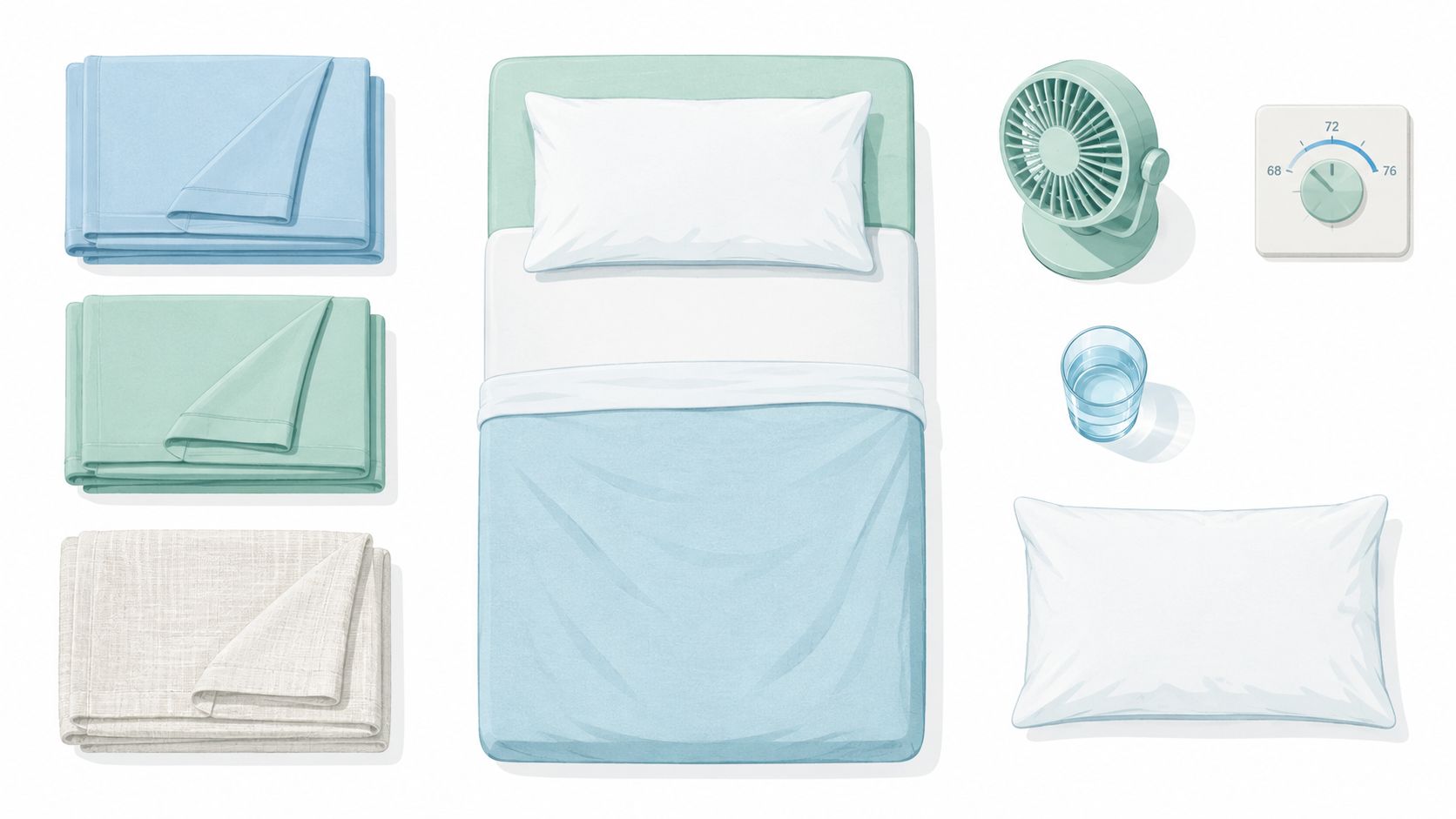
Percale, Tencel, linen, and other breathable bedding can let air and moisture move more freely than tightly woven or heat-retaining fabrics. Thread count alone doesn't tell a shopper whether bedding will sleep cool. Fiber, weave, finish, and the sleeper's own perspiration pattern matter more than a single label number.
A cooling protector or topper can offer a temporary adjustment, but it also adds another layer between the body and the mattress. Choose a design that preserves airflow rather than placing a dense barrier over a breathable surface. Anyone dealing with a warm bedroom should also review practical home cooling help for the room itself, not just the bed.
Reduce heat around the room
- Move air across the bed: A fan aimed so air travels across the sleeping surface can support evaporation more effectively than air that circulates elsewhere.
- Control humidity: Moist air slows evaporation, so ventilation or a suitable room system can help the body's natural cooling process.
- Adjust bedding by layer: Keep a lightweight sheet close at hand and use heavier bedding only when needed, so temperature changes don't require a full wake-up.
- Protect the sleep surface: Use window coverings when sunlight has warmed the room, then ventilate when outdoor conditions are more favorable.
Maintenance also affects temperature. Wash protectors according to their care instructions, air the bed when practical, and rotate the mattress if the manufacturer permits it. Pillows can hold heat near the head and neck, so an old or dense pillow deserves the same scrutiny as the mattress.
A detailed guide to mattress care for a cool, clean bed can help turn those habits into a routine. If these changes reduce sweating but don't stop wake-ups, the surface construction may be the remaining issue.
Choosing the Right Cooling Mattress
The right cooling mattress depends on the complaint, the sleeper, and the desired feel. A shopper who loves deep memory foam but wakes warm may prefer an open-cell or copper-infused option. Someone who changes positions often may find a responsive latex hybrid easier to move across than a contouring foam bed. A partner who sleeps hot adds another reason to examine airflow and the amount of shared surface contact.
Match the construction to the problem
| Common complaint | Construction to test | What to notice |
|---|---|---|
| The body sinks and feels enclosed | Responsive latex or a ventilated foam | Whether movement feels easier and the surface remains open |
| The surface feels cool at first, then warms | Hybrid coils with breathable upper layers | Whether warmth disperses after several minutes |
| Partner movement causes repeated disturbance | Contouring foam or a stable hybrid | Whether motion isolation remains comfortable without excessive sink |
| Pressure relief matters more than bounce | Zoned foam or a cushioned hybrid | Whether the body stays supported without creating a hot pocket |
| Heat comes mainly from the cover | Cooling cover with breathable quilting | Whether the cool sensation continues after initial contact |
A proper test should last long enough for the body to settle. Lie in the usual sleep position, then switch positions as normally done at home. Compare two models after several minutes, notice whether the back or hips feel supported, and ask whether the cover, comfort layer, and base each contribute to cooling.
Gates Sleep Care gives shoppers a guided way to evaluate support and temperature in the 30,000-square-foot Grants Pass showroom. The same local team serves shoppers from Medford, Central Point, Ashland, and throughout Southern Oregon, so the decision can be based on body position and feel rather than a label alone. A focused mattress guide for hot sleepers can help narrow questions before the visit.
Cleanliness affects comfort after purchase, too. For professional information about hospitality mattress cleaning methods, shoppers can review Renue Systems Four Points hospitality cleaning. The practical takeaway is simple. Test the mattress, understand the layers, and confirm care requirements before committing.
Frequently Asked Questions From Hot Sleepers
Does feeling cool mean the mattress improves sleep stages?
Not always. A 2025 controlled study found that a temperature-controlled mattress cover improved perceived sleep quality, calmness, thermal comfort, and refreshment, but it didn't significantly change objective sleep metrics or biometric measures (2025 temperature-controlled cover study). The clear takeaway is to separate subjective comfort from measurements such as polysomnography. A cooler-feeling surface may be valuable even when an objective sleep change isn't demonstrated for every sleeper.
What should active cooling warranties cover?
Ask for the warranty documentation before buying. The mattress warranty and the cooling module warranty may have different terms, exclusions, service processes, and coverage periods. Confirm what happens if a controller, pump, fan, sensor, or connection stops working, and ask whether the mattress remains usable without the powered component.
How long should foam or latex be given to settle?
Allow a reasonable adjustment period rather than judging only the first night. Foam may change in feel as it airs and as the sleeper becomes accustomed to its contour, while a latex hybrid often feels more immediately responsive. A shopper who has been advised to allow 30 to 60 nights for foam to stabilize should still contact the retailer if the mattress creates persistent discomfort or unusual heat.
Can a cooling pad void a mattress warranty?
It can, depending on the manufacturer's terms. Read the warranty before adding a pad or topper, especially if the accessory has straps, heating elements, liquid, or a dense barrier that changes the support surface. Keep receipts and product documentation, and ask the retailer to confirm compatibility in writing.
How can shoppers separate evidence from marketing?
Request independent temperature or humidity testing when a claim sounds specific. Ask whether the data applies to the cover, a single layer, or the complete loaded mattress. During showroom time, rest on candidate beds for several minutes, probe the edge and surface layers, and ask staff to explain every cooling feature in plain language.
Gates Home Furnishings has served Grants Pass and the Rogue Valley since 1946, guided by George Gates Jr.'s original promise of “Service and Value.” The local showroom includes mattresses alongside La-Z-Boy, Flexsteel, Ashley, and Beautyrest furnishings, plus Unique Finds made with reclaimed wood and teak. Financing through Gates Easy Pay includes $0 down, 6-month interest-free options, and no-credit-needed choices, while white-glove delivery includes professional assembly and mattress haul-away rather than a simple box drop.
Visit Gates Home Furnishings in the Grants Pass showroom to test cooling materials, covers, and mattress feels side by side with guidance from the Gates Sleep Care team. Ask about Gates Easy Pay, white-glove setup, and mattress haul-away so the path from choosing a cooler sleep surface to enjoying it at home is clear.