Best Mattress for Stomach Sleepers: Top Picks for 2026


A lot of stomach sleepers land on this page after the same kind of morning. They wake up with a tight lower back, a stiff neck, or that tired feeling that says the body never fully relaxed. The mattress may feel soft at first, but by sunrise it's working against them.
That's why the search for the best mattress for stomach sleepers is different from a general mattress search. Stomach sleepers make up only 7% of Americans, according to Saatva's stomach sleeper guidance, so broad advice often misses what this group needs. A more focused approach matters.
Since 1946, Gates has served Southern Oregon on George Gates Jr.’s promise of Service and Value. That kind of local sleep guidance still matters, especially for shoppers in Grants Pass, Medford, Central Point, Ashland, and across the Rogue Valley who want clearer answers before they buy. For readers who want to improve the bigger picture of nightly rest, this guide on how to improve sleep quality is a helpful companion to mattress shopping.
Table of Contents
- Your Guide to Better Sleep as a Stomach Sleeper
- Understanding the Stomach Sleeper's Spinal Dilemma
- Finding Your Perfect Firmness Level
- The Best Mattress Materials for Stomach Sleepers
- More Than a Mattress Pillows Toppers and Technique
- The Gates Advantage How to Test a Mattress in Person
- Common Questions from Southern Oregon Stomach Sleepers
Your Guide to Better Sleep as a Stomach Sleeper
Stomach sleepers usually don't need more marketing. They need a mattress that keeps the body from folding into the bed overnight.
The challenge starts with how weight settles in this position. The body typically carries more pressure through the midsection than through the chest, so the hips tend to drop first. When that happens, the lower back often takes the strain.
That's why mattress shopping for stomach sleepers should start with support, not fluff. A bed can feel cozy in a showroom or in an online photo and still be the wrong fit once the sleeper lies face down for the night. The right choice supports the hips and abdomen without feeling like a board.
A useful way to think about it is this:
- Soft comfort isn't the goal. Pressure relief still matters, but too much sink usually creates the very pain people are trying to solve.
- Surface resistance is good. Stomach sleepers usually do better when the mattress gently pushes back instead of letting the middle of the body settle too far.
- Construction matters. Material choice changes how a mattress feels under the pelvis, chest, and shoulders.
Stomach sleepers often feel best on a mattress that gives more lift than hug.
That doesn't mean every stomach sleeper needs the exact same bed. Body type, old injuries, temperature preference, and whether someone rolls to the side during the night all shape the final choice. But the starting point is almost always the same. Keep the spine closer to neutral, and mornings usually improve.
Understanding the Stomach Sleeper's Spinal Dilemma
A stomach sleeper's biggest problem often starts in the center of the mattress. If the surface is too forgiving, the hips sink lower than the upper body. The spine then bends into an unhealthy curve, much like a hammock sagging too much in the middle.
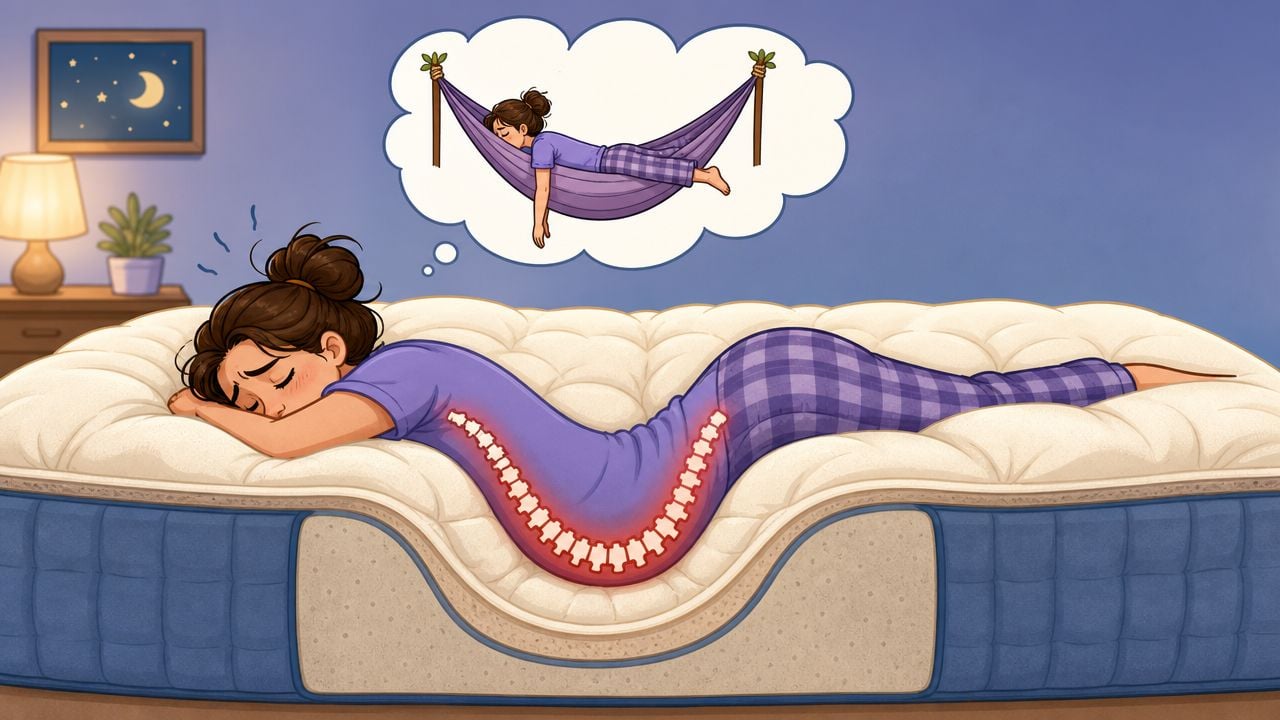
For shoppers dealing with recurring soreness, this guide on how to choose a mattress for back pain can help connect mattress feel with what the body is doing overnight.
Why the lower back takes the hit
When someone lies on the stomach, the pelvis and abdomen press down first. On a mattress with too much give, those areas drop while the chest stays higher. That creates extra extension through the lumbar spine.
The result is often easy to spot in the morning:
- Aching across the beltline
- Tight hip flexors
- A stiff feeling when standing up
- A sense that sleep didn't feel restorative
This is one reason stomach sleeping gets tricky. The body isn't evenly loaded the way it might be on the back. The middle section wants to sink, and the mattress has to stop that from happening too much.
What neutral alignment actually means
Neutral alignment sounds technical, but the idea is simple. The spine should rest in a position that doesn't force it to twist, arch, or collapse for hours at a time.
For a stomach sleeper, that usually means the mattress does three jobs at once:
- Supports the hips and abdomen
- Allows a bit of cushioning at the chest
- Prevents the body from bowing downward in the middle
Practical rule: If the mattress lets the stomach and hips fall noticeably below the rest of the body, it's probably too soft for regular stomach sleeping.
A lot of mattress confusion comes from the fact that “soft” can feel pleasant for a few minutes. But short-term softness and overnight support aren't the same thing. A mattress can feel inviting at first contact and still place the lower back in a poor position by the end of the night.
That's why spinal alignment is the core issue. Once shoppers understand that, the rest of the decision gets easier.
Finding Your Perfect Firmness Level
For most stomach sleepers, firmness is the first filter. It doesn't answer every question, but it narrows the field quickly and keeps shoppers away from mattresses that are likely to let the pelvis dip too low.
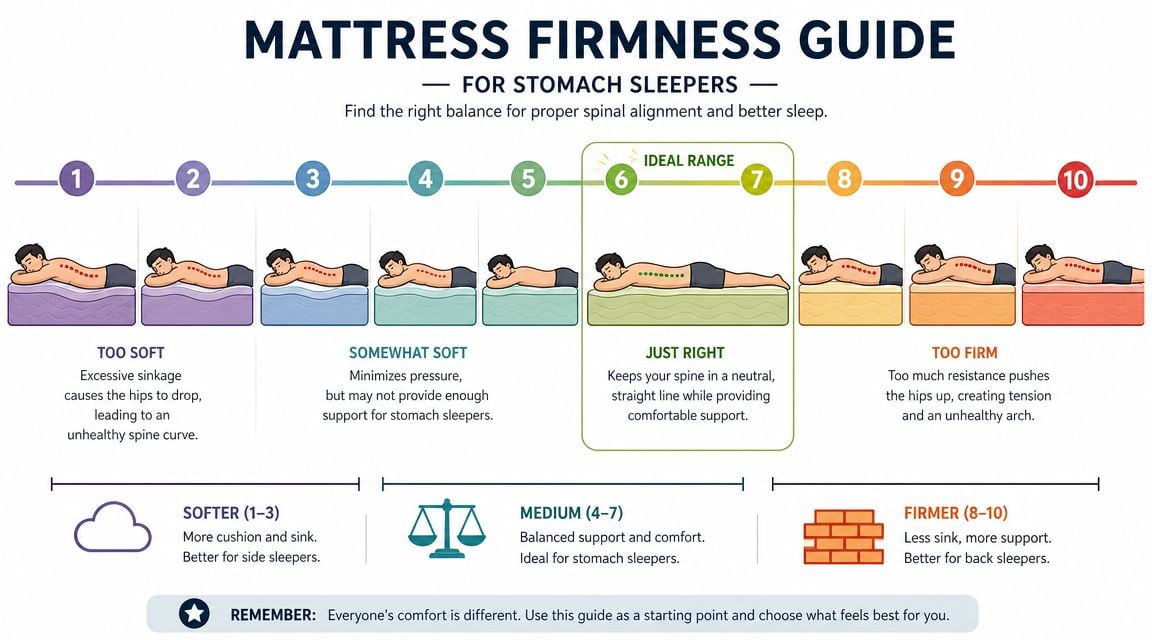
According to the National Council on Aging guidance for stomach sleepers, stomach sleepers should prioritize a mattress with a firmness rating between 6.5 and 9 out of 10 to help maintain a neutral spine. That range is firm enough to reduce the risk of the pelvis dropping below the shoulders, which can increase lower-back stress.
What the firmness scale is really telling you
A firmness scale is just a shorthand for feel. Lower numbers feel plusher and allow more sink. Higher numbers feel flatter, stronger, and more resistant under weight.
For stomach sleepers, the practical takeaway is usually this:
| Firmness feel | How it often performs for stomach sleepers |
|---|---|
| Soft | Usually allows too much sink through the midsection |
| Medium | Can work for some bodies, but needs careful testing |
| Medium-firm to firm | Most reliable starting zone |
| Extra firm | Useful for sleepers who want very strong pushback |
A firmer surface helps keep the torso from collapsing into the bed. But firmness should still feel supportive, not punishing. If the chest and pelvis feel jammed into a rigid surface with no contour at all, the mattress may be firm in the wrong way.
Why firm does not mean hard
Many shoppers mistakenly believe firm mattresses lack comfort. A mattress can be firm and still have comfort. The better models for stomach sleepers offer a stable support core with just enough cushioning on top to avoid sharp pressure at the ribs, knees, or chest.
That's also why pain can show up in more than one place. If the mattress is too soft, the lower back may ache. If the surface is too unyielding or the body isn't positioned well, the neck and pelvis may complain too. Readers dealing with that kind of discomfort may find Lake City Physical Therapy for pelvic health helpful for understanding how sleeping position can affect the body.
A local shopper comparing options can also use this mattress firmness guide to make sense of showroom labels and online descriptions.
The right firmness feels steady under the hips while still giving the body a place to settle.
That's why a firmness number should be treated as a starting point, not the final answer. Two mattresses labeled “firm” can behave very differently once a real person lies on them.
The Best Mattress Materials for Stomach Sleepers
Once firmness is narrowed down, material choice becomes the next big decision. Construction changes how the mattress lifts, contours, cools, and responds when the sleeper moves.
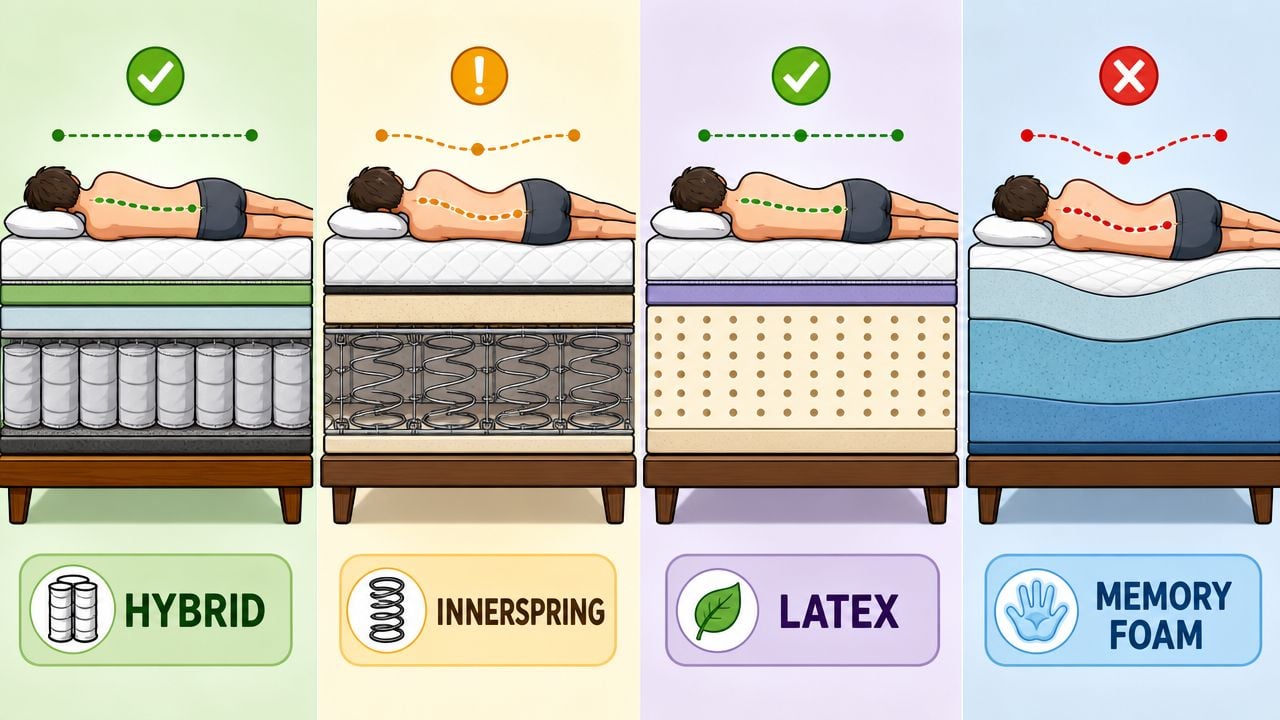
Expert guidance has shifted toward hybrid, latex, and innerspring constructions because they tend to provide the lift stomach sleepers need. Sleep Advisor's overview of mattresses for stomach sleepers notes that this is a meaningful change from older advice that treated any firm mattress as good enough.
How the main mattress types compare
Each material behaves differently under the body.
- Hybrid mattresses combine a supportive coil system with comfort layers on top. For many stomach sleepers, this creates a useful balance of lift and pressure relief.
- Innerspring mattresses usually feel more buoyant and straightforward. They often appeal to sleepers who want less sink and a flatter sleeping surface.
- Latex mattresses tend to feel responsive and gently springy. They can support the hips well without the slow-melting feel some sleepers dislike.
- Memory foam mattresses vary the most. Some firmer foam beds can work, but softer all-foam models often let the midsection settle too far.
A quick comparison helps:
| Mattress type | Main strength for stomach sleepers | Main caution |
|---|---|---|
| Hybrid | Balanced support and contouring | Top layers still need to be controlled, not plush |
| Innerspring | Strong lift and easier movement | Can feel too flat if comfort layers are minimal |
| Latex | Responsive support with less sink | Feel is different from traditional foam and should be tested |
| Memory foam | Can reduce pressure points in some designs | Too much contour can throw off alignment |
What to notice beyond the label
The label alone doesn't tell the whole story. Shoppers should pay attention to how quickly the surface responds, whether the hip area stays supported, and whether the bed traps warmth.
Features that often matter for stomach sleepers include:
- Supportive coils that resist deep compression
- Restrained contouring rather than a plush pillow-top feel
- Breathable foams or covers for temperature control
- A stable center section under the torso
For readers weighing foam options specifically, this explanation of what is a memory foam mattress can help clarify why some foam beds feel supportive while others feel too enveloping.
One practical note for local shoppers: selections in a mattress gallery often include multiple material types from established brands such as Beautyrest. In Southern Oregon, some stores also carry extra firm and medium mattresses that can suit stomach sleepers, depending on how the support system is built.
More Than a Mattress Pillows Toppers and Technique
Even the right mattress can't do all the work alone. Pillow height, topper choice, and sleeping technique can either help alignment or undo it.
Pillow height matters more than most people think
Many stomach sleepers do better with a very thin pillow or no pillow under the head at all. The reason is simple. A thick pillow pushes the head upward while it's already turned to one side, which can increase strain through the neck.
That doesn't mean every stomach sleeper should sleep flat with nothing. It means the head should stay as close to neutral as possible for the position. People waking up with neck tightness can also look at MedAmerica Rehab Center's neck pain insights for a useful explanation of how sleep posture affects the cervical spine.
Helpful pillow habits often include:
- Choose low loft. Thick, overstuffed pillows usually create too much bend at the neck.
- Keep the face angle gentler. If possible, avoid turning the head sharply to one side all night.
- Consider a small support under the pelvis. Some sleepers find that a thin pillow there reduces lower-back arching.
When a topper helps and when it doesn't
A topper can help in one narrow situation. If the mattress is supportive but feels just a touch too firm at the surface, a thin topper may add comfort without ruining alignment.
A topper usually does not help when the mattress is already too soft. In that case, adding more cushioning often makes the main problem worse.
A topper can fine-tune feel. It can't rebuild support that isn't there.
That distinction saves people from spending money in the wrong place. If the hips are sinking too far, the answer is usually a more supportive mattress, not a plusher layer on top.
Technique matters too. Some stomach sleepers feel better in a slight three-quarter position with one knee bent and the body partly rotated. It's still close to stomach sleeping, but often places less stress on the lower back and neck.
The Gates Advantage How to Test a Mattress in Person
Online research is useful, but for stomach sleepers it should be preparation, not the final step. This sleep position is too specific for guessing based on reviews alone.

Guidance for stomach sleepers increasingly points to nuance over slogans. The video discussion on stomach sleeper mattress choice emphasizes that in-person testing matters because a shopper can feel the difference between a mattress that is merely firm and one that offers the right mix of surface resistance, pressure relief, and cooling for that body type.
Why online research is only the first step
Two mattresses can share the same firmness label and still feel completely different. One may hold the hips up with gentle contouring. Another may feel flat at first, then slowly allow too much sink. That distinction is hard to judge on a screen.
In-person testing helps shoppers answer questions reviews can't settle:
- Does the pelvis stay level or drop?
- Does the chest feel supported or jammed?
- Is the surface easy to move on when changing position?
- Does the mattress sleep too warm?
That's where a physical showroom becomes valuable. A store with enough variety gives shoppers the chance to compare material, firmness, and feel side by side instead of gambling on descriptions.
How to do a real mattress test drive
A proper test shouldn't be rushed. In a large 30,000 sq. ft. showroom in Grants Pass, shoppers from Medford, Central Point, Ashland, and across the Rogue Valley can lie in their normal sleep position and pay attention to what the body says after a few quiet minutes.
A simple test process works well:
- Lie on the stomach first. Don't start seated on the edge and guess from there.
- Notice the hip area. It should feel supported, not swallowed.
- Check the neck position. Bring the pillow setup as close as possible to what's used at home.
- Roll once or twice. Combination sleepers need to know how the bed responds during movement.
One local option for that hands-on process is Gates Home Furnishings, where the mattress gallery and Gates Sleep Care system help narrow choices by feel and support needs. The setting also makes it easier to compare established brands such as Beautyrest alongside other comfort options.
There's also the practical side after the purchase. Gates Easy Pay includes $0 down, 6-month interest-free, and no-credit-needed options. Delivery matters too. Professional white-glove service means the team sets the mattress up and hauls the old one away instead of leaving a boxed bed at the front door.
For many households, that full process matters just as much as the mattress itself. A family-owned store founded in 1946 can still offer something online-only shopping can't. Real testing, real guidance, and real follow-through. Shoppers may even come across the store's Unique Finds in reclaimed wood and teak while they're there, which is one more reason the showroom stands apart from a typical big-box stop.
Common Questions from Southern Oregon Stomach Sleepers
Can a lighter stomach sleeper choose something less firm
Sometimes, yes. Lighter sleepers often don't sink as far into the mattress, so a slightly less firm model may still keep the body in good alignment. The key is whether the hips stay supported once the sleeper fully relaxes.
What if someone shifts between stomach side and back
That changes the decision. Mattress guidance isn't one-size-fits-all, especially for lighter stomach sleepers and combination sleepers. NapLab's discussion of stomach sleeper mattress fit notes that construction details such as supportive coils and breathable foams can matter more than a simple firmness number when a mattress must work across multiple positions.
Can a soft mattress ever work
For dedicated stomach sleeping, usually not. A soft surface often feels pleasant for a moment, then lets the torso settle too far into the bed. That tends to be the opposite of what this sleep position needs.
If a mattress feels cozy but the hips sink first, it's probably the wrong direction for a stomach sleeper.
Is there an adjustment period with a firmer mattress
There can be. If someone has been sleeping on a sagging or very plush bed, a more supportive mattress may feel different at first. That doesn't automatically mean it's the wrong choice.
What matters is the trend after the first several nights. If the body starts feeling more level and mornings improve, that's usually a good sign. If pressure points or neck strain keep getting worse, the fit needs another look.
For shoppers around Grants Pass and Southern Oregon, in-person guidance can particularly save time. A few minutes of careful testing often answers questions that weeks of online searching never quite resolve.
For stomach sleepers who are ready to stop guessing, Gates Home Furnishings offers a practical next step. Visit the Grants Pass showroom to test supportive mattress options in person, compare feel across materials, and get help from a local team that has served the Rogue Valley since 1946 on George Gates Jr.’s promise of Service and Value. Shoppers can also browse the collection online, ask about Gates Easy Pay financing, and arrange white-glove delivery with setup and mattress haul-away.