
Reclaimed Wood Media Console Guide for Your Home


Choosing a reclaimed wood media console by its color and weathered texture alone is popular advice, but it puts appearance ahead of the details that determine whether the piece will work. A handsome cabinet can still have poorly supported shelves, an unsuitable finish, or compartments that trap heat around electronics. The better approach is to evaluate materials, construction, and equipment fit before styling.
Why Reclaimed Wood Belongs in a Media Room
A Southern Oregon living room might combine a comfortable sofa, a television, family photographs, and a game system that never quite disappears. Reclaimed wood can soften that collection of screens and cables with grain, irregular color, and a sense of history. The appeal isn't just rustic style. It's furniture that gives a technology-heavy room a more personal atmosphere.
Consider a room with pale walls and upholstered seating. A console with varied boards can provide a visual anchor without requiring matching tables or elaborate decoration. Its surface becomes part of the room's character rather than just a platform beneath the screen.
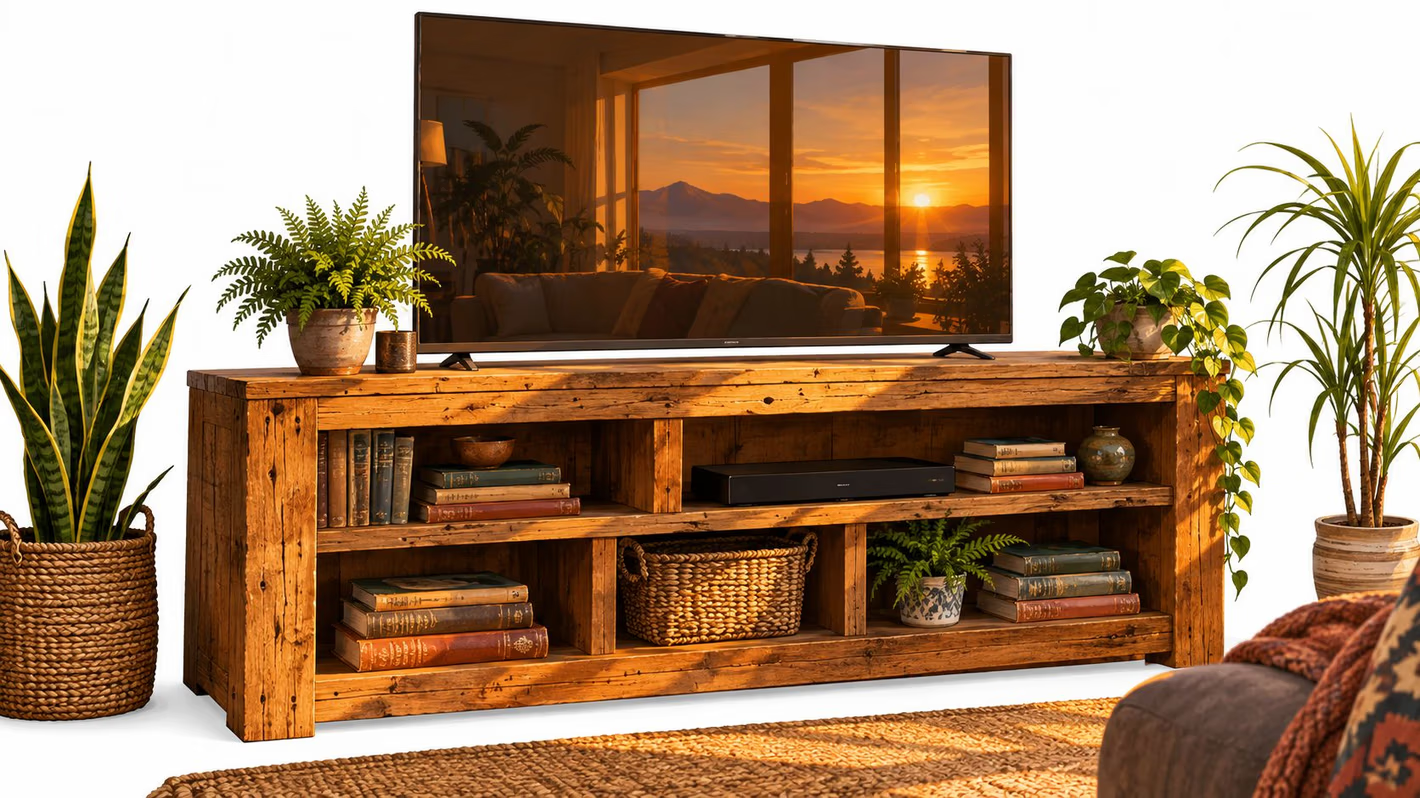
More than a decorative cabinet
A media console has several jobs, and they deserve equal attention:
- Furniture: Its proportions should suit the seating arrangement and leave usable walking space.
- Storage: Doors, drawers, and shelves should accommodate what the household keeps.
- Equipment platform: The top and compartments need appropriate support, access, and ventilation.
For broader layout inspiration, Famous Movie Posters offers a resource to help plan your viewing room. Treat the room arrangement and the console selection as connected decisions, not separate purchases.
Character worth examining in person
Reclaimed describes a material's previous use, not a guarantee of craftsmanship. An appealing board still needs suitable preparation and sound construction before it belongs beneath valuable electronics.
Founded in 1946 by George Gates Jr., Gates continues the original promise of “Service and Value,” with a 30,000-square-foot showroom in Grants Pass where customers can test furniture in person, including seating comfort and furniture proportions, as described on the Gates website. Its Unique Finds offer an opportunity to consider reclaimed wood, teak, and individual statement pieces alongside the rest of a room.
A console should earn its place through both character and everyday usefulness.
What Makes a Reclaimed Wood Media Console Different
Think of a reclaimed console as a restored vintage cabinet. The visible face tells part of its story, but the frame, shelves, and hardware determine how it functions. A weathered door doesn't reveal what's behind it.
A piece may combine genuine reclaimed boards with new plywood, particleboard, adhesives, metal components, or repaired sections. That combination isn't automatically a problem. An undefined material description is the problem, because buyers can't evaluate construction or care requirements without knowing what each component contains.
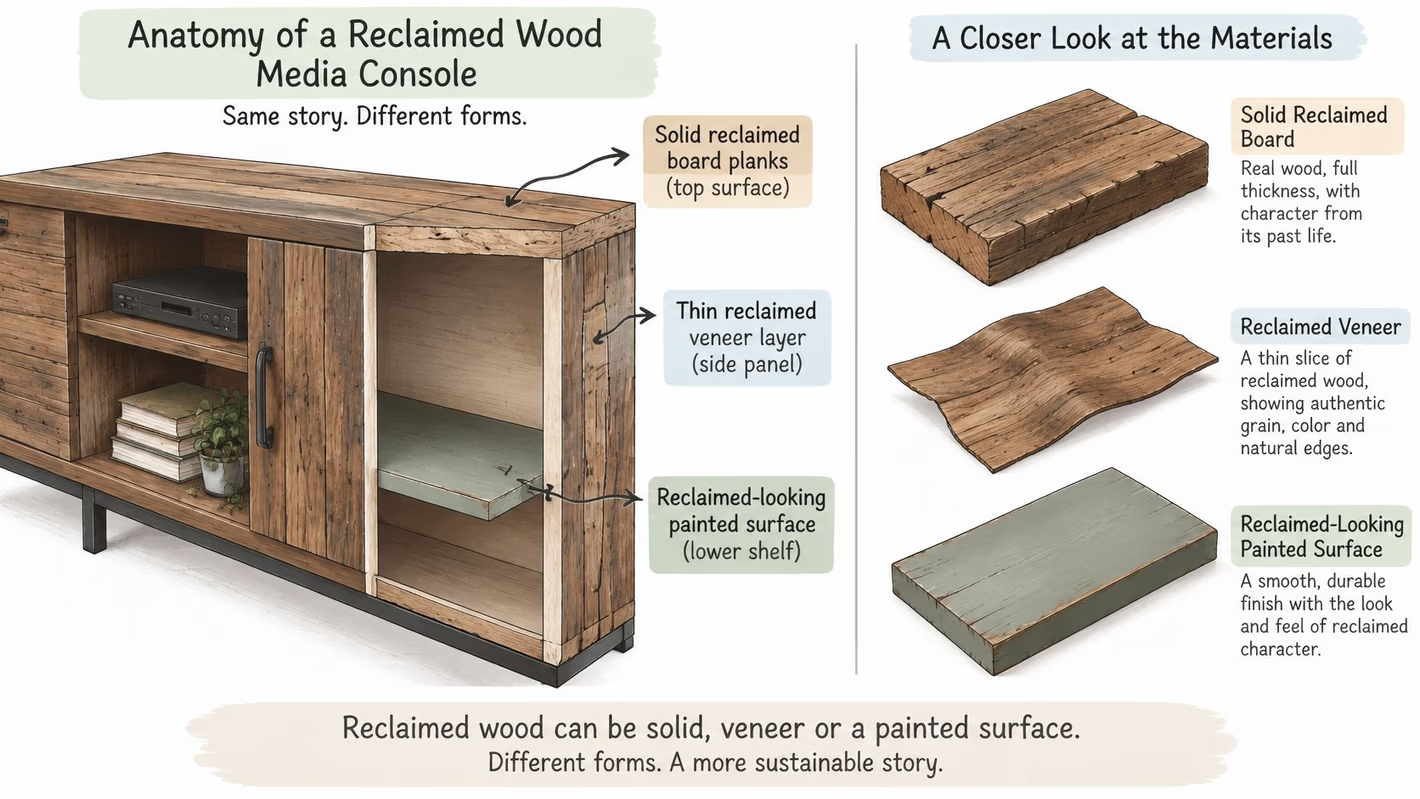
Read the cabinet by its components
The carcass is the cabinet's main body. It supports the shelves and provides mounting points for doors and drawers. The top carries the television or decorative objects, while the back may contain cable openings and help define the equipment compartments.
Ask for a component-level description:
- Top and doors: Are they solid reclaimed boards, reclaimed veneer, or newly distressed wood?
- Body and shelving: Are these solid wood, plywood, or particleboard?
- Back and drawers: What materials appear in less-visible locations?
- Repairs and adhesives: What was added during manufacture or restoration?
- Origin: Is the salvage source known, and which details can the seller document?
A useful product description should distinguish reclaimed material from a reclaimed-looking finish. Neither photographs nor a rustic product name can settle that question.
Indoor suitability needs its own answers
Reclaimed doesn't automatically mean low-emission. The EPA's guidance on formaldehyde and indoor air quality identifies pressed-wood furniture components as potential formaldehyde sources and explains that emissions generally increase with heat and humidity.
For composite components, request applicable emissions documentation, such as TSCA Title VI compliance. Ask about the finish and adhesive as well, especially when the piece will enter a home with asthma concerns or limited opportunities for outdoor airing.
A plain-language material passport would make these decisions easier: identified wood origin, reclaimed components, composite substrates, finish, care directions, and delivery ventilation recommendations. Even without a formal document, those are reasonable questions for a seller to answer.
Advantages and Trade-Offs of Reclaimed Wood
The strongest reason to choose reclaimed wood is often the quality that makes standardized shopping difficult: variation. Nail holes, knots, patched areas, and changing grain directions can make a console feel individual. Those features should be assessed rather than automatically rejected or automatically celebrated.
A smooth, secure patch may contribute to the design. A loose repair beneath a hinge deserves a different response. Character describes appearance; condition describes whether the piece is ready for use.
Compare the material, not just the label
| Material description | Potential appeal | What needs clarification |
|---|---|---|
| Reclaimed hardwood | Varied boards and visible history | Species, preparation, repairs, and finish |
| Solid teak | Distinctive grain and durable material | Finish, construction, weight, and care |
| Reclaimed teak | Reused timber with individual markings | Provenance, treatment, and conditioning |
| Teak veneer | Real-wood appearance over another material | Substrate, edge construction, and repair limits |
| Composite-core construction | A different structural approach beneath the surface | Panel documentation, edge sealing, and shelf support |
Teak has natural oils that provide resistance to water, rot, insects, and weather, along with tight grain and high tensile strength. The material can be durable without oil or varnish, but that doesn't make every finished console maintenance-free, as the teak material reference hosted by Portland helps explain.
Reclaimed teak may come from structures scheduled for demolition. Its reuse and visible marks can be meaningful advantages, but buyers still need to distinguish solid recovered boards from material applied over a manufactured core, as discussed in this explanation of teak furniture and reclaimed timber.
Consider daily ownership
Weight matters when furniture must pass through stairs, narrow entries, or rental-home layouts. Don't infer it from the wood name alone. Request the finished piece's weight and plan how it will reach its intended position.
Maintenance deserves the same attention. Ask whether household spills require special treatment, whether an odor is expected after delivery, and what the seller recommends before equipment goes inside. An unexplained smell shouldn't be dismissed as proof of authenticity.
For a household that wants a lasting statement piece, teak or reclaimed hardwood may be appealing. For another household, a documented mixed-material cabinet may suit the room and budget. The sensible choice is the one with verified construction, suitable care requirements, and an honest material description, not merely the most persuasive reclaimed label.
Evaluate Construction and Finish Before You Buy
Start an inspection behind the doors and beneath the top. Decorative surfaces are easy to notice; hidden attachments and unfinished edges require a deliberate look. Ask permission before examining the underside or requesting technical checks.
Check moisture conditioning first
Furniture-grade hardwood is typically dried to approximately 6–8% moisture content, while indoor equilibrium commonly falls around 6–9% when relative humidity stays near 30–50%, according to the wood-movement guidance from Lee Valley. Boards assembled materially wetter than their eventual room can continue drying afterward, opening joints or stressing attached components.
Ask whether the maker checked moisture at multiple locations, including board ends and repaired areas. Unusually varied readings deserve an explanation, because they may indicate mixed stock or incomplete acclimation.
Wood moves most across its grain. A wide top therefore needs attachments that accommodate that movement, such as figure-eight fasteners, Z-clips, or elongated screw slots, rather than rigid restraint across its width.
Reclaimed Wood Console Inspection Guide
| Inspection Area | What To Look For | Why It Matters |
|---|---|---|
| Moisture preparation | Recorded conditioning and varied-location checks | Helps assess readiness for indoor use |
| Top attachment | Movement-tolerant hardware | Allows normal cross-grain adjustment |
| Panels and edges | Balanced construction and sealed edges | Reduces uneven moisture uptake |
| Shelves | Appropriate supports and stated capacity | Connects construction to intended loads |
| Doors and drawers | Smooth travel and consistent alignment | Reveals binding, looseness, or distortion |
| Finish and repairs | Identified coating and secure repaired areas | Makes maintenance decisions more reliable |
Composite panels need attention too. Research on recovered wood and particleboard formaldehyde release identifies material and environmental factors that affect emissions. The practical takeaway is to request documentation rather than assume a reclaimed surface describes the whole cabinet.
Ask questions that produce useful answers
“Is this good wood?” is less helpful than “What supports this shelf?” or “How is the top attached?” Open each door, operate each drawer, and ask whether visible inconsistencies are intentional details or conditions requiring correction.
The Gates guide to choosing hardwood for longevity and style provides a useful companion to comparing individual pieces with a showroom team member.
Pet households should also consider the surrounding seating and circulation. The Sofa Cover Crafter's sofa cover ideas for pet owners can support that broader room plan, while console finishes still need their own manufacturer-approved care instructions.
Inspection rule: Attractive aging is worth preserving. Unexplained structural problems are worth resolving before purchase.
Check Fit for Your TV and AV Equipment
A tape measure and a paper sketch are more useful than a screen-size label. Record the television's foot placement, total weight, and actual base depth. Then compare those measurements with the console's usable top dimensions and stated load rating.
Decorative lips, uneven edges, or raised sections can reduce usable space. The feet need proper support, not merely a position that looks centered from the sofa.
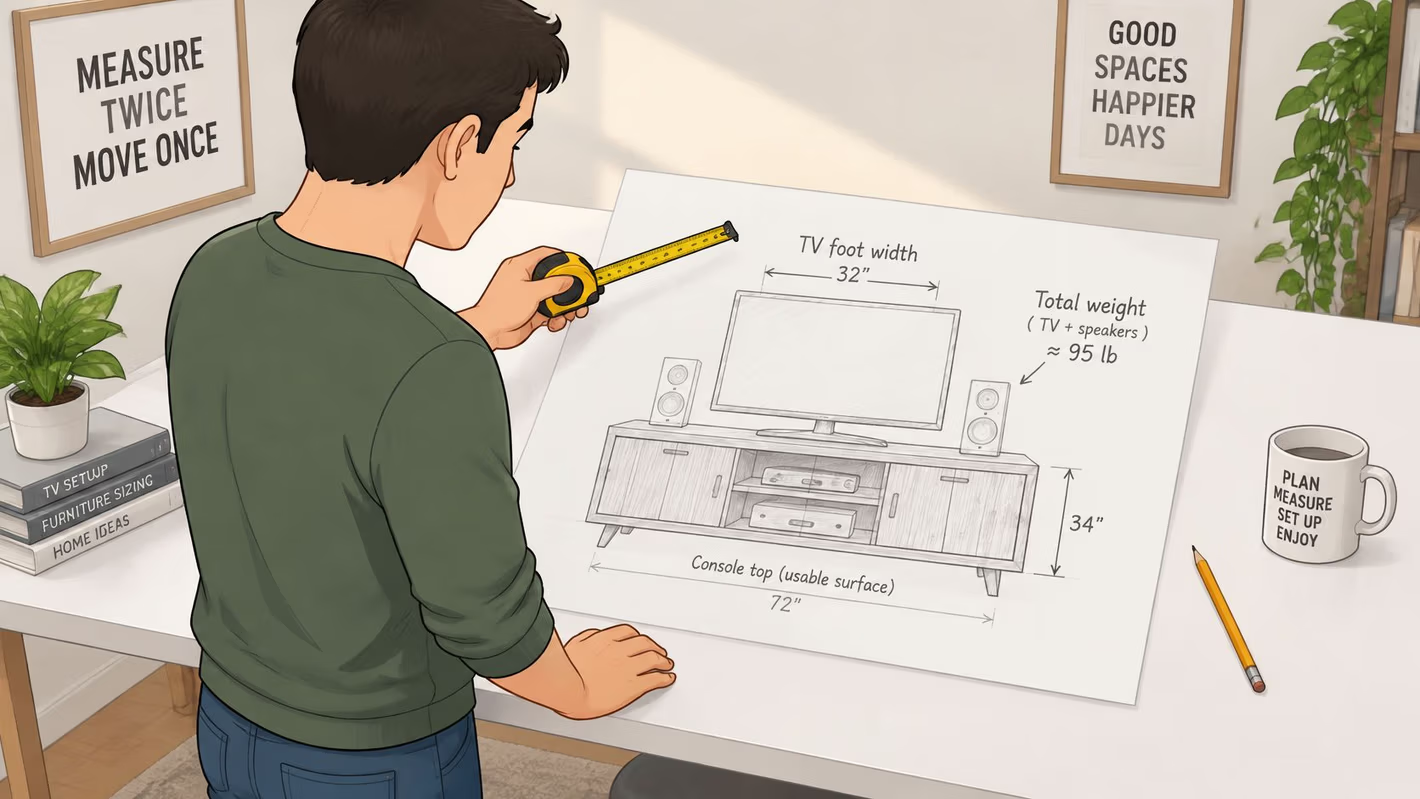
Measure the complete equipment arrangement
Include the soundbar, receiver, streaming device, amplifier, and game system in the sketch. Measure equipment with its cables connected where possible, because plugs and cable bends occupy space behind the chassis.
A soundbar can fit on the top yet obstruct the lower screen or remote sensor. An amplifier can fit inside a compartment yet leave no practical access to its connections. These are functional failures even when the furniture's exterior dimensions seem generous.
The Gates resource on shopping for TV stands can help organize the furniture side of that assessment.
Treat ventilation as a fit requirement
Rear openings aren't just a way to hide cords. They must also support an equipment arrangement that allows airflow and service access, a distinction addressed in guidance on making a media console work.
Follow each device manufacturer's clearance requirements. A closed cabinet may look tidier but be unsuitable for heat-producing equipment, especially when the only ventilation opening is crowded with cables.
Don't assume an open back solves every problem. Equipment pressed against a wall can still lack the required clearance, and tightly packed shelves can obstruct vents.
Use a final fit checklist
- Television support: Confirm foot placement, base depth, and the console's rated capacity.
- Compartment space: Include equipment height, connected plugs, and required clearance.
- Soundbar position: Check the screen edge, sensor, and cable route.
- Controls: Test whether doors interfere with infrared remote operation.
- Access: Keep outlets, connections, and power controls reachable.
- Door movement: Allow doors to open without striking nearby furniture.
- Cable routing: Avoid plans that require cutting structural rails or shelf supports.
Wall mounting may be the more suitable arrangement when a tabletop configuration doesn't work. It still requires an appropriate mounting method, and equipment stored below still needs adequate support and airflow.
Style Reclaimed Wood in Southern Oregon Homes
A reclaimed console doesn't need a room full of matching rustic furniture. In fact, a more restrained arrangement can make its texture easier to appreciate. Choose a few relationships, such as a shared warm color or a repeated metal finish, rather than repeating the same wood everywhere.
The television already creates a strong visual shape. Accessories should help the console belong in the room without crowding the screen or interfering with equipment.
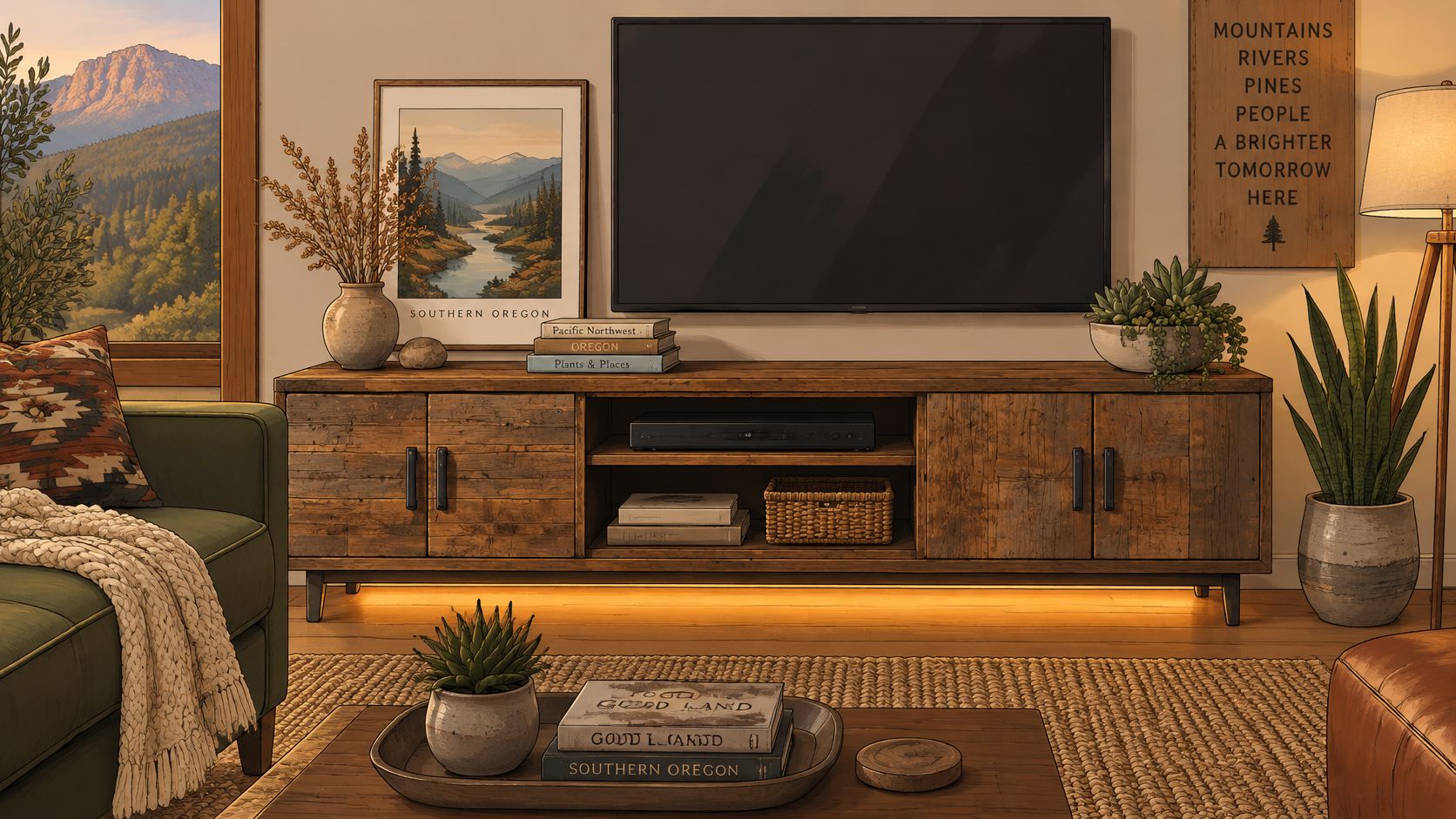
Different rooms call for different balances
A rustic farmhouse room can pair weathered boards with simple ceramics, woven baskets, and softly textured upholstery. Keep the arrangement edited so the console's markings remain visible. A basket belongs in an accessory compartment, not across equipment ventilation.
A craftsman-inspired room can connect reclaimed wood with framed art and restrained metal accents. Repeating the hardware finish in a nearby lamp can create continuity without buying a matching furniture set. The Gates comparison of industrial and rustic furniture styles offers another way to consider that balance.
A refined room can let teak or reclaimed timber become the primary statement. Quieter upholstery and a limited accessory palette provide contrast. There's no need to make every surface look aged.
Group objects without creating clutter
A simple grouping might combine books, a ceramic object, and a small plant at different heights. Treat that as a starting point, not a decorating rule that overrides access or safety. Plants need a suitable protective container and a location away from electronics.
- Repeat selectively: Carry a wood tone into a picture frame or small accent.
- Vary texture: Combine grain with fabric, ceramic, or woven materials.
- Leave breathing room: Preserve visible surface around decorative groupings.
- Use soft accents nearby: Place textiles on seating rather than over equipment.
For that softer layer, Cashmere Boutique's ideas for cashmere throws and home textiles offer inspiration without requiring another substantial furniture purchase.
For homes in Grants Pass, Medford, Central Point, Ashland, and the broader Rogue Valley, personal style needn't follow a single regional formula. Gates' Unique Finds suit shoppers seeking reclaimed wood, teak, and one-of-a-kind pieces rather than a fully coordinated big-box look. The aim is a room that feels collected and usable, not staged around a television.
Protect and Restore the Finish
Before applying any cleaner, identify the finish. Reclaimed timber may have an existing coating, a newly applied finish, or repaired areas that need particular treatment. A product suitable for one surface may be inappropriate for another.
The first care question is therefore simple: What does the maker recommend for this exact piece? Keep that answer with the purchase paperwork rather than relying on a generic wood-care routine.
Separate patina from active damage
Old color variation and established marks may belong to the intended appearance. A fresh spill, lifting surface, newly loose joint, or changing door alignment calls for attention. Photograph questionable areas before attempting a repair, especially if delivery service or protection coverage may apply.
For routine protection, use a soft cloth and the confirmed cleaning method. Blot spills promptly rather than spreading moisture across the surface. Coasters, trays, and felt pads can help separate everyday objects from the finish.
The Gates guide to protecting wood furniture from scratches and stains offers additional care considerations.
Manage the room as well as the surface
The moisture-conditioning principles discussed earlier also guide placement. Avoid damp exterior walls, direct heating vents, and strong sunlight, and aim for reasonably stable indoor conditions through Southern Oregon's seasonal changes.
Normal movement doesn't mean the furniture has failed. The concern is a developing problem, such as a drawer that begins binding or a gap that changes noticeably. Don't force hardware back into position without understanding the cause.
Preserve the piece's established character, but don't mistake new damage for desirable aging.
Match the intervention to the problem
Cleaning, spot treatment, re-oiling, waxing, and refinishing aren't interchangeable. Oil or wax should only be used when compatible with the identified finish. Refinishing requires assessment of existing coatings, repaired areas, veneers, and hardware before any stripping or sanding begins.
A practical maintenance rhythm is straightforward:
- Daily use: Address spills and avoid dragging objects.
- Seasonal checks: Inspect alignment, placement, and equipment airflow.
- Occasional deeper care: Follow the approved cleaning method and seek advice about changing surfaces or joints.
The goal isn't to erase every mark. It's to keep the console functional while preserving the qualities that made it worth choosing.
Make the Purchase with Confidence
A sound buying decision combines the cabinet, the equipment plan, and the service agreement. Price matters, but so do delivery placement, assembly, packaging removal, payment terms, and any protection coverage. A lower ticket price doesn't answer those questions.
Bring room photographs, access measurements, and the equipment sketch to the showroom. Compare the actual piece with those requirements rather than relying on a similar display model or a product photograph.
Understand the payment agreement
Gates Easy Pay includes $0 down and six equal payments, with six-month interest-free options and no-credit-needed or lease-to-own choices described among its financing arrangements. Availability and terms should be confirmed against the applicable agreement rather than assumed from a headline offer.
A payment comparison should establish:
- Cash price and total cost: Identify fees and the full amount payable.
- Payment schedule: Confirm payment amounts, deadlines, and the promotional end date.
- Interest conditions: Establish what happens if the balance isn't paid in full within the promotional period.
- Ownership terms: Distinguish installment financing from lease-to-own arrangements.
- Missed payments: Understand late-payment consequences before signing.
These questions don't make financing less flexible. They make the choice more informed.
Specify what delivery includes
White-glove service should mean more than dropping boxes at the curb. Gates provides professional in-home delivery, assembly, and setup, with mattress haul-away when applicable. Console shoppers should confirm room placement, access requirements, packaging removal, and which tasks appear on their own order.
Ask about Gates Care Shield without assuming every finish issue, equipment-related problem, or preexisting mark is covered. Request the applicable coverage, exclusions, and claim procedure in writing.
Choose a piece and a service plan together
A family-owned, local approach should make these conversations easier, not replace documentation with reassurance. George Gates' original “Service and Value” promise is most useful when it translates into clear material descriptions, practical fit checks, and understood purchase terms.
The Gates resource on finding reclaimed wood furniture nearby provides a starting point for exploring the category. Whether the eventual choice is a reclaimed statement piece or another well-documented construction, the right console should meet the household's real requirements without demanding compromises that remain hidden until delivery.
Visit Gates Home Furnishings at the Grants Pass showroom to compare reclaimed wood and teak Unique Finds in person. Bring room measurements, television specifications, and an equipment list so the team can help assess materials, fit, delivery needs, and payment options before a console comes home.
