
How to Support Local Businesses in Grants Pass & Beyond

On any given week in Grants Pass, you can feel the difference between a town with strong local businesses and one that’s losing them. It’s in the familiar storefronts downtown, the places where someone remembers your name, and the businesses that keep showing up for school events, local causes, and neighbors who need help. That same feeling carries across Medford, Central Point, Ashland, and the rest of the Rogue Valley.
We’ve seen that reality up close for generations. Gates Home Furnishings has been part of Southern Oregon since 1946, when George Gates Jr. built the business on a simple promise of Service and Value. That promise still matters because local business has never only been about transactions. It’s about whether a community keeps its character, its relationships, and its ability to take care of its own.
If you’ve ever said, “We should do a better job supporting local,” you’re not alone. Many individuals want to help. The challenge is knowing what works beyond a bumper-sticker version of “shop small.”
This guide is about practical action. Not guilt. Not slogans. Real ways to support the businesses that make Southern Oregon feel like home.
You can learn more about our local story at Gates Home Furnishings.
Introduction Our Community Our Responsibility
Walk through Grants Pass and you’ll notice something chain-heavy places can’t copy. The coffee shop owner waves at regulars. The florist knows which schools are hosting events. The furniture store, hardware store, and bakery all have history tied to the same streets and families.
That local fabric doesn’t hold itself together. People in the Rogue Valley keep it alive through ordinary choices.
What local ownership really means here
A locally owned business doesn’t just operate in Southern Oregon. It belongs to Southern Oregon in a more personal way. Owners live here, hire here, solve problems here, and feel the consequences here when times get tight.
That matters in a town like Grants Pass, where reputation still travels by conversation. If a business treats people well, neighbors hear about it. If it cuts corners, neighbors hear about that too.
Local support works best when it’s steady, not symbolic.
Why this feels personal to us
Our business began in 1946 with George Gates Jr.’s promise of Service and Value. That wasn’t a marketing line then, and it isn’t one now. It’s a practical standard for how a local business earns trust over time.
In Southern Oregon, the businesses that last are usually the ones that solve real problems well, treat people fairly, and stay connected to the community that supports them. That’s the standard neighbors should expect from all of us.
The Ripple Effect of Shopping Local in Southern Oregon
When people ask how to support local businesses, the clearest answer is this. Spend intentionally where your money stays close to home.
Research shows that $68 out of every $100 spent at local stores remains in the local community, and local retailers circulate 289% more revenue back into the local economy than chain stores according to Capital One Shopping’s local spending research.
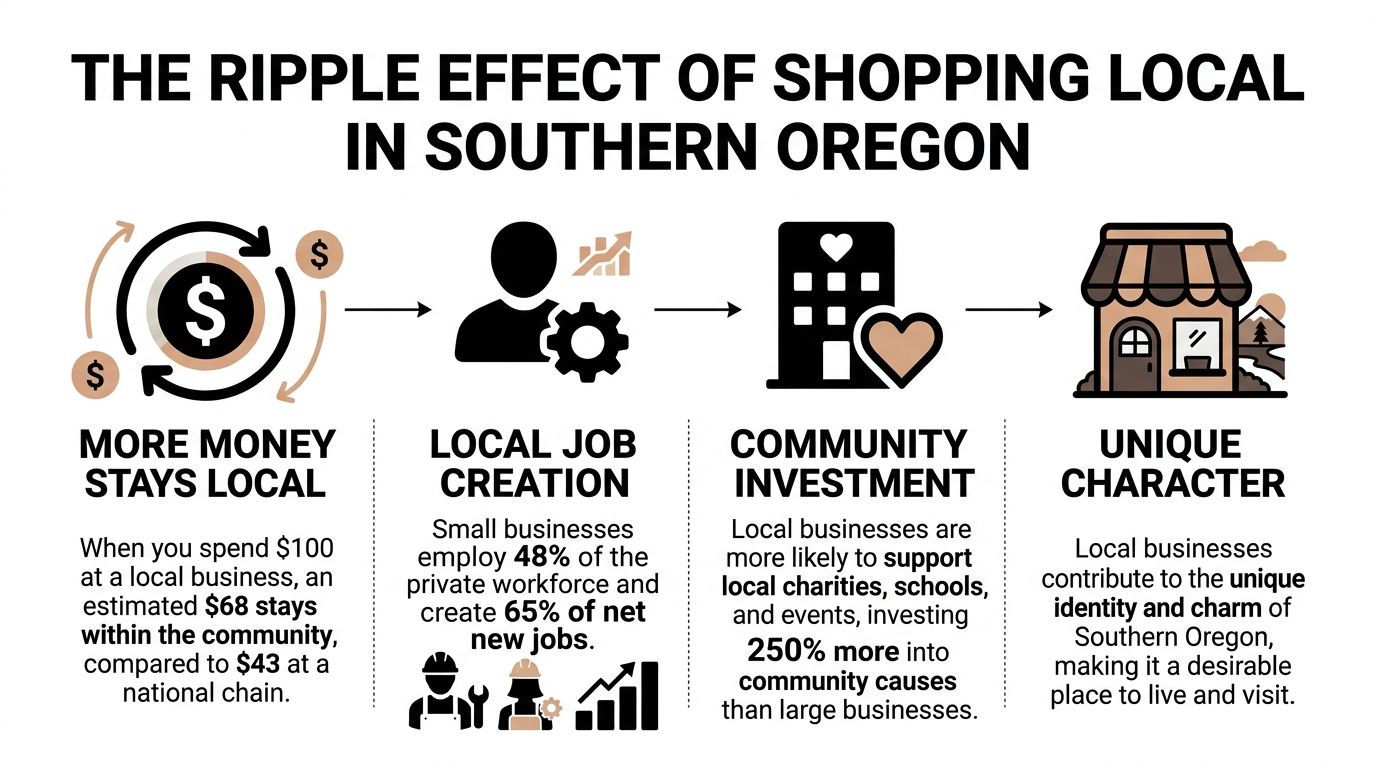
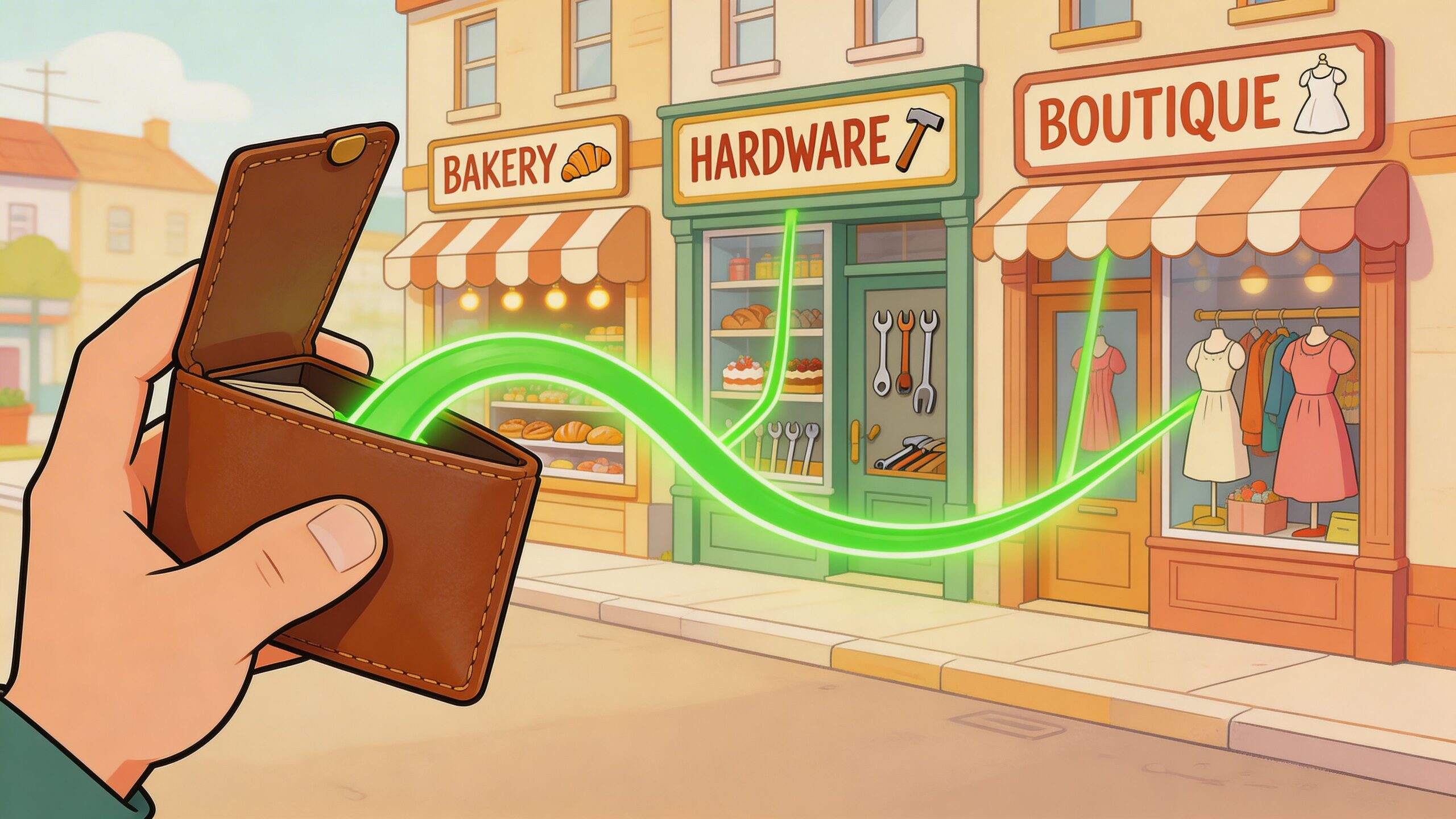
That’s the multiplier effect in plain language. A dollar doesn’t stop at the register. It moves through payroll, local services, nearby suppliers, taxes, repairs, and community spending.
What that looks like in the Rogue Valley
When a Grants Pass family buys from a local business, the impact usually spreads wider than people expect.
A local owner may:
- Pay local employees who then spend on groceries, gas, and school needs nearby
- Hire local service providers such as accountants, delivery teams, tradespeople, or printers
- Reinvest in the property instead of routing decisions through a distant corporate office
- Support local events and organizations because they’re part of the same community calendar
That kind of circulation helps protect the character of a region. It also makes local business districts more resilient when outside conditions get rough.
Trade-off behind convenience
The hardest truth is that convenience can drain a town. A fast click or a lower advertised price may solve the short-term need, but it often sends the long-term value elsewhere.
That doesn’t mean every purchase must be local. People have budgets, timing issues, and real constraints. But if households make local buying a habit where it makes sense, the cumulative effect is substantial.
A helpful comparison from another service-based industry is this piece on the benefits of working with a local business. The details are different from furniture or retail, but the principle is the same. Local providers tend to bring context, accountability, and community connection that national options often can’t match.
Practical rule: Save convenience buying for true one-off needs. For repeat needs, planned purchases, and higher-value purchases, start local first.
Why urgency matters
Local businesses don’t just face competition. They face cash-flow pressure, rising operating costs, staffing challenges, and the simple reality that one weak season can hurt.
We wrote more during the pandemic about why intentional support matters at moments like that, and that local-first mindset still applies now: supporting local during COVID-19.
Everyday Actions That Build a Stronger Community
Most support doesn’t start with a grand gesture. It starts with a routine.
Research shows that 80% of consumers shop locally with the intention of supporting their community, and consumers are willing to spend an average of $150 more per month to support favorite local shops, according to business.com’s look at why people support small businesses.
Start with one change in your weekly routine
Don’t try to overhaul everything at once. Pick a category and shift that category local for the next month.
Good starting points include:
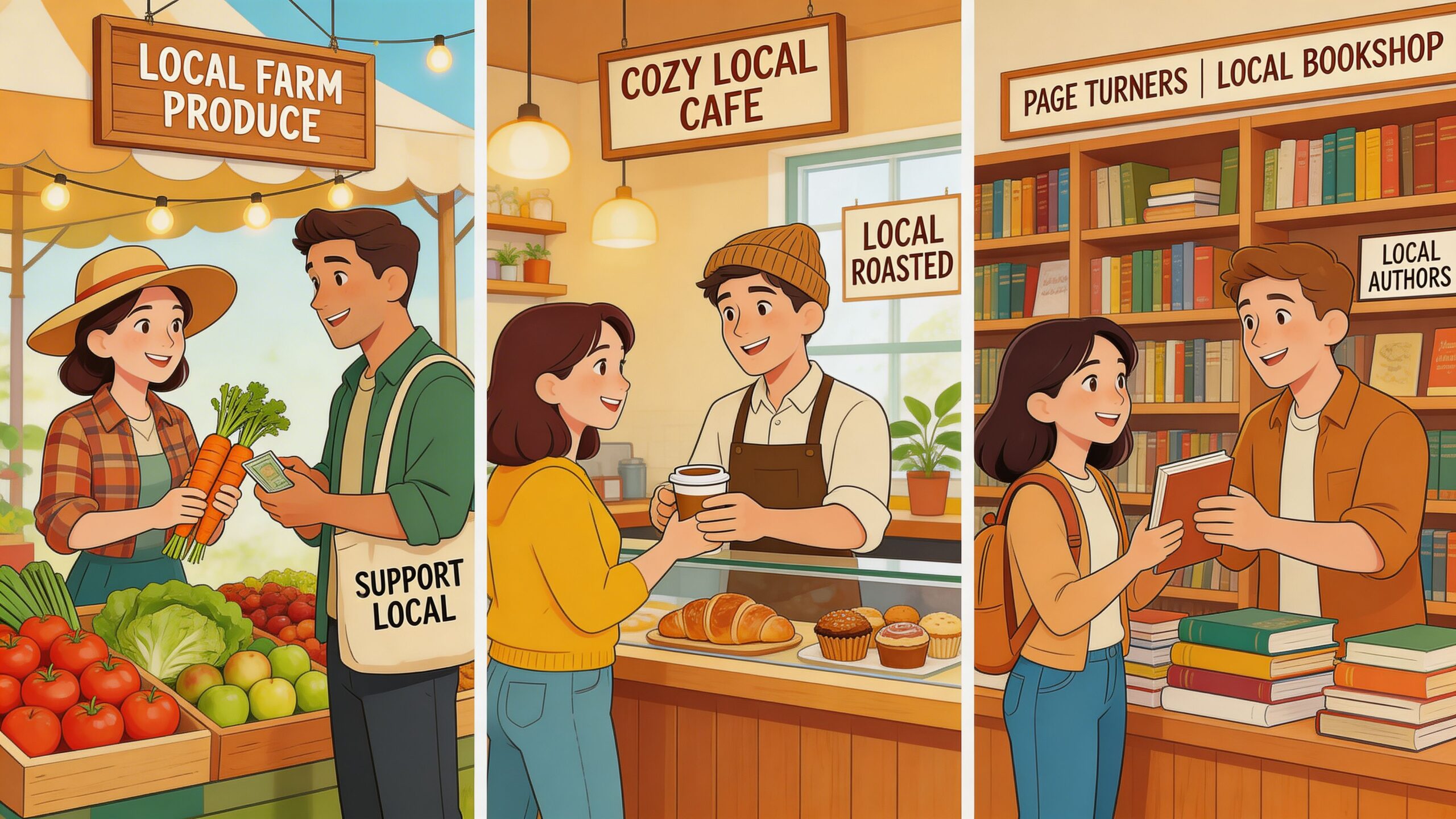
- Coffee and lunch stops when you’re running errands in Grants Pass or Medford
- Home purchases that benefit from seeing materials, comfort, or quality in person
- Seasonal gifts that are easy to redirect toward local makers and shops
- Services you’ll need again such as cleaners, yard care professionals, repair specialists, and salons
That approach is more realistic than trying to buy everything locally all at once.
Go where local businesses are
Some people want to support local businesses but default to the easiest app because they haven’t built a local habit yet. The fix is simple. Create your own short list.
Keep a note in your phone with:
- A few local food spots
- A couple of home-related businesses
- One local gift source
- One or two service providers you trust enough to recommend
Once you know your options, local gets easier.
Choose in-person shopping when touch and fit matter
Some purchases are hard to judge on a screen. Seating comfort, mattress feel, table finish, drawer construction, and scale in a room are easier to evaluate in person.
That’s especially true in home furnishings. A photo can’t tell you if a recliner fits your back, if a sofa cushion feels supportive, or if reclaimed wood has the texture you want.
Southern Oregon shoppers who want to test instead of guess can visit our 30,000 sq. ft. showroom in Grants Pass, where they can compare comfort, materials, and scale directly. We carry brands such as La-Z-Boy, Flexsteel, Ashley, and Beautyrest, along with reclaimed wood, teak, and other Unique Finds that don’t read like cookie-cutter inventory.
Loyalty isn’t passive
Many local businesses don’t need every customer to buy constantly. They need customers to come back, speak up, and choose them first when the timing is right. That pattern is what creates staying power.
This is one reason industry marketers pay close attention to consumer loyalty. Loyalty lowers the need for constant reacquisition and gives local businesses a steadier base to operate from.
If you’ve had a good experience with a local business, don’t treat it like a one-time event. Return when the next relevant need comes up.
Financial Fortitude How Your Wallet Can Be a Lifeline
There’s a difference between helping a local business make a sale and helping it stay steady. The second one matters more than most customers realize.
A business can be busy and still feel unstable. Predictable cash flow, repeat demand, and trusted financing options often make the difference between reacting to the month and planning for the year.
Gift cards help more than people think
A gift card is one of the simplest ways to support a local business even when you don’t need something today. It gives the business working capital now, and it often introduces a new customer later if you give it as a gift.
This works especially well for:
- Restaurants and cafes
- Boutiques and bookstores
- Salons and wellness businesses
- Home and furnishing stores where purchases may be planned rather than immediate
Financing can support both households and local retailers
For larger home purchases, many people delay buying because they assume they must pay all at once. That hesitation can stall necessary purchases and create uneven demand for local retailers.
Used responsibly, financing can solve a real household need while giving the business more predictable revenue. One example is furniture financing options, including $0 down, 6-month interest-free, and no-credit-needed options. For customers, that can make a mattress, recliner, or dining set more manageable. For a local showroom, it helps inventory planning and staffing stay steadier.
Look beyond purchases in underserved communities
Some businesses need more than sales volume. They need access, trust, and practical support.
As discussed in the NEI article on reaching underserved small businesses, programs such as Detroit Means Business show that small businesses in underserved communities often benefit from targeted outreach, bookkeeping help, coaching, and equitable lending access, not just customer traffic.
That lesson applies in Southern Oregon too. If you care about broad local health, support the groups helping business owners manage capital, language barriers, digital tools, and administrative hurdles.
Better support is often more intentional support
If you want your spending to act like a lifeline, think in these terms:
| Approach | Why it helps |
|---|---|
| Preplanned purchases | Gives local businesses a fair shot before you default elsewhere |
| Gift cards | Creates immediate support without forcing an immediate item purchase |
| Financing for bigger needs | Helps customers buy responsibly and gives stores steadier revenue |
| Referrals to underserved businesses | Expands trust and access where barriers are higher |
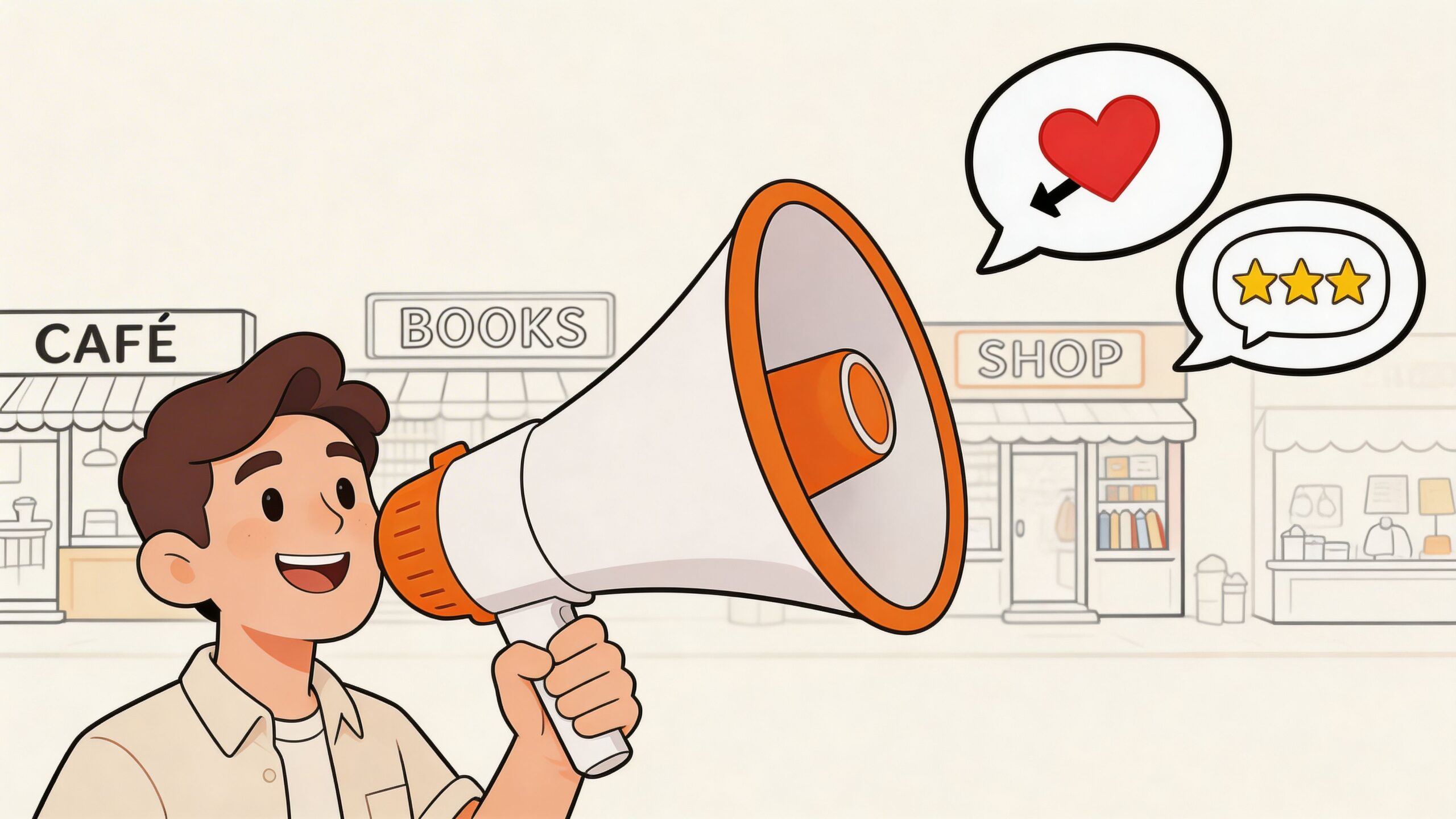
Becoming a Local Champion Amplify Your Impact for Free
A lot of people assume support only counts if money changes hands. That isn’t true.
For many local businesses, visibility is the bottleneck. National brands can buy attention. Local businesses usually have to earn it one customer conversation at a time.
Write reviews that are useful
A review helps most when it answers the next customer’s question.
Include details like:
- What you bought or used
- What problem the business solved
- How the staff handled the process
- Why you’d return
A review that says “great place” is kind. A review that says, “They helped us compare recliners without pressure and explained delivery clearly,” is far more useful.
If you’ve worked with us before, customer feedback can be shared through our reviews page.
Share with context, not just a tag
On social media, a photo alone rarely does much. A short explanation works better.
Try this instead:
- Show the purchase in real life so people can picture it in a home
- Mention the specific feature you liked, such as comfort, finish, or service
- Tag the business so others can find it
- Add location context such as Grants Pass or Rogue Valley when relevant
That extra sentence often matters more than the image itself.
A useful recommendation beats a generic compliment every time.
Word of mouth still wins locally
Southern Oregon still runs on trusted recommendations. People ask neighbors where to go for mattresses, dining sets, repair work, and gifts because they want to avoid expensive mistakes.
Three easy referral moments:
- When someone says they’ve just moved
- When a friend complains about a bad buying experience
- When a family member asks for a local option instead of another chain
The strongest referrals are specific. Name the business, say what it’s good at, and mention what kind of customer it fits.
The Local Furniture Advantage A Southern Oregon Guide
Furniture is one of the clearest examples of why local support matters. It’s not a simple commodity purchase for most households. People want comfort, durability, guidance, delivery that goes smoothly, and help if something needs attention after the sale.
That’s where local furniture stores have a real advantage over anonymous checkout pages.
What customers gain when they buy local furniture
With furniture, the purchase experience matters almost as much as the product itself.
Local stores can offer:
- In-person comfort testing instead of buying from a screen
- Guidance on fit and room use based on how people live
- White-glove delivery with professional assembly rather than a box left at the door
- Mattress setup and haul-away help that removes a major hassle
- Distinctive inventory such as reclaimed wood, teak, and one-of-a-kind statement pieces
Those details aren’t extras. They’re often what turns a stressful purchase into a satisfying one.
Why loyalty matters in this category
Nearly 50% of small retail businesses fail by year five, according to U.S. Bureau of Labor Statistics data cited in this analysis. In practice, that means local retailers need consistent demand to stay healthy.
For furniture stores, that support doesn’t have to mean constant big-ticket buying. It can mean referring friends, returning when a new room needs attention, or choosing local when service quality matters more than bare-bones convenience.
A good local furniture store also solves needs that chains often flatten. Seniors may need recliners or lift chairs with real sit-test comparison. New movers may need budget-conscious outlet options. Design-minded buyers may want character pieces that don’t look mass produced.
We’ve written more about what shoppers should look for when comparing stores in our guide to best places to buy living room furniture.
The strongest local furniture experience doesn’t end at checkout. It continues through delivery, setup, and how the piece lives in your home.
Conclusion Your Choices Shape Our Community
Southern Oregon doesn’t keep its local character by accident. It keeps it because neighbors decide, over and over, where to spend, who to recommend, and which businesses deserve a fair chance.
That support takes a few forms. Buy local when it makes sense. Use gift cards and thoughtful financing for bigger purchases. Leave detailed reviews. Recommend businesses to new neighbors. Make your spending and your voice work in the same direction.
Those actions may feel small on their own. Together, they shape what Grants Pass and the Rogue Valley will look like a few years from now.
If we want downtowns with personality, service that feels human, and businesses that still know this region well, then supporting local has to become a habit instead of a slogan.
Frequently Asked Questions About Shopping Local
Is it always more expensive to shop local
No. Sometimes a local option costs more upfront, but the better comparison is total value. Service, product guidance, assembly, delivery quality, and problem resolution all matter.
For home purchases especially, the cheapest sticker price can become the most frustrating option if the fit is wrong or the support disappears after checkout.
How can I find local businesses for things I need
Start with the categories you use most often. Search locally, ask neighbors, and build a short personal list in your phone.
Focus first on businesses you’re likely to use again, such as food spots, home stores, repair services, salons, and family gifts. That keeps local shopping practical instead of overwhelming.
What if I’m on a tight budget
Support doesn’t have to mean spending more. You can shift one purchase category locally, buy during promotions, use gift cards strategically, refer friends, or leave strong reviews.
You can also support businesses that offer flexible payment options, outlet merchandise, or value-focused inventory. Budget-conscious support still counts.
Do online actions really help local businesses
Yes, if they’re specific. A thoughtful review, a tagged post with real context, or a direct referral can influence the next buyer more than people realize.
The most helpful online support answers a practical question for the next customer. What did you buy, what was the experience like, and who is that business a good fit for?
What makes local furniture shopping different from buying online
Furniture is tactile. Comfort, scale, finish, support, and delivery all matter. Many shoppers want to sit on the sofa, open the drawers, compare mattress feels, and ask questions before they commit.
That’s why local showrooms remain useful. They reduce guesswork, especially for mattresses, recliners, dining sets, and statement pieces.
What’s one simple way to start this week
Pick one local business you already like and do one concrete thing for it. Buy there, leave a review, send a referral, or share a photo and a useful comment.
That’s how to support local businesses in a way that builds momentum.
If you’re furnishing your home in Grants Pass, Medford, Central Point, Ashland, or anywhere in the Rogue Valley, visit Gates Home Furnishings to explore our collection online or stop by our Grants Pass showroom to test comfort in person.
