Mastering Placing Furniture in a Living Room

You walk into the living room with a coffee cup in one hand and a tape measure in the other. Maybe the room is empty except for boxes from a recent move. Maybe it already has a sofa, two chairs, and a coffee table that never quite felt right. Either way, the question is the same: where should everything go?
That question comes up every week for homeowners and renters across Grants Pass, Medford, Central Point, Ashland, and the wider Rogue Valley. Placing furniture in a living room sounds simple until you try to make the room feel open, comfortable, easy to walk through, and suited to real life.
We’ve been helping Southern Oregon families solve that puzzle since 1946, when George Gates Jr. built this business on a promise of Service and Value. Good layout is not about copying a showroom photo. It is about reading the room, understanding how your household lives, and making each piece earn its place.
From Empty Space to Your Favorite Place
A living room usually becomes several rooms at once. It often hosts activities like watching the game, visiting with friends, helping with homework, reading in the evening, or taking a quick afternoon nap. That is why a room can feel “off” even when the furniture itself is nice.
We often see two common starting points. One is the blank room that feels harder than it should. The other is the hand-me-down mix, where every piece came from a different home and nothing seems to belong together. Both can work well with a little planning.
Why layout matters more than commonly believed
A good layout changes how a room feels before you buy one new lamp or pillow. It can make a small room feel calmer. It can make a large room feel less empty. It can also stop the daily annoyances, like bumping your knee on the coffee table or having to talk across too much space.
That is why we always tell neighbors to start with function first. Ask simple questions:
- Who uses this room most. Kids, guests, retirees, or everyone.
- What happens here most often. TV watching, conversation, reading, or mixed use.
- What frustrates you now. Tight walkways, glare on the screen, awkward seating, or clutter.
A room that works for a retired couple in Grants Pass may need a very different setup than a rental near downtown Medford or a busy family room in Central Point.
Tip: If you are stuck, start by naming the room’s main job in one sentence. “This is our TV room.” “This room is for visiting with family.” “This is our all-purpose room.”
Sometimes a little inspiration helps, especially when you are deciding what pieces belong in the room at all. Our guide to living room essentials is a practical place to sort out what you need before you start moving furniture around.
Start with a Plan Not a Pulled Muscle
The worst way to begin is by shoving the sofa against one wall, stepping back, then dragging it somewhere else. That usually ends with sore backs and a room that still feels wrong.
The best first move is a notepad, a pencil, and a tape measure.

Measure the room before you measure furniture
Start with the room itself.
Write down:
- The room length and width
- Doorways and where they swing
- Windows
- Fireplace, built-ins, floor vents, and outlets
- Any spots furniture cannot block
A quick sketch is enough. It does not need to look fancy. If one square on graph paper equals one foot, even better.
This step matters because the room never lies. Our eyes do. A sofa that looked compact in a photo can take over a room once it lands in place.
Use the 30% rule as your reality check
One guideline we like because it is simple is the 30% Rule. It recommends that furniture should occupy only 30% of a room’s floor area, leaving 70% open. For a common 15×20 foot living room, that means about 90 square feet for furniture and 210 square feet open, which helps prevent the cramped feeling found in 70-80% of average homes according to this overview of the 30% rule.
You do not need a calculator for every chair leg. The point is to stop before the room gets overloaded.
What to bring with you when testing a layout
When shoppers visit our 30,000 sq. ft. showroom in Grants Pass, the most prepared ones bring a few basics.
- Room measurements so they can compare the actual dimensions of a sofa or sectional
- Doorway measurements so there are no delivery-day surprises
- A rough sketch to test different arrangements
- Photos of the room to show window placement, wall space, and flooring
We often suggest using a measuring guide like how to measure furniture before you shop, especially if you are considering a recliner, sectional, or sleeper.
Key takeaway: Planning feels slow at the start, but it saves time, protects your walls, and makes every later decision easier.
Find Your Room's Anchor The Focal Point
Some rooms tell you right away where the furniture should go. A stone fireplace does that. A big picture window with a hill view does that too. Other rooms are less obvious, and that is where people start floating from one idea to another.
A living room works better when it has one clear anchor.

What counts as a focal point
Your focal point might be:
- A fireplace
- A television wall
- A large window
- A piece of art
- A statement console or bookcase
- One of our Unique Finds, such as a reclaimed wood or teak piece with real visual weight
The focal point is the spot your eye goes first. Once you know that, your largest seating piece usually follows.
Place the sofa with purpose
Expert interior architects recommend starting with the primary focal point and placing main seating to face it directly or at a gentle angle, often forming a conversational U-shape. That approach achieved 15-20% better spatial perception and user satisfaction in the methodology described by Povison’s living room layout guide.
In plain language, that means your sofa should not land in the room randomly. It should answer the room’s main purpose.
If the fireplace is the star, let the sofa face it. If movie night rules the house, orient seating toward the TV. If the room has a beautiful outdoor view, consider giving that view a role in the arrangement.
If the room has no natural focal point
Some newer homes and rentals have long blank walls and no built-ins. That does not mean the room has no structure. It means you create the structure.
A simple way to do that is:
| Room challenge | Practical anchor |
|---|---|
| Blank wall | Media console and TV |
| No fireplace | Large artwork over a console |
| Open-concept room | Sofa facing a rug-centered seating group |
| Awkward corner | Tall bookshelf or one statement piece |
That is also where a placement guide like calculating the best placement for your sofa and television can help if the screen is going to be your anchor.
Tip: If you have two strong focal points, such as a fireplace and TV on different walls, choose which one matters most for daily life. Rooms feel better when one priority wins.
Create Connections with Smart Layout Patterns
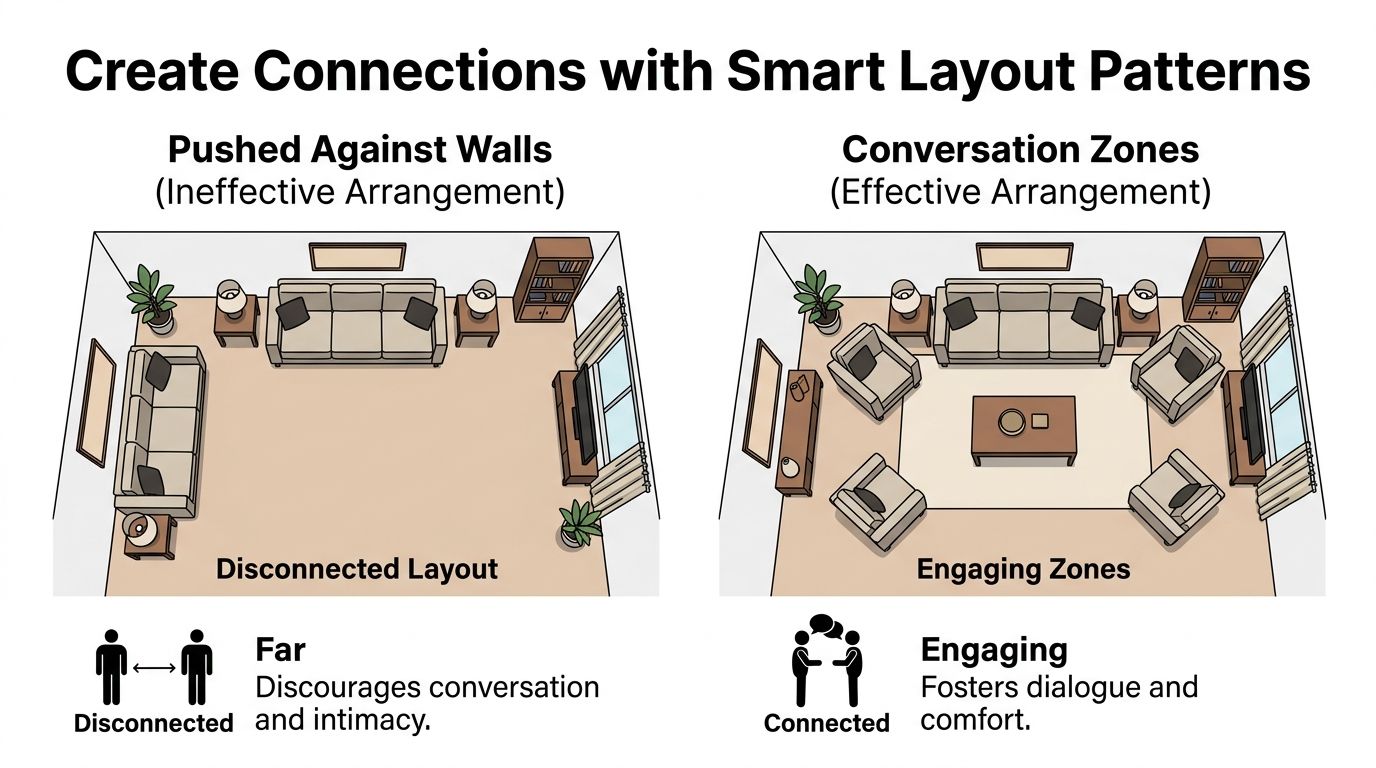
Once the anchor is set, the room needs a pattern. At this point, many individuals either become too rigid or too loose. They either push every piece to the perimeter or scatter furniture without creating a real seating zone.
The better approach is to pick a layout pattern that matches the way you live.
The classic conversation layout
This is the setup many people picture when they think of a warm family room. One sofa faces two chairs, often with a coffee table in the middle.
It works well for visiting, board games, and mixed-use living rooms where the TV is present but not the only priority. Research on functional zoning found that a one-sofa-plus-two-chairs arrangement has a 92% satisfaction rate for traditional family rooms in Gardner White’s layout discussion.
Good fit for:
- Traditional homes
- Family rooms
- People who host often
Less ideal for:
- Very narrow rooms
- Households that mainly watch TV from one direction
The sectional layout
An L-shaped sectional can solve several problems at once. It defines a seating area, offers more seats, and helps divide open floor plans without adding extra pieces.
That same functional zoning source notes that L-shaped sectionals have an 88% success rate in multi-use open plans. This is one reason an Ashley sectional or a similar scaled piece often works well in homes where the living room flows into the kitchen or dining area.
A sectional is especially useful when you need the room to do more than one job. The long side can face the focal point, while the return side helps frame the zone.
The floating layout
This is the arrangement many people resist at first. They assume furniture belongs against the walls. In reality, a floating layout often makes a room look more finished.
Pulling the sofa and chairs inward can create a defined living space, especially in larger rooms or open-concept homes. It also keeps the middle of the room from feeling like a vacant parking lot.
The same source warns that wall-hugging layouts can compress perceived space by 25% in rooms under 250 sq ft. That surprises people, but we see it often. A little air around furniture can make the room feel more relaxed.
A quick comparison
| Layout pattern | Best for | Watch out for |
|---|---|---|
| Conversation grouping | Families, guests, reading, social rooms | Can feel formal if too symmetrical |
| Sectional-based layout | Open plans, movie nights, multi-use rooms | Sectional size can overpower a small room |
| Floating arrangement | Larger rooms, modern layouts, defining zones | Needs careful spacing to avoid drift |
| Wall-lined setup | Very tight rooms only | Often feels disconnected |
If you like seeing unusual but workable setups, these uncommon furniture arrangements that work wonders can spark ideas beyond the usual sofa-on-one-wall formula.
Key takeaway: Choose the pattern that fits your daily habits. A layout that supports real life always outperforms one that only looks good in a photo.
Mastering Traffic Flow and Breathing Room
A living room can look beautiful and still fail every day. You feel that failure when people sidestep around a chair, bump the coffee table, or stop walking because the path dead-ends at the sofa arm.
Good traffic flow is quiet. You notice it because nothing gets in the way.
The three measurements that matter most
Standard furniture spacing guidelines call for 30-36 inches for main walkways, 18 inches between a sofa and coffee table, and 3.5 to 10 feet between seating areas for comfortable conversation. Violating these rules causes 45% of layout complaints, according to the summary in Emily Henderson’s living room rules.
Those three numbers solve a lot of common problems.
- 30-36 inches for main walkways keeps people moving naturally through the room.
- 18 inches from sofa to coffee table keeps drinks, remotes, and feet within easy reach.
- 3.5 to 10 feet between seats helps people talk without leaning awkwardly or shouting.
Where people usually get stuck
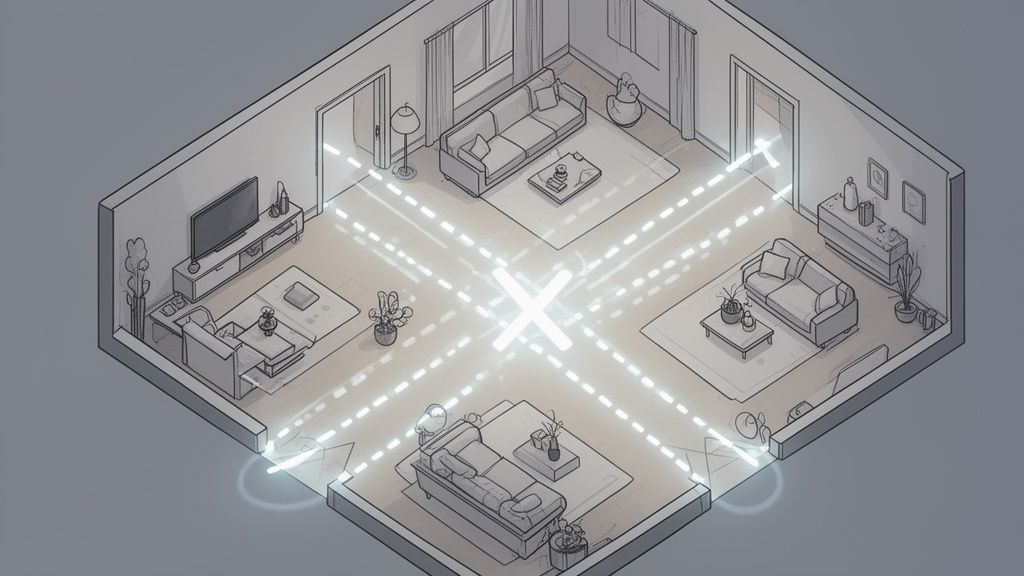
The most common issue is treating the room like a storage problem instead of a movement problem. People fit furniture first, then hope the pathways work out.
Try the opposite. Draw the walking routes first.
Think about:
- The path from the main doorway to the sofa
- The route to adjoining rooms
- The line to the TV or fireplace
- Whether anyone has to walk in front of the screen repeatedly
Let the room breathe
A sofa does not always need to sit flush against the wall. Even a little space behind it can make the setup feel less boxed in.
That detail matters on delivery day too. Our White-Glove Delivery team handles in-home setup and assembly rather than dropping boxes at the curb, so the room can be arranged with those spacing basics in mind from the start. That is especially helpful with heavier pieces like recliners, sleeper sofas, and solid wood consoles.
Tip: Walk the room before you commit. If you have to turn sideways or step around a corner sharply, the path needs work.
Add the Finishing Touches for Every Home
Once the sofa, chairs, and tables are in the right places, the room still needs its last layer. Comfort, personality, and practical living all come together here.
The finishing touches are not just decoration. They help the layout make sense.
Rugs that hold the room together
A rug should connect the seating group, not float like a small island in the middle. In most living rooms, placing at least the front legs of the sofa and chairs on the rug helps the arrangement feel intentional.
That is one of the easiest fixes for a room that feels scattered. If the furniture looks like separate pieces rather than one group, the rug is often the missing link.
Lighting that supports how you live
Good living rooms use layered light. One overhead fixture rarely does the whole job well.
Try mixing:
- Ambient light from a ceiling fixture
- Task light from a floor lamp beside a chair
- Accent light from a table lamp on an end table or console
This matters even more in Southern Oregon during darker, wetter stretches of the year, when the living room carries more of the household’s day-to-evening activity.
Smart choices for renters and smaller homes
Small apartments and rental homes need furniture that works harder. That does not mean the room has to feel temporary.
Useful options include:
- Storage ottomans for blankets, games, or cords
- Sleeper sofas for guests
- Narrow arm sofas when every inch counts
- Round tables when sharp corners make a room feel tight
Our showroom includes practical options from brands like La-Z-Boy, Flexsteel, Ashley, and Beautyrest, along with a Gates Outlet area where shoppers often look for value-minded pieces that still fit a well-planned room.
You can also borrow styling ideas from a guide like this foolproof coffee table styling article once the main arrangement is settled.
Layouts that support aging in place
This part gets skipped far too often. A room can look attractive and still be hard for a senior to use safely.
A 2023 AARP survey found that 75% of adults over 50 wish to age in place, yet many homes are not designed for it. Furniture placement for seniors should prioritize clear 36-inch pathways for mobility aids and give lift chairs or recliners ample space for operation, according to this design-focused accessibility summary.
That can look like:
- A recliner positioned with enough clearance to fully open
- Side tables that are easy to reach without twisting
- Straight walking paths instead of zigzag routes
- Stable seating near the room’s main focal point
If someone in the home uses a walker or desires easier movement, layout decisions matter as much as furniture choice.
Budget matters too
A good room plan should work for the budget you have. Flexible financing can make that easier, especially when a room needs more than one piece at once. Gates Easy Pay includes $0 down, 6-month interest-free, and no-credit-needed options, which can help households build a functional room in stages instead of settling for a layout filled with mismatched stopgaps.
Your Perfect Layout Awaits in Grants Pass
The best living rooms rarely happen by accident. They come together because someone measured first, chose a clear focal point, matched the layout to real life, and respected the space people need to move around comfortably.
That approach has guided our work since 1946. George Gates Jr. started this business with a promise of Service and Value, and that still shapes how we help people furnish homes across Grants Pass, Medford, Ashland, Central Point, and the Rogue Valley.
If you are unsure whether your sofa is too large, whether a sectional should float, or whether a recliner has enough clearance, it helps to test those ideas in person. Our 30,000 sq. ft. showroom in Grants Pass gives you a place to compare layouts, sit in different seat depths, and see how reclaimed wood, teak, and other Unique Finds can anchor a room without guessing.
And when the choice is made, our White-Glove Delivery team can handle assembly and setup, plus mattress haul-away when needed.
If you’re ready to stop guessing about placing furniture in a living room, visit Gates Home Furnishings in Grants Pass or browse our collection online. We’re here to help you create a room that feels right from the first step through the doorway.